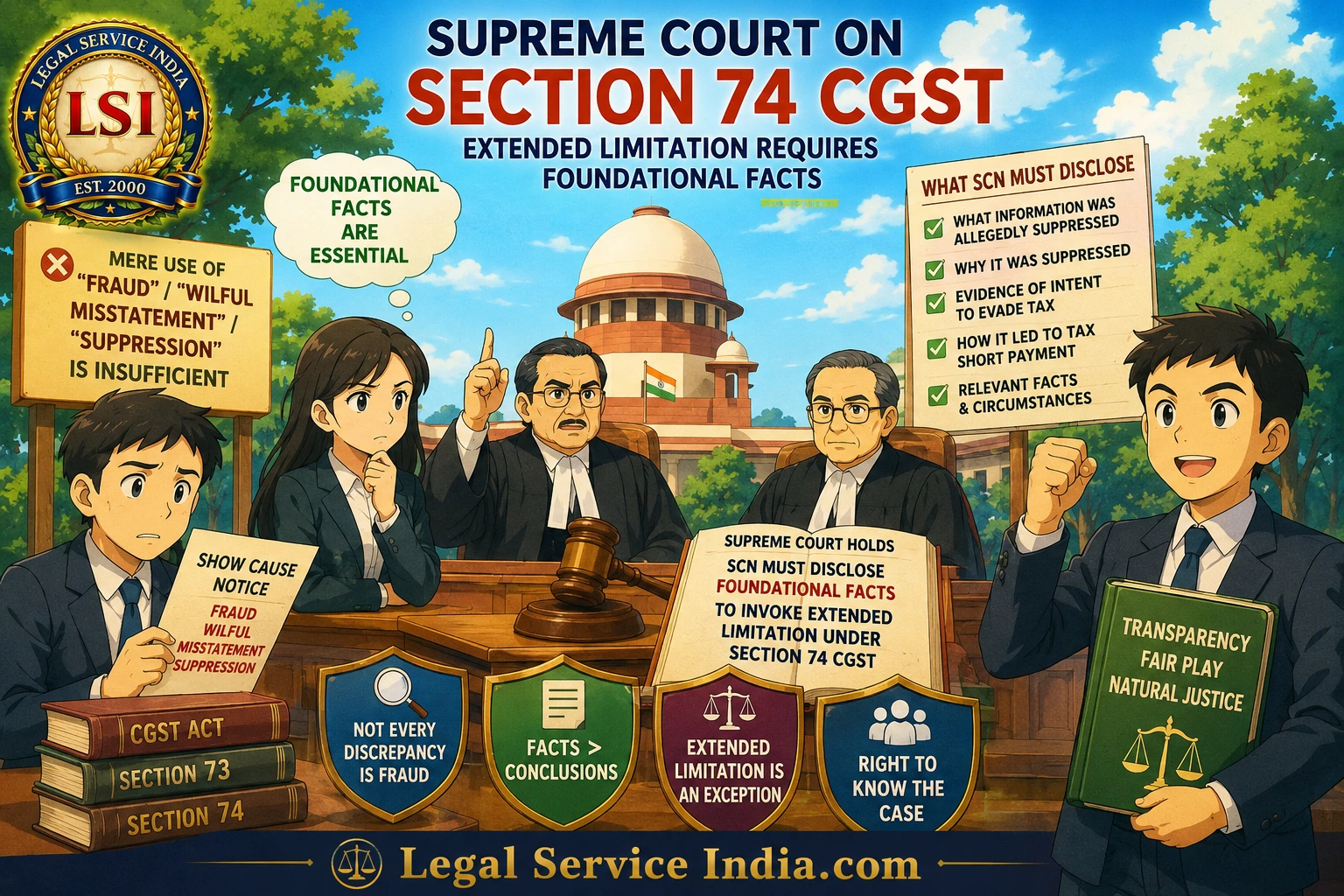
Supreme Court on Section 74 CGST: Extended Limitation Requires Foundational Facts
Focus Keyword: Section 74 CGST
Case: M/s Tata Steel Limited v. Union of India through the Secretary, Ministry of Finance & Ors.
Date of Judgment: 25 August 2026
Bench: Justice J.B. Pardiwala and Justice K. Vinod Chandran
Citation: 2026 INSC 920; 2026 LiveLaw (SC) 862
Subject: Section 74, Central Goods and Services Tax Act, 2017 — extended limitation — fraud, wilful misstatement and suppression of facts — validity of show-cause notice.
A Landmark Clarification on Section 74 CGST
The Supreme Court has once again placed an important limitation on the manner in which the GST authorities may invoke the extended limitation mechanism under Section 74 of the Central Goods and Services Tax Act, 2017.
In M/s Tata Steel Limited v. Union of India, decided on 25 August 2026, the Court set aside a show-cause notice issued under Section 74, along with the consequential adjudication order. The Court’s reasoning goes to the heart of GST limitation law: where the Department seeks to travel beyond the ordinary limitation period by alleging fraud, wilful misstatement or suppression of facts, it cannot simply reproduce those expressions from the statute.
The show-cause notice must contain the factual foundation from which such a conclusion can reasonably be drawn.
For taxpayers confronted with an old GST demand, particularly one issued after the ordinary limitation period has become problematic, this is a judgment that deserves close attention.
The decision is also important from the standpoint of administrative law. A statutory authority exercising a power with serious civil consequences must demonstrate application of mind and must disclose the factual basis upon which the statutory power is being invoked.
Why Section 74 CGST Is Different from Section 73
The significance of the ruling becomes clearer when Sections 73 and 74 are viewed together.
Section 73 broadly deals with situations involving tax that has not been paid or has been short-paid, erroneous refunds, or wrongly availed or utilised input tax credit, where the circumstances are not attributable to fraud, wilful misstatement or suppression of facts with intent to evade tax.
Section 74 addresses the more serious situation in which the tax consequence is alleged to have occurred because of fraud, wilful misstatement or suppression of facts with intent to evade tax.
That distinction has direct consequences for limitation.
Section 74 provides the Department with the benefit of a longer limitation period in appropriate cases. It is therefore not merely another procedural route for recovering an ordinary tax shortfall.
The statutory conditions that justify invoking Section 74 are consequently substantive. The Department cannot convert a case falling within the ordinary tax-dispute framework into a Section 74 proceeding simply by adding the words “fraud”, “wilful misstatement” or “suppression” to the notice.
The Supreme Court’s judgment is important precisely because it insists that the substance supporting those expressions must be present.
The Facts Behind the Tata Steel Litigation
The dispute arose from GST proceedings concerning Tata Steel for the financial years 2018-19, 2019-20 and 2020-21.
The proceedings were connected with audit objections relating to alleged ITC mismatches and alleged short payment of tax. Ultimately, the Department issued a show-cause notice dated 13 June 2025 under Section 74.
Tata Steel challenged the proceedings, including the invocation of the extended limitation period. Its case was, in substance, that the statutory basis necessary to invoke Section 74 had not been properly established and that the notice could not simply rely upon the language of fraud, wilful misstatement or suppression to overcome limitation.
The Supreme Court was therefore confronted with a significant legal question: whether the extended limitation available under Section 74 can be invoked when the SCN merely uses the statutory expressions without disclosing the factual circumstances that led the officer to infer the existence of such conduct.
The Court answered that question firmly: a mechanical recital of those expressions is insufficient.
The Supreme Court’s Central Principle
The most important part of the judgment concerns what the Court described as the foundational facts.
When the Department alleges fraud, wilful misrepresentation or suppression in order to invoke an extended limitation period, the circumstances that produced that inference must be apparent from the show-cause notice.
The use of the statutory vocabulary, by itself, does not establish that the officer has actually applied his mind.
There is a fundamental distinction between saying that a taxpayer committed “fraud” and setting out the facts which allegedly constitute that fraud.
The same applies to “suppression”. Merely describing something as suppressed does not explain what information was allegedly withheld, what obligation existed to disclose it, or what circumstances establish that the omission was deliberate and intended to evade tax.
Similarly, calling an act a “wilful misstatement” does not by itself demonstrate either wilfulness or the factual basis for that conclusion.
The Supreme Court therefore rejected mechanical reproduction of statutory language as a means of securing the extended limitation available under Section 74.
What Are the Foundational Facts?
This is perhaps the most practical aspect of the decision.
Where Section 74 is invoked, the taxpayer should be able to understand from the SCN the factual chain connecting the alleged irregularity with the statutory allegation of fraud, wilful misstatement or suppression.
The notice should, depending upon the facts, make reasonably clear what information was allegedly suppressed, whether there was a statutory obligation to disclose it, what conduct is said to constitute the suppression or misstatement, what material supports the allegation, and how that conduct is connected with the alleged tax short-payment, erroneous refund or wrongful availment or utilisation of ITC.
Most importantly, where the Department relies upon suppression or wilful conduct, the factual circumstances must provide a basis for the statutory allegation rather than leaving the taxpayer with nothing more than a conclusion.
A notice that merely states that tax was short-paid and then adds that the taxpayer “suppressed facts with intent to evade tax” does not necessarily provide the factual bridge required for Section 74.
The distinction is between a conclusion and the facts supporting that conclusion.
That distinction lies at the centre of the Supreme Court’s ruling.
Section 74 Cannot Be Used Merely to Rescue an Expired Limitation Period
The judgment has a wider significance because limitation is an important element of legal certainty.
A taxpayer cannot ordinarily be expected to remain indefinitely exposed to tax proceedings relating to old transactions. Parliament has prescribed limitation periods and has separately created an extended mechanism for specified serious cases.
Section 74 is therefore an exception to the ordinary limitation framework.
But an exception must satisfy the conditions attached to it.
If the mere insertion of the words “fraud”, “wilful misstatement” or “suppression” were enough, virtually any old tax demand could potentially be brought within the extended period.
The Supreme Court’s approach prevents that result.
The Department must establish the factual basis for treating the matter as one falling within Section 74. The extended period cannot become available merely through the drafting of an SCN.
This is why the judgment is likely to be important in future disputes involving belated GST demands.
Why the SCN Matters So Much
The Court’s insistence that the foundational facts emerge from the notice itself is also closely connected with natural justice.
A show-cause notice is supposed to tell the taxpayer what case he or she is required to answer.
Consider the practical difficulty created by a notice that merely says:
“You have suppressed facts with intent to evade tax.”
A taxpayer would reasonably want to know: Which facts? When were they allegedly withheld? What disclosure was required? Where is the evidence of deliberate suppression? How did that alleged conduct produce the tax liability?
Without that information, the opportunity to reply may exist formally but not meaningfully.
The SCN must therefore communicate the factual basis of the Department’s case with sufficient clarity to enable an effective response.
The Supreme Court’s reasoning consequently has significance beyond GST drafting. It reflects the broader administrative-law requirement that a person affected by a serious statutory action should know the case being made against him.
Can the Department Cure a Defective Notice Later?
An important implication of the judgment is that the Department cannot simply assume that deficiencies in the original SCN can always be repaired later by supplying a different factual explanation during subsequent litigation.
The foundational basis for invoking Section 74 must emerge from the notice itself.
This is logical because the taxpayer’s defence is structured around the allegations communicated through that notice.
A completely new factual foundation introduced later would potentially deprive the taxpayer of the meaningful opportunity contemplated by natural justice.
The Court’s approach therefore reinforces the importance of drafting the original SCN correctly rather than attempting to reconstruct the statutory basis after litigation has begun.
Section 74 Is Not Automatically Attracted by a Tax Discrepancy
One of the most important practical lessons is that a tax discrepancy and fraud are not synonymous.
A mismatch may arise from accounting treatment, reconciliation differences, interpretation, classification, reporting issues or other circumstances.
Similarly, an ITC dispute does not automatically establish suppression.
Nor does every incorrect statement amount to wilful misstatement.
The Department must identify the circumstances that take the case from an ordinary tax dispute into the special category contemplated by Section 74.
That distinction is particularly important in the modern GST environment, where discrepancies can be identified through comparisons among returns, invoices, e-way bills, e-invoices, audit data and other electronic records.
The existence of a mismatch may justify inquiry. It does not, without more, necessarily establish the ingredients of Section 74.
The Role of the Proper Officer
The judgment also reinforces the importance of independent application of mind by the proper officer.
An audit objection may identify a potential tax issue. Investigation material may point towards an irregularity. But the statutory authority issuing a Section 74 notice must still apply the law to the facts and determine whether the conditions for invoking the provision exist.
Section 74 cannot be treated as a protective label attached to an ordinary demand simply because the normal limitation period is approaching.
The officer must be able to connect the evidence with the statutory ingredients.
This is particularly significant because the invocation of Section 74 carries consequences that Parliament has deliberately distinguished from ordinary proceedings under Section 73.
The Supreme Court’s Treatment of the Tata Steel Notice
Applying these principles, the Supreme Court found that the Section 74 notice issued against Tata Steel could not be sustained.
The Court also set aside the consequential Order-in-Original dated 26 December 2025.
However, the Court did not permanently prevent the Department from taking action in circumstances where the statutory requirements could otherwise be satisfied.
The Court noted that the extended period had not yet completely expired and granted liberty to the Department, if permissible in law, to initiate an appropriate proceeding under Section 74, provided the foundational facts emerged from the notice itself and an order was passed before 28 February 2027.
That qualification is legally important.
The Supreme Court has not held that every Section 74 notice is inherently invalid.
Nor has it said that the Department must prove its entire case as though it were delivering a final adjudication order at the SCN stage.
The principle is narrower and more precise: where the Department seeks to invoke the exceptional limitation available under Section 74, the notice must have the necessary factual foundation for doing so.
The Judgment Does Not Give a Blanket Defence to Taxpayers
There is an equal danger in reading this judgment too broadly.
A taxpayer should not assume that every Section 74 notice can now be defeated simply by citing Tata Steel.
Where the SCN contains specific factual allegations supported by material indicating fraud, wilful misstatement or suppression, the Department’s case will have to be examined on its own facts.
The Supreme Court has not abolished Section 74.
It has not required a complete adjudication of the allegations before a notice can be issued.
What the judgment requires is that the statutory basis for invoking the extended limitation must be real, factually supported and discernible from the notice.
Consequently, the ruling should be understood as a protection against mechanical invocation, not as an automatic shield against legitimate Section 74 proceedings.
Implications for Taxpayers Receiving Section 74 Notices
For a taxpayer receiving an old GST notice, the judgment provides a useful framework for examination of the SCN.
The first issue should be limitation. If the Department is relying upon Section 74 because the ordinary period has expired, the taxpayer should determine whether the extended limitation has actually been validly invoked.
The next question is the nature of the allegation. Does the notice identify a specific act of fraud, wilful misstatement or suppression, or does it simply reproduce the statutory expressions?
The taxpayer should then identify what information is said to have been suppressed and examine whether the notice explains the legal and factual basis for that allegation.
The material relied upon by the Department should also be examined carefully. Returns, invoices, books of account, audit reports, correspondence and other records may be crucial to determining whether the allegation has any factual foundation.
Finally, the taxpayer should examine whether the alleged conduct is actually connected with an intention to evade tax and whether the statutory requirements have been independently considered by the proper officer.
A taxpayer should nevertheless respond carefully to the SCN rather than assume that the judgment automatically terminates the proceedings.
What the Decision Means for the GST Department
The judgment is equally instructive for tax administration.
GST authorities unquestionably have the power and responsibility to protect government revenue. But effective enforcement requires the distinction between a genuine tax discrepancy and conduct falling within the more serious statutory category contemplated by Section 74.
The Department must therefore avoid treating the following propositions as interchangeable:
There is a tax discrepancy.
and
The tax discrepancy resulted from fraud, wilful misstatement or suppression of facts with intent to evade tax.
The first may justify an investigation or demand depending upon the circumstances.
The second requires the additional factual foundation contemplated by Section 74.
The judgment therefore calls for more disciplined SCN drafting and more careful application of mind before the extended limitation provision is invoked.
Audit Material Does Not Replace Statutory Satisfaction
The background of the Tata Steel litigation also makes it important to distinguish audit material from the statutory decision-making process.
An audit objection may be an important source of information. It may identify an apparent discrepancy or potential revenue loss.
But the existence of an audit objection does not, by itself, eliminate the need for the proper officer to independently examine whether Section 74 is attracted.
The statutory authority must still determine whether the facts satisfy the requirements of the provision.
This is an important safeguard against treating an audit observation as though it were itself a final finding of fraud or suppression.
Protective Demands and Limitation
The judgment also addresses the concept of a protective demand.
The Court did not accept the proposition that GST law permits the Department to employ a protective mechanism simply to preserve a claim against the expiry of limitation.
The statutory framework must authorise the action being taken.
Revenue protection is undoubtedly a legitimate governmental objective, but it cannot justify the creation of procedural devices that have no foundation in the governing legislation.
This part of the ruling reinforces the broader proposition that tax authorities, like every statutory authority, must operate within the boundaries created by Parliament.
The Constitutional Dimension
At a deeper level, the decision is not merely about GST forms, limitation calculations or SCN drafting.
It concerns the rule of law.
Taxation involves the exercise of sovereign authority. But the power to impose and recover tax must be exercised according to the statute that confers that power.
Where Parliament has prescribed a special limitation period for cases involving fraud, wilful misstatement or suppression, the executive authority must satisfy those statutory conditions.
The Department cannot enlarge the scope of its power merely by changing the language of the notice.
The Supreme Court’s reasoning is therefore consistent with a fundamental administrative-law principle: the exercise of statutory power depends upon satisfaction of the conditions prescribed by the statute.
A Practical Legal Checklist
In my view, lawyers examining a Section 74 CGST notice should pay particular attention to five questions.
- First, determine whether the notice has been issued within the ordinary limitation period or whether the Department is depending upon Section 74 to extend the period.
- Second, identify precisely which statutory ground is alleged—fraud, wilful misstatement, suppression, or a combination of them.
- Third, examine whether the SCN actually states the facts supporting that allegation instead of merely reproducing statutory terminology.
- Fourth, determine whether the alleged conduct is connected with the tax short-payment, erroneous refund or wrongful ITC and whether the material demonstrates the necessary intention to evade tax.
- Finally, examine the notice, relied-upon documents and procedural history together rather than treating the words appearing in the SCN in isolation.
The answer will necessarily depend upon the facts of each case.
What Makes the Tata Steel Judgment Important
The real significance of M/s Tata Steel Limited v. Union of India lies in its rejection of the proposition that limitation can effectively be extended through drafting alone.
If the mere use of the words “fraud”, “wilful misstatement” or “suppression” were enough, the carefully drawn statutory distinction between Sections 73 and 74 could lose much of its meaning.
The Supreme Court has prevented that possibility by insisting upon the factual foundation.
The Department must identify the basis for the allegation.
The taxpayer must be told the case that has to be answered.
The proper officer must apply his or her mind to the statutory requirements.
And the exceptional limitation available under Section 74 must be supported by facts that bring the case within the statutory provision.
That is why this judgment is likely to become an important authority in future GST limitation disputes.
Conclusion
The Supreme Court’s decision in M/s Tata Steel Limited v. Union of India marks an important development in the jurisprudence surrounding Section 74 CGST.
The Court has not questioned the legitimate power of the GST authorities to invoke the extended limitation period where the statutory ingredients genuinely exist. What it has rejected is the mechanical use of statutory expressions as a substitute for those ingredients.
The message is straightforward but legally important: fraud must have a factual foundation; wilful misstatement must be supported by circumstances demonstrating wilfulness; and suppression cannot be established merely by attaching the label “suppression” to a tax discrepancy.
For taxpayers, the decision provides an important basis for scrutinising vague Section 74 notices, particularly where the ordinary limitation period has become an issue.
For the Department, it is a reminder that effective revenue enforcement must be accompanied by proper application of mind and legally sustainable reasoning.
Ultimately, the decision preserves the balance between two legitimate interests: the State’s right to recover tax lawfully due and the taxpayer’s right to certainty, fair procedure and protection against an extraordinary limitation period being invoked without the factual foundation required by Parliament.
— Adv. Tarun Choudhury
Supreme Court Advocate | 25+ Years of Legal Experience
This article is for general legal information and educational purposes and should not be treated as legal advice in any particular case.