





I. The Core Ruling: Pazhanathal v. Alamathal
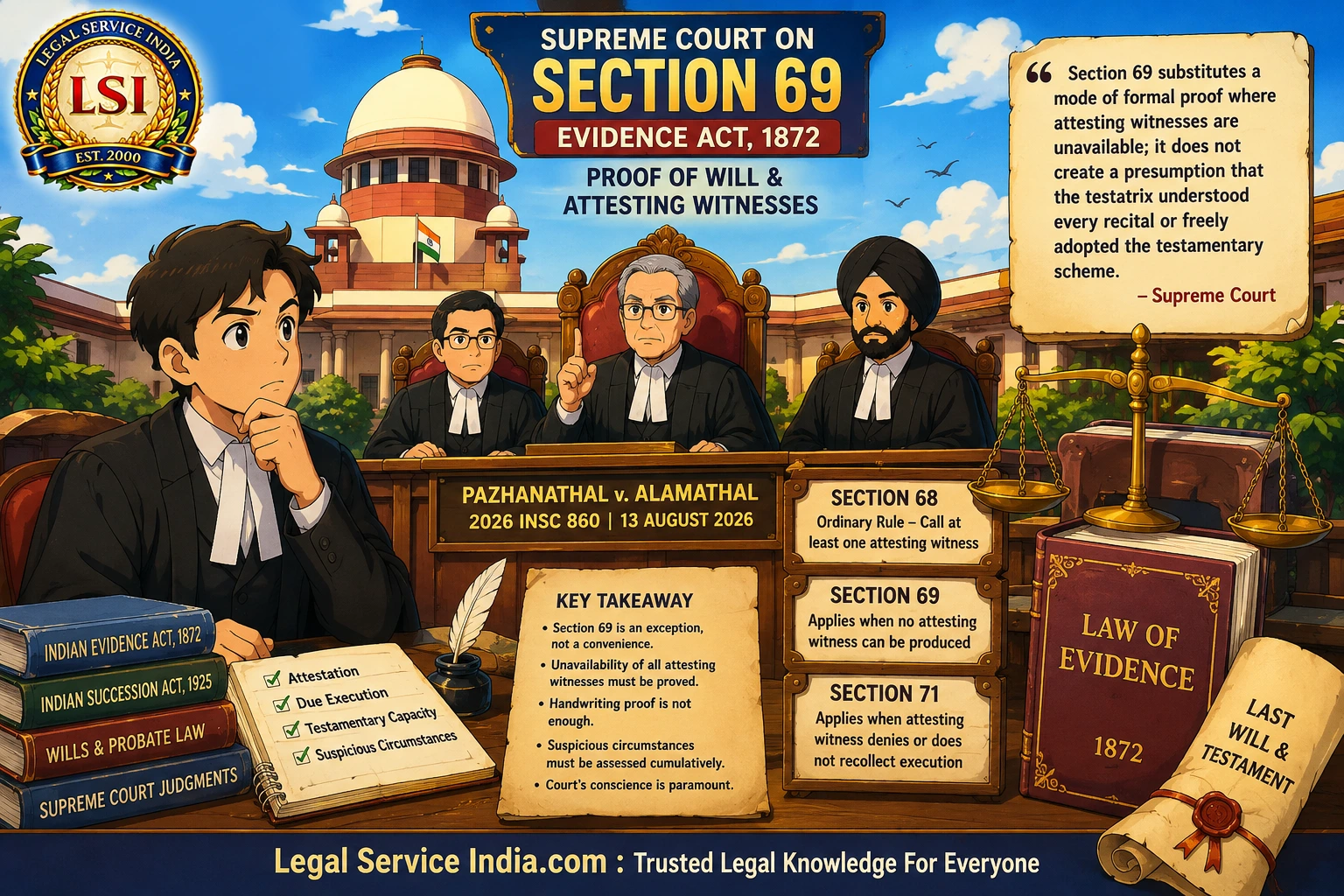
Pazhanathal (Dead) Through LRs & Ors. v. Alamathal (Dead) Through LRs & Ors.
Civil Appeal Nos. 10169–10170 of 2013, decided 13 August 2026; Neutral Citation 2026 INSC 860 (Karol and Kotiswar Singh, JJ.)
The Supreme Court has confirmed that Section 69 of the Indian Evidence Act, 1872, is not a route of convenience available to a propounder who prefers to avoid producing attesting witnesses. It is a statutory exception, triggered only once the propounder has satisfactorily shown that no attesting witness can be found to prove the will under Section 68.
Two named witnesses, Marappa Gounder and Avanashi Gounder, had attested the disputed 1976 will. The death of Marappa Gounder was established through his son’s testimony, but the unavailability of Avanashi Gounder was never satisfactorily proved. The Madras High Court had accepted proof under Section 69 regardless; the Supreme Court set that aside and restored the trial court’s rejection of the will.
The fortifying detail worth noting for practitioners is the Bench’s second holding, distinct from the gateway point: even where Section 69 is properly attracted and handwriting is proved, that proof does not by itself resolve the enquiry into testamentary validity.
The Court criticised the High Court for evaluating individual suspicious circumstances in isolation rather than assessing their cumulative effect — a methodological point that now applies squarely alongside the older suspicious-circumstances doctrine discussed in Part III below.
Section 69 substitutes a mode of formal proof where attesting witnesses are unavailable; it does not create a presumption that the testatrix understood every recital or freely adopted the testamentary scheme.
— paraphrasing the Bench’s holding, Pazhanathal v. Alamathal, 2026 INSC 860
II. The Statutory Hierarchy: Sections 68, 69 and 71
Section 63(c) of the Indian Succession Act, 1925
Section 63(c) of the Indian Succession Act, 1925, requires attestation by at least two witnesses, each of whom must have seen the testator sign or receive a personal acknowledgement of the signature, and each of whom must sign in the testator’s presence.
Section 68 of the Evidence Act
Section 68 of the Evidence Act is the ordinary rule: at least one attesting witness, if alive, subject to the court’s process, and capable of giving evidence, must be called to prove execution.
The proviso that dispenses with an attesting witness for registered documents expressly excludes Wills, so registration alone never substitutes for this requirement.
Section 69 of the Evidence Act
Section 69 operates only where no attesting witness can be produced. It relaxes the mode of proof — permitting proof of an attesting witness’s handwriting and the executant’s signature — but not the precondition that Section 68 has become genuinely impossible to satisfy.
Section 71 of the Evidence Act
Section 71 is narrower still. It comes into play only after an attesting witness who has actually been called denies execution or cannot recollect it.
It cannot be invoked to excuse the deliberate non-examination of an available witness, nor as a shortcut around Section 68.
III. Fortifying Precedent
H. Venkatachala Iyengar v. B.N. Thimmajamma & Ors.
AIR 1959 SC 443; 1959 Supp (1) SCR 426 (Constitution Bench)
This remains the foundational authority on proof of wills.
The Court held that a will is proved like any other document, subject to the special attestation requirement of Section 63 of the Succession Act, and that the propounder carries the burden of satisfying the court’s conscience that the instrument is the last will of a free and capable testator.
Where the propounder takes a prominent part in execution and receives a substantial benefit, that fact is itself a suspicious circumstance calling for explanation.
Jaswant Kaur v. Amrit Kaur & Ors.
(1977) 1 SCC 369; AIR 1977 SC 74
Applying Venkatachala Iyengar, the Court held that mere assertion by the propounder that the will bears the testator’s signature, or that natural heirs were excluded for unstated reasons, does not discharge the burden once suspicion has legitimately arisen.
The propounder must affirmatively remove every such suspicion before the document is accepted as the last will.
Janki Narayan Bhoir v. Narayan Namdeo Kadam
(2003) 2 SCC 91; AIR 2003 SC 761
This decision anchors the relationship between Sections 63(c), 68 and 71.
One attesting witness suffices under Section 68 only if that witness proves the full requirements of due attestation; if that witness fails and a second attesting witness remains available, the propounder must call the second witness.
Section 71 does not excuse that omission — it exists to assist a party who has done its best but is let down by the witnesses actually examined, not one who withholds an available witness.
Benga Behera & Anr. v. Braja Kishore Nanda & Ors.
(2007) 9 SCC 728; AIR 2007 SC 1975
The Court held that Sections 69, 70 and 71 are each distinct exceptions to Section 68, engaged only in their own specific contingencies.
It further clarified that a sub-registrar who endorses a document under the Registration Act, 1908, does not thereby become an attesting witness to a will, since the registering officer’s statutory duty is to endorse admission or execution, not to attest with the intention required of a witness under Section 3 of the Transfer of Property Act (animus attestandi).
A scribe or drafting advocate is treated the same way absent independent evidence of such intent.
Jagdish Chand Sharma v. Narain Singh Saini (Dead) through LRs & Ors.
(2015) 8 SCC 615; Civil Appeal Nos. 4181–4182 of 2015
Where the sole attesting witness examined could not depose to the presence or signing of the second attesting witness, and that second witness remained available but unexamined, the will was held not proved.
The judgement reinforces that execution and attestation are separate statutory requirements and that a witness must speak to both.
Raj Kumari & Ors. v. Surinder Pal Sharma
Civil Appeal arising out of SLP (C) No. 26957 of 2018, decided 17 December 2019; 2019 INSC 1388; 2019 ALL SCR (Online) 1229
The Court declined to treat Section 71 as available merely because one attesting witness could not be served with summons; the other named attesting witness had not even been summoned.
Registration of the Will did not, by itself, cure this evidentiary gap. The decision is a useful companion to Pazhanathal on the specific point that unserved or unattempted summons does not equate to proved unavailability.
Kavita Kanwar v. Pamela Mehta & Ors.
Civil Appeal No. 3688 of 2017, decided 19 May 2020; 2020 INSC 397
Although concerned principally with suspicious circumstances rather than the Section 68/69 gateway, this decision is the clearest earlier statement of the cumulative-assessment principle that Pazhanathal now revives in the Section 69 context.
The Court held that individual circumstances, none decisive on its own, may cumulatively persuade the court that a will does not reflect the testator’s free and informed intention and reaffirmed that a probate proceeding is ultimately a matter of the court’s conscience.
The Bench also drew on the older holding in Surendra Pal v. Dr (Mrs) Saraswati Arora (1974) 2 SCC 600, that a propounder who takes a prominent part in execution and receives substantial benefit bears a heavier explanatory burden.
Rama Datta Gupta v. Gopal Das (Calcutta High Court)
IA No. GA/3/2026, decided 24 June 2026 (Basak and Rashidi, JJ.)
A recent High Court decision of persuasive value: where attesting witnesses were unavailable, the Division Bench held that the evidence of an attending witness—one present at execution though not himself an attester—could be considered under Sections 69 and 71 alongside proof of testamentary capacity, and granted probate on that combined evidentiary basis.
Practitioners outside the jurisdiction of the Madras and Calcutta High Courts should note this remains High Court authority, not binding outside its own jurisdiction, and should be cited as persuasive rather than as settled Supreme Court doctrine.
IV. Evidentiary Consequences for Practice
A propounder invoking Section 69 should be prepared to place before the court:
- A death certificate or other reliable, source-attributed proof of death.
- The witness’s last known address and evidence of efforts made to trace them.
- Testimony of a person with direct personal knowledge of the witness’s death or disappearance — ideally someone from the witness’s own locality, not merely a relative of a beneficiary.
- Returned summons, police reports, or other documentary record of a genuine, not merely nominal, attempt at service.
- A clear evidentiary distinction between a witness who is dead, one who is alive but temporarily absent, one who is traceable but unwilling, one beyond jurisdiction but summonable, and one who has been examined but denies or cannot recollect execution — only the last of these engages Section 71, and only genuine unavailability of all attesting witnesses engages Section 69.
- Even where Section 69 is validly attracted, the propounder’s task is not complete. Testamentary capacity, voluntary execution, and the absence of suspicious circumstances must still be established, and Kavita Kanwar’s cumulative-assessment method should now be applied alongside Pazhanathal’s caution against evaluating each suspicious circumstance in isolation.
V. Citation Table
| Case | Citation |
|---|---|
| Pazhanathal v. Alamathal | 2026 INSC 860 |
| H. Venkatachala Iyengar v. B.N. Thimmajamma | AIR 1959 SC 443; 1959 Supp (1) SCR 426 |
| Jaswant Kaur v. Amrit Kaur | (1977) 1 SCC 369; AIR 1977 SC 74; 1977 SCR (1) 925. |
| Janki Narayan Bhoir v. Narayan Namdeo Kadam | (2003) 2 SCC 91; AIR 2003 SC 761 |
| Benga Behera v. Braja Kishore Nanda | (2007) 9 SCC 728; AIR 2007 SC 1975 |
| Jagdish Chand Sharma v. Narain Singh Saini | (2015) 8 SCC 615; Civil Appeal Nos. 4181-4182 of 2015, decided 1 May 2015. |
| Raj Kumari v. Surinder Pal Sharma | 2019 INSC 1388; 2019 ALL SCR (Online) 1229; decided 17 Dec 2019. |
| Kavita Kanwar v. Pamela Mehta | Civil Appeal No. 3688/2017; 2020 INSC 397 decided 19 May 2020, Khanwilkar and Maheshwari, JJ. |
| Surendra Pal v. Saraswati Arora | (1974) 2 SCC 600 |
| Rama Datta Gupta v. Gopal Das | IA No. GA/3/2026 (Cal HC, 24 June 2026) |
VI. Practitioner’s Checklist — Section 68/69 Gateway
- Identify every named attesting witness on the face of the Will before pleading Section 69 in the alternative.
- For each witness, build a discrete evidentiary record of death or unavailability — do not rely on a composite or generalised assertion.
- Where one witness’s unavailability is proved but the second is not, plead and argue on the footing that Section 68 still governs; do not assume the gateway opens on partial proof.
- If relying on Section 71, confirm the witness was actually called and either denied execution or could not recollect it — non-service of summons is not the same thing.
- Even after crossing the Section 68/69 gateway, separately plead and prove testamentary capacity, voluntary execution, and absence of suspicious circumstances, addressing their cumulative effect per Kavita Kanwar and Pazhanathal.
- Do not treat registration, or a sub-registrar’s endorsement, as a substitute for attestation — per Benga Behera, the registering officer is not thereby an attesting witness.
- Frame Order XX Rule 5 CPC findings on due execution and suspicious circumstances as separate issues, so an appellate court reviewing the record can trace the cumulative reasoning distinctly from the gateway finding.
Written By: Inder Chand Jain
Ph no: 8279945021, Email: [email protected]

