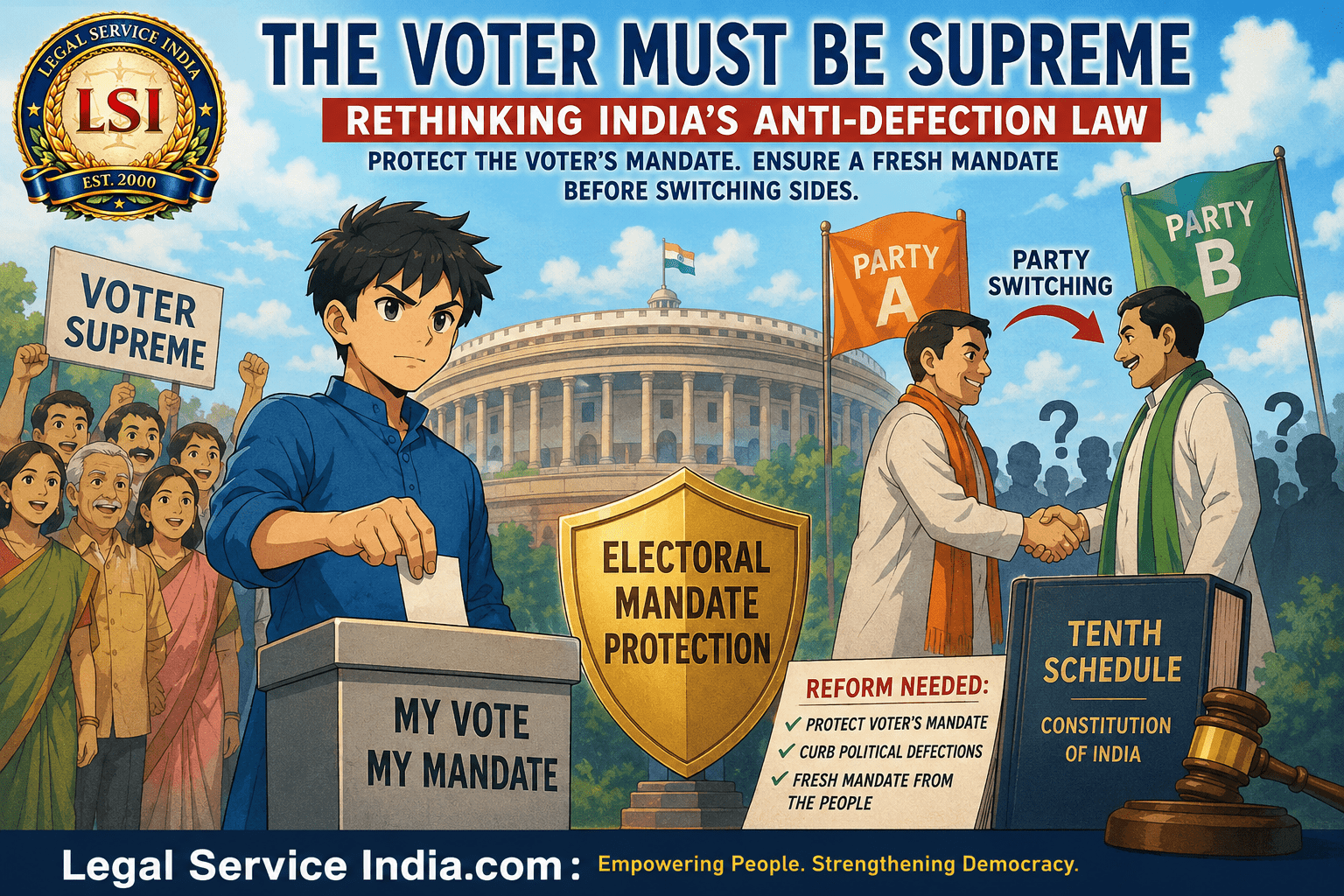
The Voter Must Be Supreme: Rethinking India’s Anti-Defection Law and Restoring the People’s Mandate
Why India Needs to Move From Party-Centred Anti-Defection Law to Voter-Mandate Protection
“A politician may change parties, change positions and even change political loyalties—but the people’s mandate is not theirs to carry elsewhere. If you want to change sides, go back to the people and ask them again.”
— Adv. Tarun Choudhury
India is a representative democracy. Every five years, or whenever an election is otherwise held, the people exercise one of the most powerful constitutional rights available to them: they choose who will represent them.
The political party matters. The candidate matters. The manifesto matters. The political ideology matters. But ultimately, it is the voter who casts the decisive vote.
That leads me to a simple question:
If the voter gives the mandate, why should the law primarily protect the relationship between the political party and the elected representative while giving comparatively less direct protection to the mandate given by the voter?
This is the question that, in my view, India must confront while reconsidering the anti-defection law.
The Tenth Schedule was introduced in 1985 to deal with the serious problem of political defections. Its purpose was entirely legitimate. Legislators changing political allegiance after being elected had become a serious threat to political stability and democratic government. The Supreme Court has itself recognised that the Tenth Schedule was intended to curb the practice of legislators changing allegiance after being elected on the ticket of a political party.
But more than four decades after the introduction of the anti-defection framework, we should be willing to ask a more fundamental question:
Has the law protected the voter as much as it has protected the political party?
My answer is not adequate.
I am not suggesting that the Tenth Schedule should simply be repealed. Nor am I suggesting that every disagreement between an elected representative and his or her party should result in disqualification.
That would be equally dangerous.
What I am proposing is something more precise:
The voter should remain free to elect a representative, the representative should remain free to exercise legislative judgement, but the representative should not be permitted to transfer the electoral mandate from one political identity to another without returning to the electorate for a fresh mandate.
That, in my view, is the missing link in India’s anti-defection framework.
1. The Fundamental Question: Who Owns the Democratic Mandate?
Let me begin with the basic constitutional relationship.
- A political party selects a candidate.
- The candidate contests the election.
- The voter enters the polling booth.
- The voter chooses.
- The Election Commission declares the result.
- The elected representative enters Parliament or the Legislative Assembly.
At that point, an important constitutional relationship is created.
The representative has not received the seat merely from the political party. The representative has received the democratic mandate through the votes of the electorate.
Of course, modern elections cannot be understood without political parties. The Supreme Court has recognised the central role of political parties in India’s democratic system, and its 2023 judgement concerning the Maharashtra political crisis specifically connected the anti-defection framework to the problem of legislators shifting allegiance after being elected on a party ticket.
But recognising the importance of political parties should not lead us to the opposite conclusion—that the political party effectively owns the electoral mandate.
The party may provide the political vehicle. The voter provides the mandate.
That distinction should become the foundation of the next generation of electoral reform.
2. What Is Wrong With the Present Anti-Defection Framework?
The present Tenth Schedule provides for disqualification where, among other things, a member voluntarily gives up membership of the political party or votes or abstains contrary to the direction issued by the political party, subject to the provisions of the Schedule. It also treats an elected member as belonging to the political party, if any, by which the member was set up as a candidate.
This was designed to solve a real problem.
But the structure creates an important imbalance.
The law asks:
- Did the legislator violate party discipline?
- Did the legislator voluntarily give up membership of the party?
- Did the legislator vote contrary to the party direction?
But I believe we must add another question:
What happened to the mandate that the voters gave that representative?
That question is not merely philosophical.
It becomes extremely important when an elected representative leaves one political party and joins another.
Suppose a candidate contests an election under Party A.
The candidate wins.
Two years later, the representative leaves Party A and joins Party B.
Party B now gets a legislator who was elected under Party A’s political identity.
But the voters of that constituency were never asked whether they wanted their representative to become a representative of Party B.
The political identity has changed. The voter has not been consulted.
This is the precise democratic gap that I believe the law must address.
3. I Am Not Advocating That Every MLA or MP Must Obey Every Voter
This distinction is extremely important.
If we say that “the voter is supreme” in a representative democracy, it cannot mean that an MP or MLA must conduct a referendum before every vote in the House.
That would destroy representative democracy.
An elected representative must have the freedom to:
- debate;
- disagree;
- scrutinise legislation;
- oppose government policy;
- exercise conscience;
- represent local interests;
- change his or her position after considering new facts.
A representative is not merely a voting machine.
Therefore, I would reject the idea that every disagreement with a party should automatically result in disqualification.
In fact, I believe India’s anti-defection law should become more tolerant of legitimate legislative dissent while becoming stricter against the transfer of an electoral mandate from one political party to another.
That may sound contradictory.
It is not.
It is the key to reform.
4. My Proposal: The Electoral Mandate Protection Principle
I propose that India should adopt what I would describe as the:
Electoral Mandate Protection Principle
Its central rule should be simple:
An elected representative who voluntarily changes the political party under whose candidature the representative was elected should not be permitted to transfer that mandate to another political party without obtaining a fresh mandate from the electorate.
In plain language:
- You can change your political allegiance.
- You can disagree with your party.
- You can resign from your party.
But if you want to represent another political party from the same constituency, go back to the people.
Ask them again.
Let the voters decide.
That is what I mean by making the voter supreme.
5. The “No Transfer of Mandate Without Voter Confirmation” Rule
I would build the reform around one simple democratic proposition:
No elected representative should be able to transfer the political mandate received from the voters to another political party merely by changing party affiliation.
Imagine the following situation.
| Stage | Situation |
|---|---|
| First | A candidate contests an election under Party A. |
| Second | The candidate wins. |
| Third | Two years later, the candidate joins Party B. |
| Fourth | Under my proposed system, joining Party B would trigger a mandate reconfirmation requirement. |
The representative would have two principal choices.
First Option: Resign and Seek a Fresh Mandate
The representative resigns the seat and contests a by-election as a candidate of Party B.
If the voters approve the decision:
The representative returns with a fresh mandate.
If the voters reject the decision:
The representative does not return.
There is nothing undemocratic about this.
On the contrary, it is democracy in its purest form.
The representative is not being permanently punished.
The representative is simply being told:
You have changed the political identity under which you were elected. Now ask the people whether they agree with you.
6. The Representative Should Not Be Punished for Dissent
This is where my proposal differs from a crude anti-defection law.
Suppose an MLA belonging to Party A disagrees with the party on a social policy.
Suppose the MLA votes differently on an ordinary bill.
Suppose the MLA publicly criticises the party leadership.
Should the MLA automatically lose the seat?
No.
I would oppose such a rule.
The law should distinguish between:
- Political dissent
- Political defection
They are not the same thing.
A democracy needs dissent.
A parliamentary democracy needs debate.
A legislature filled with representatives who simply obey every instruction of their party leadership is not necessarily a healthy legislature.
Therefore, the reformed anti-defection law should protect government stability without converting every legislative vote into a test of personal loyalty to the party leadership.
7. Three Categories of Legislative Voting
To achieve this, I propose that parliamentary voting be divided into three broad categories.
Category One: Government-Survival Votes
These would include matters such as:
- confidence motions;
- no-confidence motions;
- votes directly determining whether the government continues in office;
- appropriately defined money and supply matters.
Here, party discipline has a strong constitutional justification.
A government elected on a particular political programme cannot be allowed to collapse merely because individual legislators are induced to change sides.
A valid whip should therefore continue to operate strongly in this category.
Category Two: Core Electoral Mandate Votes
These would relate to a limited number of fundamental commitments expressly identified by the political party before the election.
But there is an important safeguard.
A party should not be permitted to classify every sentence of its manifesto as a “core mandate”.
Otherwise, the exception would swallow the rule.
I therefore propose that political parties should identify a small and clearly defined list of core electoral commitments before the election.
Those commitments could be publicly registered.
This would create transparency.
The voters would know what the party itself considers central to its electoral mandate.
Category Three: Ordinary Legislative Votes
For most ordinary legislation:
- There should be greater freedom for legislators to exercise judgement.
The party may issue a political position.
The party may persuade its legislators.
The party may debate internally.
But an ordinary disagreement should not automatically become a constitutional disqualification.
This would restore a degree of legislative independence without returning India to the era of uncontrolled horse-trading.
8. A New Institutional Mechanism: The Electoral Mandate Register
There is another reform I believe can make this system practical.
Before every general election, political parties should be required to file an Electoral Mandate Statement.
This would be publicly available.
It could contain:
- the party manifesto;
- its principal policy commitments;
- its identified core electoral commitments;
- its candidate list;
- registered coalition arrangements;
- any formal pre-election alliance commitments.
The objective is not to convert every manifesto promise into a legally enforceable obligation.
That would be impractical.
The objective is simply to establish a transparent record of the political identity presented to voters at the time of election.
This would create an important democratic record:
What did the voter actually vote upon?
9. The Mandate Register Should Not Become a Political Control Register
This safeguard is essential.
I do not propose that government officials should decide whether a political party is “ideologically pure”.
That would be dangerous.
The Register should be factual and limited.
It should record:
- What did the party formally present to the electorate?
It should not determine:
- What political opinions are permissible?
Political parties must remain free to evolve.
Political circumstances change.
New economic crises occur.
National security situations change.
Coalitions change.
Public opinion changes.
Therefore, the law should not freeze a political party into its election manifesto for five years.
The Mandate Register is primarily a transparency mechanism.
10. The Most Important Rule: Party Switching Should Trigger a Fresh Mandate
This is the heart of my proposal.
If an elected representative:
- leaves Party A;
- joins Party B;
- and seeks to continue representing the same constituency as a member of Party B,
The law should ordinarily require:
A fresh electoral mandate.
This principle is not without international precedent.
New Zealand, for example, has legislation dealing with circumstances in which an MP ceases to be a parliamentary member of the political party for which the MP was elected. Its stated purpose includes enhancing public confidence in electoral integrity and maintaining the proportionality of political-party representation as determined by electors.
India need not copy New Zealand.
But we can learn from the underlying principle:
The composition of the legislature should not be disconnected from the political choice made by the electorate.
11. But What Happens If the Political Party Itself Changes?
This is where a serious reform must be nuanced.
Suppose a candidate is elected under Party A.
After two years, Party A itself abandons the political position on which the election was fought.
The representative says:
“I have not abandoned the mandate. The party has.”
Should the representative automatically lose the seat?
No.
That would be unfair.
Therefore, I propose a narrowly defined:
Mandate Discontinuity Defence.
A representative could argue before an independent adjudicatory body that the political party itself has fundamentally altered the political identity presented to the electorate.
This should not become an easy escape route.
There should be a high threshold.
But the law must recognise the possibility.
Otherwise, the reform would protect the party at the expense of the voter all over again.
12. The Speaker Should Not Be the Final Arbiter of Political Defection
Another major weakness in the present framework is institutional.
The Speaker occupies an inherently political constitutional office.
When the question is whether a legislator has defected, the dispute can directly affect:
- government survival;
- party strength;
- leadership;
- coalition arithmetic.
Expecting one political actor to conclusively determine another political actor’s constitutional fate inevitably creates controversy.
The Supreme Court has subjected decisions under the Tenth Schedule to judicial review, and its jurisprudence has repeatedly addressed the constitutional role of the Speaker in defection proceedings.
I therefore propose an:
Independent Electoral Mandate Tribunal.
It could consist of persons with strong constitutional and electoral expertise, with judicial leadership and transparent appointment criteria.
The objective would not be to remove Parliament from the process.
The objective would be to ensure that a politically decisive constitutional dispute is determined through an independent process.
13. There Must Be a Strict Time Limit
An anti-defection law that takes years to produce a decision defeats its own purpose.
The question is not merely:
Who is right?
The question is:
Who is entitled to occupy the seat while the dispute remains unresolved?
Delay can itself alter the political balance of a House.
Therefore, I propose:
90 days as the normal outer limit.
If exceptional circumstances genuinely prevent a decision within that period, reasons should be publicly recorded and judicially reviewable.
The Supreme Court’s recent jurisprudence has itself emphasised the need to prevent unreasonable delay in deciding disqualification proceedings.
A constitutional right without timely enforcement is often only a theoretical right.
14. My Proposal Is Not a General Right of Recall
I want to make this distinction very clear.
I am not proposing that voters should be able to recall their MP or MLA merely because they are unhappy with the representative’s performance.
There are serious practical questions surrounding a general recall mechanism.
It could lead to:
- political instability;
- repeated elections;
- harassment of representatives;
- misuse by wealthy political interests;
- continuous campaigning;
- minority pressure.
India should therefore be cautious.
My proposal is much narrower.
- Poor performance? The voter can remove the representative at the next election.
- Ordinary disagreement? The representative should be free to exercise judgement.
- Political dissent? It should not automatically cause disqualification.
- Voluntary transfer from Party A to Party B? Return to the voter.
That is the distinction.
15. Why This Would Actually Strengthen Representative Democracy
Some may argue that giving voters this power would weaken representatives.
I believe the opposite could happen.
Today, an elected representative may face pressure from:
- party leadership;
- political financiers;
- rival factions;
- government;
- opposition;
- constituency;
- ideological groups.
The proposed system would create another important constitutional consideration:
The voters.
A representative contemplating a party switch would know:
“If I change sides, I must explain my decision to the electorate.”
That changes incentives.
It discourages opportunistic defections.
But it does not prohibit genuine political realignment.
A politician who genuinely believes that the new political party better represents the constituency can make that case.
The voters then become the judge.
16. This Could Reduce Horse-Trading
The anti-defection law was originally introduced because defections could destabilise governments.
But political incentives matter.
If switching parties automatically means risking a by-election, the political calculation changes.
A legislator cannot simply calculate:
“If I move to the other side, what position will I receive?”
The calculation becomes:
“If I move to the other side, will the people send me back?”
That is a powerful democratic deterrent.
The reform therefore attacks the incentive structure rather than merely increasing punishment.
17. The Real Innovation Is Not Technology
There will inevitably be discussion about creating digital systems, databases and online mandate registers.
Those tools are useful.
But they are not the real innovation.
The real innovation is conceptual.
The existing anti-defection framework essentially asks:
Did the legislator remain loyal to the political party?
My proposed framework asks:
Did the legislator remain within the mandate for which the electorate elected him or her?
That is a fundamental change in perspective.
- The party remains important.
- The representative remains important.
- But the voter becomes the constitutional reference point.
18. A Constitutional Amendment Could State the Principle Clearly
If Parliament eventually considers such a reform, I believe the constitutional amendment should be built around a simple principle.
It could provide, in substance:
Where an elected member voluntarily changes the political party under whose candidature the member was elected and seeks to represent another political party during the term of the House, the member shall obtain a fresh mandate from the electorate, subject to constitutionally recognised exceptions.
It should then make it equally clear:
Nothing in the anti-defection provisions shall disqualify a member merely for expressing dissent or voting independently on ordinary legislative matters, except in constitutionally defined matters necessary for governmental stability or protection of the electoral mandate.
The exact legislative language would require extensive constitutional drafting.
But the principle should be simple enough for an ordinary voter to understand.
19. The Voter Should Be Able to Understand the Law
This is an often ignored part of electoral reform.
If the voter cannot understand the law, the law has failed democratically.
An ordinary voter should be able to understand three rules:
Rule 1
You elect the representative.
Rule 2
The representative may disagree with the party.
Rule 3
If the representative changes political parties and wants to carry the seat with the new party, the representative must return to you.
That is a system a voter can understand.
20. A Practical Roadmap for Reform
I would not recommend attempting to rewrite the entire anti-defection system overnight.
The reform should proceed in stages.
Stage One — Research and Drafting
A constitutional reform committee should examine:
- all major anti-defection judgements;
- historical defections;
- Speaker decisions;
- delays;
- government collapses;
- party-switching patterns;
- international models.
The Law Commission’s electoral-reform work provides an important starting point, including Reports 170, 244 and 255.
Stage Two — Historical Simulation
Take major Indian defection cases from the last several decades.
Apply the proposed rules retrospectively as a research exercise.
Ask:
Would the proposed law have produced a better democratic result?
This is crucial.
We should test the idea against reality before putting it into the Constitution.
Stage Three — Public Consultation
Consult:
- voters;
- MPs;
- MLAs;
- political parties;
- former speakers;
- constitutional lawyers;
- judges and former judges;
- Election Commission experts;
- academics;
- civil society.
Stage Four — Pilot the Mandate Register
Before making the system legally binding, create a transparent voluntary framework for registering:
- manifestos;
- candidates;
- core commitments;
- alliances.
Stage Five — Constitutional Amendment
Only after the evidence is available should Parliament consider the constitutional amendment.
21. What Would Happen If the Pilot Failed?
A serious reform proposal must also accept the possibility of failure.
Suppose the pilot shows:
- too many unnecessary by-elections;
- widespread manipulation;
- political parties abusing the system;
- voters becoming confused;
- excessive litigation.
Then the proposal should be narrowed.
For example, the fresh-mandate requirement could initially apply only to:
- a legislator who formally joins another registered political party during the same legislative term.
It could exclude:
- resignation without joining another party;
- temporary suspension;
- merger situations recognised by law;
- cases involving proven fundamental alteration by the original party.
In other words:
The system should be designed to learn.
22. Ten Safeguards I Would Insist Upon
Any amendment based on this proposal should contain at least these safeguards:
- No automatic disqualification for ordinary dissent.
- No general recall mechanism.
- Fresh mandate requirement primarily for party switching.
- Independent adjudication.
- A strict 90-day decision period.
- Judicial review must remain available.
- A narrowly defined defence where the original party fundamentally changes its political identity.
- Manifesto commitments must be registered before elections.
- Only a limited number of commitments may receive special mandate status.
- All decisions should be publicly accessible and reasoned.
23. The Political Objection Will Be Obvious
Political parties may understandably resist this proposal.
Why?
Because the proposal removes an important political advantage.
A legislator considering defection would no longer be able to assume that the constituency automatically travels with the legislator.
The legislator would have to convince the voters.
That is precisely why I believe the proposal deserves serious consideration.
Electoral law should not be designed merely around what is convenient for political parties.
It should be designed around what protects democratic choice.
24. My Answer to the Most Difficult Question
Someone may ask me:
“But what if the voters actually want the politician to switch parties?”
My answer is:
Then let them say so.
Why should we fear that result?
If the voters approve the switch, the politician wins the by-election.
The politician returns stronger than before.
The new party receives a legitimate mandate.
The constituency has spoken.
The political system gains legitimacy rather than losing it.
The problem arises only when politicians are allowed to assume that the voters will follow them without being asked.
25. The Seat Should Not Become a Personal Political Property
This is perhaps the deepest issue.
An elected seat should not become the personal property of:
- the politician;
- the political party;
- the party leadership;
- a faction;
- a coalition.
The seat represents the electorate.
The representative occupies it for the duration of the mandate.
That is why I would describe the proposed principle in one sentence:
The representative holds the seat; the voter holds the mandate.
The representative exercises the mandate.
The representative does not own it.
26. The Difference Between a Representative and a Delegate
There is another constitutional balance that must never be forgotten.
An MP or MLA is a representative, not merely a delegate.
A delegate must vote exactly as instructed.
A representative is expected to exercise judgement.
Therefore, making the voter supreme cannot mean eliminating the representative’s discretion.
The correct balance is:
- The voter chooses the representative.
- The representative exercises judgement.
- The political party provides the political platform.
- The legislature provides the forum for debate.
- But if the representative fundamentally changes the political vehicle through which the electorate elected him or her, the electorate should have the final word.
That is the balance I propose.
27. From Anti-Defection Law to Electoral Mandate Law
Perhaps the time has come to change the way we even describe this legislation.
Calling it simply the “Anti-Defection Law” keeps the focus on preventing politicians from changing sides.
I believe the larger constitutional objective should be:
Protection of the Electoral Mandate.
Defection is only one problem.
The deeper problem is the possibility that a political mandate can be transferred without the consent of the electorate.
Therefore, India’s next generation of reform should move from:
Anti-Defection
to
Mandate Protection.
That is a more democratic framework.
28. The Reform I Am Proposing in One Example
Let me put the entire proposal into one simple example.
A candidate named X contests an Assembly election from Constituency Y on Party A’s ticket.
The voters of Y elect X.
Two years later, X announces:
“I no longer agree with Party A. I am joining Party B.”
Under the existing framework, the question largely becomes one of constitutional disqualification under the Tenth Schedule.
Under my proposed framework, another question immediately arises:
Do the people of Constituency Y want X to continue representing them as a member of Party B?
The answer should come from the voters.
A by-election is held.
| Outcome | Democratic Meaning |
|---|---|
| If X wins | The voter has approved the political transition. |
| If X loses | The voter has rejected the political transition. |
Either way, democracy wins.
29. Why I Believe This Is Better Than Simply Increasing Punishment
We often respond to political misconduct by increasing punishment.
But punishment alone does not necessarily change incentives.
Suppose the political benefits of defection are greater than the perceived cost.
The law will continue to be tested.
My proposal changes the incentive itself.
It says:
If you change sides, you must convince the people.
That is not merely punishment.
That is accountability.
30. The Larger Constitutional Principle
The debate over anti-defection law is ultimately not just about politicians changing parties.
It is about the relationship between:
- the voter,
- the representative and
- the political party.
My proposal attempts to restore the constitutional balance among all three.
I do not want to weaken political parties.
India needs political parties.
I do not want to weaken elected representatives.
India needs representatives capable of independent thought.
I do not want governments to become unstable.
India needs stable governments capable of governing.
But I also do not want the voter to disappear from the legal equation after the election result is declared.
The voter cannot become constitutionally invisible for five years.
31. My Proposed Democratic Formula
I would therefore reduce the entire reform to five principles:
- First — The voter gives the mandate.
- Second — The representative exercises the mandate.
- Third — The party provides the political platform.
- Fourth — Ordinary legislative dissent should remain protected.
- Fifth — A representative who changes political parties should seek a fresh mandate before carrying the constituency to the new party.
This, in my view, is the middle path India needs.
32. Conclusion: Let the People Decide
India does not need an anti-defection law that merely asks whether a politician has remained loyal to a political party.
India needs an electoral system that asks a deeper question:
Has the mandate given by the people been respected?
The Tenth Schedule was an important constitutional response to a serious political problem. But constitutional systems must evolve with experience. The Law Commission continues to identify electoral reform as an important area of legal reform, and the Supreme Court’s continuing jurisprudence demonstrates that the anti-defection framework remains a live constitutional issue.
Rebalancing the Anti-Defection Law
My proposal is therefore not to destroy the anti-defection law.
It is to rebalance it.
We should protect governments from horse-trading.
We should protect political parties from opportunistic defections.
We should protect representatives who genuinely exercise legislative judgement.
But above all, we should protect the voter from having his or her electoral mandate transferred without consent.
Go Back to the People
If a politician believes that another political party is better for the constituency, there should be no prohibition against making that political choice.
But there should be one democratic condition:
Go back to the people.
Tell them why you changed sides.
Tell them why your new political position is better.
Stand before them.
Ask for their vote again.
If they agree, return to the House with a fresh mandate.
If they disagree, accept the verdict.
That is not political punishment.
That is democracy.
The Mandate Belongs to the People
The principle I am proposing is therefore very simple:
“The representative may change sides, but the mandate cannot change hands without the people.”
And if we genuinely believe that sovereignty in a democracy ultimately rests with the people, then the law should ensure that the voter is not merely supreme on polling Constitutional Law > The Voter Must Be Supreme: Rethinking India’s Anti-Defection Lawday but remains the ultimate source of legitimacy whenever an elected representative seeks to fundamentally change the political mandate under which he or she was elected.
The seat may be occupied by the representative.
The party may provide the symbol.
But the mandate belongs to the people.
And the law should say so.
Need Legal Guidance? Speak With an Experienced Supreme Court Advocate
Adv. Tarun Choudhury
Supreme Court Advocate | 25+ Years of Legal Experience
If you need professional legal guidance, consultation, or assistance with a constitutional, civil, commercial, or other legal matter, you can connect directly for a consultation.
- 📞 Call: 9891244487
- 💬 WhatsApp: 9891244487
Get informed. Understand your legal rights. Take the right legal step.
Frequently Asked Questions
1. What Are the Major Flaws in India’s Anti-Defection Law?
The major flaws in India’s Anti-Defection Law include its strong focus on political party discipline, the limited direct protection given to the voter’s mandate, excessive use of party whips, and delays in deciding disqualification petitions. The proposed reform seeks to make the voter’s electoral mandate the central focus of anti-defection law.
2. How Can the Anti-Defection Law Be Amended to Protect Voters’ Supremacy in Indian Democracy?
The Anti-Defection Law can be amended by introducing an Electoral Mandate Protection Principle. Under this approach, an elected representative who voluntarily leaves the political party on whose ticket he or she was elected and joins another political party should ordinarily be required to seek a fresh mandate from the voters.
3. Should an MLA or MP Lose Their Seat for Disagreeing With Their Political Party?
Not necessarily. Ordinary legislative disagreement, political dissent and the exercise of independent judgementConstitutional Law > The Voter Must Be Supreme: Rethinking India’s Anti-Defection Law should not automatically result in disqualification. Anti-defection provisions should primarily address party switching and votes affecting government survival, while allowing greater freedom on ordinary legislative matters.
4. What Should Happen When an Elected MLA or MP Changes Political Parties?
Under the proposed Voter Mandate Protection Model, an MLA or MP who changes political parties should ordinarily have to resign and seek a fresh electoral mandate if they wish to represent the new party. This ensures that voters—not political parties or individual legislators alone—decide whether the political transition is acceptable.
5. How Can the Anti-Defection Law Make the Voter Supreme in Indian Democracy?
The voter can be placed at the centre of the Anti-Defection Law by recognising that an elected representative holds the seat through an electoral mandate granted by the people. A representative should remain free to debate and dissent but should not be able to transfer that mandate from one political party to another without returning to the electorate for approval. The representative holds the seat; the voter holds the mandate.
Key Takeaways: Anti-Defection Law and Voter Supremacy
| Key Principle | What It Means |
|---|---|
| The voter is the source of the electoral mandate. | In a representative democracy, political parties and elected representatives are important, but the mandate ultimately comes from the voters. |
| India’s Anti-Defection Law is largely party-centred. | The Tenth Schedule focuses significantly on the relationship between political parties and legislators, while the voter’s direct mandate receives comparatively less protection. |
| Party switching and legislative dissent should be treated differently | An MP or MLA should not automatically face disqualification merely for disagreeing with the party on ordinary legislative matters. |
| Electoral Mandate Protection Principle | The proposed Electoral Mandate Protection Principle would require an elected representative who voluntarily switches from the political party under whose ticket they were elected to another party to ordinarily seek a fresh mandate from the voters. |
| The representative holds the seat, but the voter provides the mandate. | A legislator should not be able to transfer the political mandate received from one party to another without giving the electorate an opportunity to decide. |
| A fresh election can strengthen democracy. | If voters approve the representative’s decision to change parties, the representative returns with a renewed democratic mandate. If voters reject it, the mandate ends. |
| Party whips should be narrowly defined. | Strong party discipline should remain for government-survival matters such as confidence and no-confidence votes, while ordinary legislative dissent should receive greater protection. |
| An Electoral Mandate Register could improve transparency. | Political parties could publicly register their manifestos, core electoral commitments, candidates and alliance arrangements before elections. |
| Anti-defection cases need independent and timely adjudication. | The proposed Electoral Mandate Tribunal would reduce concerns surrounding politically sensitive disqualification proceedings and should ordinarily decide cases within a strict 90-day period. |
| A general right to recall is not necessary. | Instead of allowing voters to recall representatives for every disagreement or poor performance, the proposed model focuses specifically on voluntary party switching and transfer of the electoral mandate. |
| The reform should balance three interests. | India needs to protect government stability, legitimate legislative independence, and the voter’s democratic mandate at the same time. |
The Central Reform Principle
“A politician may change parties, but the mandate belongs to the people.”
Summary
India’s Anti-Defection Law should be reformed to better protect the voter’s electoral mandate. The proposed Electoral Mandate Protection Model would allow legitimate legislative dissent while requiring an elected MP or MLA who voluntarily switches political parties to seek a fresh mandate from voters before representing the new party.
The proposal also recommends restricting party whips, creating an Electoral Mandate Register, establishing independent adjudication and imposing strict timelines for defection cases.
The objective is to balance political stability with representative independence while making the voter the ultimate authority over the transfer of an electoral mandate.