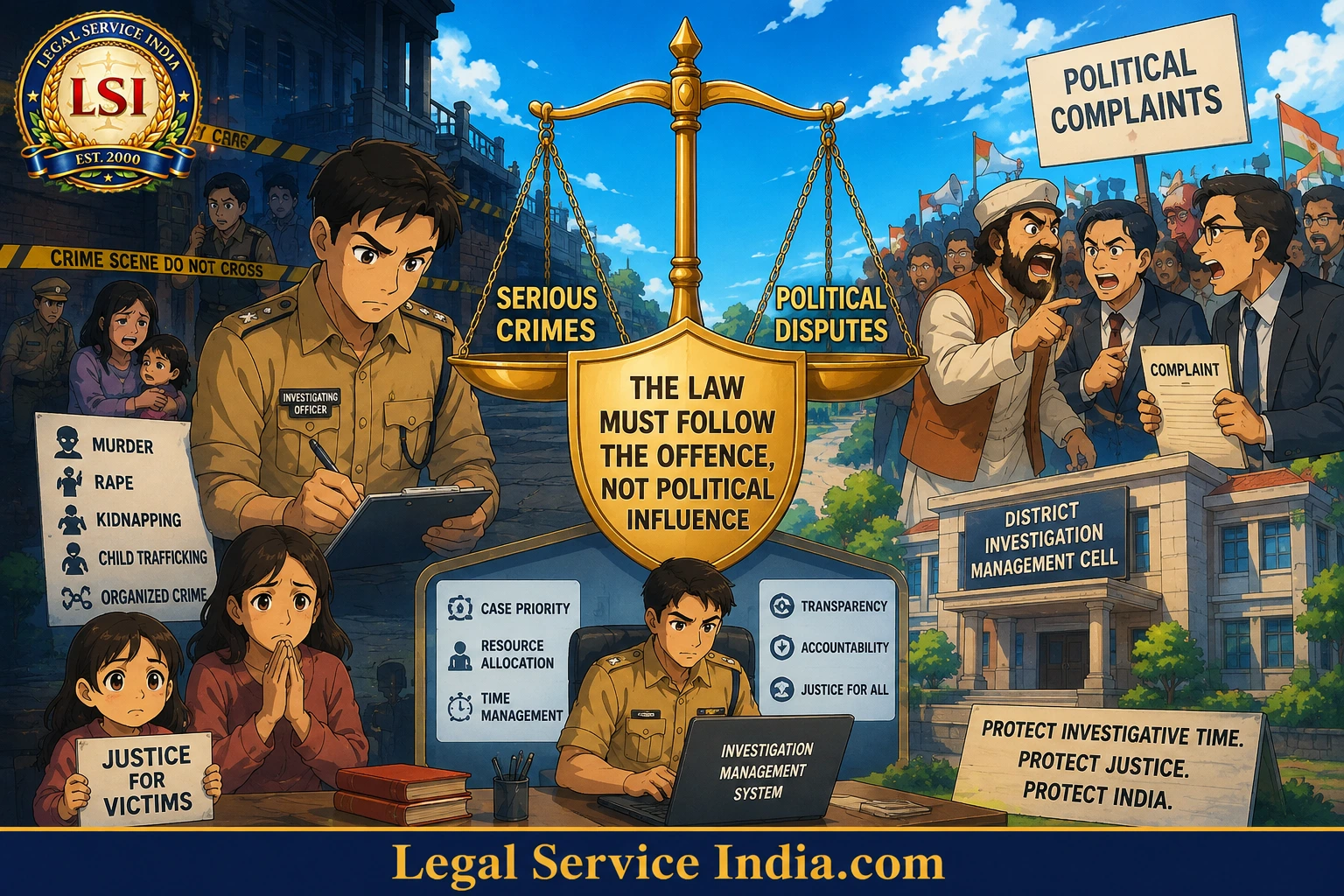
“The law must follow the offence—not the political influence of the person who complains.”
— Adv. Tarun Choudhury
There is a question that India needs to ask itself honestly: How much of our police investigative capacity is being consumed by politically charged complaints, counter-complaints, public-order disputes and criminal proceedings arising from political confrontations, while investigators are simultaneously struggling to deal with murder, rape, kidnapping, trafficking and crimes against children?
Protecting India’s Investigative Capacity
This is not an argument against the right of any political party, organisation or citizen to approach the police.
It is not an argument that complaints filed by political parties are false.
And it certainly cannot become an argument that a complaint should receive less protection because the complainant belongs to a particular political ideology or organisation.
The real issue is different.
India has a scarce investigative resource, and that resource must be intelligently protected and allocated.
A police investigator who is occupied for days examining competing political allegations, collecting social media material, examining speeches, recording statements from dozens of political workers and dealing with repeated counter-complaints is not available during those hours to investigate a rape, murder, kidnapping or organised crime case.
That is not merely an administrative inconvenience.
It can become a question of public safety and access to justice.
And therefore, I believe India should resist the temptation to create a separate “Political FIR Department”.
Instead, India should create something far more neutral, practical and constitutionally defensible:
A Protected Serious Crime Investigation System
supported by a small
District Investigation Management Cell.
The distinction may appear technical.
It is not.
It goes to the heart of how a constitutional democracy should organise its police force.
The Problem Is Not Political Complaints. The Problem Is Misallocation of Investigative Capacity
Every citizen has the right to approach the police.
A political worker has that right.
A political party has that right.
A journalist has that right.
An activist has that right.
An ordinary citizen has exactly the same right.
If information discloses a cognisable offence, the law cannot be selectively applied according to the political identity of the complainant.
The mistake would therefore be to frame the problem as:
“Political FIRs are a nuisance and should be sent somewhere else.”
That formulation is both legally dangerous and politically unsustainable.
The better question is:
“How should the State protect its limited investigative capacity so that the investigation of grave offences is not unnecessarily disrupted by high-volume, repetitive, politically sensitive or public-order-related litigation?”
That is a completely different question.
It is also a question that can be answered without discriminating against anybody.
The Police Investigator Is a Scarce Public Resource
We often discuss police shortages by counting police officers.
But there is another way of looking at the problem.
Consider an investigating officer.
His or her time is finite.
There are only twenty-four hours in a day.
If that officer spends six hours responding to a political dispute, those six hours cannot simultaneously be spent:
- visiting a crime scene;
- examining CCTV footage;
- questioning witnesses;
- locating an accused;
- collecting forensic evidence;
- tracing a missing child;
- recording a victim’s statement;
- examining call records;
- coordinating with forensic experts.
The State, therefore, has an invisible currency:
Investigative Time.
India rarely discusses policing in these terms.
We should.
The question should not merely be:
How many FIRs are pending?
It should also be:
How many investigative hours are being consumed, by what category of cases, and at what cost to more serious investigations?
That is the beginning of intelligent police administration.
The Supreme Court Had Already Identified Part of the Problem
India does not need to start from zero.
In Prakash Singh v. Union of India, the Supreme Court directed, among other reforms, the separation of investigation from law-and-order functions.
The logic was straightforward: investigation requires specialisation, continuity and expertise, whereas law-and-order policing has a different operational character.
The Court’s concern remains remarkably relevant today.
If an investigating officer is constantly pulled away from the investigation for:
- political rallies;
- demonstrations;
- VIP duties;
- law-and-order deployment;
- miscellaneous administrative work;
- politically sensitive disputes,
Then formal separation on paper becomes meaningless.
The real question is therefore not merely:
Have we separated investigation from law and order?
It is:
Have we protected investigators after separating them?
That is where India’s next police reform should begin.
Why I Would Reject a “Political FIR Department”
At first glance, the proposal sounds attractive.
Create a special police department for politically motivated FIRs.
Send political complaints there.
Let the ordinary police concentrate on serious crime.
The difficulty is obvious.
Who decides what is “political”?
Suppose a BJP worker alleges assault by opposition workers.
Suppose an opposition worker alleges the same thing against BJP workers.
Suppose an RSS worker is attacked.
Suppose a journalist is threatened by political activists.
Suppose a political leader is genuinely murdered.
Suppose a political rally becomes the scene of serious violence.
Are these all “political cases”?
And who decides?
The government of the day?
The police?
A minister?
A senior bureaucrat?
A committee?
Every answer creates a possibility of manipulation.
A government could classify inconvenient cases as “political” and deprioritise them.
An opposition government could do precisely the same thing in reverse.
That would transform police reform into political engineering.
I would therefore reject the concept of a political FIR department.
Not because the underlying problem is imaginary.
But because the proposed institutional solution is vulnerable to abuse.
The Better Idea: Protect the Serious Crime Investigator
Instead of creating a police department for political cases, create a system that protects investigators handling grave offences.
Call it:
Protected Serious Crime Investigation System — PSCIS
The principle should be simple:
Once an investigator is assigned to a grave offence, that investigative capacity should ordinarily be protected from routine diversion.
The system should cover cases such as:
| Serious Crime Category | Investigative Priority |
|---|---|
| murder | Highest protection |
| rape | Highest protection |
| gang rape | Highest protection |
| kidnapping | Highest protection |
| trafficking | Highest protection |
| serious offences against children | Highest protection |
| terrorism | Highest protection |
| organised violent crime | Highest protection |
| offences involving an immediate threat to life | Highest protection |
| other offences specifically designated by the State | As designated by the State |
The exact list can be prescribed by the State after examining its crime profile.
The important point is that the protection attaches to the seriousness of the crime—not to the political identity of the victim, accused or complainant.
A Murder Does Not Become Less Serious Because Politics Is Involved
This principle must be hard-wired into the system.
Imagine that a political worker is murdered.
That is not a “political case” in the sense of reduced investigative priority.
It is a murder.
It should receive the highest investigative protection.
If a journalist is murdered, it is a murder.
If an activist is murdered, it is a murder.
If a police officer is murdered, it is a murder.
If an ordinary citizen is murdered, it is a murder.
The State must investigate all of them according to the same objective principles.
Therefore:
The system must protect offences, not identities.
That sentence should become the philosophical foundation of the reform.
Then What Happens to Politically Sensitive Complaints?
They do not disappear.
They do not lose their legal status.
They do not automatically become “frivolous”.
They remain subject to the ordinary criminal law.
If the information discloses a cognisable offence, the statutory framework governing FIR registration must be followed.
The important change comes after the legal registration decision.
The matter is then assessed for:
- seriousness;
- immediate threat;
- victim vulnerability;
- risk of evidence disappearing;
- organised criminal activity;
- complexity;
- public-order implications;
- duplication;
- counter-complaints;
- investigative workload.
The political identity of the complainant should not be a priority criterion.
Enter the District Investigation Management Cell.
I propose a small:
District Investigation Management Cell — DIMC
This should not become another giant police bureaucracy.
It should not become another crime branch.
It should not conduct every investigation.
It should not decide guilt.
It should not decide whether a political party is telling the truth.
Its role should be much narrower:
Manage investigative capacity.
The DIMC Should Have Five Principal Functions
- Protect Serious Investigations Ensure that officers investigating grave offences are not routinely diverted.
- Identify Duplicate And Related Complaints Detect situations where several complaints arise from substantially the same incident.
- Monitor Investigator Workload Identify investigators carrying unreasonable numbers of cases.
- Monitor the Diversion Record when investigators are pulled away from serious investigations for other duties.
- Escalate Problematic Cases Identify cases suffering from unexplained delay, repeated transfers, conflicts or unusual interference.
That is enough.
The smaller the institution, the less opportunity there is for it to become another bureaucratic monster.
One Incident Should Not Produce Five Parallel Investigations
This may be one of the most practical reforms.
Imagine a political confrontation.
- Party A files a complaint.
- Party B files a counter-complaint.
- Three supporters submit additional complaints.
- Another person approaches the police with another version of the same incident.
If every complaint results in completely independent investigative work, police resources can be multiplied unnecessarily.
The solution is not automatically to merge every FIR.
That could itself create legal problems.
Instead, the DIMC should create an:
Incident Cluster
The individual FIRs retain their legal identity where required.
But investigators can coordinate:
- chronology;
- witnesses;
- CCTV;
- forensic evidence;
- location data;
- medical records;
- digital evidence.
In other words:
Cluster the investigation administratively without unlawfully merging the criminal cases.
This is a much safer approach.
The “One Incident — One Evidence Map” Principle
I would go one step further.
Where several FIRs arise from substantially the same incident, the police should maintain a common:
Evidence Map
It should identify:
- what happened;
- when it happened;
- where it happened;
- who was present;
- what CCTV exists;
- which witnesses are common;
- what forensic evidence exists;
- which allegations overlap;
- which allegations are materially different.
Each FIR can then be legally dealt with according to its own facts.
But police should not repeatedly rediscover the same evidence.
This is basic efficiency.
Three Categories Are Enough
The system should not become an academic scoring exercise.
I would use three simple investigative levels.
| Level | Classification | Purpose |
|---|---|---|
| RED | Protected Investigation | For grave or high-risk offences. These cases receive protected investigative capacity. |
| AMBER | Enhanced Supervision | For cases involving serious complexity, organised group activity, significant public-order consequences, major economic offences, repeated violent conflict or unusually high evidentiary demands. These receive periodic senior review. |
| GREEN | Normal Investigation | Ordinary cases proceed through the normal system. |
The classification is not a statement about the guilt or innocence of anyone.
It is a resource-management decision.
Political Sensitivity Must Never Reduce Priority
There should be an explicit rule:
Political sensitivity shall never by itself reduce the investigative priority of a criminal case.
In fact, where political involvement creates a greater threat to life or public order, the case may require greater, not lesser, investigative attention.
This prevents the system from becoming a political dumping ground.
A Serious Crime Investigator Should Not Be Sent to Every Political Rally
Here lies one of the biggest practical gains.
Suppose Inspector X is investigating a rape.
There is a political demonstration in the district.
There are other officers available.
Inspector X should not automatically be pulled away because of administrative convenience.
If there is a genuine emergency requiring the officer’s deployment, that should be possible.
But it should require:
- senior authorisation;
- written reason;
- duration;
- alternative investigator arrangement.
This creates what I would call:
Investigation Assignment Lock
Not an absolute prohibition.
A controlled exception.
That is practical.
The Rule Should Be Simple
If a serious-case investigator is diverted:
The system asks:
- Why?
- For how long?
- Who authorised it?
- Who is now investigating the serious case?
- What investigative task was delayed?
That creates accountability without preventing legitimate emergency deployment.
We Do Not Need Artificial “Investigation Hour Budgets”
I would reject another tempting idea.
It sounds attractive to say:
| Offence | Illustrative Investigation Hours |
|---|---|
| Murder | 1,000 hours |
| Rape | 500 hours |
| Political Complaint | 50 hours |
But policing is not factory production.
Some murders are straightforward.
Some are extraordinarily complex.
Some apparently minor cases become serious conspiracies.
Therefore, the State should not impose rigid investigative-hour quotas.
Instead, for the pilot, simply record:
How many investigator-hours are actually being consumed?
After six months, the State will have real data.
That is far better than guessing.
The Invisible Measure India Needs: Investigative Capacity
Imagine two districts.
Both have:
- 100 investigators.
District A has investigators spending 80% of their time on actual investigation.
District B has investigators spending 40% of their time investigating and the remaining 60% on miscellaneous duties.
Official manpower statistics might say both districts have:
- 100 investigators.
Operationally, they are not equivalent.
That is why I propose measuring:
Protected Investigative Capacity
How much of the available investigative workforce is actually available for investigation?
That number should be reported every month.
The District Police Dashboard
Every DGP, Commissioner and SP should eventually be able to see:
Serious Crime
- murders pending;
- rape investigations pending;
- kidnapping cases pending;
- child-protection cases pending;
- Organised crime investigations pending.
Investigation Capacity
- investigators available;
- investigators protected;
- investigators diverted;
- average cases per investigator.
Political/Public-Order Work
- number of related complaints;
- counter-complaint clusters;
- repeated complaints;
- investigator-hours consumed.
Quality
- investigation delays;
- forensic delays;
- charge-sheet timelines;
- cases returned for defective investigation;
- court-related investigation deficiencies.
The police leadership would then know not simply:
How many cases exist?
but:
where its investigative capacity is actually going.
This Reform Should Be Politically Neutral by Design
This is perhaps the most important feature.
The police system should not create categories such as:
BJP Case.
Congress Case.
RSS Case.
Bajrang Dal Case.
Left Case.
Activist Case.
Journalist Case.
Those labels are invitations to bias.
Instead, the system should use neutral descriptors:
- election-related;
- public-order related;
- multiple counter-complaints;
- mass gathering;
- organised group involvement;
- repeat complaint;
- related proceeding;
- high public sensitivity.
And even these classifications should not determine guilt.
They are simply management flags.
A Constitutional Firewall
The government notification creating the system should contain an explicit safeguard:
No complaint shall be classified, delayed, downgraded or otherwise treated differently merely because of the political affiliation, ideological association, profession, public profile or identity of the complainant or accused.
And another:
No classification under the investigative management system shall extinguish, suspend or dilute any statutory right or obligation relating to registration, investigation, victim protection, arrest, prosecution or judicial remedy.
These provisions would make the reform considerably harder to weaponise.
What About False and Malicious Complaints?
This problem should also be handled neutrally.
Not every failed case is a false case.
Not every acquittal proves malicious prosecution.
A complainant may genuinely believe something happened, and yet the prosecution may ultimately fail.
The criminal law already recognises consequences for making false charges with intent to injure.
The answer is therefore not to frighten people away from approaching the police.
The answer is to identify deliberate and demonstrably malicious misuse through ordinary legal processes.
Technology Should Come Later
Another mistake would be to begin this reform with an expensive AI project.
The first pilot can use existing systems.
India already has CCTNS and the Interoperable Criminal Justice System architecture connecting different parts of the criminal justice system.
Start with what already exists.
Only after the process works should technology be added to:
- identify duplicate complaints;
- detect common names;
- identify related incidents;
- map cases;
- track investigator workload;
- identify unusual transfers;
- generate supervisory alerts.
AI should never determine:
“This person is guilty.”
Nor should an algorithm determine:
“This political complaint is false.”
Technology should assist administration, not replace legal judgement.
A 90-Day Pilot Is Enough to Start
I would not recommend beginning with a nationwide scheme.
Select one district.
For the first thirty days:
Do Nothing Differently
Measure.
Record:
- number of investigators;
- number of serious cases;
- number of political/public-order cases;
- investigator-hours;
- diversion;
- duplicate complaints;
- delays.
That becomes the baseline.
Days 31–60
Introduce:
- RED protected investigations;
- incident clustering;
- serious-case investigator roster.
No elaborate technology.
No new bureaucracy.
Days 61–90
Add:
- investigation assignment lock;
- weekly workload review;
- diversion reporting.
Then compare the results against the baseline.
Better still, select a comparable district as a control.
That would turn a political argument into an empirical experiment.
The Pilot Should Be Allowed to Fail
A genuine reform does not predetermine success.
The government should abandon or redesign the scheme if:
- serious-crime investigation does not improve;
- Investigators spend more time on paperwork;
- political bias increases;
- Victims face greater difficulty;
- duplicate investigation does not decline;
- Investigators are still routinely diverted;
- Courts identify legal problems.
The purpose of a pilot is to discover whether the reform works.
Not to produce a press release.
Who Will Oppose This Reform?
There will be resistance.
Some political actors may dislike losing informal influence over investigators.
Some police officers may dislike additional accountability.
Some bureaucrats may dislike workload transparency.
Some administrators may argue:
“We have always managed it this way.”
But institutional convenience cannot be the measure of justice.
The question is:
Does the system produce better investigation?
If it does, it deserves to survive.
If it does not, change it.
The Reform Must Also Protect the Police Officer
There is another side of this debate that deserves attention.
A police officer who refuses political pressure may fear:
- transfer;
- disciplinary action;
- loss of posting;
- adverse reporting.
Therefore, the reform should protect not only the investigation but also investigative continuity.
If an investigator handling a serious case is transferred, the system should record:
- who authorised the transfer;
- why;
- stage of investigation;
- pending investigative tasks;
- identity of replacement officer.
This does not prohibit transfers.
It creates accountability for them.
The Real Reform Is Not Anti-Political
This point deserves emphasis.
Political parties are part of democracy.
Political activism is part of democracy.
Protests are part of democracy.
Public criticism is part of democracy.
Criminal law can legitimately become involved when conduct crosses the statutory threshold.
The objective is therefore not:
to keep politics out of the police station.
That is impossible.
The objective is:
to keep political influence from determining the allocation of investigative justice.
That is entirely different.
The Golden Rule
If I were drafting the policy, I would put one principle at the top:
Crime Severity, Not Political Influence, Determines Investigative Priority.
A politically powerful complainant should not receive unlimited police resources.
A politically unpopular complainant should not receive less protection.
A serious crime should receive serious investigation.
That is the balance a constitutional democracy requires.
What India Should Actually Ask the Government to Do
I would therefore not ask the Union Government or State Government to create a:
“Political FIR Department.”
I would ask it to implement the following:
Protected Serious Crime Investigation System
with a:
District Investigation Management Cell.
The system should have four pillars:
| Pillar | Purpose |
|---|---|
| First — Protect investigation | Investigators handling grave crimes should ordinarily remain dedicated to those investigations. |
| Second — Manage duplication | Related and repetitive complaints should be administratively clustered so that police do not repeatedly investigate identical facts. |
| Third — Measure capacity | The State should measure actual investigative manpower and investigator-hours. |
| Fourth — Guarantee political neutrality | Political affiliation must never itself determine investigative priority. |
Ten Immediate Steps
The reform can begin tomorrow without waiting for a constitutional amendment.
- Select one district for a 90-day pilot.
- Create a small District Investigation Management Cell from existing personnel.
- Identify RED-category serious investigations.
- Create a protected investigator roster.
- Record every diversion of a serious-crime investigator.
- Create a related-complaint/incident-cluster register.
- Measure actual investigator-hours for different categories of work.
- Introduce written authorisation for diversion or transfer of protected investigators.
- Publish an independent pilot evaluation.
- If successful, expand gradually to additional districts.
Conclusion: Protect the Police From the Politics of Police Work
India’s criminal justice system does not suffer merely because there are too many FIRs.
It suffers when scarce investigative capacity is badly allocated.
The answer is not to tell a political party that it cannot complain.
The answer is not to tell an ordinary citizen that a politically sensitive matter will not be investigated.
And the answer certainly is not to create a new political police department whose composition and priorities can change with every government.
The answer is more principled.
- Register lawfully.
- Investigate fairly.
- Prioritise objectively.
- Protect serious investigations.
- Consolidate investigative effort where facts overlap.
- Record every diversion.
- Measure the workload.
- Audit the system.
A murder investigation should not wait because an investigator has been pulled into a political dispute.
A rape investigation should not lose valuable time because the investigating officer has been deployed for a political demonstration.
A missing child should not compete for investigative attention with a chain of repetitive counter-complaints.
And at the same time, a genuine offence committed by or against a political worker must receive exactly the same protection as an offence committed against anyone else.
That is not anti-politics.
That is pro-justice.
The Ultimate Test of Police Reform
The ultimate test of police reform should therefore be very simple:
When a woman reports rape, when a family reports murder, when a child goes missing, or when a citizen faces a serious criminal threat, does the State have an investigator available to act immediately?
If the answer is no because the State has allowed its investigative officers to be endlessly consumed by avoidable work, then the problem is not merely police shortage.
It is institutional design.
India should now redesign that system.
Not by creating a political FIR department.
But by creating a Protected Serious Crime Investigation System, backed by a lean District Investigation Management Cell, with one principle permanently embedded in its architecture:
The law must follow the offence—not the political influence of the person who complains.
Need Experienced Legal Guidance?
Adv. Tarun Choudhury
Supreme Court Advocate | 25+ Years of Legal Experience
For professional legal consultation and guidance on complex legal matters, constitutional issues, criminal law, police reforms, litigation and public-interest concerns:
- 📞 Call: 9650499965
- 💬 WhatsApp: 8851978611
When the law matters, experience matters.
Frequently Asked Questions (FAQs)
1. What Is a Protected Serious Crime Investigation System in India?
A Protected Serious Crime Investigation System (PSCIS) is a proposed police reform designed to protect investigators handling serious offences such as murder, rape, kidnapping, trafficking and crimes against children from unnecessary diversion to routine law-and-order or politically sensitive matters. The objective is to improve investigation speed, continuity and quality.
2. Why Should India Not Create a Separate Political FIR Department?
A separate political FIR department could create serious concerns about political bias and selective policing. It could be misused by the government of the day to classify inconvenient complaints as politically motivated.
A better approach is to treat every complaint equally while allocating investigative resources according to crime severity, victim vulnerability, evidence risk and public safety, rather than political affiliation.
3. What Is a District Investigation Management Cell (DIMC)?
A District Investigation Management Cell (DIMC) is a proposed small police-management unit that would monitor investigative workload, identify duplicate or related complaints, protect serious-crime investigators from unnecessary diversion, monitor delays and improve allocation of police investigative resources.
It would not decide guilt, suppress FIRs or discriminate against political complaints.
4. How Can India Prevent Politically Motivated FIRs From Overburdening the Police?
India can address the problem through investigative triage, case clustering, workload monitoring and protected investigation.
Multiple complaints arising from the same political incident can be administratively linked for evidence and resource management without automatically merging separate FIRs.
Serious offences should receive priority based on objective criteria rather than the political identity of the complainant or accused.
5. How Can Police Reforms Protect Serious Crime Investigations From Political Interference?
Police reforms can create Protected Investigation Status, requiring senior-level written authorisation when an investigator handling a serious crime is diverted or transferred.
A digital audit trail can record who authorised the diversion, why it occurred, how long it lasted and who took over the investigation.
This can strengthen police accountability, investigative independence and criminal justice efficiency while preserving legitimate government supervision.
Key Takeaways: Protected Serious Crime Investigation System
- India does not need a separate “Political FIR Department”. Such a department could create risks of political bias, selective investigation and misuse of police powers.
- The better solution is a Protected Serious Crime Investigation System (PSCIS) that protects police investigators handling murder, rape, kidnapping, trafficking, crimes against children and other grave offences from unnecessary diversion.
- Investigative capacity is a scarce public resource. When police investigators spend excessive time handling politically sensitive complaints, counter-complaints and repetitive public-order disputes, less time remains for serious criminal investigations.
- The proposed District Investigation Management Cell (DIMC) would manage police investigative resources rather than decide guilt or suppress complaints.
- The DIMC could identify duplicate, repetitive and related complaints arising from the same incident, allowing police to coordinate investigative work without automatically merging separate FIRs.
- Political affiliation should never determine investigative priority. The same standards must apply to BJP, Congress, RSS, Bajrang Dal, other political organisations, journalists, activists and ordinary citizens.
- The guiding principle should be: “Crime severity, not political influence, determines investigative priority.”
- Serious cases should receive Protected Investigation Status, while other cases can be managed through enhanced supervision or normal investigation according to objective risk.
- Any diversion or transfer of an investigator handling a serious crime should require recorded senior-level authorisation, creating accountability and reducing the possibility of improper interference.
- India should measure actual investigator workload and investigative hours, rather than relying only on the number of pending FIRs.
- The reform should build upon the Supreme Court’s police-reform framework in Prakash Singh v. Union of India, particularly the principle of separating investigation from law-and-order functions.
- Technology should support—not replace—police and judicial decision-making. Existing CCTNS/ICJS infrastructure can initially support case tracking, duplicate detection and workload monitoring without requiring an expensive AI system.
- The most practical approach is a 90-day pilot in one district, followed by independent evaluation and comparison with a similar control district.
- The pilot should measure serious-crime investigation delays, investigator diversion, workload, duplicate investigations, investigative continuity and quality of investigation.
- The ultimate objective is simple: protect India’s limited police investigative capacity so that a murder, rape or missing-child investigation does not lose valuable time because investigators are continuously diverted to avoidable or repetitive work.
Summary
India should replace the idea of a political FIR department with a politically neutral Protected Serious Crime Investigation System and District Investigation Management Cell that prioritise serious crimes, prevent investigative duplication and protect police investigators from unnecessary diversion.