





Abstract
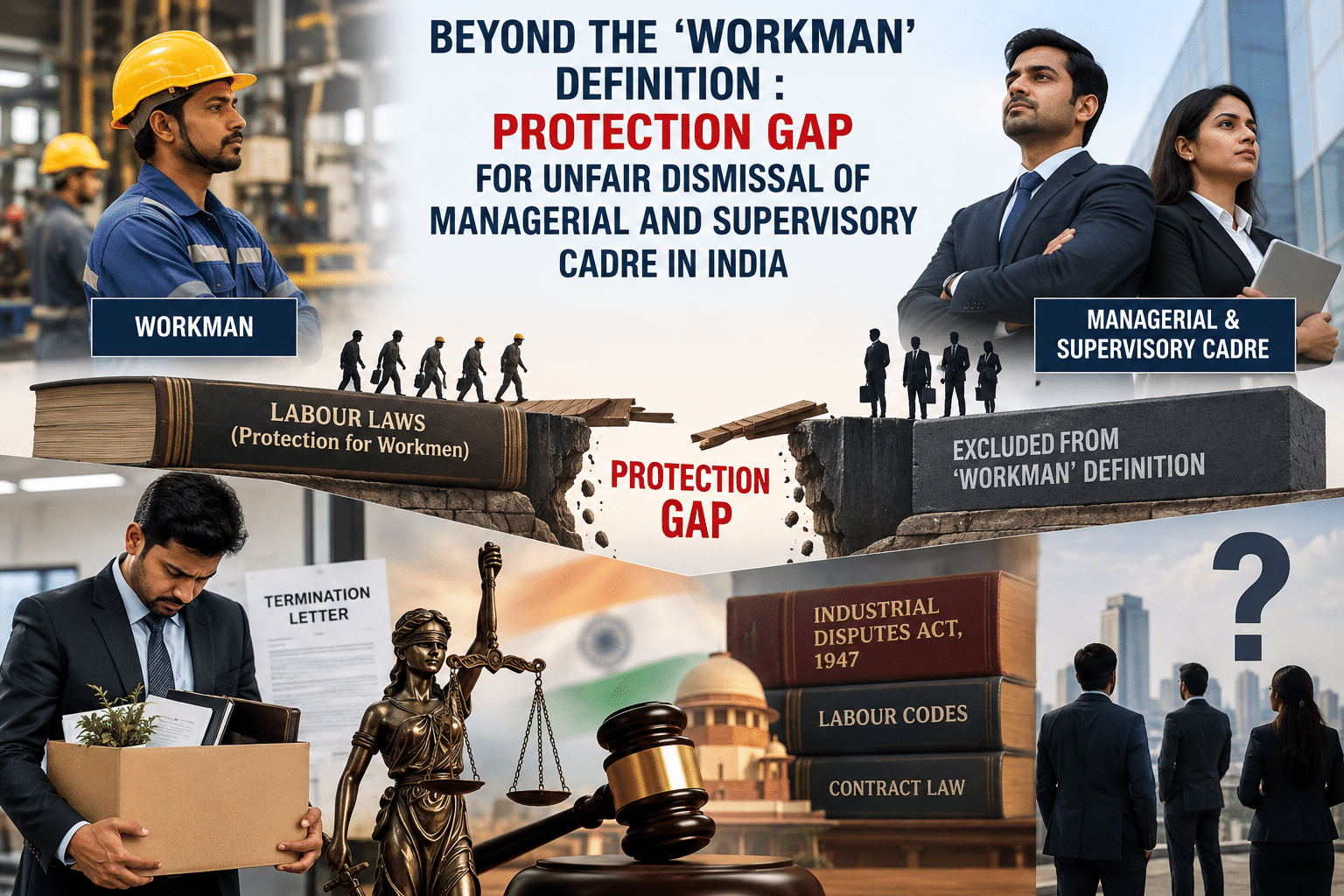
One of the critical issues of Indian labor law is the distinction between employees who fall into the statutory category of “worker” and those who mainly exercise managerial, administrative, or supervisor roles. The distinction is important because those who do not fall under the statutory definition of a worker may not qualify for the same industrial relation remedies and protection as workers.
The study examines legal protection for managerial and supervisory employees in India who face unfair dismissals. The study looks at Section 2(zr) of the Industrial Relations Code, 2020 (IR Code), and the concept of “workman” under the Industrial District Act 1947. The study looks at whether the document highlights the central issue of whether employees who are excluded from the legal definition have a legal option if they lose their jobs.
The study uses the doctrinal and analytical research methodology to examine the statutory framework, the difference between managerial, supervisory, and worker categories, relevant cases including HR Adyanthaya V. Santosh (India) Ltd., S.K. Maini V. Carona Sahu Co. Ltd., and Mukesh K. Tripathi, and the available contractual, civil statutory, and public law remedies to exclude employees. The study examines both sides of the issue and suggests a balanced approach, which could provide basic procedural protections to certain managerial and supervisory employees. This would clearly differentiate senior management from lower-level managers and supervisory employees while focusing on fair procedures rather than guaranteeing that an employee will continue in the job.
Introduction
Employment is one of the most important relationships in modern economic and social life. Employees depend on their job for income, career growth, social security, and a sense of personal dignity, while employers need enough managerial flexibility to run their organization effectively and respond to changing business needs.
Termination of employment is therefore one of the most sensitive areas of labor law and humor resource management. An employee may lose their job for reasons such as misconduct, poor performance, redundancy, restructuring, business closure, technological change, or other valid business reasons. Meanwhile, termination may be arbitrary, discriminatory, retaliatory, or procedurally unfair.
Indian labor law has traditionally dealt with this issue by placing employees into different legal categories. The historical concept of “workman” under the Industrial Disputes Act, 1947, played a central role. The Contemporary Industrial Relations Code, 2020, refers to “worker” and excludes those employed mainly in managerial and administrative and certain supervisory roles. The supplied research document highlights this distinction as the main issue of the study. The problem that is particularly interesting is classified as a ‘manager’ or ‘supervisor’ but does not possess substantial authority. Many organizations contain several levels of management:
- Senior executive
- General manager
- Departmental manager
- Assistant manager
- Team leader
- Supervisor
- Front-line supervisors
Employees have different levels of decision-making power and bargaining ability. Therefore the main question is not simply:
“Is the employee called manager?”
- What work does the employee actually perform?
- What authority does the employee possess?
- Does the employee exercise managerial or administrative functions?
- Does the employee supervise other employees?
- How much independent decision-making power does the employee have?
- What legal options does an employee have if they are dismissed?
Background Of The Study
The research topic was selected because the question of protection and availability to managerial/supervisory employees talked about more than worker protection.
The research material explained that employees falling under the statutory definition of ““ “workman,” now “worker,” may receive worker-specific remedies concerning industrial disputes and termination, while those exercising managerial or supervisory responsibility may fall outside their definition.
The research material highlights the relevance because:
- Managerial/supervisory employees may not receive the same worker-specific remedies;
- Modern employment relationships are changing;
- The Industrial Relations Code, 2020, has changed the statutory framework;
- There may be an up protection gap;
- Contract-based remedies may not always give employees the same level of protection as legal remedies.
Statement Of The Problem
The central problem of the research is the protection between workers and managerial/supervisory employees.
And employees qualifying as statutory workers may have access to specific legal mechanisms concerning industrial disputes. Yet an employee outside the definition may depend on:
- The employment contract;
- Applicable state employment legislation;
- Civil law remedies are better maintainable;
- Constitutional/public-law remedies in appropriate cases;
- Internal grievance mechanisms.
The research examines what legal options employees have if they are not covered by the statutory definition and whether this leaves them with less protection. The problem is more complicated because not every managerial employee has the same bargaining power. A senior executive may negotiate substantial contractual benefits while a junior manager may have limited ability to negotiate employee terms. Therefore, a uniform exclusion may create difficulties in situations where formal managerial status does not necessarily correspond to actual managerial power.
Research Gap
The research cap focus is on the connection between an employee’s legal status and the actual level of job protection.
Traditional labor law tends to distinguish workers from managers and supervisors based on state statutory categories.
However, modern organizations have developed complex-level management and authority:
- Employee → possible responsibility
- Senior executive → strategic policy and organizational decision
- General manager → department management
- Assistant manager → limited managerial responsibility
- Team leader → operational coordination
- Supervisor → monitoring and directing workers
- Workers → technical and operational duties
The legal impact of these different roles may not always match the employees’ job titles. Therefore, further research is needed to examine whether the current framework adequately distinguishes:
- Genuine senior management;
- Middle management;
- Junior management;
- Supervisory personal;
- Employee with limited authority.
Aim Of The Research
The primary aim of day research is to examine legal protection available to managerial/supervisory employees against unfair dismissal in India and to determine exclusion from the statutory definition of ‘worker’ and create a protection gap.
Objectives of Research
- To understand the meaning and scope of ‘worker’ under the Industrial Relations Code, 2020.
- To understand the historical concept of ‘workman’ under the Industrial Disputes Act, 1947.
- To examine the exclusion of managerial/administrative employees.
- To examine the position of supervisory employees.
- To analyze judicial approaches to classification.
- To examine H.R. Adyantha v. Sandoz (India) Ltd..
- To examine S.K. Maini v. Carona Sahu Co. Ltd.
- To examine Mukesh K. Tripathi.
- To identify remedies available to excluded managerial/supervisory employees.
- To analyze the concept of unfair dismissal.
- To examine whether a protection exists.
- To analyze arguments in favor of broader protection.
- To examine the argument against providing wider legal protection.
- To consider the issue from an HRD perspective.
- To propose a balanced legal framework.
Research Questions
- Why are managerial and certain supervisory employees excluded from the statutory definition?
- Who qualified as a worker under the industrial relation code 2020?
- What legal remedies are available to a worker when they are terminated?
- What remedies are available to managerial/supervisory employees outside the statutory definition?
- Does excluding certain employees from the statutory definition leave them with less protection against unfair dismissal?
- Should India provide employee moral legal protection against unfair dismissal?
- How can employee protection be balanced with the employee need for managerial flexibility?
Research Methodology
Research Design
- This is primarily a doctrinal legal research study.
- The study examines status, judicial decision, legal principle, employment contract, labor-law concept, and HRD implication.
The research mainly uses the Industrial Relations Code, 2020; the Industrial Disputes Act, 1947; employment-contract principles; state shop and establishment law; and relevant court decisions as important sources.
Nature of Research
The research is qualitative, doctrinal, analytical, conceptual, and comparative in limited respects; it does not claim to be an empirical survey.
Primary Sources
Include:
- Industrial Relation code 2020;
- Industrial Dispute Act, 1947;
- Judicial decision;
- Relevant employee legislation.
Secondary Sources
Includes:
- Labor-law journals;
- HRM Journals
- Legal commentaries;
- Academic books;
- ILO publication;
- Research articles.
Legal Framework
Industrial Dispute Act, 1947
The Industrial Dispute Act, 1947, is historically significant because the concept of ‘workman’ formed an important gateway to industrial rest with protection.
The supplied document specifically states that the Industrial Disputes Act should be examined for the definition of ‘workman’ and the historical evolution of the concept.
The historical framework is important because many judicial principals concerning employee classification were built around the workman definition.
Industrial Relations Code, 2020
The Industrial Relation Code, 2020 represents the contemporary statutory framework identified in the supplied material.
The key provision for this research Section 2(zr) concerning the definition of ‘worker’.
According to the supply document the definition excludes:
- Persons mainly employee in managerial capacity;
- Person mainly employee in administrative capacity;
- Certain supervisory employees.
The exclusion is central to the research problem.
Why Does Employee Legal Classification Important?
Classification is important because an employees legal rights and protection may depend on their status under the law.
Consider two employees: Employee A-machine operator Ho perform technical duties; Employee B- a department manager who makes staffing and disciplinary decision.
Their employment relationship with organization maybe similar in one respect they both receive salaries, but their legal classification maybe different. This can affect: industrial dispute remedies; termination procedures; available forums; available relief; reinstatement contractual protection.
Therefore, employee classification is not merely an HR designation; it may have legal consequences.
Managerial Employees
Managerial employees generally participate in activities such as: planning, organising, staffing, decision-making, supervision, performance management, implementation of organisational policy, resource allocation, disciplinary recommendations, departmental administration.
However, the word ‘Manager’ is not sufficient by itself to established the legal position.
For example: senior managers may posses-recruitment authority, disciplinary authority, budgetary authority, strategic decision-making authority. Junior manager may only- coordinate employees, prepare reports, monitor attendance, implement instruction.
Therefore, the actual function of the employ become important.
Supervisor Employee
Supervisors occupy and intermediate position. They may – allocate work, monitor performance, supervisory employees, report misconduct, prepare performance reports, co-ordinate shifts, enforce organisation procedures. However, every supervisor have not significant managerial power or decision-making authority. The raises a significant legal and HRD questions; ‘Should every employee will supervisory responsibility be treated in extreme the same way?’ The answer depends on the law and that applies enter employee actual duties.
Judicial Perspective
He supplied research material identify the following authority;
H.R. Adyanthaya V. Sandoz (India) Ltd.
The case is relevant to understanding the statutory concept of ‘workman’ and the importance of determining whether and an employee falls within the statutory definition. HR professionals should not depends only on an employees job title. This case should examines: authority, responsibility, reporting structure, decision -making power.
Mukesh K. Tripathi
The research material also identify Mukesh K.Tripathi as an important case related to the employ classification. Its significance for students is that an employees and title meant to label or protons and depends upon the employees satisfied the applicable statutory definition.
S.K. Maini V. Carona Sahu Co. Ltd.
This case is relevant to the distinction between managerial/supervisory work and other categories of employment. The case can be used to explain Why organisations should maintain: accurate job descriptions, reporting structures, delegated authority documents, performance records, clearly define managerial responsibilities.
What Is Unfair Dismissal?
Unfed dismissal can be maximum several dimensions:
Arbitrary Dismissal
Termination without a rational or legitimate basis.
Discriminatory Dismissal
Termination base on an unlawful discriminatory ground.
Retaliatory Dismissal
Termination concerned with an employee exercising a legal protection right or arising a leg limited complaint.
Procedurally Dismissal
Termination where an applicable of fair procedure has not been followed.
Contractually Improper Dismissal
When an employee is terminated in violation of the terms agreed upon in the employment contract.
The legal remedy depend on the applicable law and the fact of the case.
Remedies Available To Managerial And Supervisory Employees
Being excluded from the statutory definition does not necessarily mean that an employee has no legal remedies.
Contractual Remedies
An employment agreement may contain; notice provisions, termination clauses, compensation provisions, disciplinary procedures, grievance mechanisms.
Shops And Establishment Legislation
Depending on the State law and employee category some employment protection maybe available.
Civil Remedies
Civil remedies may apply depending on the nature of the employment relationship and fake after cases.
Constitutional/Public Law Remedies
In some situations, constitutional remedies may also be available, particularly where public- law issues are involved.
However, these remedies are not the same as the Labour-law remedies specifically available workers.
Internal Grievance Mechanism
Organisation may provide: grievance committees, HR review, appeal mechanisms, disciplinary review, mediation.
Why Many Alternative Legal Remedies Not Fully Solve A Problem?
A contractual remedy and a statutory labour remedy can be different in several respects.
| Factor | Worker Specific Stated A Mechanisms | Contractual Route |
|---|---|---|
| Source | Statute | Employment agreement |
| Coverage | Statutory | Contract specific |
| Procedure | Statutory framework | Contract/court-dependent |
| Forum | Depends on statue | Depend on claim |
| Remedies | Statutorily determined | Contract/legal principles |
| Protection | Potentially broader | Potentially narrower |
| Bargaining power | Statutory minimum | Depends on contract |
Therefore, the existence of a contract does not automatically mean that an employee has equivalent protection.
Argument In Favour Of Broader Protection
The research material phrase and several argument in favour of providing broader protection.
Fairness
Manager and supervisor can also face unfair termination. Minimum procedural protection can help promo fairness.
Protection Against Arbitrary Action
Requiring employers to give clear reason and follow a proper process can help prevent arbitrary decision.
Protection Against Discrimination
Broader protection can strengthen safeguard against discriminatory dismissal.
Bargaining Power
Not every manager has strong bargaining power. Junior Manager may depends heavily on continued employment.
Organizational Trust
Fair procedures may increase employee confidence in HR systems.
Better HR Governance
Clear procedures can encourage: documentation, consistency, transparency, accountability.
Arguments Against Broader Protection
Research material gives reasons for providing product protection.
Managerial Responsibility
Manager may represent the interest of the employer and exercise authority over other employees.
Organizational Flexibility
Businesses may need to: restructure, replace managers, change leadership, reorganize departments.
Performance Management
Employer should have enough flexibility to deal with actual case of poor performance.
Ligation Costs
Giving broader legal protection may lead to more employment related disputes.
Literature Review
H.R. Adyanthaya V. Sandoz (India) Ltd.
The case highlights that an employee’s actual duties and functions are important in determining whether the employee falls within the statutory definition of a worker. Job designation alone is not sufficient.
S.K. Maini V. Carona Sahu Co. Ltd.
This case is relevant to distinguishing managerial and supervisory employees from other employees. It emphasizes the importance of examining the employee’s actual responsibilities and authority.
Mukesh K. Tripathi
The case is relevant to employee classification and supports the principle that an employee’s legal status depends on the applicable statutory definition rather than merely the job title.
Industrial Disputes Act, 1947
The literature shows that the concept of “workman” under the Act historically determined access to important industrial-relations protections and remedies.
Industrial Relations Code, 2020
The Code continues the distinction between workers and persons mainly employed in managerial, administrative and certain supervisory capacities. This creates an important issue concerning protection against unfair dismissal.
Discussion
The research material supports conclusion that exclusion from the statutory worker definition may create a protection gap while also recognizing that excluded employees may have other remedies. The central issue is therefore one of degree and accessibility of protection rather than complete absence of law.
The most difficult category is likely to be lower and middle management. Senior executives may have substantial contractual protection and bargaining capacity. Lower-level managers may not. This distinction show the need to consider a more flexible legal approach.
The proposed hybrid approach would maintain the difference between workers and managers while setting minimum procedural standards for certain managerial and supervisory employees. Such an approach could help reduce unfair decision-making without stopping organisation from making legitimate change.
Policy Implications
The research has several policy implications.
- First, employee roles and legal categories should be easy to understand so that there is less confusion.
- Second, The law should focus on an employees actual managerial authority rather than just their job title.
- Third, minimum procedural safeguards could be considered for employees who are outside worker status but remain comparatively vulnerable.
- Fourth, employers should h

