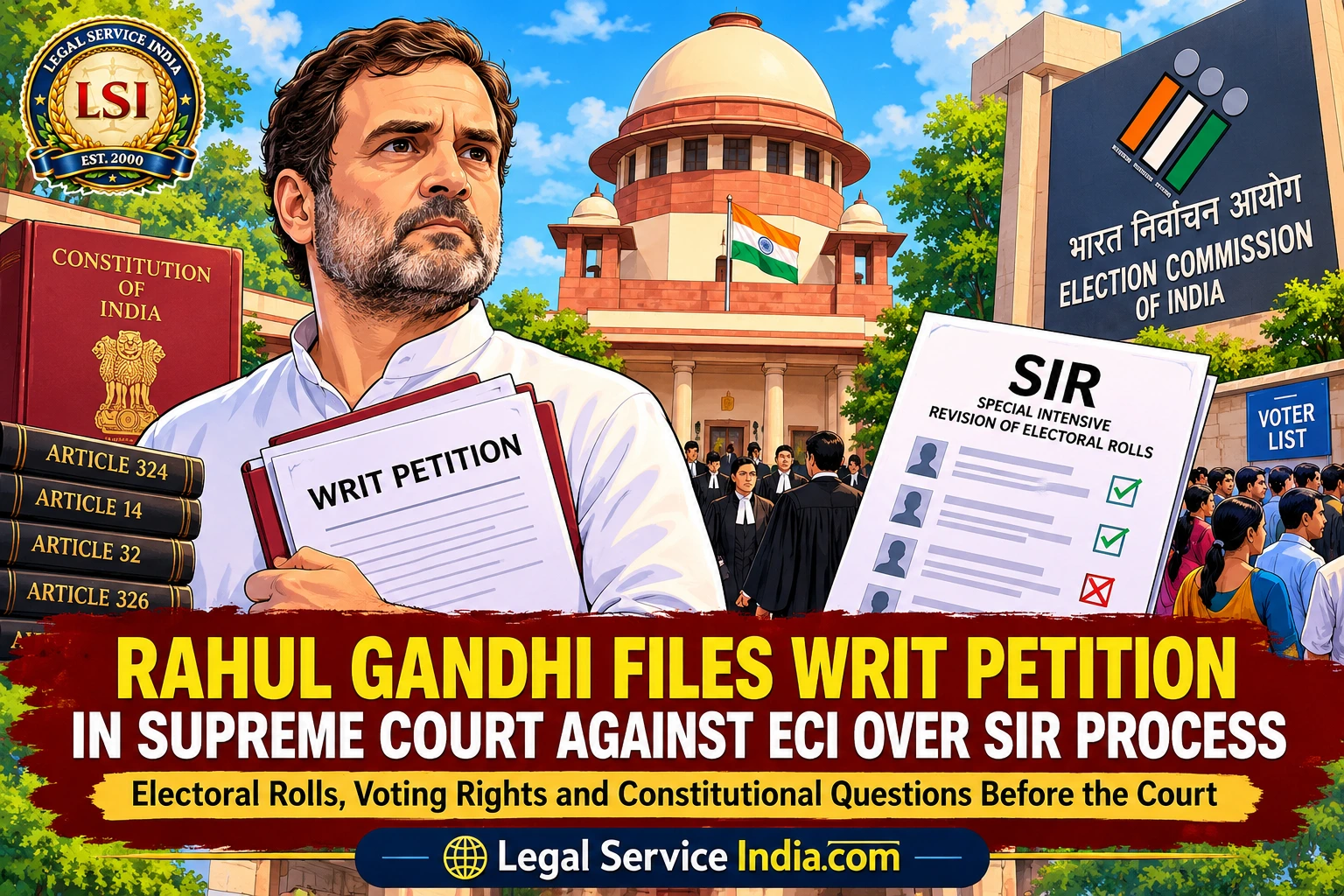
Rahul Gandhi Files Writ Petition in Supreme Court Against ECI Over SIR: Voting Rights and Constitutional Issues Explained
Legal Update | 12 October 2026
The controversy surrounding the Special Intensive Revision (SIR) of electoral rolls has entered a significant new phase, with Congress leader and Leader of the Opposition in the Lok Sabha Rahul Gandhi approaching the Supreme Court of India over concerns relating to the Election Commission of India’s functioning and the conduct of the electoral-roll revision exercise.
The development comes amid growing political opposition to the SIR process, questions surrounding the administration of electoral rolls, and demands for greater institutional accountability from the constitutional authority responsible for conducting elections in India.
The filing assumes considerable significance because electoral-roll revision is not merely an administrative exercise. It determines who is included in the electoral process and, consequently, who can exercise the right to vote. Any controversy over the legality, transparency or fairness of that exercise inevitably raises questions about the constitutional foundations of representative democracy.
However, the legal position must be understood carefully. The filing of a writ petition does not establish that the Election Commission has acted unlawfully, nor does it mean that the Supreme Court has accepted the petitioner’s allegations. Those questions can be resolved only through judicial examination of the pleadings, the applicable law and the evidence placed before the Court.
The central question is whether the exercise of the Election Commission’s constitutional powers can withstand scrutiny when concerns are raised about the procedures followed, the decisions taken and the safeguards available to eligible voters.
What Happened on 12 October 2026?
On 12 October 2026, Rahul Gandhi’s legal representatives filed a petition in the Supreme Court amid an INDIA bloc march to the Court in connection with the opposition’s objections to the Election Commission and the SIR process.
Contemporaneous reporting indicates that the Court permitted a delegation of Congress representatives to enter its premises to access the filing counter. The filing took place against the backdrop of a broader political campaign demanding accountability from Chief Election Commissioner Gyanesh Kumar and raising concerns about electoral-roll revision.
The development followed an unsuccessful attempt by opposition leaders to meet the Chief Justice of India to present their concerns through a memorandum. The Chief Justice reportedly indicated that matters requiring judicial intervention should be pursued through appropriate legal proceedings rather than through an administrative representation to the Court.
Why Formal Judicial Proceedings Matter
This distinction is important.
The Supreme Court does not decide constitutional disputes merely because a political party or a group of elected representatives raises concerns before the Chief Justice. Judicial intervention ordinarily requires a properly instituted proceeding, consideration of the relief sought, an opportunity for the affected parties to respond, and adjudication in accordance with law.
The filing of a writ petition provides a formal legal avenue through which the allegations can be examined.
Important Qualification Regarding the Petition
An important qualification: As of the date of this article, the complete text of Rahul Gandhi’s reported petition and its precise prayers for relief could not be independently verified from the Supreme Court’s publicly accessible records. The legal analysis below therefore addresses the constitutional questions arising from the reported challenge without attributing unverified allegations or specific requests for relief to the petition.
What Is the Special Intensive Revision of Electoral Rolls?
The Special Intensive Revision, commonly known as SIR, is an exercise undertaken by the Election Commission to examine and revise electoral rolls.
Electoral rolls must accurately reflect the persons legally entitled to vote in a constituency. Over time, changes in population, migration, deaths, duplication of entries and other circumstances may affect their accuracy.
A revision exercise can therefore serve legitimate and important democratic objectives, including:
- Identifying duplicate or otherwise ineligible entries.
- Removing names where the statutory requirements for inclusion are no longer satisfied.
- Adding eligible citizens whose names have been omitted.
- Correcting errors in existing electoral entries.
- Improving the accuracy, completeness and reliability of electoral rolls.
There is nothing inherently unconstitutional about revising electoral rolls. Indeed, a credible electoral system requires reliable voter lists.
The difficulty arises when the methods adopted to achieve that objective are alleged to create an unreasonable risk of excluding eligible voters.
A process designed to improve the accuracy of electoral rolls must not inadvertently defeat the very purpose for which electoral rolls exist: enabling eligible citizens to participate in elections.
The Key Legal Questions Raised by SIR
The legal inquiry must consequently examine both sides of the exercise.
- First, does the Election Commission possess the authority to conduct the revision and prescribe the procedures it has adopted?
- Second, do those procedures adequately protect eligible voters against arbitrary exclusion, procedural unfairness and errors that could deprive them of their opportunity to vote?
These are questions of constitutional and statutory compliance, not merely political disagreement.
Article 324: How Far Do the Election Commission’s Powers Extend?
The constitutional foundation of the Election Commission’s authority is Article 324 of the Constitution of India.
Article 324(1) vests the superintendence, direction and control of the preparation of electoral rolls and the conduct of elections to Parliament, State Legislatures, and the offices of the President and Vice-President in the Election Commission, subject to the constitutional framework.
This provision gives the Commission an independent constitutional responsibility in the administration of elections.
However, the existence of constitutional power does not mean that every decision taken in its exercise is automatically lawful.
The Commission must operate within the Constitution, applicable parliamentary legislation and valid statutory rules.
The distinction between constitutional authority and the lawful exercise of that authority is central to understanding the controversy surrounding SIR.
The Supreme Court’s Existing Legal Framework
In Mohinder Singh Gill v. Chief Election Commissioner, (1978) 1 SCC 405, the Supreme Court examined the breadth of the Election Commission’s constitutional powers under Article 324.
The judgment is an important authority on the Commission’s role in ensuring free and fair elections. Its constitutional powers are significant, but their exercise remains subject to the applicable legal framework.
Similarly, in A.C. Jose v. Sivan Pillai, (1984) 2 SCC 656, the Supreme Court addressed the relationship between Article 324 and legislation governing elections.
The decision is commonly relied upon for the principle that the Election Commission cannot disregard applicable law in the exercise of its constitutional powers.
These decisions provide the appropriate starting point for evaluating disputes over electoral administration.
The question is not whether the Commission possesses substantial powers. It plainly does.
The question is whether the particular action under challenge falls within those powers and complies with the governing law.
The Significance of the SIR Litigation
The Supreme Court has already examined the Election Commission’s authority to undertake SIR in Bihar.
In the proceedings arising from the challenge brought by the Association for Democratic Reforms, the Court upheld the Commission’s authority to conduct the exercise, while considering the statutory framework and procedural safeguards applicable to electoral-roll revision. The judgment was delivered on 27 May 2026.
That decision is important background, but it should not be misunderstood as blanket approval of every subsequent decision, form, procedure or administrative measure adopted by the Commission.
A judicial determination concerning one exercise does not automatically settle the legality of every later measure undertaken in connection with electoral rolls.
The precise issues decided, the relief granted and the factual circumstances of the earlier proceeding must be distinguished from any fresh challenge.
4. Why the Controversy Is About More Than Electoral Administration
The controversy surrounding SIR raises a fundamental democratic concern: how should the law balance the need for accurate electoral rolls against the need to protect eligible citizens from wrongful exclusion?
Both objectives are constitutionally significant.
An electoral roll containing duplicate entries or the names of persons who do not satisfy the statutory requirements may undermine electoral integrity.
Conversely, an electoral roll that excludes eligible citizens because of defective procedures, inaccessible documentation requirements or administrative errors undermines democratic participation.
The legal framework must accommodate both concerns.
A. Accuracy Cannot Become a Justification for Arbitrary Exclusion
The objective of maintaining accurate electoral rolls cannot be used to dispense with the legal requirements governing the addition and deletion of names.
Every decision affecting an individual’s eligibility must have an appropriate legal foundation.
Where the applicable law requires notice, verification, an opportunity to respond or other procedural safeguards, those requirements cannot simply be disregarded in the name of administrative efficiency.
At the same time, not every revision exercise requires the Commission to preserve every existing entry indefinitely.
The governing statute and rules determine the conditions under which names may be included, corrected or removed.
The essential requirement is that the process must be lawful, rational and consistent with the safeguards prescribed by the applicable framework.
B. Eligible Voters Must Have a Meaningful Opportunity to Establish Their Entitlement
Documentation and verification procedures can have substantial practical consequences.
A first-time voter, a person who has moved residence, an individual whose records contain discrepancies, or a citizen seeking restoration of a deleted entry may face different administrative difficulties.
A legally sound system must provide procedures appropriate to the applicable statutory requirements and the circumstances of the case.
The law does not permit an authority to treat administrative inconvenience as a substitute for determining whether a person satisfies the legal conditions for registration.
Equally, the requirement to establish eligibility cannot simply be disregarded.
The balance must be struck in accordance with the governing legislation, rather than through an assumption that either inclusion or exclusion must invariably prevail.
C. Transparency Is Essential to Public Confidence
Electoral administration depends not only on the legality of individual decisions but also on the public’s ability to understand how those decisions are made.
Where questions arise about the criteria used, the procedures followed or the authority under which a particular requirement has been introduced, disclosure of the relevant legal and administrative framework becomes important.
Transparency enables affected citizens, political parties and reviewing courts to determine whether the prescribed safeguards have been followed.
It also helps distinguish genuine administrative errors from substantiated allegations of unlawful conduct.
Nevertheless, allegations of irregularity must be supported by relevant material. Political criticism, by itself, cannot establish that electoral administration has been manipulated.
5. The Statutory Framework: The Representation of the People Act, 1950
The preparation and revision of electoral rolls are governed principally by the Representation of the People Act, 1950, together with the applicable rules.
Several provisions are particularly relevant to understanding disputes involving voter registration and electoral-roll revision.
Section 16: Disqualifications for Registration
Section 16 addresses statutory disqualifications for registration in an electoral roll.
It provides the legal framework for determining circumstances in which a person is disqualified from registration.
The provision reinforces the principle that electoral eligibility must be assessed according to law rather than political considerations.
Section 19: Conditions for Registration
Section 19 addresses the conditions for registration in an electoral roll, including the prescribed age and ordinary-residence requirements.
These statutory conditions are central to determining whether an individual is entitled to registration in a constituency.
The practical implication is straightforward: an administrative process must apply the conditions prescribed by law and cannot substitute unrelated criteria for them.
Section 21: Preparation and Revision of Electoral Rolls
Section 21 provides for the preparation and revision of electoral rolls.
It is an important statutory foundation for revision exercises undertaken by the Election Commission.
However, the existence of a statutory power to revise electoral rolls does not eliminate the need to comply with the applicable procedural requirements.
Section 22: Correction and Deletion of Entries
Section 22 addresses the correction of entries and the deletion of names from electoral rolls in the circumstances specified by law.
Its relevance lies in the fact that electoral-roll administration involves both the correction of inaccurate information and the removal of entries where the statutory conditions are satisfied.
The exercise of this power must be distinguished from an arbitrary deletion of names without an adequate legal basis.
Section 23: Inclusion of Names
Section 23 deals with the inclusion of names in electoral rolls, subject to the applicable statutory conditions.
It is particularly relevant to individuals seeking registration or inclusion in a roll.
The interaction between Sections 21, 22 and 23 illustrates why the legality of any SIR-related procedure must be examined in the context of the statutory scheme as a whole.
A comprehensive legal analysis should also consider the Registration of Electors Rules, 1960, and the particular orders or instructions under which the relevant revision exercise has been undertaken.
The precise legal question in any challenge will depend on the actual procedure being questioned and the relief sought.
6. Can the Election Commission Introduce Additional Documentation or Declarations?
One of the significant legal controversies surrounding the current SIR process concerns the requirements attached to Form 6, which is used for applications seeking inclusion in electoral rolls.
On 12 October 2026, the Supreme Court clarified that it had not adjudicated the validity of a subsequently modified online version of Form 6.
The Court explained that the modified form had not been in existence when it considered the earlier Bihar SIR proceedings. It therefore rejected the suggestion that its earlier observations amounted to judicial approval or disapproval of the later modification. The Court indicated that the issue would be examined in the pending proceedings. Hindustan Times
This clarification is legally important.
It demonstrates that an earlier judgment must be understood according to the issues and measures actually placed before the Court.
A court’s consideration of an administrative exercise does not amount to approval of a later procedure that was not before it.
The Legal Question Concerning Form 6
The controversy reportedly concerns an additional declaration associated with the online application process, including information about whether an applicant or specified family members appeared on an earlier electoral roll prepared during a previous SIR.
The legal issue is whether such an additional requirement has been introduced and applied in accordance with the governing statutory framework.
The Registration of Electors Rules, 1960, prescribe the relevant framework for electoral registration forms and procedures. Section 28 of the Representation of the People Act, 1950, provides for rule-making in relation to the Act.
A proper legal examination would therefore require the Court to consider matters such as:
- The statutory basis for the additional declaration.
- Whether the requirement is authorised by the applicable Act and rules.
- Whether the relevant statutory procedure for introducing or modifying the requirement has been followed.
- Whether the additional requirement is consistent with the conditions governing electoral registration.
- Whether its implementation creates an unreasonable risk of excluding eligible applicants.
- Whether adequate safeguards and remedies exist for applicants whose cases cannot be resolved through the additional requirement.
The answers cannot responsibly be assumed without examining the relevant documents and the arguments advanced by the parties.
The important distinction is between a lawful verification requirement and an administrative condition that exceeds the authority granted by law.
That distinction may prove central to the wider litigation concerning the SIR process.
7. Article 14: Can Electoral-Roll Procedures Be Challenged as Arbitrary?
Article 14 guarantees equality before the law and equal protection of the laws.
Although the Election Commission has a specialised constitutional role, its actions remain subject to the Constitution and the applicable legal framework.
Where a procedure is alleged to be arbitrary, discriminatory or unsupported by a rational legal basis, Article 14 may become relevant.
A challenge under Article 14 would ordinarily require examination of the actual measure, its objectives, its legal basis and its practical operation.
For example, the Court might need to consider whether a particular verification requirement operates differently for similarly situated applicants and, if so, whether that difference is legally justified.
It may also need to examine whether the procedure imposes an unreasonable burden on a class of applicants or creates an unjustified obstacle to registration.
However, the mere fact that a procedure is burdensome does not automatically establish an Article 14 violation.
The assessment must be grounded in the applicable legal principles and the evidence before the Court.
8. Article 326 and the Constitutional Significance of the Right to Vote
Article 326 provides for elections to the House of the People and the Legislative Assemblies of States on the basis of adult suffrage, subject to the constitutional provisions governing eligibility and disqualification.
The provision is central to India’s system of representative democracy.
It recognises that electoral participation is not a privilege to be distributed according to political preference. It operates within a constitutional framework under which eligible citizens are entitled to participate in elections in accordance with law.
The Supreme Court has, however, drawn an important distinction between the constitutional significance of voting and the legal source of the enforceable right to be registered or to vote.
In Jyoti Basu v. Debi Ghosal, (1982) 1 SCC 691, the Court emphasised the statutory character of electoral rights in the context of election law.
In Kuldip Nayar v. Union of India, (2006) 7 SCC 1, the Court also discussed the distinction between constitutional and statutory aspects of electoral rights.
These decisions should not be read as diminishing the democratic importance of voting. Rather, they demonstrate why disputes concerning electoral participation must be examined through the particular constitutional and statutory provisions governing them.
In the context of SIR, the legal question is whether the revision process lawfully identifies those entitled to registration and provides the required safeguards against erroneous exclusion.
The principle of adult suffrage cannot be separated from the legal procedures through which the electoral roll is prepared and maintained.
At the same time, the constitutional importance of elections makes it imperative that these procedures be administered fairly and consistently with the law.
9. Can the Supreme Court Intervene Under Article 32?
Article 32 guarantees the right to move the Supreme Court for the enforcement of fundamental rights.
It is one of the Constitution’s most important safeguards against unlawful state action.
A writ petition invoking Article 32 must, however, establish a legally sustainable basis for the relief sought.
The Court must examine the nature of the alleged violation, the relevant constitutional or statutory framework, the standing of the petitioner where contested, and the remedies sought.
In a challenge involving electoral-roll revision, the Court may have to determine whether the impugned action raises a substantial constitutional question and whether the requested directions are legally justified.
The mere invocation of Article 32 does not automatically entitle a petitioner to an interim stay or a final order setting aside the challenged process.
Possible Forms of Judicial Relief
Depending on the pleadings and the issues established, the Court could consider several forms of relief, where legally warranted:
- A declaration concerning the interpretation or validity of a challenged procedure.
- Directions requiring compliance with statutory safeguards.
- Orders for disclosure or production of relevant records.
- Appropriate directions concerning the treatment of affected applications or electoral entries.
- Interim protection where the legal requirements for such relief are satisfied.
These are possible forms of relief in constitutional litigation generally. They should not be understood as a statement of the precise prayers contained in Rahul Gandhi’s reported petition.
The Court’s actual response will depend on the petition’s contents, the applicable law and the submissions of the parties.
10. Judicial Review of the Election Commission: Accountability Without Institutional Overreach
The Election Commission occupies an important position in India’s constitutional architecture.
Its independence is necessary to maintain public confidence in the electoral process. At the same time, constitutional independence does not mean immunity from judicial review.
The courts have a legitimate role in determining whether the Commission has acted within its jurisdiction and complied with the applicable law.
But that role must also be exercised within constitutional limits.
Courts are not substitutes for election administrators in every operational decision. Nor should judicial review become a means of resolving political disagreements without a legally sustainable cause of action.
The distinction is between reviewing the legality of a decision and assuming responsibility for the entire administration of elections.
A court may examine whether the Commission acted lawfully, whether a challenged procedure is constitutionally valid and whether affected persons have been afforded the safeguards required by law.
It must nevertheless remain attentive to the statutory framework governing electoral administration and the institutional responsibilities assigned to the Commission.
This balance is particularly important in a politically contentious dispute.
The legitimacy of judicial intervention rests not on whether the Court’s conclusions favour one political party or another, but on whether its reasoning follows the Constitution and the law.
11. What About Allegations of Irregularities Within the Election Commission?
The wider controversy has also included reports concerning disagreements between Chief Election Commissioner Gyanesh Kumar and Election Commissioners Sukhbir Singh Sandhu and Vivek Joshi over aspects of the Commission’s functioning and decisions connected with SIR.
Separate petitions have reportedly raised questions about the Commission’s decision-making, the legality of the revision process and the possibility of an independent inquiry. The Indian Express
These issues must be considered carefully.
A disagreement between constitutional officeholders may warrant scrutiny, particularly where the dispute concerns the exercise of statutory powers or the integrity of electoral administration.
But an internal disagreement does not, by itself, establish that a decision is unlawful.
The legal inquiry must focus on the relevant records, the applicable decision-making framework, the authority under which the measure was adopted and any demonstrated consequences for the rights of affected persons.
If a petitioner seeks an independent investigation, the Court would need to examine the factual and legal basis for that request.
It would also have to consider whether the material placed before it justifies such an exceptional intervention.
The existence of allegations is not equivalent to proof. Nor does the seriousness of a political controversy eliminate the need for evidence.
A judicial determination must rest on the material before the Court and the applicable legal standards.
12. Does the Earlier Bihar SIR Judgment Settle the Present Controversy?
No such conclusion can responsibly be drawn without examining the precise issues involved in the fresh proceedings.
The Supreme Court’s judgment of 27 May 2026 in the Bihar SIR litigation provides an important legal starting point.
As noted above, the Court upheld the Commission’s authority to conduct the revision exercise within the relevant constitutional and statutory framework. The decision also considered the safeguards applicable to electoral-roll revision. ADR
However, the subsequent controversy concerning the modified online Form 6 illustrates why the scope of a judgment matters.
On 12 October 2026, the Supreme Court expressly clarified that it had not adjudicated the validity of the modified form subsequently introduced by the Commission. The Court’s earlier judgment therefore could not be treated as a judicial endorsement of that later measure. Hindustan Times
The Distinction Under the Doctrine of Precedent
The distinction is fundamental to the doctrine of precedent.
A judgment is authoritative for the legal propositions decided in the case, read in the context of its facts and reasoning. It cannot automatically be extended to a distinct administrative measure that was not before the Court.
Consequently, the legality of a later measure must be assessed on its own terms, subject to any binding principles established by the earlier judgment.
This is particularly relevant where the dispute concerns the precise manner in which a statutory power has been exercised.
13. What Happens Next in Rahul Gandhi’s Supreme Court Petition?
The immediate procedural question is whether the reported petition will be listed for consideration, whether it will be heard alongside related proceedings and what directions, if any, the Court may issue.
The Supreme Court has already indicated that related matters concerning the SIR process and the modified Form 6 are before it. The Court has also stated that the Form 6 issue will be examined in the pending proceedings. Hindustan Times
If Rahul Gandhi’s petition is placed before the Court, several procedural developments are possible.
First: Examination of the Petition
The Court may examine the nature of the challenge, the relief sought and its relationship with pending cases.
It may also consider whether the matter should be heard separately or alongside related proceedings.
Second: Notice to the Respondents
If the Court considers it appropriate, it may issue notice to the Election Commission or other respondents and call for their responses.
The issuance of notice would not, by itself, establish that the allegations are correct.
It would indicate that the Court considers a response or further examination appropriate at that stage.
Third: Consideration of Interim Relief
A petitioner may seek interim protection while the matter is pending.
Whether such relief is granted depends on the applicable legal standards, the material placed before the Court and the potential consequences of granting or refusing the requested order.
No assumption should be made that the filing of the petition automatically suspends SIR.
Fourth: Examination of the Merits
If the matter proceeds to substantive adjudication, the Court may examine the constitutional and statutory questions raised by the pleadings.
The ultimate outcome could depend on the specific provisions challenged, the factual record, the Commission’s response and the legal principles applicable to the case.
Status of the Reported Petition as of 12 October 2026
As of 12 October 2026, the reported filing should not be described as a Supreme Court judgment against the Election Commission. No final judicial determination in Rahul Gandhi’s reported petition has been verified for this article.
The case’s diary number, complete pleadings and subsequent judicial orders should be checked against the official Supreme Court record before any later procedural development is reported as established fact.
The official source for checking the Court’s published orders, judgments and case-related information is the Supreme Court of India website.
14. Why This Case Matters for India’s Democratic Institutions
The significance of the controversy extends beyond the political fortunes of the Congress or the governing party.
Electoral-roll administration is one of the foundations of representative democracy. It determines how eligible citizens are identified and enabled to participate in the electoral process.
A reliable electoral system must satisfy three basic requirements.
First, Accuracy
Electoral rolls must comply with the law and must not retain entries that do not satisfy the applicable statutory conditions.
Second, Inclusion of Eligible Voters
Administrative procedures must provide a lawful and effective means for eligible persons to obtain registration and seek correction of errors.
Third, Accountability
Decisions affecting electoral participation must be capable of scrutiny through the mechanisms provided by law.
Balancing Accuracy, Inclusion and Accountability
These requirements reinforce rather than contradict one another.
The Election Commission must be able to maintain accurate rolls, but it must do so within the constitutional and statutory framework.
Citizens must comply with the lawful requirements for registration, but they must also have access to the procedures and safeguards that the law provides.
Political parties may raise concerns about electoral administration, but allegations must ultimately be tested against evidence and legal standards.
The judiciary, in turn, must determine the legality of the challenged action without substituting political preferences for constitutional reasoning.
This is the institutional balance that gives the present controversy its wider significance.
15. The Broader Constitutional Principle: Electoral Integrity Requires Both Accuracy and Fairness
It would be a mistake to treat electoral-roll revision as a choice between maintaining accurate voter lists and protecting the right of eligible citizens to vote.
A constitutionally sound system must pursue both objectives.
The deletion of genuinely ineligible entries may be necessary to maintain electoral integrity. Equally, an eligible voter must not be deprived of registration through a procedure that is inconsistent with the governing law.
The challenge for the legal system is to ensure that verification requirements are proportionate to their legitimate purpose, authorised by the applicable law and administered with the safeguards that the law requires.
Where a genuine dispute arises, the relevant records and legal provisions must be examined rather than allowing competing political narratives to determine the outcome.
The controversy surrounding Rahul Gandhi’s reported writ petition therefore raises questions that deserve examination on their legal merits.
Key Constitutional Questions
- Does the challenged procedure have a sufficient statutory foundation?
- Are the prescribed safeguards being followed?
- Can eligible applicants effectively seek registration or correction?
- And does the exercise of the Commission’s powers comply with the Constitution and applicable legislation?
These questions must be answered through the judicial process, not by presuming the correctness of either the allegations or the defence.
Conclusion: A Significant Constitutional Challenge, but Not Yet a Judicial Verdict
The reported filing of Rahul Gandhi’s writ petition in the Supreme Court against the Election Commission over the SIR process marks an important development in the continuing debate about electoral administration, institutional accountability and voting rights.
Its significance lies in the constitutional questions surrounding the preparation and revision of electoral rolls, the extent of the Election Commission’s powers under Article 324, the application of the Representation of the People Act, 1950, and the safeguards available to eligible voters.
The Supreme Court’s existing jurisprudence makes clear that the Election Commission has substantial constitutional responsibilities in conducting elections. It also establishes that those responsibilities must be exercised within the applicable legal framework.
The Court’s clarification on 12 October 2026 concerning the modified Form 6 is particularly instructive: an earlier judgment cannot be treated as an endorsement of a later measure that the Court had not adjudicated.
The next stage will depend on the contents of the reported petition, the issues formally presented for adjudication and the directions, if any, issued by the Court.
Until those matters are established through the official judicial record, it would be premature to predict the outcome or to describe the filing as a ruling against the Election Commission.
Ultimately, the constitutional test is straightforward, even if its application may be complex: electoral rolls must be accurate, eligible citizens must receive the protections the law guarantees, and the Election Commission must exercise its powers in accordance with the Constitution and applicable legislation.
That is the legal framework within which the controversy over SIR must be examined.
Need Legal Guidance on Electoral Rights or Constitutional Remedies?
If you are concerned about the Special Intensive Revision (SIR) of electoral rolls, wrongful deletion of voter names, voter registration disputes or the constitutional powers of the Election Commission of India, obtaining appropriate legal guidance can help you understand your rights and available remedies.
Discuss your concerns with Adv. Tarun Choudhury, Supreme Court Advocate, with over 25 years of legal experience.
Whether you need clarity on electoral laws, constitutional remedies or a potential legal challenge, professional guidance can help you assess the applicable law, understand the available options and determine the appropriate next steps.
Contact Adv. Tarun Choudhury
| Contact Method | Details |
|---|---|
| Advocate | Adv. Tarun Choudhury |
| Professional Designation | Supreme Court Advocate |
| Legal Experience | 25+ Years of Legal Experience |
| Call | 9650499965 |
| 8851978611 | |
| [email protected] | |
| Website | Legal Service India |
Take an informed next step. Contact Adv. Tarun Choudhury to discuss your electoral-law or constitutional-law concerns and understand the legal options that may be available in your circumstances.
Legal remedies depend on the individual facts and applicable law. No particular outcome can be guaranteed.
Legal References and Primary-Source Verification
The following authorities provide the legal foundation for the analysis:
Constitution of India
- Article 14
- Article 32
- Article 324
- Article 326
Representation of the People Act, 1950
- Section 16
- Section 19
- Section 21
- Section 22
- Section 23
- Section 28
Registration of Electors Rules, 1960
Relevant provisions governing electoral registration, correction and revision.
Relevant Supreme Court Judgments
- Mohinder Singh Gill v. Chief Election Commissioner, (1978) 1 SCC 405.
- A.C. Jose v. Sivan Pillai, (1984) 2 SCC 656.
- Jyoti Basu v. Debi Ghosal, (1982) 1 SCC 691.
- Kuldip Nayar v. Union of India, (2006) 7 SCC 1.
Association for Democratic Reforms v. Election Commission of India
Association for Democratic Reforms v. Election Commission of India, W.P. (C) No. 640 of 2025, Supreme Court judgment dated 27 May 2026, concerning the Bihar SIR proceedings. The case materials and judgment are available through the Association for Democratic Reforms’ legal documents page. ADR
Frequently Asked Questions (FAQs): Rahul Gandhi’s Supreme Court Writ Petition Against ECI Over SIR Process
1. Why Has Rahul Gandhi Filed a Writ Petition in the Supreme Court Against the Election Commission Over the SIR Process?
Rahul Gandhi’s reported writ petition concerns the Election Commission of India’s Special Intensive Revision (SIR) of electoral rolls and raises broader questions about electoral transparency, voter registration and constitutional safeguards. The legal issues surrounding SIR include the Election Commission’s powers under Article 324 of the Constitution, compliance with electoral laws and the protection of eligible voters against wrongful exclusion. The precise grounds and relief sought must be verified from the petition itself.
2. What Is the Special Intensive Revision (SIR) of Electoral Rolls, and How Does It Affect Voting Rights?
The Special Intensive Revision (SIR) is an exercise undertaken by the Election Commission of India to verify and revise electoral rolls. Its purpose is to maintain accurate voter lists by identifying eligible voters, correcting errors and removing entries where the legal requirements for registration are no longer satisfied. However, the process must comply with the Representation of the People Act, 1950, and applicable rules. Eligible citizens who believe their names have been wrongly omitted or deleted should explore the appropriate procedures for inclusion, correction or restoration.
3. Is the Election Commission of India Legally Empowered to Conduct SIR Under Article 324 of the Constitution?
Yes. Article 324 of the Constitution vests the Election Commission of India with the superintendence, direction and control of the preparation of electoral rolls and the conduct of elections, subject to the constitutional and statutory framework. The Commission’s powers are significant but are not unlimited. Its actions must comply with applicable legislation, including the Representation of the People Act, 1950, and the Registration of Electors Rules, 1960. Courts may review challenged actions to determine whether they comply with the law.
4. What Legal Remedies Are Available if a Voter’s Name Is Wrongly Deleted During the SIR Process?
A person whose name has been omitted or wrongly deleted from an electoral roll may be able to seek inclusion, correction or restoration through the procedures prescribed under applicable electoral laws. Depending on the circumstances, the appropriate course may involve submitting an application to the relevant electoral registration authority, pursuing an available statutory remedy or seeking judicial intervention where legally justified. The correct procedure depends on the facts, the stage of the revision exercise and the applicable rules. Promptly obtaining legal advice can help identify the appropriate remedy.
5. Can a Supreme Court Advocate Help With SIR-Related Voter Rights Disputes and Constitutional Remedies?
A Supreme Court advocate can assess the legal issues arising from an SIR-related dispute, examine relevant electoral records and identify potentially applicable statutory or constitutional remedies. Depending on the circumstances, legal assistance may include advice concerning voter registration, wrongful deletion of names, electoral-roll revision procedures and the possibility of approaching the appropriate court. Adv. Tarun Choudhury, Supreme Court Advocate with over 25 years of legal experience, can be contacted to discuss electoral-law and constitutional-law concerns.
Contact for Legal Assistance
- Call: 9650499965
- WhatsApp: 8851978611
- Email: [email protected]
- Website: Legal Service India
Legal remedies depend on the individual facts and applicable law. No particular outcome can be guaranteed.
Key Takeaways: Rahul Gandhi’s Supreme Court Writ Petition Against ECI Over SIR Process
Rahul Gandhi’s Supreme Court writ petition against the Election Commission of India (ECI) brings renewed attention to the constitutional and legal issues surrounding the Special Intensive Revision (SIR) of electoral rolls.
- The SIR process aims to maintain accurate electoral rolls by verifying voter details, correcting errors and removing entries that do not satisfy statutory requirements. However, the process must also protect eligible citizens against wrongful exclusion.
- Article 324 of the Constitution of India empowers the Election Commission to supervise the preparation of electoral rolls and the conduct of elections, subject to constitutional and statutory limitations.
- The Representation of the People Act, 1950, and the Registration of Electors Rules, 1960, provide the principal legal framework governing electoral-roll preparation, revision, correction and inclusion of voter names.
- Voter rights and electoral transparency are central to the SIR controversy. Any challenge must examine whether the procedures adopted by the Election Commission comply with the law and provide appropriate safeguards to eligible voters.
- The legality of additional documentation requirements, including changes to Form 6, depends on their statutory basis, the applicable rules and the manner in which they are implemented.
- The Supreme Court can exercise judicial review to examine whether challenged actions of the Election Commission comply with the Constitution and applicable electoral laws. The availability of a particular remedy depends on the facts and legal grounds established.
- An earlier Supreme Court judgment upholding the authority to conduct SIR does not automatically validate every subsequent procedure. Each distinct measure must be assessed in light of the relevant judgment, statutory provisions and facts.
- The filing of a writ petition does not amount to a judicial finding of illegality. The precise grounds, relief sought and subsequent developments must be verified through official court records.
- Citizens facing wrongful deletion or omission of their names from electoral rolls should explore the remedies available under electoral law. The appropriate procedure depends on their individual circumstances and the stage of the revision process.
Legal Assistance for Electoral-Roll and Voting Rights Disputes
For guidance concerning voter registration, electoral-roll revision, constitutional remedies and related legal issues, contact Adv. Tarun Choudhury, Supreme Court Advocate, with over 25 years of legal experience.
- Call: 9650499965
- WhatsApp: 8851978611
- Email: [email protected]
Legal Service India — Legal Information, Professional Guidance and Informed Decisions.
Editorial note: These key takeaways summarise the article’s legal analysis. The precise contents and procedural status of Rahul Gandhi’s reported petition should be confirmed from the Supreme Court’s official records. Filing a petition does not establish that the allegations have been judicially proved.