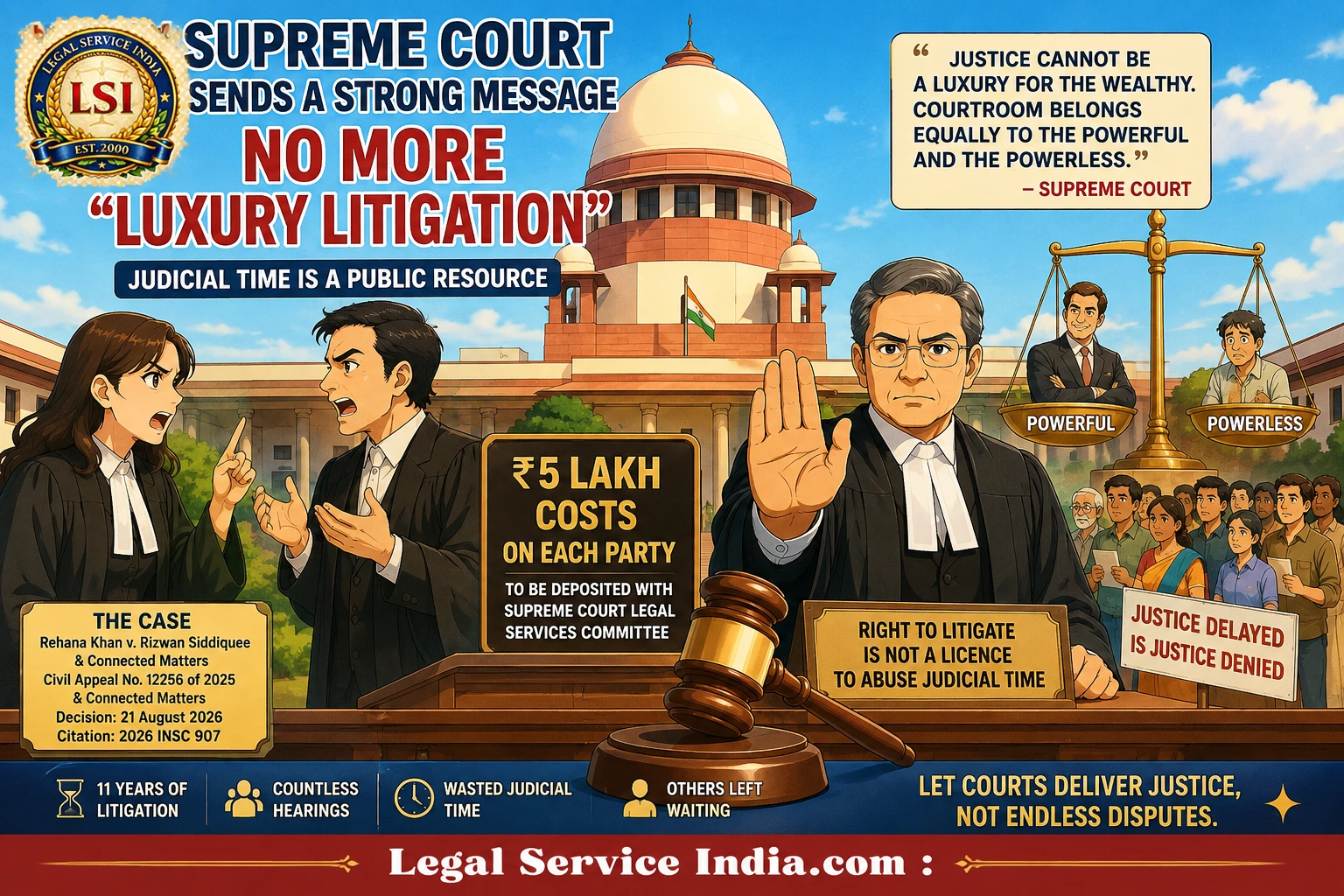
‘Luxury Litigation’ vs. Justice for the Poor: Supreme Court Sends a Strong Message to Wealthy and Influential Litigants
“Justice cannot be allowed to become a luxury available to those who can afford endless litigation. The courtroom belongs equally to the powerful and the powerless, and every hour consumed by needless litigation is an hour taken away from someone who may be waiting simply for a chance to be heard.”
— Adv. Tarun Choudhury
Supreme Court Advocate
Introduction: When Litigation Becomes a Luxury
There is a fundamental difference between access to justice and access to endless litigation.
Every citizen has a constitutional right to approach a court for the protection of his or her legal rights. But that right does not mean that a litigant can treat the judicial system as a private arena for settling personal scores, protecting a damaged reputation, prolonging a dispute, or repeatedly seeking judicial attention.
That distinction has been brought into sharp focus by the Supreme Court’s recent judgment in Rehana Khan v. Rizwan Siddhiquee, decided on 21 August 2026.
The judgment is significant not merely because the Supreme Court dismissed the connected appeals or imposed ₹5 lakh costs on each of the two parties. Its larger importance lies in the Court’s powerful reminder that judicial time is a public resource.
The Court noted that the two parties had consumed the time of the Bar Council of India, the High Court, and the Supreme Court for approximately eleven years, while other litigants were waiting for genuine relief. The Court therefore strongly disapproved of their conduct and directed each party to deposit ₹5 lakh with the Supreme Court Legal Services Committee within four weeks.
The judgment deserves attention because it takes us beyond the ordinary question of who won and who lost.
The deeper question is
Who pays the price when one person’s prolonged litigation occupies the judicial time needed by hundreds of other citizens?
That is where the expression “luxury litigation” acquires its real significance.
Case: Rehana Khan v. Rizwan Siddhiquee & Connected Matters
Civil Appeal No. 12256 of 2025 with T.C.(C) No. 30 of 2026 and Civil Appeal No. 7959 of 2026
Decision: 21 August 2026
Citation: 2026 INSC 907
Bench: Justice Vikram Nath, Justice Sandeep Mehta, and Justice Vijay Bishnoi
The Supreme Court’s Message in One Sentence
The message is simple but powerful:
The right to litigate is not a license to abuse judicial time.
A court exists to administer justice—not to become a stage upon which private disputes are repeatedly performed.
The Supreme Court made this point in unusually strong language. It observed that the machinery of justice cannot be placed at the disposal of parties to settle scores, repair reputations they themselves have endangered, or extract advantage from controversies of their own making.
The Court also made an important observation about the nature of the proceedings: litigation may be fascinating, dramatic, and even sensational, but the drama surrounding a case does not determine its legal merit.
That is a warning worth remembering.
What Was the Case About?
The litigation arose from a professional-misconduct dispute between Rehana Khan and advocate Rizwan Siddhiquee.
The dispute had its origins in events dating back to 2013–2014.
Khan had engaged Siddhiquee as her advocate. Subsequently, serious allegations and disagreements arose between them. The matter eventually travelled through different legal forums, including disciplinary proceedings before the Bar Council and subsequent proceedings before the constitutional courts.
The litigation eventually reached the Supreme Court through cross-proceedings.
The underlying dispute was therefore not a simple one-time court case. It had developed into a prolonged legal battle involving several proceedings over many years. The Supreme Court was particularly concerned that the parties had continued litigating against each other while each was also responsible for a substantial part of the controversy.
The Professional Misconduct Issue
One of the important questions before the Supreme Court concerned the conduct of advocate Rizwan Siddhiquee.
The Bar Council of India’s Disciplinary Committee had found professional misconduct and imposed a two-year suspension from practice, along with monetary penalties.
The Supreme Court upheld that disciplinary finding.
The Court’s reasoning on professional confidentiality is particularly important for the legal profession.
The Court held that an advocate’s obligation concerning confidential information obtained from a client does not disappear merely because the professional relationship subsequently breaks down.
In substance, the Court made it clear that:
A lawyer cannot use confidential information received from a client against that client merely because the client later becomes an adversary.
That principle is fundamental to the lawyer-client relationship.
Without confidentiality, a client cannot speak freely to his or her lawyer. And without candid communication between lawyer and client, effective legal representation becomes almost impossible.
Why Did the Supreme Court Refuse to Increase the Punishment?
Interestingly, the appellant herself sought enhancement of the punishment imposed upon the advocate.
But the Supreme Court refused.
Why?
Because the Court found that the appellant had herself not approached the Court with the degree of candor required from someone seeking discretionary relief.
The Court found, among other things, that material circumstances had not been fully disclosed and that the appellant had herself participated in conduct relevant to the controversy.
The Court therefore invoked a very old and important equitable principle:
A Person Seeking Equitable or Discretionary Relief Must Come to Court With Clean Hands
The principle is not merely a technical procedural rule.
It is based on common sense.
If a litigant asks the court to punish the other side while concealing or minimizing his or her own conduct, the court is entitled to examine whether that litigant deserves the relief sought.
The Supreme Court therefore upheld the disciplinary order but declined to enhance the punishment.
The Most Important Part: Eleven Years of Judicial Time
For me, as a practicing lawyer, this is perhaps the most important part of the judgment.
The Supreme Court observed that the two parties had occupied the time of:
- the Bar Council of India;
- a High Court; and
- the Supreme Court
for eleven years.
And the Court pointed out that this judicial time belonged not merely to the two parties.
It belonged to other litigants waiting for genuine relief.
This is a profound observation.
A court’s time is not unlimited.
A judge who spends hours hearing an unnecessarily prolonged dispute cannot simultaneously hear another case. A court listing is therefore not simply an administrative diary.
It is, in reality, a distribution of a scarce public resource.
When one matter consumes disproportionate judicial time, somebody else may have to wait.
That “somebody else” may be:
- an undertrial prisoner;
- a widow seeking pension;
- a worker fighting for wages;
- a tenant facing eviction;
- a senior citizen fighting a property dispute;
- a consumer seeking compensation;
- a victim seeking compensation;
- a family waiting for succession rights; or
- a poor litigant who cannot afford repeated appearances before courts.
That is why the Court’s observation has constitutional significance.
What Does “Luxury Litigation” Really Mean?
The expression “luxury litigation” should not be misunderstood.
It does not mean that a wealthy person loses the right to approach the courts.
Nor does poverty automatically make a litigant deserving while wealth makes another litigant undeserving.
The law must remain blind to economic status when deciding legal rights.
The real issue is conduct.
Luxury litigation is better understood as litigation pursued or prolonged in circumstances where the legal process becomes an instrument for purposes other than genuine adjudication—for example:
- settling personal scores;
- buying time;
- harassing an opponent;
- repeatedly reopening matters;
- filing overlapping proceedings;
- suppressing material facts;
- pursuing weak or manufactured claims;
- using litigation to exert pressure;
- prolonging disputes because the litigant can financially sustain the process; or
- treating judicial proceedings as a strategic game rather than a genuine quest for justice.
The Supreme Court has been concerned about this phenomenon for years.
In Ashok Kumar Mittal v. Ram Kumar Gupta, (2009) 2 SCC 656, the Court had already criticized the inadequacy of nominal costs and observed that insufficient costs do not effectively deter vexatious or “luxury litigation” arising from ego, greed, or a strategy of buying time.
The principle has therefore been developing for years.
The 2026 judgment gives the issue a particularly powerful contemporary expression.
The Supreme Court Has Now Put Judicial Time at the Center of the Debate
This is an important development.
Traditionally, when we discuss costs, we tend to think about compensating the successful litigant.
But modern judicial thinking increasingly recognizes another purpose: costs can protect the judicial system itself.
If a litigant knows that filing unnecessary proceedings will cost little or nothing, litigation can become a relatively inexpensive weapon.
A financially strong litigant may think:
“Let the case continue. I can afford the lawyers. I can afford the appearances. I can afford the delay.”
But the weaker litigant may not be able to afford the same strategy.
This creates a dangerous inequality.
The poorer litigant is not necessarily defeated on the merits. He may simply be unable to survive the litigation marathon.
The ₹5 Lakh Cost Is More Than a Monetary Penalty
The Supreme Court directed each party to pay ₹5 lakh, making a total of ₹10 lakh, to the Supreme Court Legal Services Committee within four weeks.
The destination of the money is itself significant.
The cost was not merely an amount payable between the two disputants. It was directed towards the Supreme Court Legal Services Committee—an institution associated with access to legal services.
There is therefore an important symbolic message:
Judicial resources must ultimately serve access to justice, not become the playground of prolonged private disputes.
The cost also performs a deterrent function.
A cost order tells litigants that judicial time has a value.
Does This Mean Wealthy People Cannot Litigate?
Absolutely not.
This distinction must be made very clearly.
A wealthy individual, corporation, celebrity, or influential person has exactly the same right to approach a court as an economically weaker person.
The Constitution does not create one justice system for the rich and another for the poor.
The problem arises when financial strength is used to sustain litigation that has become abusive, repetitive, or disproportionate.
Likewise, a poor litigant can also abuse the legal process.
The Supreme Court’s principle is therefore not
“Rich people should not litigate.”
The principle is
Nobody should be permitted to misuse judicial machinery.
That is a much more constitutionally defensible proposition.
Article 14: And Equal Access to Justice
The judgment also raises an important constitutional question.
Article 14 guarantees equality before the law and equal protection of the laws.
Article 39A, contained in the Directive Principles of State Policy, directs the State to promote equal justice and provide free legal aid so that opportunities for securing justice are not denied because of economic or other disabilities.
Although Article 39A is a directive principle rather than a directly enforceable fundamental right, it expresses a foundational constitutional commitment.
The Supreme Court’s concern about judicial time fits naturally into that constitutional philosophy.
Because formal equality is not enough.
Suppose two citizens technically have the same right to approach the Supreme Court.
One has unlimited financial resources and can maintain multiple proceedings for ten or fifteen years.
The other cannot afford repeated travel, lawyers, documentation, and adjournments.
On paper, both have equal access.
In reality, their access to justice may be dramatically different.
That is why preventing abusive litigation is not anti-litigant.
Properly understood, it is pro-access to justice.
The “Poor Litigant In The Queue” Problem
This is the most human aspect of the judgment.
Behind every pending case is a human story.
A case file may simply contain a number.
But behind that number may be someone’s:
- home;
- livelihood;
- pension;
- marriage;
- inheritance;
- freedom;
- employment;
- dignity; or
- future.
When a court says that judicial time consumed by one prolonged dispute belonged to other litigants waiting for genuine relief, it reminds us that delay is not an abstract statistic.
Delay can change lives.
A poor litigant may wait years for a hearing, while a well-funded litigant can repeatedly challenge interlocutory orders, seek adjournments, pursue parallel remedies, and carry the dispute through multiple levels.
That is precisely the inequality that judicial discipline must attempt to control.
The Court’s Powerful Warning: “A Court Is Not An Auditorium”
One of the most striking aspects of the judgment is the Court’s observation that litigation may have drama and fascination, but:
“A court is not an auditorium, and the drama of a case is no measure of its merit.”
That sentence deserves to be remembered.
Modern litigation increasingly takes place not only in courtrooms but also in the court of public opinion.
Television debates, social media, press conferences, and viral allegations can create enormous public interest around a dispute.
But popularity is not proof.
Publicity is not evidence.
Drama is not law.
And a sensational dispute does not automatically deserve priority over a quiet case involving a person who desperately needs justice.
Why “Clean Hands” Matter
The Supreme Court’s insistence on clean hands is equally important.
Litigants sometimes present litigation as though they are completely innocent victims and the opposing party is entirely responsible for the dispute.
Real life is rarely so simple.
The court found that in the present dispute both parties had contributed to the controversy.
That led the court to a balanced outcome.
It did not simply accept one side’s narrative and condemn the other.
Instead:
- The professional misconduct finding against the advocate was upheld;
- The request for enhanced punishment was rejected
- Both sides were criticized; and
- Both sides were ordered to pay ₹5 lakh in costs.
This is an important lesson in judicial fairness.
Courts do not have to choose between two competing narratives when both parties have contributed to the problem.
Sometimes the correct judgment is
Both sides are wrong in different ways.
The Advocate’s Duty Goes Beyond Winning A Case
The judgment carries a particularly strong message for members of the Bar.
A lawyer does not merely receive instructions.
A lawyer receives confidence.
Clients tell advocates things they may not tell their family members, friends, or even spouses.
They disclose:
- personal history;
- financial information;
- business secrets;
- family disputes;
- weaknesses in their case;
- sensitive documents; and
- information that could potentially damage them if publicly disclosed.
That information is shared because the client believes that the lawyer will protect it.
The Supreme Court has therefore reaffirmed an essential principle:
The advocate-client relationship is founded on trust, confidentiality, and professional responsibility.
The termination of the professional relationship does not give the advocate a free license to exploit confidential information acquired during that relationship.
Why the Judgment Matters Beyond This Particular Case
It would be a mistake to treat this judgment merely as a dispute involving an actress and an advocate.
Its implications are much wider.
The decision potentially affects the way courts approach:
1. Frivolous Litigation
Litigants who repeatedly pursue weak proceedings may face meaningful costs.
2. Strategic Delay
Using litigation merely to postpone an inevitable outcome can attract judicial disapproval.
3. Suppression Of Material Facts
A litigant who withholds important information risks losing discretionary relief.
4. Parallel Proceedings
Courts are increasingly conscious of the burden created when the same dispute travels through multiple procedural routes.
5. Abuse of Judicial Process
Courts can treat misuse of their machinery as a matter affecting the administration of justice itself.
6. Professional Ethics
Advocates must remember that professional obligations survive the breakdown of the lawyer-client relationship.
7. Access to Justice
Judicial time must be distributed fairly among competing claims for relief.
The Earlier Supreme Court Warning in Ashok Kumar Mittal
The 2026 judgment should also be read alongside Ashok Kumar Mittal v. Ram Kumar Gupta, (2009) 2 SCC 656.
Nearly seventeen years earlier, the Supreme Court had already warned that the system of imposing very small or no costs did not effectively deter vexatious or luxury litigation.
The Court referred to litigation driven by ego, greed, or a strategy of buying time and called for a more realistic approach to costs.
That earlier judgment is extremely relevant today.
Because the problem has not disappeared.
If anything, the economic capacity of some litigants to sustain prolonged legal battles has made the issue more important.
Costs Should Not Become Punishment for Simply Losing
There is another side to the issue that must not be ignored.
Every unsuccessful case is not a frivolous case.
A litigant should never be punished merely because the court ultimately disagrees with his or her legal position.
The law must permit citizens to test difficult, novel, and even uncertain legal questions.
Otherwise, the fear of costs could discourage legitimate litigation.
Therefore, the correct test should not be
“Did the litigant lose?”
The better questions are
- Was the proceeding genuinely arguable?
- Were material facts disclosed?
- Was the proceeding pursued in good faith?
- Was there unnecessary duplication?
- Was judicial process being used for a collateral purpose?
- Were repeated proceedings filed merely to delay?
- Was the conduct oppressive or vexatious?
- Did the litigant abuse procedural opportunities?
That distinction is essential for a fair justice system.
A Practical Message for Litigants
The judgment provides some very practical lessons.
Before filing another proceeding, a litigant should ask:
1. Do I genuinely have a legal grievance?
Not every personal disagreement is a legal cause of action.
2. Have I disclosed all material facts?
A half-truth can be more dangerous than an outright falsehood.
3. Am I seeking justice or revenge?
Courts are not instruments for settling personal scores.
4. Is another proceeding already pending?
Multiple proceedings can create unnecessary duplication.
5. Am I prolonging the matter merely because I can afford to do so?
Financial ability does not create a moral entitlement to consume unlimited judicial time.
6. Am I asking the Court for discretionary relief?
If so, clean hands become especially important.
A Practical Message for Lawyers
There is an equally important message for advocates.
A lawyer should not become so personally involved in a client’s dispute that professional judgment is replaced by personal combat.
The advocate’s role is to:
- advise;
- represent;
- protect confidentiality;
- comply with professional ethics;
- identify legally sustainable remedies; and
- assist the court in reaching a just decision.
An advocate is not merely a hired warrior.
The Bar is part of the justice delivery system.
When unnecessary litigation is prolonged, lawyers are not completely detached from its consequences.
The profession therefore has an important responsibility in discouraging clients from using litigation as harassment or delay.
My View as a Supreme Court Lawyer
After more than 25 years of practice, I believe the most important lesson from this judgment is not the ₹5 lakh figure.
It is the Court’s recognition that judicial time belongs to the public.
We often speak about the backlog of cases in India as though it is simply a problem of insufficient judges.
There is certainly a need for more judges, better infrastructure, technology, and procedural reform.
But there is another side of the equation.
We must also ask how efficiently existing judicial time is being used.
If a court spends disproportionate time on litigation manufactured by the parties themselves, increasing the number of judges alone will not solve the problem.
The justice system needs a culture in which:
- genuine litigation is protected,
- Legitimate legal innovation is encouraged, but
- Abusive litigation is made economically and procedurally unattractive.
That requires realistic costs.
It requires judicial case management.
It requires consequences for suppression of material facts.
It requires responsible advocacy.
And, above all, it requires litigants to understand that the courtroom is not a place where money can purchase unlimited procedural oxygen.
Does This Judgment Create a New Law Against Wealthy Litigants?
No.
That would be an overstatement.
The Supreme Court has not declared that wealthy litigants have fewer legal rights.
Nor has the Court created a separate legal standard based merely on a person’s financial status.
The real target is abuse of the legal process.
The reference to wealthy or influential litigants should therefore be understood in the broader context of unequal capacity to sustain prolonged litigation.
The principle applies equally to rich and poor.
Abuse of process is abuse of process, regardless of the litigant’s bank balance.
What This Means for the Future of Indian Litigation
I expect the philosophy reflected in this judgment to become increasingly important.
Indian courts are under enormous pressure.
The future of civil and constitutional justice cannot depend only upon increasing the number of cases disposed of.
We also need to ask:
- How many judicial hours were unnecessarily consumed?
- How many adjournments were avoidable?
- How many parallel proceedings were unnecessary?
- How many cases were filed primarily to delay another proceeding?
- How many genuine litigants waited while these disputes continued?
These are not merely administrative questions.
They go to the heart of the right to meaningful access to justice.
The Larger Constitutional Message
Ultimately, the Supreme Court’s message is about equality.
Justice should not become a contest between the person who can afford ten years of litigation and the person who cannot afford ten months.
A court must remain equally accessible to:
| Litigants | Equal Access to Justice |
|---|---|
| the industrialist | and the laborer |
| the celebrity | and the ordinary citizen |
| the corporation | and the consumer |
| the landlord | and the tenant |
| the powerful | and the powerless |
But equal access requires something more than opening the doors of the courthouse.
It requires ensuring that one litigant cannot effectively block the doorway for everyone else.
That is the deeper constitutional significance of the Supreme Court’s warning against what has been described as “luxury litigation.”
Conclusion: Justice Cannot Become a Rich Man’s Waiting Room
The Supreme Court’s judgment in Rehana Khan v. Rizwan Siddhiquee is a timely reminder that courts are not private theaters for prolonged personal battles.
The court upheld the professional misconduct finding against the advocate, refused to enhance the punishment sought by the appellant, dismissed the connected proceedings, and imposed ₹5 lakh in costs on each party. More importantly, it highlighted the eleven years of judicial and institutional time consumed by the dispute and reminded us that this time was also needed by other litigants awaiting genuine relief.
The expression “luxury litigation” therefore deserves to be understood carefully.
It is not an attack on wealth.
It is not an attack on the right to litigate.
It is an attack on the idea that money, influence, or persistence can convert the judicial process into a private instrument for endless litigation.
A poor person’s case may not make headlines.
It may not involve celebrities.
It may not generate television debates.
But for that person, the case may mean everything.
And when that person has been waiting for years for a hearing, every unnecessary hour spent on manufactured or prolonged litigation becomes more than a procedural inconvenience.
It becomes a question of justice itself.
In my view, that is the real significance of this judgment.
The Supreme Court has reminded us of a principle that should never be forgotten:
The doors of justice must remain open to everyone—but nobody should be permitted to keep those doors occupied merely because he or she has the money, influence, or endurance to keep litigating.
Important Legal Citation
Rehana Khan v. Rizwan Siddhiquee & Connected Matters, Civil Appeal No. 12256 of 2025 with T.C.(C) No. 30 of 2026 and Civil Appeal No. 7959 of 2026, 2026 INSC 907, decided on 21 August 2026, Supreme Court of India.
Earlier Important Authority
Ashok Kumar Mittal v. Ram Kumar Gupta & Anr., (2009) 2 SCC 656, where the Supreme Court discussed the inadequacy of nominal costs as a deterrent against vexatious or “luxury litigation” driven by ego, greed, or a strategy of buying time.
Need Legal Guidance?
Adv. Tarun Choudhury
Supreme Court Advocate | 25+ Years of Legal Experience
Facing a complex legal dispute or need professional guidance on your case? Get in touch for experienced legal assistance and practical advice.
- 📞 Call: 9650499965
- 💬 WhatsApp: 8851978611
Discuss Your Legal Matter Today—Experienced Counsel Can Make the Difference.
This article is intended for legal information and public awareness. It should not be treated as legal advice in any individual case.
Frequently Asked Questions (FAQs)
1. What Did the Supreme Court Say About “Luxury Litigation” by Wealthy Litigants?
The Supreme Court strongly criticized the misuse of judicial process through prolonged or unnecessary litigation, observing that valuable judicial time cannot be monopolized by influential or financially powerful litigants. The Court stressed that judicial resources must remain available to genuine litigants, including poorer people awaiting justice.
2. Why Did the Supreme Court Impose ₹5 Lakh Costs on Each Litigant?
The Supreme Court imposed ₹5 lakh costs on each of the two parties because their dispute had consumed the time of multiple legal forums for approximately 11 years. The costs serve both as a deterrent against abuse of judicial process and as a reminder that judicial time is a valuable public resource.
3. Does the Supreme Court Judgment Restrict Wealthy People From Filing Cases?
No. The judgment does not take away the legal right of wealthy or influential people to approach courts. The Supreme Court’s concern is with frivolous, vexatious, repetitive, or abusive litigation, regardless of the litigant’s financial status. Wealth does not reduce a person’s legal rights, but neither does it provide a license to misuse the judicial system.
4. How Does the “Luxury Litigation” Judgment Protect Access to Justice for Poor Litigants?
The Supreme Court highlighted that judicial time consumed by unnecessarily prolonged litigation is time that cannot simultaneously be used to hear other genuine cases. The judgment therefore reinforces the broader principle of equal access to justice, particularly for litigants who may lack the financial resources to sustain years of litigation.
5. What Is the Legal Significance of the Supreme Court’s “Luxury Litigation” Ruling?
The judgment is significant because it reinforces judicial control over abuse of process, prolonged litigation, and misuse of judicial resources. It also highlights the importance of approaching courts with clean hands, full disclosure, and genuine legal grievances. The decision sends a strong message that courts are institutions for resolving legitimate disputes—not instruments for settling personal scores or prolonging private battles.
Key Takeaways: Supreme Court Attacks “Luxury Litigation” by Wealthy Litigants
- The Supreme Court attacks “luxury litigation” by wealthy litigants, warning that influential parties cannot misuse judicial resources through prolonged, repetitive, or unnecessary litigation.
- The Supreme Court emphasized that judicial time is a valuable public resource and must remain available to genuine litigants, particularly people who cannot afford years of litigation.
- The Court imposed ₹5 lakh costs on each of the two litigants, sending a strong message against abuse of the judicial process.
- The judgment highlights the constitutional importance of equal access to justice and the need to prevent financially powerful litigants from gaining an unfair advantage through prolonged litigation.
- The Supreme Court clarified that the issue is not wealth itself, but the misuse of wealth, influence, or procedural opportunities to sustain vexatious or unnecessary litigation.
- The judgment reinforces the principle that litigants seeking discretionary relief must approach the court with clean hands and full disclosure of material facts.
- The Court also reaffirmed the importance of advocate-client confidentiality, emphasizing that confidential information obtained during professional representation cannot simply be used against a former client.
- The judgment demonstrates that frivolous, vexatious, and abusive litigation can attract substantial costs, making litigation a more accountable process.
- The Supreme Court’s ruling sends a strong warning that courts are not a forum for settling personal scores, prolonging disputes, or creating pressure on opponents.
- The broader message is clear: the right to access justice does not include the right to monopolise judicial time.
Summary
The Supreme Court’s “luxury litigation” judgment is a significant ruling on judicial accountability, equal access to justice, and abuse of court proceedings. By imposing ₹5 lakh costs on each litigant, the court warned wealthy and influential parties that financial capacity cannot be used to sustain unnecessary litigation or consume judicial time that is needed by genuine litigants. The judgment reinforces clean hands, full disclosure, professional ethics, and responsible use of the judicial process.