





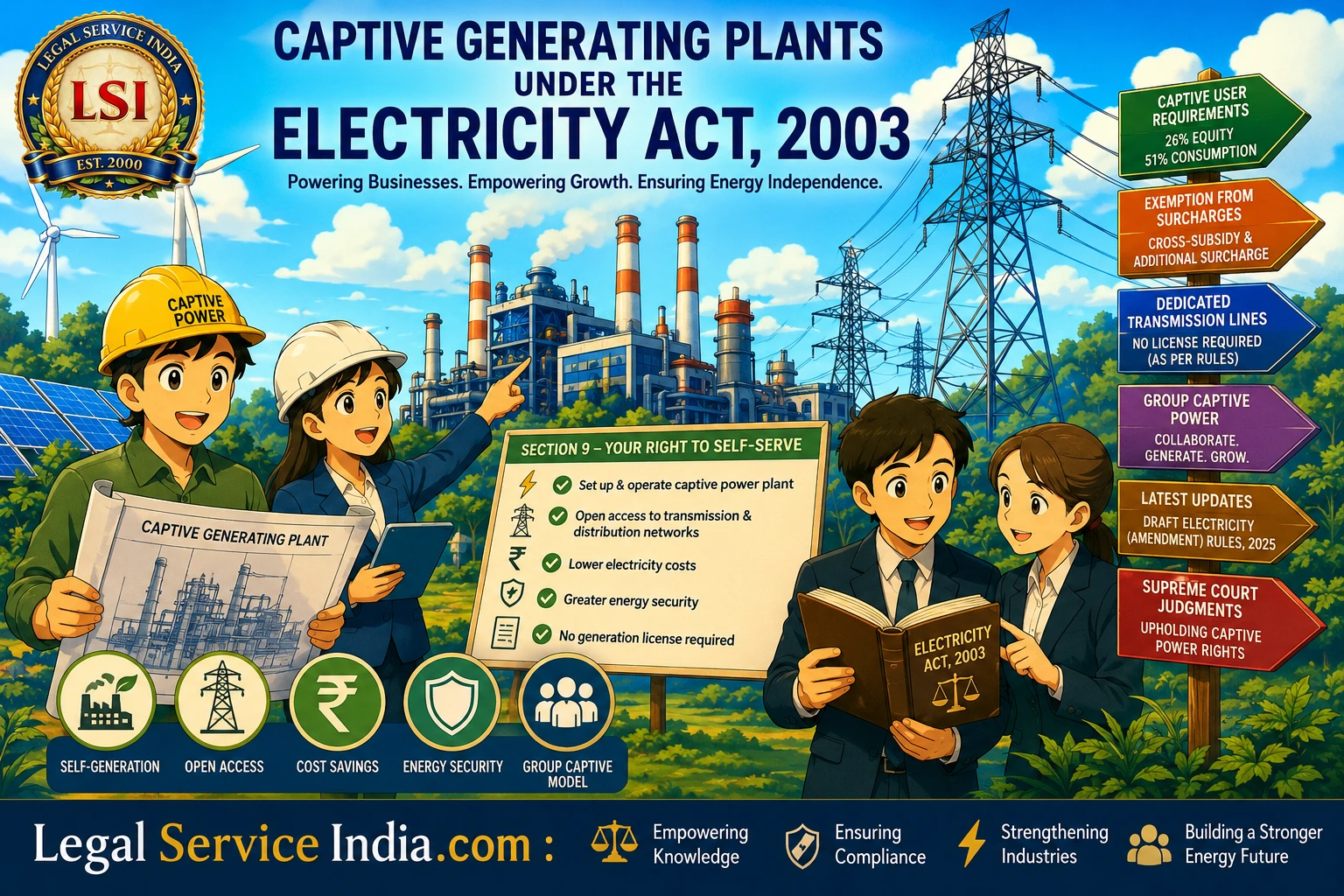
Captive Generating Plants Under the Electricity Act, 2003
The Electricity Act, 2003 consolidated the law relating to “generation, transmission, distribution, trading and use of electricity”. The aim of the law was to develop the electricity industry, promote competition and inter alia encourage private participation. In furtherance of these objectives the 2003 Act delicensed generation and freely permitted captive generation. Section 9 of 2003 Act has been incorporated under Electricity law by which any person was allowed to set up captive generation plant.
Definition of Captive Generating Plant
The clause 8 of Section 2 defines “Captive Generating Plant”. It means a power plant set up by any person to generate electricity primarily for his own use and includes a power plant set up by any co-operative society or association of persons for generating electricity primarily for use of members of such co-operative society or association.
| Provision | Description |
|---|---|
| Section 2(8) | Defines “Captive Generating Plant” under the Electricity Act, 2003. |
| Section 9 | Allows any person to establish and operate a captive generating plant. |
Rights Under Section 9 of the Electricity Act, 2003
Section 9 of the Electricity Act, 2003, essentially grants you the “right to self-serve” by allowing any person or group to build and operate their own captive power plant for personal use without needing a government license. It provides a legal guarantee called open access, which means you have the right to use existing state power lines to transport electricity from your plant to your facility, provided there is enough capacity in the grid.
While you must follow standard safety and technical rules, this section is designed to help businesses save money and ensure a reliable power supply by cutting out the middleman and bypassing many of the heavy surcharges typically paid by commercial consumers.
Key Benefits of Section 9
- Allows establishment of captive power plants without obtaining a generation license.
- Provides open access to transmission and distribution networks, subject to grid availability.
- Helps businesses achieve greater energy security.
- Reduces dependence on external electricity suppliers.
- May lower electricity costs through self-generation.
- Encourages private participation in the power sector.
Difference Between Captive and Non-Captive Users
The main distinction between captive and commercial (non-captive) users is in ownership and cost. A captive consumer is legally free from paying high Cross-Subsidy Surcharges and other fees since they are a part-owner of the power plant (holding at least 26% equity) and use the electricity they generate.
A non-captive user, on the other hand, purchases power from the grid or a third party and has no ownership stake. As a result, they are responsible for any government-mandated levies that pay for less expensive electricity for homes and farmers.
Captive status essentially turns a customer become a producer-consumer, giving them the legal right to less expensive, self-managed electricity that is unavailable to ordinary commercial users.
Comparison: Captive vs. Non-Captive Users
| Criteria | Captive User | Non-Captive User |
|---|---|---|
| Ownership in Power Plant | Part-owner of the generating plant | No ownership stake |
| Minimum Equity Requirement | At least 26% equity | Not applicable |
| Source of Electricity | Self-generated electricity | Purchased from grid or third party |
| Cross-Subsidy Surcharge | Generally exempt | Payable as applicable |
| Additional Surcharge | Generally exempt | Payable as applicable |
| Cost Advantage | Higher due to self-generation benefits | Lower compared to captive users |
Surcharge Exemptions for Captive Consumers
The captive consumers are exempt from paying applicable surcharges which includes cross-subsidy surcharge to support current levels of cross-subsidy and additional surcharge to cover the fixed costs of utilities due to their obligation to supply electricity.
These surcharges are generally imposed because bulk consumers who pay higher rates might use open access. Their exit could adversely affect the finances of existing utilities or distribution licensees by reducing their ability to cross-subsidize vulnerable sections of society and recover fixed costs.
The surcharge mechanism compensates the license for these impacts.
Purpose of Surcharges
- Support existing cross-subsidy structures in the electricity sector.
- Protect the financial viability of distribution licensees.
- Help recover fixed costs incurred by utilities.
- Ensure continued supply obligations to consumers.
- Prevent financial losses arising from migration of large consumers to open access arrangements.
Captive Generating Plants and Dedicated Transmission Lines
Section 9 enables individuals to build, operate, and maintain a CGP and dedicated transmission lines. The Electricity Rules, 2005 provide that:
- A generating company;
- A person setting up a CGP or energy storage system; or
- A consumer with a load of at least 25 megawatts for inter-state transmission or 10 megawatts for intra-state transmission,
does not require a license under the Electricity Act to establish, operate, or maintain a dedicated transmission line, if they comply with the regulations, technical standards, guidelines, and procedures issued under the provisions of the Electricity Act.
Criteria for Captive Generating Plant Status
To qualify as a Captive Generating Plant under the Electricity Rules, 2005, two specific criteria must be met:
| Requirement | Threshold |
|---|---|
| Equity Shareholding | The captive user(s) must hold at least 26% of the equity share capital with voting rights. |
| Power Consumption | The captive user(s) must consume at least 51% of the total electricity generated on an annual basis. |
Rule 3 and the Draft Electricity (Amendment) Rules, 2025
Rule 3 under The Electricity Rules, 2005 governs captive generation, which is significantly altered by the Draft Electricity (Amendment) Rules, 2025. They suggest doing away with the previous proportionality criteria and allowing all captive customers in an Association of Persons (AoP) to jointly satisfy the ownership and consumption requirements.
The amount of power any user can assert in relation to their ownership share is limited by a 110% limitation on captive consumption advantage. Furthermore, the scope of eligible captive customers is expanded by extending the definition of ownership to include indirect shareholding through a holding company, its subsidiaries, or any subsidiary of the holding company.
Understanding the 110% Captive Consumption Rule
The 110% rule caps the captive consumption benefit that user can claim. Each captive user’s entitlement to captive benefit is limited to 110% of their proportional ownership share in the CGP’s total generation. Any consumption beyond that threshold will not qualify for captive-use benefits.
This ensures equitable distribution of benefits and prevents disproportionate advantage to any single user.
| Aspect | Impact |
|---|---|
| Captive Benefit Eligibility | Limited to 110% of proportional ownership share. |
| Excess Consumption | Will not qualify for captive-use benefits. |
| Purpose | Ensures equitable distribution of benefits. |
Expanded Ownership Definition for CGPs
The revised ownership definition expressly allows holding companies, subsidiaries or subsidiaries of the holding company to own or operate captive generating plants.
This flexibility facilities captive investments through corporate group structures and allows returns from captive power supply to flow through related entities within the group.
Benefits of the Collective Compliance Framework
The risk of losing captive status as a result of little deficiencies by individual consumers is decreased by collective consumption. It guarantees that the CGP will remain captive as long as the group as a whole satisfies the 51% minimum consumption level.
When there are operational disruptions or fluctuations in customer energy consumption, this paradigm is especially helpful.
SMEs can cooperate together on captive projects more easily and without having to bear disproportionate compliance obligations thanks to the liberalization of ownership regulations and the framework for collective compliance.
The change promotes more fair access to low-cost power and broadens SME participation in captive generation by switching from individual to group-based compliance.
Key Advantages for SMEs
- Reduced risk of losing captive status due to minor individual deficiencies.
- Collective fulfillment of consumption requirements.
- Greater flexibility during operational disruptions.
- Simplified compliance obligations.
- Improved access to low-cost power.
- Enhanced participation in captive generation projects.
Verification of Captive Generating Plant Status
The Electricity Rules state that if a generating plant and its captive users are located in different states, the Central Electricity Authority is responsible for verifying the captive status of such CGPs.
However, the Electricity Rules do not specify the entity responsible for verifying a CGPs’ status when both the generating plant and its captive user(s) are located in the same state.
In such cases, this verification is typically conducted by the relevant distribution company (“Discom”) and/or the appropriate regulatory commission.
| Location of CGP and Captive User(s) | Verifying Authority |
|---|---|
| Different States | Central Electricity Authority (CEA) |
| Same State | Relevant Distribution Company (Discom) and/or Appropriate Regulatory Commission |
Judicial Interpretation of Captive Regulations
The regulation of captive power in India has evolved significantly, with judicial interpretations providing clarity on various provisions. A key issue has been whether a company incorporated as an SPV (Special Purpose Vehicle) can be treated as an AoP (Association of Persons), and whether the Rule of Proportionality applies.
Kadodara Power Private Limited Case
In Kadodara Power Private Limited and Others vs Gujarat Electricity Regulatory Commission and Others, the APTEL held that a CGP owned by an SPV must be treated as an AoP, requiring it to consume 51% of its generation in proportion to the ownership of the plant.
Tamil Nadu Power Producers Association Case
While the Kadodara Decision was under appeal before the Supreme Court of India, the APTEL, in Tamil Nadu Power Producers Association vs Tamil Nadu Electricity Regulatory Commission, ruled that SPVs cannot be equated with AoPs under Rule 3 of the Electricity Rules.
APTEL held that, in terms of previous judgments passed by APTEL, it is already established that the requirement of 26% shareholding and 51% captive consumption are the minimum requirements to be fulfilled by a set of captive users. Once the same is complied with, the rest of the captive users not fulfilling the above conditions will have no impact on the overall captive structure. The TNPA Decision was also appealed against before the Supreme Court.
Supreme Court Settlement of Interpretation
The apex court, in Dakshin Gujarat Vij Company Limited vs Gayatri Shakti Paper and Board Limited and Another, finally settled the interpretation of the relevant provisions of the Electricity Rules.
The Supreme Court, in its judgment, referred to both the Kadodara Decision and the TNPA Decision. The Court also clarified that if members of a cooperative society collectively consume more than 51% of the electricity generated, the power project would be considered a CGP, and the members of such society would be regarded as captive users.
Further, the Court reiterated that the cooperative society may supply 49% or less of the aggregate electricity generated by a CGP to third parties. Any third party who is not a member of the cooperative society will be treated as a non-captive user and will be liable to pay cross-subsidy surcharge and other applicable charges.
Through the judgment, the apex court sought to restrict “gaming” of the captive power framework in order to protect the interests of distribution licensees. In cases where an insignificant shareholder of a CGP disproportionately uses the electricity generated, such a person should not be treated as a group captive user and, therefore, should be denied the benefits available to captive users under the Electricity Act.
Key Judicial Pronouncements at a Glance
| Case | Forum | Key Finding |
|---|---|---|
| Kadodara Power Private Limited and Others vs Gujarat Electricity Regulatory Commission and Others | APTEL | SPV-owned CGP to be treated as an AoP; proportional captive consumption requirement emphasized. |
| Tamil Nadu Power Producers Association vs Tamil Nadu Electricity Regulatory Commission | APTEL | SPVs cannot be equated with AoPs under Rule 3; compliance with 26% shareholding and 51% captive consumption is sufficient. |
| Dakshin Gujarat Vij Company Limited vs Gayatri Shakti Paper and Board Limited and Another | Supreme Court of India | Settled interpretation of captive power provisions and clarified treatment of cooperative societies and captive users. |
Potential Challenges
Captive consumption faces a number of obstacles, including delays and misreading of legislation by Discoms.
Key challenges include:
- Open Access Charges: Customers must pay open access charges. While cross-subsidies and additional surcharges are eliminated, wheeling and banking fees (if applicable) increase the landed tariff for consumers.
- Delays in Open-Access Procurement: Securing open access frequently results in procedural delays. Although the Ministry of Power issued the Electricity (Promoting Renewable Energy Through Green Energy Open Access) Rules, 2022, which require speedy disposal of open access applications, not all states have embraced them.
- Discom Hostility: Discoms’ hostility towards captive mode sales remains a significant hurdle in scaling up captive consumption in India. Due to the weak financial position of many Discoms, they often prefer arrangements under which they continue supplying power to major commercial consumers within their licensed areas. When commercial consumers opt for captive power arrangements, the viability of the Discom is affected.
- Other Operational Challenges: Local implementation issues, project financing difficulties, and complications arising from legal and regulatory changes continue to impact captive power projects.
Key Takeaways: Captive Generating Plants Under the Electricity Act, 2003
| Point | Key Topic |
|---|---|
| 1 | Captive Power Generation Is Freely Permitted in India |
| 2 | What Is a Captive Generating Plant (CGP)? |
| 3 | Section 9 Grants a Statutory Right to Self-Generation |
| 4 | Captive Users Enjoy Significant Cost Advantages |
| 5 | Captive Status Requires Compliance with Two Core Conditions |
| 6 | Open Access Is a Major Benefit of Captive Power |
| 7 | Dedicated Transmission Lines Can Be Built Without a License |
| 8 | Draft Electricity (Amendment) Rules, 2025 May Transform Captive Power Compliance |
| 9 | The New 110% Rule Seeks to Prevent Misuse |
| 10 | SMEs Stand to Benefit Significantly from Group Captive Models |
| 11 | Verification of Captive Status Depends on Location |
| 12 | Supreme Court Has Clarified Key Captive Power Principles |
| 13 | Captive Power Projects Must Avoid “Gaming” the System |
| 14 | Captive Power Supports Energy Security and Cost Optimization |
| 15 | Practical Challenges Still Exist |
1. Captive Power Generation Is Freely Permitted in India
The Electricity Act, 2003 liberalized the power sector by allowing any person, company, cooperative society, or association of persons to establish and operate a Captive Generating Plant (CGP) without obtaining a generation license.
2. What Is a Captive Generating Plant (CGP)?
A Captive Generating Plant is a power generation facility established primarily for self-consumption by its owner(s). It can be owned by an individual, company, cooperative society, or association of persons whose members consume the electricity generated.
3. Section 9 Grants a Statutory Right to Self-Generation
Section 9 of the Electricity Act, 2003 grants a legal right to:
- Establish a captive power plant.
- Operate the plant without a generation license.
- Access transmission and distribution networks through open access, subject to grid availability and regulatory compliance.
4. Captive Users Enjoy Significant Cost Advantages
Captive consumers are generally exempt from:
- Cross-Subsidy Surcharge (CSS)
- Additional Surcharge (AS)
These exemptions can substantially reduce electricity costs compared to purchasing power from the grid.
5. Captive Status Requires Compliance with Two Core Conditions
Under Rule 3 of the Electricity Rules, 2005:
- Captive users must collectively hold at least 26% ownership in the power plant.
- Captive users must consume at least 51% of the electricity generated annually.
Failure to satisfy these conditions may result in loss of captive status and surcharge exemptions.
6. Open Access Is a Major Benefit of Captive Power
Captive generators can transport electricity from the generation facility to the consumption location using existing transmission and distribution infrastructure, making captive power a practical option even when generation and consumption sites are geographically separate.
7. Dedicated Transmission Lines Can Be Built Without a License
Generating companies, captive power producers, and eligible large consumers can establish dedicated transmission lines without obtaining a transmission license, provided they comply with technical and regulatory standards.
8. Draft Electricity (Amendment) Rules, 2025 May Transform Captive Power Compliance
The proposed amendments seek to:
- Allow collective compliance by captive users.
- Relax traditional proportionality requirements.
- Recognize indirect ownership through holding companies and subsidiaries.
- Introduce a 110% cap on captive consumption benefits.
These reforms are expected to provide greater flexibility for group captive projects.
9. The New 110% Rule Seeks to Prevent Misuse
Under the Draft Rules, a captive user can claim captive benefits only up to 110% of its proportional ownership share in the total generation. Consumption beyond this threshold may lose captive status benefits.
10. SMEs Stand to Benefit Significantly from Group Captive Models
The proposed collective compliance framework:
- Reduces compliance risks.
- Encourages participation by small and medium enterprises (SMEs).
- Facilitates shared ownership structures.
- Improves access to lower-cost electricity.
11. Verification of Captive Status Depends on Location
- For inter-state captive projects, verification is conducted by the Central Electricity Authority (CEA).
- For intra-state projects, verification is generally carried out by the relevant Discom and/or the appropriate State Electricity Regulatory Commission.
12. Supreme Court Has Clarified Key Captive Power Principles
The Supreme Court’s decision in Dakshin Gujarat Vij Company Ltd. v. Gayatri Shakti Paper & Board Ltd. clarified:
- Interpretation of ownership and consumption requirements.
- Treatment of cooperative societies as captive users.
- Limits on third-party sale of captive power.
- Prevention of abuse of captive power benefits through artificial ownership structures.
13. Captive Power Projects Must Avoid “Gaming” the System
Courts have emphasized that insignificant shareholders should not disproportionately consume electricity merely to obtain surcharge exemptions. Genuine ownership and consumption alignment remains critical.
14. Captive Power Supports Energy Security and Cost Optimization
For industries with high electricity consumption, captive generation offers:
- Reliable power supply.
- Reduced dependence on Discoms.
- Long-term tariff stability.
- Improved operational efficiency.
- Greater control over energy procurement.
15. Practical Challenges Still Exist
Despite legal incentives, captive power projects often face:
- Open access approval delays.
- Regulatory uncertainty.
- Resistance from financially stressed Discoms.
- Wheeling, banking, and transmission charges.
- Financing and project implementation challenges.
Summary
Captive Generating Plants (CGPs) under the Electricity Act, 2003 allow businesses and consumers to generate electricity for self-use while enjoying open access rights and exemption from cross-subsidy and additional surcharges. To qualify as a captive user, entities must satisfy the 26% ownership and 51% consumption requirements prescribed under Rule 3 of the Electricity Rules, 2005. Recent judicial decisions and the Draft Electricity (Amendment) Rules, 2025 are reshaping captive power regulation by promoting collective compliance, broader ownership structures, and stricter safeguards against misuse.

