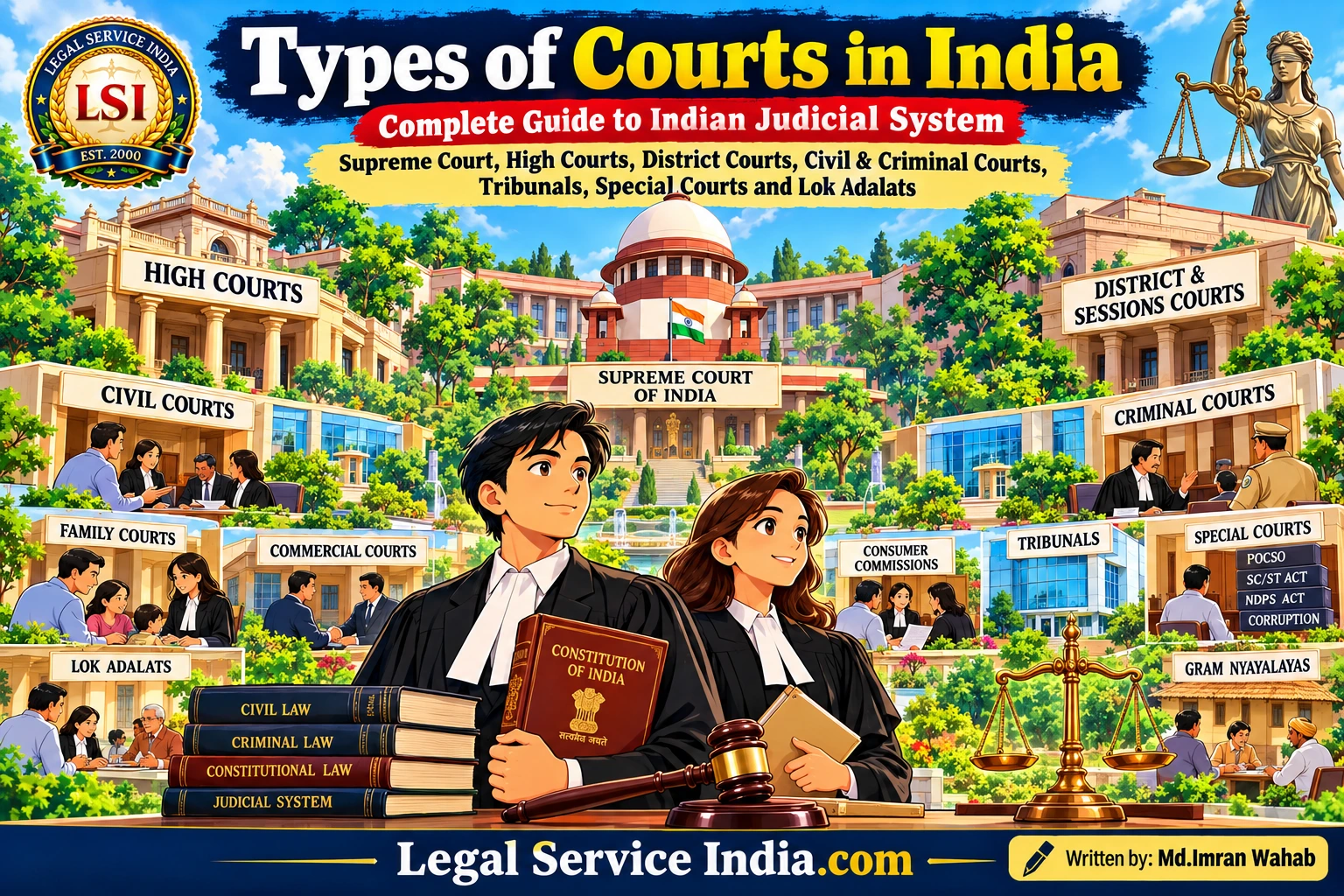
Types of Courts and Judicial Forums in India
India has a well-structured judicial system that deals with civil disputes, criminal cases, family matters, commercial disputes, consumer complaints, and many other legal issues. It comprises constitutional courts, regular courts, specialised courts, tribunals, and alternative dispute-resolution forums, each exercising jurisdiction according to the Constitution and applicable laws.
The different types of courts and judicial forums in India are outlined below.
Supreme Court of India
The Supreme Court of India is the highest court in the country. It is established under Article 124 of the Constitution and is located in New Delhi.
Main Jurisdictions of the Supreme Court
- Original jurisdiction: It directly hears certain disputes between the Union and one or more states, or between two or more states, subject to the constitutional requirements.
- Appellate jurisdiction: It hears appeals from High Courts and certain tribunals and other authorities, as provided by law.
- Advisory jurisdiction: Under Article 143, the President may refer important questions of law or fact to the Supreme Court for its opinion.
- Writ jurisdiction: Under Article 32, it can issue writs for the enforcement of fundamental rights.
Example: A person whose fundamental right has been violated may approach the Supreme Court under Article 32, subject to the requirements of law.
High Courts
High Courts are the highest courts at the state or union territory level. A single High Court may have jurisdiction over more than one state or union territory.
Main Functions of High Courts
- Exercising original jurisdiction in matters assigned to them by law;
- Hearing appeals from subordinate courts and other authorities, as provided by law;
- Issuing writs under Article 226 for the enforcement of fundamental rights and, in appropriate cases, for other legal rights; and
- Exercising supervisory jurisdiction over courts and tribunals within their jurisdiction under Article 227.
Example: A person aggrieved by a judgement of a District Court may, where the law provides, appeal to the concerned High Court.
District and Sessions Courts
District and Sessions Courts are the principal courts at the district level. The same judicial officer may function as a district judge in civil matters and as a sessions judge in criminal matters.
District Judge
Deals with important civil cases and hears appeals from subordinate civil courts, as provided by law.
Sessions Judge
Tries serious criminal cases that are triable by a Court of Session and exercises the powers conferred by criminal law.
Example: A charge of murder is ordinarily tried by a Court of Session, subject to the applicable law and procedure.
Civil Courts
Civil Courts deal with disputes concerning civil rights, property, contracts, money, and other private legal rights and obligations, rather than criminal offences.
Common Matters
- Property and ownership disputes;
- Recovery of money;
- Breach of contract;
- Injunctions;
- Compensation claims; and
- Possession and other civil rights.
The structure, powers, and names of civil courts vary from state to State under the applicable laws.
Example: If someone illegally occupies your land, you may file a civil suit seeking possession and other appropriate reliefs.
Criminal Courts
Criminal Courts deal with offences against the law. They determine whether an accused person is guilty or not guilty and, where guilt is established, impose the punishment permitted by law.
Main Levels
- Sessions Courts;
- Chief Judicial Magistrates; and
- Judicial Magistrates of the First and Second Class, where applicable.
Criminal procedure is principally governed by the Bharatiya Nagarik Suraksha Sanhita, 2023 (BNSS), along with other applicable laws.
Example: Many theft cases are tried by a Magistrate’s Court, while offences of greater seriousness that are triable by a Court of Session are dealt with by the Sessions Court.
Magistrate Courts
Magistrate courts deal mainly with criminal cases, subject to the powers and jurisdiction given to them by law.
Judicial Magistrates
These include the Chief Judicial Magistrate (CJM), Judicial Magistrates of the First Class, and Judicial Magistrates of the Second Class. They conduct criminal proceedings and trials within the limits of their statutory powers. Although judicial magistrates of the second class exist under the BNSS, many states (including West Bengal) mostly appoint magistrates with first-class powers in practice.
Executive Magistrates
They primarily deal with public order, preventive measures, and certain administrative matters under criminal procedure law. They generally do not conduct regular criminal trials like judicial magistrates.
Family Courts
Family courts are established under the Family Courts Act, 1984, to deal with disputes relating to marriage and family matters, including:
- Divorce and judicial separation;
- Maintenance;
- Child custody and guardianship; and
- Certain property disputes between spouses or family members, as provided by law.
An important objective of family courts is to promote conciliation and settlement and, where possible, help parties resolve their disputes amicably.
Commercial Courts
Commercial courts are established under the Commercial Courts Act, 2015, to deal with specified commercial disputes, including matters relating to:
- Commercial contracts;
- Business and partnership disputes;
- Intellectual property;
- Banking and financial transactions; and
- Other disputes covered by the Act.
In jurisdictions where the relevant High Court has such a structure, Commercial Divisions of High Courts also hear specified commercial matters and appeals in accordance with the law.
Consumer Commissions
Consumer Commissions are established under the Consumer Protection Act, 2019, to provide a simple and speedy mechanism for resolving consumer disputes. They function at three levels:
- District Consumer Disputes Redressal Commission (District Commission)
- State Consumer Disputes Redressal Commission (State Commission)
- National Consumer Disputes Redressal Commission (NCDRC – National Commission)
They hear complaints relating to defective goods, deficient services, unfair trade practices, and other matters covered by consumer law.
Juvenile Justice Boards (JJBs)
Juvenile Justice Boards (JJBs) are constituted under the Juvenile Justice (Care and Protection of Children) Act, 2015, to deal with cases involving children in conflict with the law.
Their approach focuses on the child’s welfare, rehabilitation, development, and social reintegration, rather than treating the child in the same manner as an adult offender. The Board follows the procedures and powers prescribed by the Act.
Children’s Courts
Children’s Courts are designated under the Commissions for Protection of Child Rights Act, 2005, for the speedy trial of offences against children and violations of children’s rights, as provided by law. They are different from Juvenile Justice Boards (JJBs), which deal with children in conflict with law under the Juvenile Justice Act, 2015.
Special Courts
Special Courts are established or designated under specific laws to deal with particular types of offences or cases. Examples include:
- POCSO cases – offences against children under the Protection of Children from Sexual Offences Act, 2012;
- SC/ST (Prevention of Atrocities) Act cases – offences covered by the Act;
- Corruption cases – offences under anti-corruption laws;
- NDPS cases – offences under the Narcotic Drugs and Psychotropic Substances Act, 1985; and
- Other specified cases for which a special court is provided by law.
The jurisdiction, powers, and procedure of a special court depend on the particular statute under which it is established or designated.
Fast Track Courts
Fast Track Courts are established or designated to ensure the speedier disposal of specified categories of cases and to reduce delays in the judicial process. They may deal with matters such as:
- Serious criminal offences;
- Sexual offences;
- Cases involving women and children; and
- Cases involving other vulnerable groups, as specified under the relevant scheme or law.
Their structure, jurisdiction, and categories of cases depend on the applicable law or government scheme.
Gram Nyayalayas
Gram Nyayalayas are village-level courts established under the Gram Nyayalayas Act, 2008, with the aim of providing accessible, affordable, and speedy justice at the grassroots level.
They can deal with certain civil and criminal matters within their jurisdiction, as provided by law. However, Gram Nyayalayas have not been established uniformly across all states, and their functioning varies from state to state.
Revenue Courts
Revenue courts or revenue authorities exercising adjudicatory functions deal with matters relating to land and revenue administration, such as:
- Land records and mutation;
- Tenancy and land-related rights;
- Land revenue; and
- Certain boundary and other land-related disputes.
Their structure, powers, and jurisdiction vary from state to state under the applicable state laws. They generally do not form part of the regular civil court hierarchy, although their decisions may be subject to remedies before courts or other authorities as provided by law.
Motor Accident Claims Tribunals (MACTs)
Under the Motor Vehicles Act, 1988. Decide compensation claims for road accident injuries or deaths.
Central Administrative Tribunal (CAT) and State Administrative Tribunal (SAT)
Under the Administrative Tribunals Act, 1985. Handles service matters of Central Government employees (and some other organisations). Some States have a Statestates Administrative Tribunal (SAT) to deal with matters of state government employees.
National Green Tribunal (NGT)
Under the National Green Tribunal Act, 2010. Deals with environmental cases and can give relief or compensation.
Armed Forces Tribunal (AFT)
Under the Armed Forces Tribunal Act, 2007. Handles service disputes and court-martial appeals for armed forces personnel.
Debt Recovery Tribunals (DRTs)
Under the Recovery of Debts and Bankruptcy Act, 1993. Help banks and financial institutions recover debts. Appeals go to Debt Recovery Appellate Tribunals (DRATs).
Income Tax Appellate Tribunal (ITAT)
Specialised body that hears appeals against income-tax orders. Has benches across India.
National Company Law Tribunal (NCLT) & National Company Law Appellate Tribunal (NCLAT)
NCLT (under Companies Act, 2013) deals with company matters, oppression/mismanagement, and insolvency cases under the Insolvency and Bankruptcy Code.
NCLAT hears appeals from NCLT (and some Competition Commission orders). Further appeals on law points can go to the Supreme Court.
Competition Matters
Handled under the Competition Act, 2002. NCLAT currently hears appeals against orders of the Competition Commission of India (CCI).
Appellate Courts
Courts that hear appeals against lower court or tribunal decisions.
Usual path: Trial Court → High Court → Supreme Court (but exact route depends on the law).
Appeal is different from review or revision.
Constitutional Courts vs Subordinate Courts
| Category | Courts |
|---|---|
| Constitutional Courts | Supreme Court and High Courts (have judicial review and constitutional powers). |
| Subordinate Courts | All courts below High Courts (District/Sessions, civil, criminal, magistrates, family courts, etc.). |
Courts vs Tribunals
| Courts | Tribunals |
|---|---|
| Form part of the regular judicial system. | Usually created or designated under specific laws. |
| Generally, exercise broader judicial jurisdiction, depending on their level and the law. | Usually have specialised jurisdiction over particular subjects. |
| The Supreme Court and High Courts exercise important constitutional powers. | Their powers are generally derived from and limited by the statute under which they are established. |
| Generally, follow the established procedures applicable to courts, subject to the relevant law. | May follow specialised or comparatively flexible procedures, subject to their governing statute and rules. |
| Can deal with a wide range of civil, criminal, and constitutional matters, depending on the court. | Generally, deal with specific categories of disputes or subject matters. |
| Examples: Supreme Court, High Courts, District Courts and Magistrate Courts. | Examples: NCLT, NGT, CAT, DRT and AFT. |
27. Lok Adalats & Permanent Lok Adalats
These are alternative dispute-resolution forums established under the Legal Services Authorities Act, 1987, to provide speedy and inexpensive settlement of disputes.
Lok Adalats
They settle pending court cases and pre-litigation disputes through compromise or settlement. Their award is final and binding on the parties and has the status of a decree of a civil court. No appeal lies against such an award.
Permanent Lok Adalats
They deal with disputes relating to specified public utility services, such as transport, postal or telecommunication services, supply of power or water, sanitation, and insurance. They first attempt conciliation; if settlement fails, they may, subject to the statutory conditions, decide the dispute on merits.
Village & Local Mechanisms
Gram Nyayalayas are the main formal village courts. Other traditional local bodies may exist but are not part of the regular court system unless recognised by law.
Overall Structure
Supreme Court of India
↓
High Courts
↓
District & Sessions Courts
↓
Subordinate Civil & Criminal Courts
Parallel specialised forums include Family Courts, Commercial Courts, Consumer Commissions, Juvenile Justice Boards (JJBs), Motor Accident Claims Tribunals (MACTs), Central Administrative Tribunal (CAT), State Administrative Tribunal (SAT), National Green Tribunal (NGT), Armed Forces Tribunal (AFT), Debt Recovery Tribunals (DRTs), National Company Law Tribunal (NCLT) and National Company Law Appellate Tribunal (NCLAT), Income Tax Appellate Tribunal (ITAT), Gram Nyayalayas, and Lok Adalats.
Conclusion
India has a multi-level judicial system, with the Supreme Court and High Courts as constitutional courts, followed by the regular civil and criminal courts at the subordinate level. Alongside these, there are numerous specialised courts, tribunals, and alternative dispute-resolution forums dealing with specific subjects. The jurisdiction and powers of each court or forum depend on the Constitution and the applicable law, and not merely on its name.