





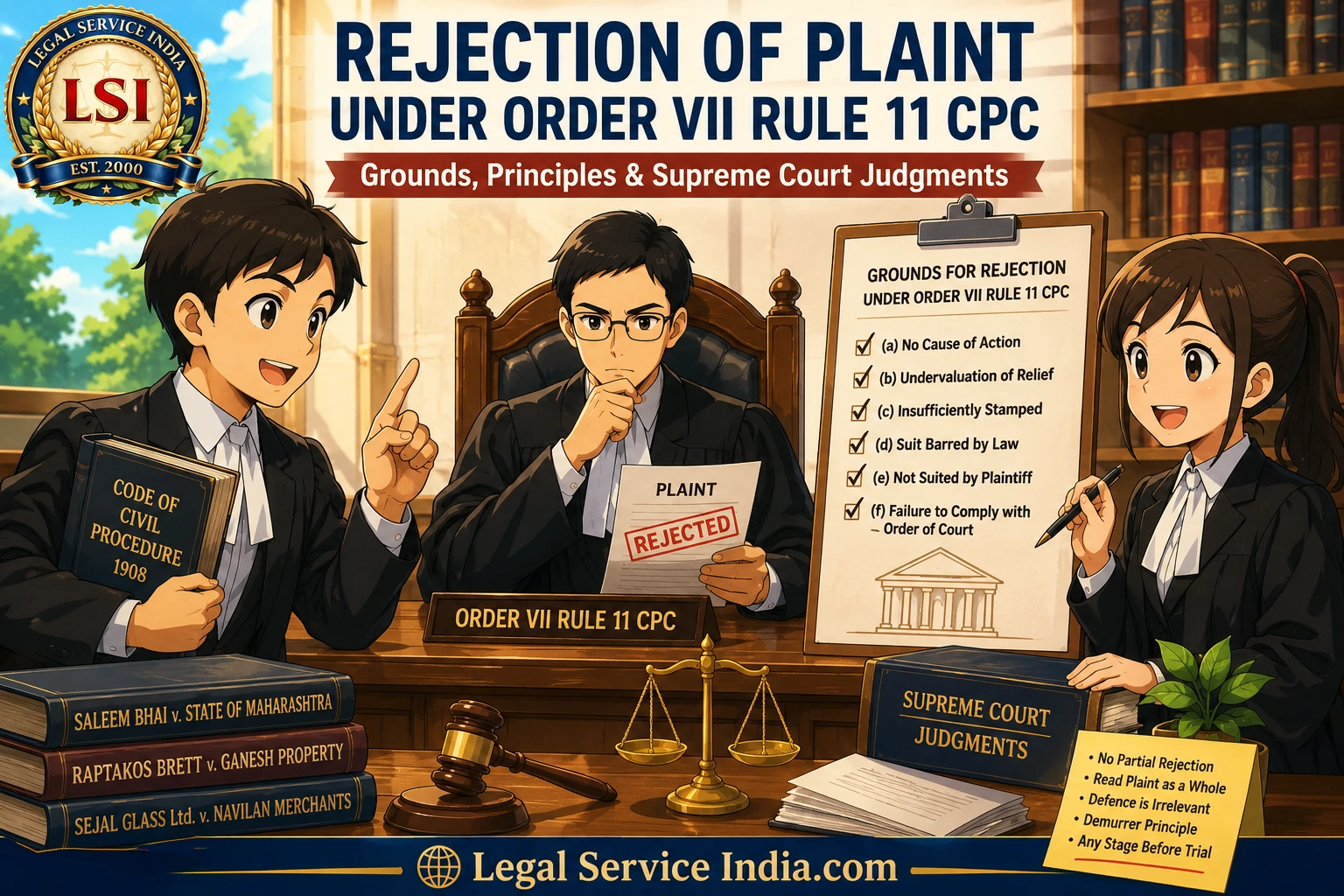
Grounds for Rejection of Plaint Under Order VII Rule 11 CPC — A Practitioner’s Comprehensive Treatise
I. Introduction and Statutory Purpose
The primary objective of Order VII Rule 11 of the Code of Civil Procedure, 1908 (“CPC”) is to terminate frivolous, vexatious, or legally untenable litigation at the very threshold. It functions as a statutory filter designed to save judicial time and to spare a defendant the harassment of a full trial where the plaint itself fails to establish a viable claim.
T. Arivandandam v. T.V. Satyapal (1977) 4 SCC 467 — the foundational authority: if clever drafting has created the illusion of a cause of action, it should be nipped in the bud at the first hearing by examining the plaint under Order VII Rule 11.
“The strength of a Rule 11 argument lies less in the number of authorities cited than in the precision with which each is matched to the proposition it actually supports.”
II. Core Principles Governing Order VII Rule 11
A. Exclusion of the Defence
The court must look strictly at the averments made in the plaint and the documents produced with it. The defence taken in the written statement, or in the Rule 11 application itself, is wholly irrelevant at this stage.
Saleem Bhai v. State of Maharashtra (2003) 1 SCC 557 — the relevant facts for deciding an application under clauses (a) and (d) are the averments in the plaint alone; the trial court may exercise the power at any stage of the suit, before or after summons, at any time before conclusion of trial.
Church of Christ Charitable Trust v. Ponniamman Educational Trust (2012) 8 SCC 706 — reiterates that the court must look only at the plaint and the documents relied upon by the plaintiff, and cannot travel into the defence.
B. The Demurrer Principle
The averments in the plaint are presumed to be true at this preliminary stage; the court does not weigh evidence or assess the plaintiff’s prospects of success.
C. The Indivisibility Principle — No Partial Rejection
A plaint cannot be rejected in part and retained in part; it must either be rejected as a whole or not at all. This rule traces to colonial-era authority and has been consistently reaffirmed by the Supreme Court across nine decades:
Maqsud Ahmad v. Mathra Datt & Co. AIR 1936 Lah 1021 — the earliest clear statement that the Code contains no provision for rejecting a plaint in part; a trial court’s note rejecting only a portion of the pleadings does not amount to rejection “as contemplated in the Civil Procedure Code.”
Roop Lal Sathi v. Nachhattar Singh Gill (1982) 3 SCC 487 : AIR 1982 SC 1559 — the Supreme Court itself held, in the context of an election petition governed by Order VI and VII CPC, that only a part of a plaint (or petition) cannot be struck down; if the pleading discloses no cause of action, it must be rejected as a whole and not selectively pruned.
Sejal Glass Ltd. v. Navilan Merchants (P) Ltd. (2018) 11 SCC 780 (2017 INSC 783) — the Supreme Court set aside a High Court order that had rejected the plaint only against the individual director-defendants while retaining it against the company; the plaint as a whole alone can be rejected under Rule 11.
Madhav Prasad Aggarwal v. Axis Bank Ltd. (2019) 7 SCC 158 — reaffirms Sejal Glass Ltd.; a plaint cannot be rejected against certain defendants or in respect of certain reliefs while being kept alive for the rest.
Geetha v. Nanjundaswamy 2023 SCC OnLine SC 1407 — decided 31 October 2023; the approach of partially rejecting a plaint is impermissible and contrary to well-entrenched Rule 11 jurisprudence.
Read together, these five authorities form an unbroken chain from 1936 to 2023 and may usefully be cited as a single composite line rather than as isolated precedents.
D. The Plaint Must Be Read as a Whole, Not in Isolated Lines
A closely related but analytically distinct safeguard requires that the plaint be read holistically — courts may not extract isolated sentences or paragraphs to justify rejection while ignoring the pleading’s overall import.
Raptakos Brett & Co. Ltd. v. Ganesh Property (1998) 7 SCC 184 — the averments in the plaint as a whole have to be seen to find out whether clause (d) of Rule 11 is attracted; a pleading is to be construed as it stands, without addition or subtraction, and its intention gathered from the tenor of the plaint taken as a whole.
Sri Biswanath Banik v. Sulanga Bose (2022) 7 SCC 731 — “few lines or a passage should not be read in isolation and the pleadings have to be read as a whole to ascertain its true import”; both the trial court and High Court had failed to advert to the relevant averments read holistically, and the rejection order was set aside.
This principle is distinct from, though it reinforces, the “meaningful reading” doctrine discussed next: the former concerns completeness of reading; the latter concerns the depth and substance of that reading.
E. Stage of Invocation
An application under Order VII Rule 11 can be filed at any stage of the suit before the conclusion of trial.
Dahiben v. Arvindbhai Kalyanji Bhanusali (2020) 7 SCC 366 — the remedy under Order VII Rule 11 is an independent tool to weed out meaningless litigation, exercisable at any stage before trial concludes.
III. Statutory Grounds of Rejection (Clauses (a) to (f))
Clause (a): Non-Disclosure of Cause of Action
A cause of action is the bundle of essential facts the plaintiff must prove to obtain relief. A distinction exists between non-disclosure of a cause of action and a weak or unprovable one: only where the averments, taken at face value, fail to disclose a bundle of facts giving rise to an actionable right can the plaint be rejected.
Liverpool & London S.P. & I Assn. Ltd. v. M.V. Sea Success I (2004) 9 SCC 512 — the cause of action must be clear from the face of the plaint, without adding to or subtracting from it.
Sopan Sukhdeo Sable v. Assistant Charity Commissioner (2004) 3 SCC 137 — the origin, alongside T. Arivandandam, of the requirement that the reading of the plaint be “meaningful and not merely formal.”
N.V. Srinivasa Murthy v. Mariyamma (2005) 5 SCC 548 — rejection upheld where the plaint, even read in proper perspective, failed to plead the facts necessary to found an actionable cause of action.
Dahiben v. Arvindbhai Kalyanji Bhanusali (2020) 7 SCC 366 — Order VII Rule 11 is an independent tool to weed out meaningless litigation where the plaint fails to set out an actionable claim; a meaningful, not mechanical or hyper-technical, reading applies.
Clause (b): Undervaluation of Relief
Where the relief claimed is undervalued and the plaintiff fails to correct the valuation within the time fixed by the court. The court cannot summarily reject the plaint on day one for undervaluation: it must first determine the correct valuation, direct correction within a specified timeframe, and reject the plaint only upon default.
Clause (c): Insufficiently Stamped Plaint
Where the plaint is correctly valued but written on paper insufficiently stamped, and the plaintiff fails to supply the requisite stamp paper within the period fixed by the court. As with clause (b), the court must grant a reasonable opportunity to pay the deficit court fee under Section 149 CPC before ordering rejection.
A. Nawab John v. V.N. Subramaniyam (2012) 7 SCC 738 — examines the discretionary power under Section 149 CPC to permit payment of deficit court fee, including where re-presentation occurs after the limitation period has run — directly relevant to the curable-defect proviso under clauses (b) and (c).
Clause (d): Suit Barred by Any Law
Where the suit appears from the statement in the plaint to be barred by any law — limitation, res judicata, or a specific statutory bar.
i. Bar of Limitation
Raghwendra Sharan Singh v. Ram Prasanna Singh AIR 2019 SC 1430 — where a plaint on its face shows the claim is time-barred, with no exemption pleaded under the Limitation Act, 1963, rejection is warranted.
Chhotanben v. Kiritbhai Jalkrushnabhai Thakkar (2018) 6 SCC 422 — where limitation is a mixed question of fact and law requiring evidence, the plaint cannot be rejected summarily at the threshold.
Popat and Kotecha Property v. State Bank of India Staff Assn. (2005) 7 SCC 510 — a plaint cannot be rejected under clause (d) unless the bar is apparent “without any doubt or dispute” from the plaint’s own statement; disputed limitation facts cannot be resolved at this stage.
ii. Genuine Statutory Bars, Distinguished From Procedural Bars
Express provisions ousting civil court jurisdiction — for example, Section 34 of the SARFAESI Act, 2002, or Section 430 of the Companies Act, 2013 — attract clause (d). It is critical, however, to distinguish a genuine jurisdiction-ouster provision from a merely procedural restriction on relief, such as Order II Rule 2 CPC.
State Bank of India v. Gracure Pharmaceuticals Ltd. (2014) 3 SCC 595 — Order II Rule 2 bars a plaintiff from splitting claims arising out of the same cause of action across successive suits — but this operates as a bar on relief, not a jurisdictional bar on the suit’s institution.
S. Valliammai v. S. Ramanathan 2026 INSC 372 — decided 16 April 2026 by Nagarathna and Bhuyan, JJ. The Court held that a plea of bar under Order II Rule 2 CPC cannot, by itself, ground rejection under Order VII Rule 11(d): that plea depends on comparing pleadings across two suits and requires evidence, and is therefore a matter for trial, not for the threshold stage. Only a genuine statutory or jurisdiction-ouster bar, discernible from the plaint itself, attracts clause (d); it distinguished N.V. Srinivasa Murthy v. Mariyamma and State Bank of India v. Gracure Pharmaceuticals Ltd. on this basis.
This distinction is now among the sharpest and most current statements of clause (d)’s outer limit, and merits prominent citation whenever a defendant seeks rejection on a procedural, rather than a true jurisdictional, bar.
Clause (e): Non-Filing in Duplicate
Where the plaint is not filed in duplicate as mandated by Order IV Rule 1(1) CPC.
Clause (f): Failure to Comply with Order VII Rule 9
Where the plaintiff fails to present the requisite number of copies of the plaint and process fees within the prescribed period.
IV. Effect of Rejection (Order VII Rule 13)
An order rejecting a plaint is deemed a decree under Section 2(2) CPC, making it appealable under Section 96. Crucially, rejection under any Rule 11 ground does not of itself preclude the plaintiff from presenting a fresh plaint on the same cause of action, provided the defect is curable and the claim remains within limitation.
Delhi Wakf Board v. Jagdish Kumar Narang (1997) 10 SCC 192 — a fresh suit instituted on the same cause of action, after an earlier plaint’s rejection under Rule 11, is not liable to dismissal merely because of the prior rejection order.
A. Nawab John v. V.N. Subramaniyam (2012) 7 SCC 738 — Rule 13 categorically declares that rejection does not, of its own force, preclude the plaintiff from presenting a fresh plaint in respect of the same cause of action.
V. A Consolidated Recent Restatement
Indian Evangelical Lutheran Church Trust Assn. v. Sri Bala & Co. 2025 INSC 42 — decided 8 January 2025. This judgment is valuable less for any single new proposition than as a comprehensive, current synthesis: it draws together T. Arivandandam, Sopan Sukhdeo Sable, Popat and Kotecha Property, Roop Lal Sathi, Raptakos Brett, Maqsud Ahmad, Sejal Glass, Madhav Prasad Aggarwal and Biswanath Banik in a single judgment, and is well suited for citation as an omnibus authority in the introduction or conclusion of any Rule 11 submission.
VI. Practitioner Checklist
- Confirm which clause of Rule 11 is invoked, and confine argument strictly to the plaint and the plaintiff’s own documents — never the written statement (Saleem Bhai; Church of Christ Charitable Trust).
- Read the plaint as a whole before framing submissions; do not rely on isolated sentences (Raptakos Brett; Biswanath Banik).
- For clause (a), test whether the pleaded facts are meaningfully absent, not merely weak (Sopan Sukhdeo Sable; Dahiben; Liverpool & London).
- For clause (d) limitation pleas, confirm the bar is apparent without dispute on the plaint’s own statement; if evidence is required, resist summary rejection (Popat and Kotecha; Chhotanben).
- For clause (d) statutory-bar pleas, verify the provision truly ousts jurisdiction rather than merely restricting relief (S. Valliammai; Gracure Pharmaceuticals).
- For clauses (b)/(c), ensure the court has granted an opportunity to cure valuation or stamp deficiency before seeking or resisting rejection (A. Nawab John).
- Never seek or concede partial rejection; the plaint stands or falls as a whole (Maqsud Ahmad → Roop Lal Sathi → Sejal Glass → Madhav Prasad Aggarwal → Geetha v. Nanjundaswamy).
- If a plaint has been rejected, advise promptly on re-filing within limitation; rejection alone does not bar a fresh suit on the same cause of action (Delhi Wakf Board; Order VII Rule 13).
VII. Consolidated Citation Table
| Case | Citation | Principle |
|---|---|---|
| T. Arivandandam v. T.V. Satyapal | (1977) 4 SCC 467 | Clever drafting creating an illusion of cause of action must be nipped in the bud |
| Roop Lal Sathi v. Nachhattar Singh Gill | (1982) 3 SCC 487 : AIR 1982 SC 1559 | Earliest Supreme Court articulation that only a part of a plaint cannot be struck down; if no cause of action, plaint must be rejected as a whole |
| Raptakos Brett & Co. Ltd. v. Ganesh Property | (1998) 7 SCC 184 | Plaint averments as a whole must be seen to determine clause (d); no isolated-sentence reading |
| Sopan Sukhdeo Sable v. Assistant Charity Commissioner | (2004) 3 SCC 137 | Origin of the “meaningful reading, not merely formal reading” test, alongside T. Arivandandam |
| Saleem Bhai v. State of Maharashtra | (2003) 1 SCC 557 | Verified Inquiry confined to plaint averments; written statement wholly irrelevant; power exercisable at any stage before trial concludes |
| Popat and Kotecha Property v. SBI Staff Assn. | (2005) 7 SCC 510 | Clause (d) bar must appear “without any doubt or dispute” on the plaint; disputed limitation facts cannot be resolved at threshold |
| N.V. Srinivasa Murthy v. Mariyamma | (2005) 5 SCC 548 | Cause of action must be pleaded with the requisite facts read in proper perspective; rejection upheld where plaint failed this test |
| Church of Christ Charitable Trust v. Ponniamman Educational Trust | (2012) 8 SCC 706 | Scrutiny confined to the plaint and the plaintiff’s own documents; defence is irrelevant |
| A. Nawab John v. V.N. Subramaniyam | (2012) 7 SCC 738 | Section 149 discretion on deficit court fee; re-presentation after limitation period considered |
| State Bank of India v. Gracure Pharmaceuticals Ltd. | (2014) 3 SCC 595 | Order II Rule 2 bar against splitting claims from the same cause of action; later distinguished in Valliammai |
| Chhotanben v. Kiritbhai Jalkrushnabhai Thakkar | (2018) 6 SCC 422 | Limitation as a mixed question of fact and law cannot be decided summarily at the Rule 11 stage |
| Sejal Glass Ltd. v. Navilan Merchants (P) Ltd. | (2018) 11 SCC 780 (2017 INSC 783) | Plaint as a whole alone can be rejected; no rejection against select defendants only |
| Raghwendra Sharan Singh v. Ram Prasanna Singh | AIR 2019 SC 1430 | Time-bar apparent from the plaint’s own averments, with no pleaded exemption, warrants rejection |
| Madhav Prasad Aggarwal v. Axis Bank Ltd. | (2019) 7 SCC 158 | Reaffirms indivisibility; no rejection against select defendants or select reliefs |
| Dahiben v. Arvindbhai Kalyanji Bhanusali | (2020) 7 SCC 366 | Meaningful reading; illusory, vexatious or manifestly time-barred claims fall within (a) and (d) |
| Sri Biswanath Banik v. Sulanga Bose | (2022) 7 SCC 731 | Isolated lines cannot found rejection; plaint must be read as a whole to ascertain true import |
| Geetha v. Nanjundaswamy | 2023 SCC OnLine SC 1407 | Partial rejection held impermissible; plaint stands or falls as a whole |
| Indian Evangelical Lutheran Church Trust Assn. v. Sri Bala & Co. | 2025 INSC 42 | Verified Comprehensive recent restatement of the whole doctrine, including Rule 13 |
| S. Valliammai v. S. Ramanathan | 2026 INSC 372 | Order II Rule 2 bar (omitted relief) is not itself a clause (d) ground; only true jurisdiction-ouster bars qualify |
| Maqsud Ahmad v. Mathra Datt & Co. | AIR 1936 Lah 1021 | Earliest statement that the Code contains no provision for rejecting a plaint in part |
| Delhi Wakf Board v. Jagdish Kumar Narang | (1997) 10 SCC 192 | Fresh suit on same cause of action after Rule 11 rejection is not itself barred |
| Liverpool & London S.P. & I Assn. Ltd. v. M.V. Sea Success I | (2004) 9 SCC 512 | Cause of action must be clear from the face of the plaint, without addition or subtraction |
VIII. Concluding Paragraph
The power under Order VII Rule 11 is to be exercised on a meaningful reading of the plaint, considered as a whole and not through isolated passages, confined strictly to the plaint and the plaintiff’s own documents, without reference to the defence. A plaint that is genuinely barred by limitation or by a true statutory or jurisdiction-ouster provision, apparent on its own averments, must be rejected; but a plea resting on a procedural bar such as Order II Rule 2, or on disputed questions of fact, cannot be resolved at this threshold stage. The power, moreover, attaches to the plaint as an indivisible whole — a doctrine traceable from Maqsud Ahmad in 1936 through Roop Lal Sathi, Sejal Glass Ltd., Madhav Prasad Aggarwal, and Geetha v. Nanjundaswamy — and its exercise does not, by itself, preclude the institution of a fresh suit on the same cause of action once the defect is cured.

