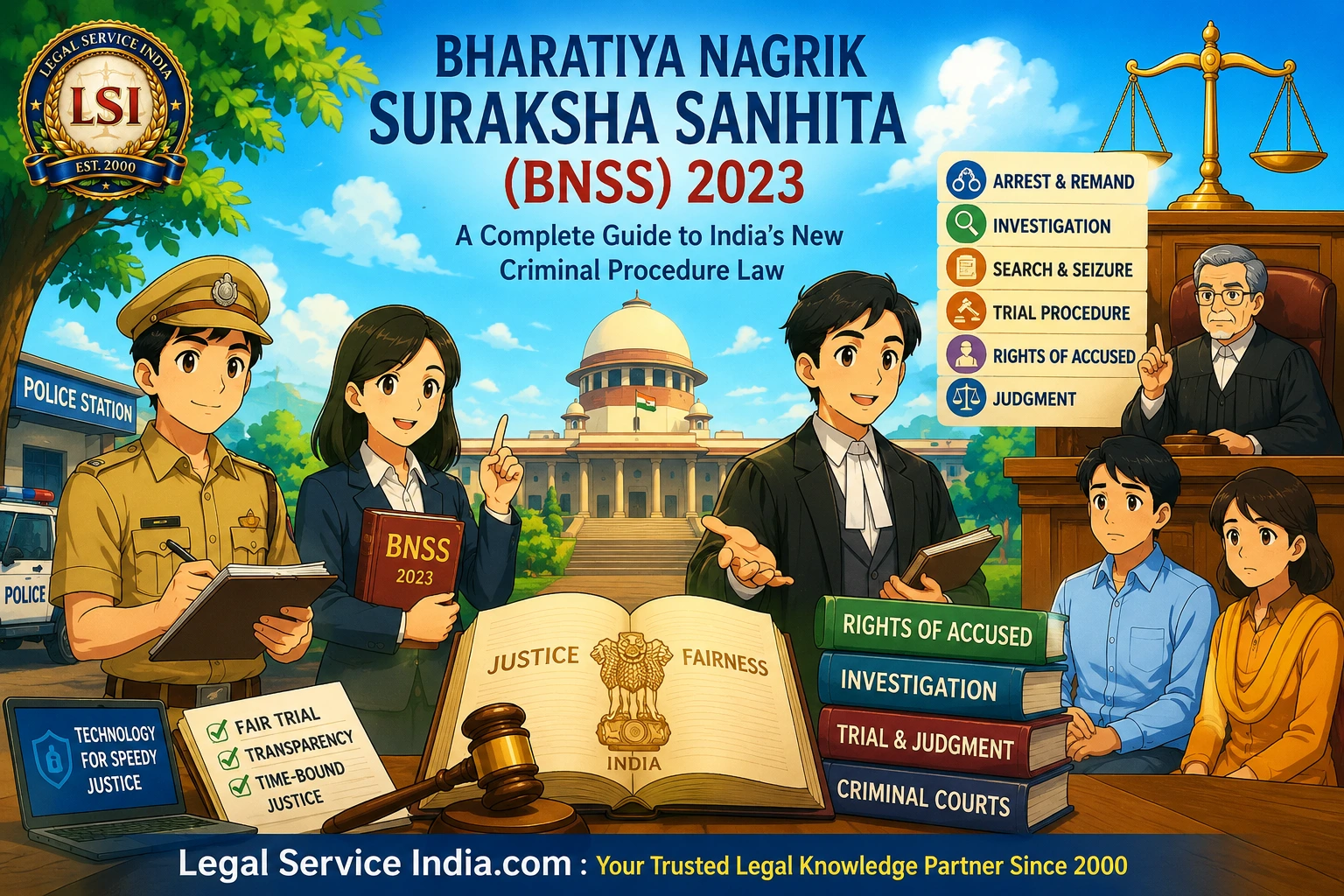
Bhartiya Nagrik Suraksha Sanhita, A Complete Guide
This complete guide will walk you through every major change in the new law, explaining each and every provision of the criminal procedure. India has officially closed the book on its colonial era of policing. The Bharatiya Nagarik Suraksha Sanhita (BNSS) is the new law of the land. It replaces the old Code of Criminal Procedure from 1973.
This massive change reshapes how police investigate crimes and how courts run trials. It brings technology into the legal system and sets strict deadlines to finish cases faster. It examines the role of the police and other authorities in the investigation, studies the rights of the accused person in a fair trial process, and examines the procedure in respect of investigation, trial and punishment from the perspective of criminal justice administration.
Topics Covered in This Guide
This articles delves into the following:
- Salient Features of the Bhartiya Nagarik Suraksha Sanhita, 2023.
- Constitution of Criminal Courts — Jurisdiction and Powers.
- Arrest of Persons (Sections 41-62).
- Search and Seizure (Sections 103, 185 and 186).
- Process to Compel Production of Persons and Things (Sections 94-105).
- Security for Keeping the Peace, Maintenance of Public Tranquillity and Preventive Action (Sections 125-142).
- Investigation (Sections 154-187).
- Initiating and Commencement of Proceedings (Sections 190-210).
- Charge (Sections 234-247).
- Trial – Summary (Sections 283-288), Warrant (Sections 259-269), Sessions (Sections 248-258) and Summons (Sections 274-282).
- Judgement (Sections 392-393).
Salient Features of the Bhartiya Nagrik Suraksha Sanhita, 2023
The BNSS provides a comprehensive hierarchy of criminal courts conferring jurisdiction, powers and functions which enables the state to work independently and impartially without interference from any other organs of the state.
The accused is presumed to be innocent until the charges are proved.
The accused has the right to be represented by his counsel.
Further, the accused has a right to cross-examine the witnesses of the opposite party.
There are sufficient provisions that provide for the arrest of a person yet at the very same time contain provisions protecting the rights of the arrested person.
The act provides for production of persons and things before the court.
In petty cases the accused can even plead guilty by post and send the amount of the fine specified in the summons to the court; therefore, he need not appear before the court.
All judicial magistrates are under the control of the High Court in the hierarchy prescribed.
The procedure for a trial is given at length, with procedures varying from case to case depending upon the gravity of offences.
It defines and provides for a complaint, police report and FIR, followed by the process and procedures for the same.
Classification of offences into bailable and non-bailable as well as cognisable and non-cognisable for which a police officer may, in accordance with law for the time being in force, arrest with a warrant. Whereas in a non-cognisable offence, a police officer has no authority to arrest without a warrant.
Key Features Summary Table
| Feature | Description |
|---|---|
| Criminal Courts’ Hierarchy | Provides jurisdiction, powers and functions to criminal courts. |
| Presumption of Innocence | The accused is presumed innocent until charges are proved. |
| Right to Counsel | The accused has the right to be represented by counsel. |
| Cross-Examination Rights | The accused can cross-examine witnesses of the opposite party. |
| Protection During Arrest | Contains provisions for arrest while safeguarding rights of arrested persons. |
| Production of Persons and Things | Provides procedures for production before courts. |
| Plea by Post | Permits accused in petty cases to plead guilty by post. |
| Judicial Supervision | Judicial magistrates function under the control of the High Court. |
| Trial Procedures | Different procedures based on gravity and nature of offences. |
| FIR and Police Reports | Defines complaint, police report and FIR procedures. |
| Classification of Offences | Categorises offences as bailable/non-bailable and cognisable/non-cognisable. |
Important Procedural Areas Under BNSS
- Arrest of Persons: Sections 41-62
- Search and Seizure: Sections 103, 185 and 186
- Production of Persons and Things: Sections 94-105
- Peace and Public Tranquility: Sections 125-142
- Investigation: Sections 154-187
- Commencement of Proceedings: Sections 190-210
- Charge: Sections 234-247
- Trial Procedures: Summary, Warrant, Sessions and Summons Trials
- Judgment: Sections 392-393
Constitution of Criminal Courts – Powers and Functions
Section 6 of Bharatiya Nagrik Suraksha Sanhita, 2023 (BNSS), states that besides the High Courts and the courts constituted under any law other than this Sanhita, there shall be, in every state, the following classes of criminal courts, namely:
Courts of Session
- Courts of Session: shall be presided over by a judge, to be appointed by the High Court, who may, upon directions from the High Court, also be an additional sessions judge of another division. Section 8 of BNSS states that the High Court may also appoint additional sessions judges to exercise jurisdiction in a court of session. If, in any particular case, the Court of Session is of opinion that it will tend to the general convenience of the parties and witnesses to hold its sittings at any other place in the sessions division, it may, with the consent of the prosecution and the accused, sit at that place for the disposal of the case or the examination of any witness or witnesses therein.
Chief Judicial Magistrates
- Chief Judicial Magistrates: As per section 10, BNSS states that every district shall have a judicial magistrate first class to be appointed as chief judicial magistrate or additional CJM or subdivisional judicial magistrate with such powers as may be specified, appointed by the High Court.
Special Judicial Magistrate
- Special Judicial Magistrate: As per section 11 of the BNSS, the High Court may appoint any judicial magistrate of first or second class as a special judge for a term not exceeding one year at a time upon the request made by the central or state government.
Judicial Magistrates of the Second Class
- Judicial Magistrates of the second class.
Executive Magistrates
- Executive Magistrates: As per section 14, every district shall have as many persons as the state government thinks fit appointed as executive magistrates and one person as the district magistrate. The state government may place an executive magistrate in charge of a subdivision or may even allow them to delegate their powers.
Changes Under BNSS
- Concept of Assistant Sessions The judge and metropolitan magistrate have been done away with under BNSS.
The law imposes duty on the police and members of society to assist the magistrates in the prevention of crimes and arrest of persons. The following shows the powers of the respective courts to grant punishment.
Powers of Criminal Courts to Award Punishment
| Court | Punishment Powers |
|---|---|
| Supreme Court | Any punishment |
| High Court | Any punishment |
| Sessions and District Judges | Death sentence, life imprisonment (to be ratified by HC) and fine. |
| Additional Session Judge | Death sentence, life imprisonment (to be ratified by HC) and fine. |
| Assistant Session Judge | Ten years’ imprisonment and a fine. |
| Chief Judicial Magistrate | Seven years’ imprisonment and a fine. |
| Additional Chief Judicial Magistrate | Seven years’ imprisonment and fine. |
| Judicial Magistrate First Class | Three years’ imprisonment and a fine. |
| Judicial Magistrate Second Class | One year imprisonment and fine upto Rs.10,000/- |
Arrest
Precisely sections 35 to 62 of the Bhartiya Nagrik Suraksha Sanhita deal with arrest, and Article 21 of the Indian Constitution says that “no person shall be deprived of personal liberty except according to the procedure established by law”. Therefore, the State, Courts and Police ensure the following to an arrested person –
Rights of an Arrested Person
- Right to be informed of the grounds of arrest.
- Right to be defended by a lawyer of his own choice.
- Right to be produced before a magistrate.
- No detention beyond 24 hours without the authority of law.
- Right to know about the charges and see the contents of the warrant.
- Right to medical examination in deserving cases.
- Right to have a woman police if the arrested person is a woman.
Who May Be Arrested Without a Warrant?
Any person can be arrested by the police who is concerned in any cognisable offence; is in the process of house-breaking; is in possession of stolen property; obstructs a police officer in the discharge of his duties; is declared a deserter from the armed forces; or commits a non-cognisable offence in the presence of police and refuses to give his name and address.
However, it is noteworthy that as per Section 35(7) of the BNSS, police cannot arrest anyone above 60 years of age or any person who is infirm without the prior permission of the DSP.
Power of a Private Person to Arrest
Any person can be arrested by a private individual u/s 41. When the law permits even a private person to arrest the accused if the accused commits any non-bailable and cognisable offence in his presence. He shall without any delay make over such a person to a police officer; in such cases the police officer can re-arrest him.
Power of the Magistrate to Arrest
The Judicial Magistrate and the Executive Magistrate are empowered to arrest a person or authorise any person to arrest the accused in the following circumstances:
- Any offence committed in his presence.
- Any person against whom the warrant can be issued.
Procedure of Arrest and Rights of Arrested Person
While arresting, the police must strictly abide by the protocols set in section 36 of the BNSS; every police officer must wear a clear and visible identification of name and designation. The police officer must draft an arrest memo detailing the grounds of arrest, which is to be signed by the person arrested and one family member, local witness or whosoever is present. The police must inform friends or relatives of the person arrested about the arrest.
As per section 43 of the BNSS, the police must not use handcuffs unless the person being arrested resists the arrest or attempts to evade. However, it may be allowed for habitual offenders, escapees, terrorists, murderers, rapists, or serious offenders.
Arrest of Women
As for women, except for exceptional circumstances, no woman can be arrested after sunset and before sunrise unless explicitly permitted by a first-class magistrate.
Search and Seizure
‘Search’ refers to the physical examination of the body of a person, of the place around him, of a vehicle or of other things related to the crime, whereas a ‘seizure’ is the step that follows a search, which involves taking possession of material found during the search if it is relevant to the investigation. Under the BNSS, the police may search with and without a warrant, depending upon the circumstances of each case; however, at times a search might be rendered illegal, following serious consequences.
Power to Search Without Warrant Under BNSS
The power to search without a warrant as per section 185 of BNSS, earlier 165 of the CRPC, empowers a police officer who is in charge of a police station or an investigating officer to search within the jurisdictional limits even without a warrant where there is a probability of evidence being destroyed or concealed, yet it does not give blanket protection.
The honourable Bombay High Court laid guidelines in State of Maharashtra versus Rahman, AIR 1960 SC210, that the following must be met to validate a search conducted without a warrant.
| S. No. | Requirement for Valid Search Without Warrant |
|---|---|
| 1 | Reasonable grounds that investigation was necessary |
| 2 | A delay could compromise the investigation |
| 3 | The reasons for such search and seizure must be recorded in writing. |
| 4 | It must be conducted by the officer incharge personally, or if delegated, that must be written |
| 5 | Copies of the records so maintained must be sent to the nearest magistrate for cognisance. |
Audio-Video Recording Mandate Under BNSS
The core procedure as provided under the CRPC resonates with that provided in BNSS, a star edition being the mandatory audio-video recording mandate under section 105 of the code, preferably using a mobile phone.
The recording so made must be forwarded to an executive or judicial magistrate without a delay and within 24 hours. In case of a warranty search, the section uses the word “shall”, thus making this an absolute necessity, leaving no ground for discretion.
Search Beyond Jurisdictional Limits
In matters of search beyond jurisdictional limit, as provided under section 186 of the BNSS, an officer in charge of a police station or any officer not below the rank of sub-inspector may either conduct a search in the other jurisdiction themselves or send a written requisition to the police station concerned, asking them to conduct the search and procedure following the principles as laid out for search in general.
In cases where undue delay might result in evidence being destroyed or concealed, the requesting officer may directly approach the other jurisdiction and conduct the search as if conducting the search within their own station’s limits; they must immediately notify the magistrate empowered to take cognisance by sending copies of the records prepared and informing the local police station concerned as provided under section 103 of BNSS.
Procedural Safeguards
In order to ensure the police are not using the power of certain seizures in an arbitrary or abusive manner, the code itself lays down certain safeguards under section 103 of the BNSS, an earlier section 100 of the CRPC.
- At least two independent witnesses, respectable residents of the locality, must be present at the time of search or seizure.
- The owner or occupant must be present either in person or through a representative in case of a search on the premises.
- In the case of a Purdanashin woman, a prior notice must be given for her to withdraw before the police enter the premises.
- Panchnama, which is the detailed record of items seized on spot, must be prepared and signed by the officer. An investigation of an accompanying witness’s presence and the owner’s or occupant’s signed copy of the same must also be given to the owner or occupier of the place.
Effect of Non-Compliance With Procedural Safeguards
In case the procedural requirements as mentioned above are not met, it may not necessarily always render such an act illegal and the evidence so obtained inadmissible.
However, the Supreme Court has held that evidence from an illegal search does not become inadmissible ipso facto unless it causes serious prejudice to the accused.
It is noteworthy that though the admissibility of evidence may not be in question, the state shall have to compensate the individual for violating the privacy and infringing rights and acting in an arbitrary manner.
Key Takeaways on Search and Seizure Under BNSS
- Search and seizure are distinct but interconnected investigative processes.
- Section 185 of the BNSS permits warrantless searches in urgent circumstances.
- Reasons for search and seizure must be properly recorded in writing.
- Audio-video recording of searches is a significant procedural safeguard under BNSS.
- Searches outside the jurisdiction are permissible under section 186 BNSS subject to statutory requirements.
- Independent witnesses and preparation of Panchnama remain crucial safeguards.
- Illegal search does not automatically make evidence inadmissible, though compensation may be awarded for violation of rights.
Process to Compel Production of Persons and Things
The process to compel production of persons and things is covered under chapter 7 of the BNSS empowering codes to secure crucial evidence and material for proper investigation and trial. The court has the power to compel the production of necessary items. The courts and the police may issue someone a summons or order to anyone to appear personally or deliver the document or thing in their possession, as per section 94 of BNSS.
If a person so summoned fails to comply, or if the authority believes that the failure was voluntary, a general search or targeted inspection may be allowed by a district magistrate or judicial magistrate under section 96 BNSS that provides when a search warrant may be issued and section 99 BNSS that provides for application to the High Court to set aside a declaration of forfeiture.
Search Warrants, Production of Persons and Documents
The code has strict protocols to safeguard personal liberty, yet at the same time, it compels the production of persons involved in the matter or the ones who have been illegally detained as given under sections 100 and 101 of the code, which compels the restoration of abducted females to the family.
The courts issue summons or warrants of arrest, which may be bailable or non-variable, depending upon the frequency of appearance. In case a DM, SDM or JMFC has a reason to believe in the existence of an offence suspected to contain stolen property or forged documents as per sections 97 and 96 of BNSS, they may issue a search warrant, whereas as per a person when he or she is unlikely to produce the required document item before the court or when the location of the documents is unknown or when a general search is considered necessary for fair enquiry and trial under this code as per section 96 of BNSS. The police are empowered to seize certain property as per section 106 of the code. A search may be conducted in the presence of a magistrate.
Important Provisions Under BNSS
| Section | Subject Matter |
|---|---|
| Section 94 BNSS | Production of documents or things before authorities |
| Section 96 BNSS | Issue of search warrants and general search |
| Section 97 BNSS | Search relating to stolen property or forged documents |
| Section 99 BNSS | Application to the High Court to set aside declaration of forfeiture |
| Sections 100 & 101 BNSS | Production of persons and restoration of abducted females |
| Section 106 BNSS | Police power to seize certain property |
Security for Keeping the Peace and Good Behaviour (Sections 125-142)
Chapters IX and XI.
When a person is convicted for committing or abetting the offences as mentioned under section 125(2) BNSS, he may be required by any court of session, judicial magistrate first class or any revisional or appellate court to execute a bond or bail bond to ensure no breach of peace will be caused by him in the future.
It is also crucial to understand what actually amounts to breach of peace. It could be –
- Offences against public tranquility as provided under chapter XI of the BNS,
- Promoting enmity between members of different groups as under 196 BNS,
- Making imputations or assertions prejudicial to national integrity as under section 197 BNS,
- Offences involving assault or use of criminal force or mischief,
- Offence of criminal intimidation or any act known to the offender to cause breach of peace, etc.
Security for Keeping Peace in Other Cases (Section 126 BNSS / 107 CrPC)
The term ‘other cases’ here means cases not leading to conviction; these empower even the executive magistrates to make a person execute a bond for a term not exceeding one year, where he receives information of an act causing a breach or affecting public tranquillity.
The period for this security must not exceed one year, and in the case of those undergoing a term, it shall start after the imprisonment has ended. However, in cases other than conviction, a show cause notice shall be issued and an enquiry shall be made as per section 135BNSS.
Security for Keeping Good Behaviour
Under the code, precisely sections 127-129 deal with instances that require security from persons disseminating certain matters, from suspected persons, and for good behaviour from habitual offenders, respectively.
Now comes a question: what is meant by ‘dissemination’? It could be the publication of any matter punishable under Section 152, 196, 197 or 299 of the Bharatiya Nyaya Sanhita or any matter concerning criminal intimidation or defamation of a judge acting in his official duties or making, producing, selling, conveying or exhibiting in any manner any obscene matter as defined in Section 294 of BNS or the like with certain exemptions in matters of publication.
Show Cause, Inquiry and Bond Proceedings
In any of the aforementioned matters, a show cause may be issued, and an inquiry (to be completed within 6 months) shall be conducted under section 135 BNSS, which may seek execution of a bond for good behaviour through an order issued under section 130 BNSS or may even lead to discharge of the accused as given under section 137 BNSS.
The code also provides that the amount of bail and bond shall not be excessive. It is significant to consider the circumstances where the person fails to pay security, so in default of security, the person shall undergo as much punishment (simple imprisonment) as prescribed in his order or may even be given a new punishment if the bond is breached.
The person undergoing such punishment may even be discharged by the DM or the Chief Judicial Magistrate, as the case may be, as provided under section 142 BNSS.
Key Features of Security Proceedings Under BNSS
| Provision | Purpose |
|---|---|
| Section 125 BNSS | Security for keeping peace after conviction |
| Section 126 BNSS | Security for keeping peace in other cases |
| Sections 127-129 BNSS | Security for good behaviour from specified categories of persons |
| Section 130 BNSS | Order for execution of bond for good behaviour |
| Section 135 BNSS | Show cause notice and inquiry proceedings |
| Section 137 BNSS | Discharge of accused where appropriate |
| Section 142 BNSS | Discharge by DM or Chief Judicial Magistrate |
Investigation Under BNSS
Investigation is often confused with inquiry; the former is collecting evidence, recording statements, arresting and filing the chargesheet by police, whereas the inquiry is what a magistrate does short of a full trial, such as examining whether there are grounds to proceed.
Meaning and Scope of Investigation
The process of collecting facts, evidence, and materials related to the crime of the offence, committed in order to figure out the truth. It commences generally after the registration of the FIR, wherein the officer concerned visits the place of occurrence, collects evidence, examines witnesses, conducts searches and seizures and even arranges for the person if necessary. With the enactment of BNSS, this process of investigation has been made time-bound, transparent and more efficient.
The term ‘investigation’ is precisely defined under section 2L of the act as follows:
“Investigation” includes all the proceedings under this Sanhita for the collection of evidence conducted by a police officer or by any person (other than a Magistrate) who is authorised by a Magistrate on this behalf.”
Key Features of Investigation Under BNSS
| Aspect | Description |
|---|---|
| Commencement | Generally begins after registration of the FIR. |
| Purpose | Collection of facts, evidence, and materials to discover the truth. |
| Activities Involved | Visit to place of occurrence, examination of witnesses, searches, seizures, and other investigative steps. |
| Objective | Transparent, efficient, and time-bound investigation process. |
Attendance of Persons Acquainted with Facts
As per section 179 of BNSS, the police have the power to require the attendance of the person acquainted with the facts and circumstances of the matter within the territorial limits of jurisdiction.
It also provides that the following persons shall not be required to attend such an investigation in general:
- Men below the age of 15 years.
- Men above 60 years of age.
- Women.
- Mentally challenged people.
- Physically challenged people.
- Those suffering from acute ailments.
Oral Examination of Witnesses Under Section 180
The section that follows that, 180 BNSS, authorises the police officer to examine witnesses orally, which may be reduced into written statements. The person so questioned is bound to answer, except where answering would incriminate him (as per article 20 clause 3 of the Indian Constitution).
However, such statements made to the police officer cannot be considered during the trial, as they lack evidentiary value, unlike the statement made voluntarily before a magistrate, except under the following circumstances:
- Statements leading to discovery of facts under section 23 of BSA.
- Dying declaration under section 26(a) BSA.
- In re-examination as a part of the statement.
- Contradicting previous statements, if made in writing under section 148 BSA.
Search Powers of Police During Investigation
A police officer investigating a matter may even make a search on reasonable grounds when it is necessary within the limits of the police station he is in charge of.
Confession During Investigation
As per section 183 of BNSS, confessions can be made and recorded before a magistrate with or without jurisdiction at any point during the investigation before the commencement of trial.
It is the duty of the magistrate concerned to clearly explain to the accused that such a confession may be used against him.
The magistrate shall then prepare and sign a memorandum stating that the accused was informed of his rights, that the confession was read over to him and was made voluntarily, providing a full and true account of the event.
Safeguards for Recording Confession
- The confession must be recorded before a magistrate.
- The accused must be informed that the confession may be used against him.
- The confession must be voluntary.
- The magistrate must prepare and sign a memorandum.
- The confession should provide a full and true account of the event.
Case Diary Under Section 192 BNSS
Section 192 of the BNSS imposes a statutory duty upon the police to maintain a case diary, reflecting day-to-day progress of the investigation; assist the court; refresh the memory of the investigating officer; and most importantly, ensure transparency.
This diary must contain:
- The time of commencement of the investigation.
- The time of completion of the investigation.
- Places visited.
- Circumstances ascertained.
- The statements taken under section 180.
However, it is not worthy that the accused or any of his representatives have no right to inspect or know the contents of this diary.
Completion of Investigation and Filing of Chargesheet
After this entire process that is referred to as ‘investigation’ is complete, the accused may either be released or be taken into custody if not already taken, followed by the filing of the chargesheet under section 193(3) BNSS.
Stages After Investigation
- Completion of investigation.
- Release of the accused or taking the accused into custody, if not already taken.
- Preparation of the police report/chargesheet.
- Filing of the chargesheet under section 193(3) BNSS.
Summary of Investigation Under BNSS
| Stage | Relevant Provision | Purpose |
|---|---|---|
| Definition of Investigation | Section 2L BNSS | Collection of evidence by authorised persons. |
| Attendance of Persons | Section 179 BNSS | Securing cooperation of persons acquainted with facts. |
| Examination of Witnesses | Section 180 BNSS | Recording oral statements during investigation. |
| Confession Before Magistrate | Section 183 BNSS | Voluntary confession with legal safeguards. |
| Maintenance of Case Diary | Section 192 BNSS | Transparency and record of investigation progress. |
| Filing of Chargesheet | Section 193(3) BNSS | Submission of final report after investigation. |
Remand and Custody
Remand can be understood as the authorised continued detention of a person accused when the investigation in a matter is going on that could not be completed within 24 hours of the arrest, as in Section 58 BNSS.
The maximum period of detention in offences punishable with 10 years or more of imprisonment or death, life imprisonment shall not be more than 90 days. Whereas 60 days for other offences as provided under section 187(3) of BNSS.
The custody may be police or judicial. The former requires no prior permission and authorisation via judicial magistrate, irrespective of jurisdiction, and can be granted for 15 days in all but may extend to 60 days when the period of investigation is 90 days, whereas the latter requires prior permission and may be conducted in person or through audio-video electronic means.
In cases where the accused deserve women or a minor, such detention shall be in a demand home or social institution recognised by law.
Remand may also be authorised by an executive magistrate. When a judicial magistrate is not available, although it can extend only up to 7 days. The accused must either be released or be produced before a judicial magistrate.
Types of Custody Under BNSS
| Type of Custody | Key Features |
|---|---|
| Police Custody | Requires authorisation by a judicial magistrate, irrespective of jurisdiction; can be granted for 15 days and may extend up to 60 days when the investigation period is 90 days. |
| Judicial Custody | Requires prior permission and may be conducted in person or through audio-video electronic means. |
Important Points on Remand
- Investigation not completed within 24 hours may result in remand.
- Maximum detention period is 90 days for serious offences punishable with death, life imprisonment, or imprisonment of 10 years or more.
- The maximum detention period is 60 days for other offences under Section 187(3) BNSS.
- Women and minors must be detained in a remand home or a legally recognised social institution.
- An executive magistrate may authorise remand when a judicial magistrate is unavailable, but only up to 7 days.
- After the authorised period, the accused must either be released or be produced before a judicial magistrate.
Charge Under BNSS
It is a formal recognition of a concrete accusation by the magistrate or court based upon a complaint or information against the accused.
The right to be informed of the accusation is a foundational pillar of fair trial principles in criminal jurisprudence. If the accused does not know exactly what they are charged with, the opportunity to defend themselves becomes meaningless, leading to grave injustice.
The rules governing the contents, form, and joinder (consolidation) of charges are outlined in Chapter 18 (Sections 234 to 247) of the BNSS.
Contents of Charge (Section 234)
The charge must state the specific offence, the law and section violated, and specify the time, place, and person against whom the offence was committed.
The charge must always include:
- the offence with which the accused is charged.
- the exact offence name for which the accused is charged.
- The definition of the offence must be clearly stated so as to bring to the knowledge of the accused the exact matter with which he has been charged if a particular name doesn’t exist.
- The law and the section of the law.
- legal condition necessary by law to create the alleged offence has been met in this case.
- must be written in the language of the court.
- If the accused has been previously convicted of any offence, then the fact, date and place of previous conviction should be stated in the charge for enhanced punishment.
When the aforementioned particulars are not sufficient to explain the offence with which the accused is charged, the charge shall contain such particulars of how the alleged offence took place.
Essential Elements of a Charge
| Requirement | Description |
|---|---|
| Offence | The offence with which the accused is charged. |
| Offence Name | The exact name of the offence. |
| Definition | Clear description where no specific offence name exists. |
| Applicable Law | The relevant law and section were violated. |
| Legal Conditions | Necessary legal conditions constituting the offence. |
| Language | Must be written in the language of the court. |
| Previous Conviction | Fact, date, and place of previous conviction for enhanced punishment. |
Separate Charges (Section 241)
The general rule mandates a separate charge and trial for every distinct offence to prevent prejudice to the accused.
Exceptions
- Several distinct offences committed within one year can be charged together.
- Multiple offences committed in a single transaction can be charged together at one trial.
Alteration of Charge
Any court is empowered to alter or add to a charge at any point prior to the delivery of the judgement. This must be evidence-driven and can only be used to add or modify charges; it cannot be used to delete a charge once it has been legally framed.
If the court finds that the alteration is significant enough to prejudice the defence, the judge may either adjourn the trial for a necessary period or direct a completely new trial.
The accused (as well as the prosecutor) has the right to recall, summon, and re-examine any witness who has already been examined, provided the testimony is relevant to the newly altered charge.
The court also retains the discretionary power to summon and examine any further witnesses if they are deemed material to the new charge.
Rights Following Alteration of Charge
| Aspect | Provision |
|---|---|
| Power of Court | May alter or add to a charge before judgement is delivered. |
| Basis for Alteration | Must be evidence-driven. |
| Deletion of Charge | Cannot be used to delete a charge once legally framed. |
| Protection of Defence | The court may adjourn the trial or order a fresh trial if prejudice is likely. |
| Rights of Accused and Prosecutor | May recall, summon, and re-examine relevant witnesses. |
| Additional Witnesses | The court may summon further material witnesses. |
Time Limits for Framing of Charge Under BNSS
To prevent inordinate delays that previously plagued criminal proceedings, the BNSS established strict statutory deadlines for sessions and trials.
The judge must frame the formal charge in writing within 60 days from the date of the first hearing on the charge. The Supreme Court of India has directed strict pan-India adherence to this 60-day mandate to expedite justice.
Discharge and Framing of Charge
- Before charges are framed, the accused has the opportunity to apply for discharge (e.g., Section 239 BNSS) if they believe the allegations are groundless.
- Once the judge frames the charges, they must be read and explained to the accused in person (or via audio-video electronic means for detainees).
- The accused are then asked whether they plead guilty or wish to claim trial.
- If applicable, an application for plea bargaining must be filed within 30 days of the charge being framed.
Trial Under BNSS
It is the judicial process that determines the guilt of an accused. Depending upon the gravity and severity of the offence, the trial is of different types, beginning from investigation and leading to final judgement that is the acquittal or sentencing of the accused.
However, in general, the following are the stages of a criminal trial under BNSS.
Stages of Criminal Trial Under BNSS
| Stage | Procedure |
|---|---|
| 1 | Filing of an FIR under Section 173 followed by a preliminary inquiry. |
| 2 | Investigation under Sections 174-187 involving forensics in cases punishable with seven years or more as mandated by Section 176 of the BNS. |
| 3 | Filing of chargesheet or police report, as the case may be, under Sections 193 and 210. It must be filed in general within 60 days, which may extend to 90 days for serious offences. |
| 4 | Framing of charges within 60 days of the first hearing on the charge. |
| 5 | Prosecution evidence (chief, cross, and re-examination) examination of the witnesses would not allow more than two adjournments allowed per party as per Section 346 BNSS. |
| 6 | Statements made by the accused (not on oath) after evidence was led by prosecution. |
| 7 | Evidence led by defence, followed by arguments. |
| 8 | Final arguments. |
| 9 | Judgement and sentence or discharge to be given within 30 days, which may be extended up to 45 days for reasons to be recorded in writing. |
| 10 | Appeal or revision. |
Quick Overview of Criminal Trial Process
- FIR and Preliminary Enquiry
- Investigation and Forensic Examination
- Filing of Chargesheet or Police Report
- Framing of Charges
- Prosecution Evidence
- Statement of the Accused
- Defence Evidence and Arguments
- Final Arguments
- Judgement, Sentence, or Discharge
- Appeal or Revision
Types of Criminal Trials Under BNSS
Moreover, not every criminal trial traces the same path. The Summons Trial (274-279 BNSS) in the case of offences punishable up to 2 years is conducted by a magistrate and does not require a formal framing of charge; the mere substance of the accusation being stated is sufficient, with a brief record of evidence and a simplified procedure for quick disposal of cases.
A warrant trial (263-273 BNSS) in offences punishable with imprisonment exceeding two years is conducted by a Chief Judicial Magistrate or Judicial Magistrate First Class. It involves formal framing of charges followed by thorough chief, cross and re-examination, generally in cases constituted upon a complaint or a police report.
The most important of all being the Sessions trial (Sections 248-260 (Chapter XIX)) is conducted by a Court of Session in serious offences like murder, rape, dacoity or others exclusively triable by a Court of Session, followed by framing a formal charge under 251BNSS post full chief, cross and re-examination on record.
Lastly, the simplest of all is summary trial (283-288 BNSS) in petty offences without formal charge or any substance of accusation being made to ensure speedy disposal of petty offences like cheque bounce or theft up to Rs 20,000.
Comparison of Trial Types Under BNSS
| Type of Trial | BNSS Sections | Nature of Offence | Key Features |
|---|---|---|---|
| Summons Trial | 274-279 BNSS | Offences punishable up to 2 years | No formal framing of charge, substance of accusation stated, brief evidence record, or simplified procedure. |
| Warrant Trial | 263-273 BNSS | Offences punishable with imprisonment exceeding two years | Formal framing of charges, detailed chief, cross- and re-examination. |
| Sessions Trial | 248-260 BNSS (Chapter XIX) | Serious offences such as murder, rape and dacoity | Conducted by the Court of Session, a formal charge under 251BNSS and a full evidentiary process. |
| Summary Trial | 283-288 BNSS | Petty offences | No formal charge and speedy disposal of minor cases such as cheque bounce or theft up to Rs. 20,000. |
Judgement
It is the court’s final decision in a criminal trial, determining guilt or acquittal. Courts must pronounce the judgement immediately after the trial terminates, or within a subsequent period of no more than 45 days. Parties or their advocates must receive prior notice if it is postponed.
The judgement must be delivered publicly in open court. It can be read in full, or the operative part can be read and explained to the accused in a language they understand. The presiding officer must sign and date every page of the judgement in open court. If dictated, every page of the transcript requires the judge’s signature.
The judgement must be written in the language of the court, and a copy of the judgement must be provided to the accused free of cost immediately upon request.
Essential Components of a Judgement
Moreover, to ensure transparency and facilitate proper appellate reviews, a judgement must explicitly include the following:
- Points for determination: The specific questions or charges the court is tasked with deciding.
- The decision: The explicit verdict on each identified point.
- Reasons for the decision: A comprehensive, reasoned discussion demonstrating how the court evaluated the evidence and applied the relevant law.
Major Reforms Under BNSS
- A major reform under the BNSS allows a court to proceed with the trial and pronounce judgement even if a proclaimed offender has absconded to evade the trial and there is no immediate prospect of arresting them.
- Judgements are expected to address compensation for victims, integrating victim-centric justice into the final verdict.
- The BNSS facilitates the holding of trials and the production of evidence in electronic format, which can be incorporated into case records and judgements.
Key Takeaways
- BNSS provides four distinct trial procedures based on the seriousness of the offence.
- Summons and summary trials are designed for quicker disposal of less serious offences.
- Warrant and Sessions Trials involve detailed evidentiary procedures and formal framing of charges.
- Judgements must be reasoned, transparent and delivered within the prescribed timeline.
- BNSS introduces significant reforms, including trials of absconding proclaimed offenders, victim compensation considerations and recognition of electronic evidence.