





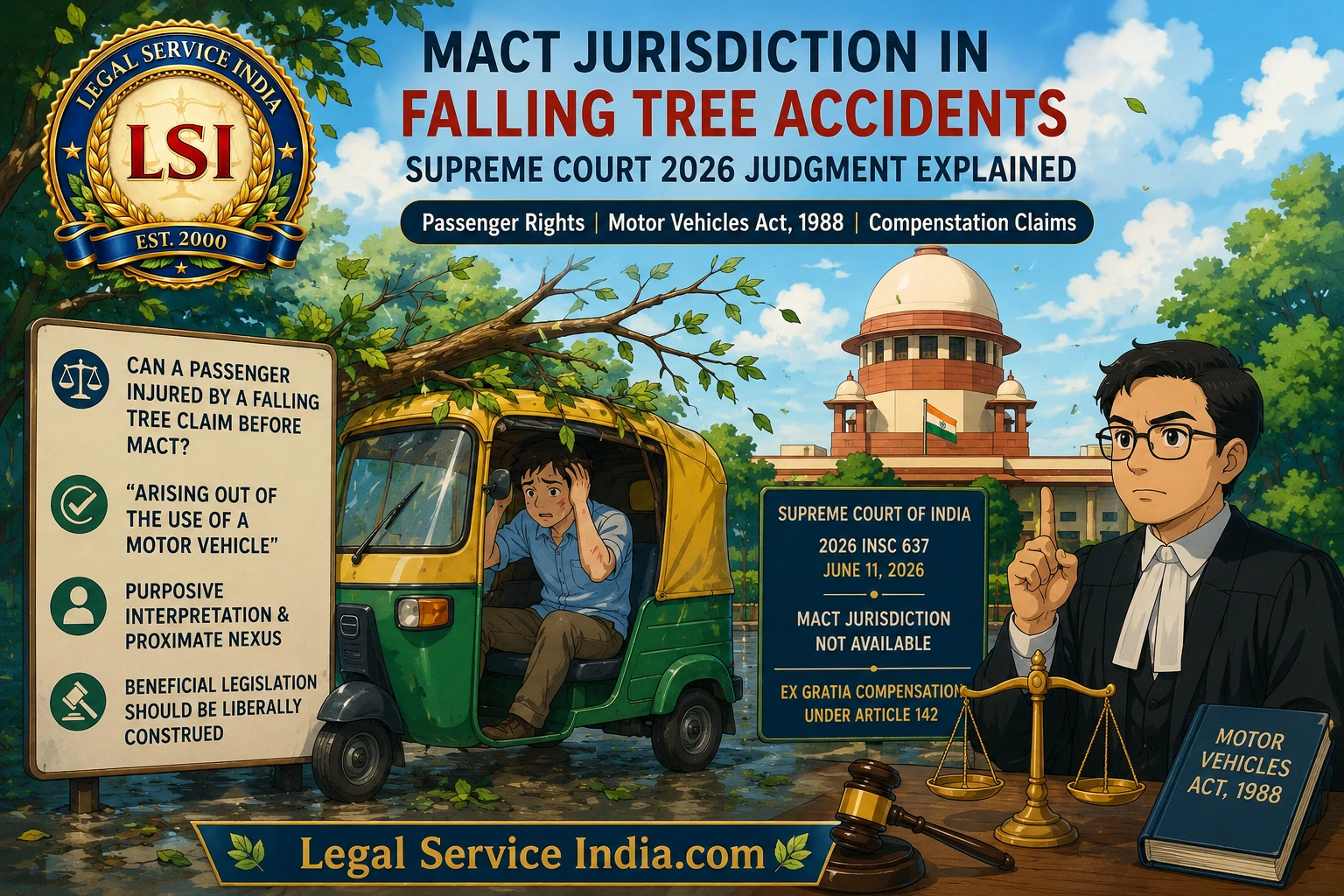
The Supreme Court of India recently in The Commissioner, Bruhat Bangalore Mahanagara Palike v. K.K. Umesh Kumar & Ors. 2026 INSC 637 decided on June 11, 2026 held that a passenger injured by a tree branch falling upon a stationary autorickshaw cannot invoke the jurisdiction of the Motor Accidents Claims Tribunal (MACT) under the Motor Vehicles Act, 1988. This article respectfully dissents from that ruling on the anterior jurisdictional question. Drawing upon the purposive construction of beneficial legislation, the canons of liberal interpretation, comparative jurisprudence, and the doctrine of proximate nexus, this article argues that the phrase ‘arising out of the use of a motor vehicle’ is wide enough to encompass environmental hazards encountered by a passenger during vehicular transit — including temporary stoppages. A stationary vehicle in the course of a journey remains ‘in use.’ The claimant’s access to the MACT forum should not be defeated by an unduly narrow causation model that the statutory text does not mandate.
I. Introduction: The Question of Jurisdictional Nexus
The Motor Vehicles Act, 1988 (hereinafter ‘the Act’) was enacted as social welfare legislation to provide swift, specialised, and accessible compensation to victims of accidents arising from vehicular use on public roads. The Motor Accidents Claims Tribunal was constituted as that specialised forum. The jurisdictional trigger is the expression ‘arising out of the use of a motor vehicle’ — a deliberately broad legislative formulation.
Core Jurisdictional Issue
The Supreme Court of India recently confronted the question of whether a passenger injured when a tree branch fell upon a stationary autorickshaw during heavy rain could approach the MACT for compensation. The Court held, in exercise of its jurisdiction under Article 142 of the Constitution, that the accident did not ‘arise out of the use of a motor vehicle’ and therefore MACT jurisdiction was unavailable, though ex gratia compensation was granted on equitable grounds.
Scope of the Dissent
This article respectfully dissents from that interpretive conclusion. The holding on maintainability, if allowed to settle as precedent, risks creating an arbitrary divide between claimants who are injured while a vehicle moves and those injured during an ordinary, unavoidable, temporary halt — a distinction that the statute itself does not draw.
Key Legal Principles Discussed
- Purposive construction of beneficial legislation
- Liberal interpretation of welfare statutes
- Comparative jurisprudence
- Doctrine of proximate nexus
- Meaning of the phrase “arising out of the use of a motor vehicle”
- Jurisdiction of the Motor Accidents Claims Tribunal (MACT)
Case Overview at a Glance
| Particulars | Details |
|---|---|
| Case Name | The Commissioner, Bruhat Bangalore Mahanagara Palike v. K.K. Umesh Kumar & Ors. |
| Citation | 2026 INSC 637 |
| Date of Decision | June 11, 2026 |
| Forum | Supreme Court of India |
| Issue | Whether injury caused by a falling tree branch on a stationary autorickshaw arises out of the use of a motor vehicle |
| Supreme Court Holding | MACT jurisdiction not available |
| Relief Granted | Ex gratia compensation under Article 142 |
| Article’s Position | Respectful dissent on the jurisdictional question |
II. The Statutory Framework and the Scope of Section 166
Section 166 of the Motor Vehicles Act, 1988 provides for an application for compensation ‘arising out of an accident of the nature specified in sub-section (1) of section 165.’ Section 165(1) empowers the MACT to adjudicate upon claims for compensation ‘in respect of accidents involving the death of, or bodily injury to, persons arising out of the use of motor vehicles.’
The critical phrase — ‘arising out of the use of motor vehicles’ — is not defined in the Act. Parliament’s deliberate choice not to restrict the phrase to ‘accidents caused by the movement of a motor vehicle’ or ‘collisions between motor vehicles’ is itself a legislative signal that the ambit is broader. The Act also does not confine claims to cases where the vehicle was in motion, where the driver was at fault, or where the vehicle itself was the instrument of impact.
Section 2(28) defines ‘motor vehicle’ with reference to a mechanically propelled vehicle adapted for use on roads. Nothing in that definition — or anywhere else in the Act — restricts ‘use’ to active propulsion. A motor vehicle parked or temporarily halted in the ordinary course of a journey continues to be used as a motor vehicle; it remains on the road in the transport system regulated by the Act.
The Ejusdem Generis and Noscitur a Sociis Canons Do Not Narrow the Phrase
Since ‘use of a motor vehicle’ is not a listed category accompanied by narrower examples, neither the ejusdem generis canon nor noscitur a sociis imports any restriction here. The phrase stands alone, and its natural breadth must be respected. The rule against surplusage further requires that the word ‘use’ carry independent significance beyond mere ownership, parking, or storage — and that significance is most coherently supplied by treating ‘use’ to mean the entire continuum of vehicular use for the purpose of transportation.
| Statutory Provision | Key Principle | Relevance to Section 166 |
|---|---|---|
| Section 166 | Compensation for accidents arising out of the nature specified in Section 165 | Provides the substantive right to claim compensation |
| Section 165(1) | Claims involving death or bodily injury arising out of the use of motor vehicles | Defines MACT jurisdiction |
| Section 2(28) | Definition of motor vehicle | Does not restrict “use” to active movement |
III. Rules of Statutory Interpretation That Favour Jurisdiction
A. The Purposive and Beneficial Construction Rule
The cardinal rule for construing social welfare legislation is that courts must adopt the interpretation that best advances the legislative purpose. The Supreme Court stated this emphatically in Workmen v. American Express International Banking Corpn., AIR 1985 SC 1650, holding that a beneficial statute must be construed liberally so as to promote its objects and suppress the mischief it was designed to remedy.
The object of the Motor Vehicles Act, and specifically of Chapters X and XI, is to protect road users — particularly passengers, pedestrians, and third parties — against the risks that flow from a mechanised transport system. Narrowing the phrase ‘arising out of use’ to cover only vehicle-on-vehicle collisions or vehicle-in-motion events would contract the statute’s protective ambit without textual warrant and contradict the remedial purpose that Parliament intended.
‘Where the words of a statute are capable of two constructions, one of which would give effect to its manifest purpose and the other would defeat it, the former must be preferred.’ — Bengal Immunity Co. Ltd. v. State of Bihar, AIR 1955 SC 661.
Key Takeaways
- The Motor Vehicles Act is a beneficial social welfare legislation.
- Courts should prefer interpretations that advance the legislative purpose.
- Restrictive interpretations should not be adopted without clear statutory language.
- Protection of road users remains the central objective of the Act.
B. The Rule That ‘Arising Out Of’ Is Wider Than ‘Caused By’
The distinction between ‘arising out of’ and ’caused by’ is well-settled in Indian jurisprudence. In CIT v. Scindia Steam Navigation Co. Ltd., AIR 1961 SC 1633, the Supreme Court recognised that ‘arising out of’ imports a broader nexus than direct or proximate physical causation. The phrase requires only a substantial connection or a meaningful causal relationship — not that the identified factor be the sole, direct, or immediate cause of the injury.
Applied to Section 165, the proper inquiry is not whether the falling tree was caused by the motor vehicle or whether the vehicle’s mechanics produced the injury. The proper inquiry is whether the injury arose out of — that is, had a real and proximate connection with — the use of the vehicle as a means of transport. A passenger inside a vehicle during transit, including a temporary halt in the course of that transit, is plainly within that nexus.
| Expression | Meaning in Law | Scope |
|---|---|---|
| ‘Caused By’ | Direct and immediate causation | Narrower |
| ‘Arising Out Of’ | Substantial or meaningful connection | Broader |
C. The Heydon’s Case Rule (Mischief Rule)
Under the mischief rule, courts must identify:
- The law before the Act;
- The mischief or defect the Act was designed to remedy;
- The cure provided; and
- The reason for the cure.
Before the Motor Vehicles Act, victims of road accidents had no dedicated forum and were remitted to slow civil litigation. The mischief was inadequate and delayed compensation for transport-related injuries. The MACT system was the cure. Restricting that cure to only collision-type accidents re-introduces the very inadequacy the Act sought to remove.
D. The Golden Rule Against Absurd Results
The golden rule of statutory construction, as formulated in Grey v. Pearson (1857) 6 HL Cas 61 and adopted in Indian jurisprudence, requires that if the literal construction of a statute produces an absurd or unjust result, the court may depart from it.
The literal approach that excludes falling-tree injuries produces manifestly anomalous outcomes: a passenger injured by a falling tree while the autorickshaw was moving would succeed before the MACT; the same passenger in the same vehicle during a momentary rain-induced halt would fail. That disparity is not grounded in any discernible statutory policy and must be avoided.
Illustration of the Absurdity
- Passenger inside moving autorickshaw → MACT jurisdiction available.
- Passenger inside temporarily halted autorickshaw during the same journey → MACT jurisdiction denied.
- Result: Different legal outcomes despite substantially identical facts.
Such an interpretation would undermine consistency and defeat the purpose of the legislation.
E. The Rule That Beneficial Legislation Must Not Be Narrowed by Judicial Gloss
The Supreme Court cautioned in Regional Director, E.S.I. Corpn. v. Francis De Costa, 1993 Supp (4) SCC 100, that courts should not impose restrictions on beneficial social legislation that Parliament itself has not enacted.
Adding the requirement that the vehicle must be the immediate physical agent of harm, or that it must be in motion, adds a condition absent from the statutory text. That is an impermissible exercise of judicial legislation.
Core Principles Summary
- Beneficial statutes must receive liberal interpretation.
- ‘Arising out of’ is broader than ’caused by’.
- The mischief rule supports wider access to compensation.
- Absurd and inconsistent outcomes should be avoided.
- Courts cannot add restrictions that Parliament did not enact.
IV. Case Law: The Evolving Judicial Understanding of ‘Arising Out of Use’
A. The Supreme Court’s Own Expansive Jurisprudence
It is instructive that the Supreme Court has, in other contexts, given a wide construction to the phrase ‘arising out of the use of a motor vehicle.’ The following decisions illustrate how the Court had previously moved away from a strict collision-centric model:
| Citation | Doctrinal Significance |
|---|---|
| Shivaji Dayanu Patil v. Vatschala Uttam More, (1991) 3 SCC 530 | Vehicle need not be moving; loading and unloading are part of ‘use.’ A truck catching fire while stationary was held to be an accident arising out of the use of the motor vehicle. |
| Nizam’s Institute of Medical Sciences v. Prasanth S. Dhananka, (2009) 6 SCC 1 | Beneficial legislation must receive an expansive construction; courts should not impose limitations on the MACT’s remedial jurisdiction absent explicit statutory text. |
| United India Insurance Co. v. Satinder Kaur, (1999) 6 SCC 692 | A vehicle being used for its ordinary purpose (transportation) remains ‘in use’ throughout the journey including stops. Third parties injured during such use are entitled to compensation. |
| Kalpana Mehta v. Union of India, (2018) 7 SCC 1 | Purposive interpretation of social welfare legislation demands that beneficial schemes be construed to maximise coverage, not limit it. |
| Bhimrao Ramchandra Khalate v. New India Assurance Co. Ltd., (2012) 11 SCC 595 | The MACT has jurisdiction even where the negligence or fault of the vehicle’s owner or driver cannot be directly traced to the movement of the vehicle itself. |
| Karnataka HC — Falling Tree Case (2022) | Death of a motorcyclist caused by a tree branch was held to be an accident arising out of the use of a motor vehicle, compensable before the MACT. Road travel includes exposure to environmental hazards encountered while using a motor vehicle on a public road. |
B. Shivaji Dayanu Patil — The Cornerstone Authority
The decision in Shivaji Dayanu Patil v. Vatschala Uttam More, (1991) 3 SCC 530 is the most important authority on the correct interpretation of ‘arising out of the use.’
A truck loaded with gas cylinders caught fire and exploded while parked. The Supreme Court held that this was an accident arising out of the use of the motor vehicle. The Court reasoned that ‘use’ encompasses all activities that form part of the transport operation — not merely the act of driving.
If a parked vehicle that explodes can generate MACT jurisdiction, a passenger inside a parked vehicle struck by a falling branch — a hazard of the road environment — has an equally meritorious claim to that forum.
“The expression ‘use of motor vehicles’ is not limited to the act of driving. It takes in other activities connected with the motor vehicle which form a part of the use of the motor vehicle as a motor vehicle.” — Shivaji Dayanu Patil v. Vatschala Uttam More, (1991) 3 SCC 530.
C. Comparative Jurisprudence: The American ‘Arising Out Of’ Doctrine
In the United States, insurance and compensation statutes using the phrase ‘arising out of the use or operation of a motor vehicle’ have been consistently interpreted broadly by state Supreme Courts.
Courts in Michigan, California, and Minnesota have held that an injury arises out of vehicular use where the vehicle was an active accessory to the accident — even if not the direct physical cause.
- The vehicle need not be the proximate cause.
- It is sufficient that vehicular use contributed to the exposure.
- The vehicle must have created or enhanced the risk.
The Michigan Supreme Court in Shinabarger v. Citizens Mutual Insurance Co., 90 NW 2d 307, articulated the ‘active accessory’ test: the vehicle need not be the proximate cause of the injury, but it must be more than a mere situs.
A vehicle carrying passengers in rain — thereby bringing them into a position of exposure to a roadside tree — satisfies that test.
V. The Causal Nexus Analysis: Vehicle As More Than A Situs
The Supreme Court’s recent ruling characterises the autorickshaw as merely the location or situs of the accident, rather than a causally relevant factor. This characterisation is, with respect, susceptible to challenge on three grounds.
First Ground: ‘But For’ Causation Runs in the Claimant’s Favour
But for the use of the autorickshaw as a vehicle of transport, the passenger would not have been at that location, under that tree, at that moment in time.
The vehicle placed the claimant in the precise physical position in which the harm occurred. The ‘but for’ test — foundational to both tortious and statutory causation analysis — is satisfied.
The vehicle was not a mere coincidental situs; it was the reason for the claimant’s presence at the point of injury.
Second Ground: The Vehicle Magnified the Risk
Sitting inside an enclosed autorickshaw during heavy rain means the passenger could not take evasive action, could not move away from the tree, and could not exercise any independent protective judgment.
The enclosed structure of the vehicle — which is part of what makes it a ‘motor vehicle’ adapted for road transport — amplified the claimant’s vulnerability to the falling branch.
The vehicle’s physical characteristics were causally relevant, not irrelevant.
Third Ground: Road Environment Hazards Are Part of Vehicular Use
The road on which the autorickshaw stood is the same road regulated by the Motor Vehicles Act. Trees lining that road are part of the transport environment.
Exposure to hazards of the road environment during a journey — whether from collisions, potholes, waterlogging, landslides, or falling branches — is a risk inherent in the activity of road travel.
The distinction between collision-hazards and environmental-hazards is not a distinction that the statute draws.
Section 147 and the Scope of Third-Party Insurance Coverage
In fact, Section 147 of the Act mandates third-party insurance coverage for ‘death or bodily injury to any person.’
The width of the mandatory insurance obligation reflects Parliamentary awareness that road travel exposes users to diverse risks, not merely vehicle-on-vehicle impact.
- Collisions involving vehicles.
- Road surface hazards such as potholes.
- Waterlogging and flooding conditions.
- Landslides and environmental dangers.
- Falling branches and roadside hazards.
- Other risks encountered during ordinary road travel.
VI. Policy Implications and the Risk of Anomalous Outcomes
A ruling that removes MACT jurisdiction in falling-tree cases—if extended to analogous situations—produces the following anomalous consequences that public policy should resist:
- A motorcyclist struck by a falling branch while riding is within MACT jurisdiction (Karnataka HC 2022). The same motorcyclist, halted for thirty seconds at a traffic signal, would be outside it. The law should not turn on such microseconds of motion.
- Passengers of buses, trains-substituted taxis, or school vans who are similarly placed during rain-induced stoppages would be denied the forum created for their protection.
- The burden of proof and procedure in the MACT is designed to favour victims; civil courts are slower and more expensive. Excluding the MACT exposes already-distressed claimants to prolonged civil litigation with no guarantee of comparable relief.
- Insurance companies that collected premiums covering third-party risks during the entire period the vehicle was “in use” on the road would escape liability for a category of risks that fell within the insured risk period—producing a windfall at the claimant’s expense.
- Municipalities and State Governments responsible for roadside tree maintenance may equally escape accountability if the MACT is closed to such claims—depriving victims of the comparative remedies the specialised forum can calibrate.
Key Policy Consequences
| Issue | Potential Consequence |
|---|---|
| Temporary Vehicle Halt | Victims may lose access to MACT solely because the vehicle was stationary. |
| Public Transport Passengers | Passengers affected during rain-related stoppages may be denied specialised remedies. |
| Victim Compensation | Claimants may be forced into lengthy and costly civil litigation. |
| Insurance Liability | Insurers may avoid liability despite collecting premiums for third-party risks. |
| Public Authority Accountability | Municipal and State authorities may escape effective scrutiny for negligent tree maintenance. |
Supreme Court Approach to Beneficial Interpretation
The Supreme Court has repeatedly held that the Motor Vehicles Act must receive a construction consistent with its social purpose. In Nizam’s Institute v. Prasanth S. Dhananka (2009) 6 SCC 1, the Court affirmed that compensation for victims of road accidents should be just, fair, and reasonable, and that the MACT’s jurisdiction should not be contracted by technical readings. The falling-tree situation is precisely where technical restriction does the greatest injustice.
VII. The Proposed Nexus Test: A Principled Reformulation
This article proposes that the correct legal test for “arising out of the use of a motor vehicle” under Section 165 of the Act should be:
The Proposed MACT Nexus Test
An accident arises out of the use of a motor vehicle within the meaning of Section 165 of the Motor Vehicles Act, 1988 whenever:
- The injured person was a passenger, driver, or lawful user of the vehicle at the time of the accident, or was physically proximate to the vehicle as a result of the vehicular operation;
- The vehicle was in the course of its use as a means of road transport—including loading, unloading, boarding, alighting, or a temporary halt that forms an ordinary incident of the journey; and
- There is a real, proximate, and substantial nexus between the use of the vehicle and the injury—meaning the vehicle was more than a mere coincidental situs; it materially contributed to the claimant’s presence at, or exposure to, the source of harm.
External Causation and Vehicle Use
The vehicle need not be the sole, direct, or immediate cause of injury. Concurrent external causation—by natural force, road hazard, or third-party act—does not sever the nexus if the above conditions are satisfied.
Application of the Nexus Test
| Scenario | Meets the Test? | Reason |
|---|---|---|
| Person standing near a vehicle they are not using and struck by a falling branch | No | Condition (i) is not satisfied. |
| Vehicle permanently parked in a private compound | No | Condition (ii) is not satisfied because the vehicle is not being used for road transport. |
| Passenger in an autorickshaw temporarily halted during transit | Yes | Conditions (i), (ii), and (iii) are satisfied. |
Why the Test Is Balanced
This test preserves principled limits while remaining faithful to the beneficial object of the Motor Vehicles Act. It excludes cases where the vehicle is merely incidental to the injury, yet protects passengers and road users whose presence at the location of harm is directly connected to the ongoing use of the vehicle as a means of transport.
VIII. Awareness: What Claimants, Insurers, and Practitioners Must Know
The recent judicial developments concerning falling-tree accidents and Motor Accident Claims Tribunal (MACT) jurisdiction have created important practical considerations for claimants, legal practitioners, insurance companies, and policymakers. Understanding the current legal position is essential for navigating future claims and litigation.
For Claimants and Their Counsel
Despite the Supreme Court’s recent observation, the position on falling-tree injuries is not settled across all High Courts. Practitioners should note the following:
- The Karnataka High Court’s 2022 ruling in favour of MACT jurisdiction in a falling-tree case remains good law within that jurisdiction and constitutes a persuasive precedent elsewhere.
- The Supreme Court’s ruling appears to have been rendered under Article 142 as an equitable exercise, and may not constitute a binding ratio decidendi on the narrow jurisdictional question. Counsel should examine the precise nature of the holding.
- Alternative remedies include:
- A civil suit for negligence against the Municipal Corporation or State Authority responsible for maintenance of the roadside tree.
- A writ petition under Article 226 or Article 32 for violation of the right to life and personal safety.
- A consumer complaint if a transport operator was involved.
- In any future falling-tree case before a MACT or High Court, the decisions in Shivaji Dayanu Patil, Bhimrao Khalate, and the Karnataka High Court’s 2022 ruling should be placed squarely before the Tribunal.
Key Takeaways for Claimants
| Issue | Important Consideration |
|---|---|
| MACT Jurisdiction | Not conclusively settled across all jurisdictions. |
| Karnataka HC 2022 Ruling | Continues to be binding in Karnataka and persuasive elsewhere. |
| Supreme Court Observation | May be based on Article 142 equitable powers rather than a binding jurisdictional ratio. |
| Alternative Remedies | Civil suit, writ petition, or consumer complaint may be available. |
| Relevant Precedents | Shivaji Dayanu Patil, Bhimrao Khalate, and Karnataka HC 2022 should be cited. |
For Insurance Companies
The denial of MACT jurisdiction does not automatically relieve the insurer. The policy of insurance covering third-party risks subsists during the entire period the vehicle is on the road in the course of use.
Insurers that attempt to escape liability by characterising the accident as outside the scope of vehicular use may face challenge under the contract of insurance itself, particularly where the policy uses broader language than the Act’s minimum requirements.
Insurance Implications at a Glance
| Aspect | Potential Impact |
|---|---|
| Third-Party Coverage | Generally continues while the vehicle is being used on the road. |
| Jurisdictional Objections | May not automatically eliminate insurer liability. |
| Policy Interpretation | Broader policy wording may create independent liability. |
| Litigation Risk | Attempts to deny coverage may be challenged contractually. |
For Legislators
The doctrinal uncertainty exposed by the recent ruling warrants a legislative response.
Parliament may consider amending Section 165 to expressly include accidents involving passengers or persons arising from environmental hazards encountered during vehicular use, or to insert an inclusive definition of “accident arising out of the use of a motor vehicle” that specifically extends to incidents occurring during temporary stoppages in the course of a journey.
Possible Legislative Reforms
- Amend Section 165 to expressly cover environmental hazards affecting passengers.
- Clarify the meaning of “arising out of the use of a motor vehicle.”
- Include incidents occurring during temporary halts and stoppages.
- Reduce jurisdictional uncertainty and conflicting judicial interpretations.
- Strengthen protection for road users and passengers.
IX. Conclusion: A Call for Reconsideration
The Motor Vehicles Act speaks of accidents “arising out of the use of a motor vehicle”—not “caused by the movement of a motor vehicle,” and not “directly produced by the vehicle as a physical instrumentality of impact.” Parliament chose broad, flexible language suited to a diverse and unpredictable transport environment. That choice should be honoured, not contracted.
A tree falling upon a passenger inside an autorickshaw during a rain-induced halt on a public road is not an accident that happens to occur near a motor vehicle. It is an accident that occurs because the claimant is a passenger in a motor vehicle, on a public road governed by the Motor Vehicles Act, in the course of a journey for which the vehicle is being used. The statutory nexus is real, proximate, and meaningful.
Why Reconsideration May Be Necessary
- The statutory language is intentionally broad and inclusive.
- Road users remain exposed to risks even when vehicles are temporarily halted.
- The connection between the accident and vehicular use may remain substantial despite the absence of direct vehicular impact.
- Conflicting judicial interpretations create uncertainty for claimants and insurers.
The recent Supreme Court holding on maintainability deserves respectful reconsideration in an appropriate future case. Until then, claimants, counsel, and courts should be alert to the distinction between the Court’s equitable grant of compensation under Article 142 and any broader ratio on jurisdictional exclusion.
The MACT system was built for road users. Passengers in halted vehicles remain road users. They deserve the protection of the forum Parliament created for them.
Final Key Points
| Issue | Position Advanced |
|---|---|
| Scope of the Motor Vehicles Act | Broad and flexible rather than narrowly confined to vehicle movement. |
| Passenger Protection | Should continue during temporary halts in the course of a journey. |
| Supreme Court Decision | May warrant reconsideration in a future case. |
| Article 142 Distinction | Must be distinguished from a binding jurisdictional ratio. |
| Role of MACT | To provide protection and compensation to road users, including passengers. |
Key Takeaways
- The Supreme Court’s 2026 ruling in The Commissioner, Bruhat Bangalore Mahanagara Palike v. K.K. Umesh Kumar held that injuries caused by a falling tree branch on a stationary autorickshaw do not fall within MACT jurisdiction, sparking significant legal debate.
- The central legal issue revolves around interpreting the phrase “arising out of the use of a motor vehicle” under Sections 165 and 166 of the Motor Vehicles Act, 1988.
- The article argues that a motor vehicle remains “in use” even during temporary stops, such as traffic halts or weather-related stoppages, and therefore passengers should continue to receive protection under the Act.
- Beneficial legislation like the Motor Vehicles Act should receive a liberal and purposive interpretation that maximizes compensation rights rather than restricts them.
- Indian courts have repeatedly recognized that “arising out of” is broader than “caused by,” requiring only a substantial connection between the injury and vehicle use rather than direct physical causation.
- Restricting MACT claims to accidents involving moving vehicles may create arbitrary distinctions and inconsistent outcomes for similarly situated victims.
- Landmark judgments such as Shivaji Dayanu Patil v. Vatschala Uttam More support a broader understanding of vehicle use, extending beyond mere movement to include activities connected with transportation.
- Comparative international jurisprudence also favors a wider interpretation of motor vehicle use, recognizing liability where a vehicle materially contributes to a person’s exposure to risk.
- The article proposes a new “MACT Nexus Test” focusing on whether the injured person was using the vehicle during transportation and whether a real and substantial connection existed between vehicle use and the injury.
- Environmental hazards encountered during travel—such as falling trees, landslides, flooding, or road collapses—may form part of the ordinary risks associated with road transport and should not automatically fall outside MACT jurisdiction.
- The decision highlights ongoing uncertainty in motor accident compensation law and may prompt future judicial reconsideration or legislative clarification.
- Claimants affected by similar incidents should explore alternative remedies including civil suits, constitutional writ petitions, and insurance claims while monitoring future developments in MACT jurisprudence.
Summary Points
| Topic | Key Focus Area |
|---|---|
| Supreme Court MACT Jurisdiction Ruling 2026 | Explanation of the 2026 judgment and its legal significance. |
| Meaning of “Arising Out of the Use of a Motor Vehicle” | Interpretation under the Motor Vehicles Act. |
| Stationary Vehicle and Vehicle Use | Whether a stationary vehicle qualifies as being “in use.” |
| Falling Tree Accidents | Motor accident compensation claims involving environmental hazards. |
| MACT vs Civil Court Remedies | Available legal remedies for road accident victims. |
| Article 142 Compensation Orders | Impact on motor accident compensation cases. |
| Passenger Rights During Temporary Stoppages | Legal rights of passengers injured while a vehicle is temporarily halted. |
| Beneficial Interpretation of the Motor Vehicles Act, 1988 | Liberal and purposive interpretation principles. |
| Environmental Hazards and Insurance Liability | Third-party insurance implications for road-related risks. |
| Future Implications | Potential effects on road users, insurers, and compensation claims. |
Major Legal Issues Covered
- Supreme Court MACT jurisdiction ruling 2026 explained.
- Meaning of “arising out of the use of a motor vehicle” under the Motor Vehicles Act.
- Whether a stationary vehicle qualifies as being “in use.”
- Falling tree accidents and motor accident compensation claims.
- MACT vs civil court remedies for road accident victims.
- Impact of Article 142 compensation orders on motor accident cases.
- Legal rights of passengers injured during temporary vehicle stoppages.
- Beneficial interpretation of the Motor Vehicles Act, 1988.
- Environmental hazards and third-party insurance liability.
- Future implications for road users, insurers, and compensation claims.

