





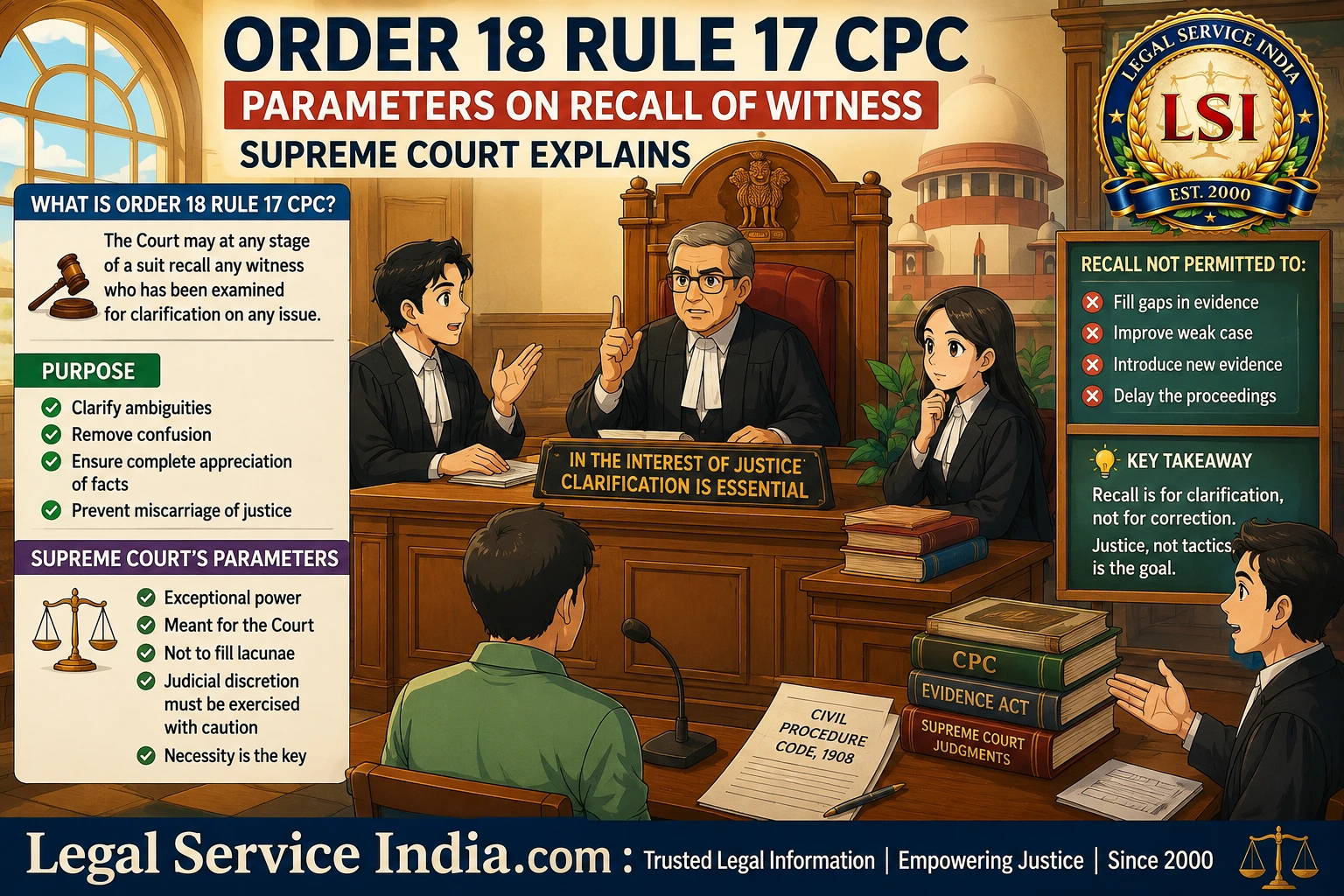
A Comprehensive Analysis of the Supreme Court’s Latest Judgement on the Recall of a Witness Under Order 18 Rule 17 CPC
Introduction
The Supreme Court has once again clarified the limited scope of Order 18 Rule 17 CPC, emphasising that the provision is not intended to enable parties to fill gaps in their evidence or improve their case after the trial has substantially progressed. Instead, the power to recall a witness exists primarily to assist the court in arriving at the truth whenever clarification on any issue becomes necessary.
This latest judgement serves as an important procedural precedent for civil litigation across India. It provides valuable guidance to trial courts on the circumstances in which a witness may legitimately be recalled while simultaneously preventing abuse of the judicial process through repetitive or tactical applications.
Although the ruling may not attract widespread public attention like constitutional decisions, it is of immense practical significance to civil practitioners, trial judges, commercial litigators, and parties engaged in civil disputes.
Understanding Order 18 Rule 17 CPC
Order 18 Rule 17 of the Code of Civil Procedure, 1908, reads:
“The Court may at any stage of a suit recall any witness who has been examined and may (subject to the law of evidence) put such questions to him as the Court thinks fit.”
The language of the provision appears broad. However, judicial interpretation over several decades has consistently held that its scope is narrow.
- The provision primarily empowers the court, not the litigating parties.
- Its object is to enable the judge to clarify doubts arising from the evidence already recorded.
- It is not a mechanism for reopening evidence.
Purpose Behind Order 18 Rule 17 CPC
The Supreme Court reiterated that the purpose of recalling a witness is to aid the court itself.
Its objectives include:
- Clarifying ambiguities in testimony.
- Removing confusion in evidence.
- Ensuring complete appreciation of facts.
- Preventing miscarriage of justice.
The Court observed that judicial discretion under Order 18 Rule 17 CPC must always be exercised cautiously and only when genuinely necessary for adjudication.
Also Read: Supreme Court Rules States Cannot Oppose Judicial Officers’ Retirement Age Hike on Financial Grounds
Supreme Court’s Key Principles
The judgement lays down several important parameters governing the recall of witnesses.
1. Recall Is an Exceptional Power
The Court explained that recalling a witness should remain an exception rather than the rule.
Routine recall applications unnecessarily prolong litigation and defeat the objective of speedy justice.
Trial courts must therefore exercise restraint.
2. The Provision Is Intended for the Court
One of the most significant observations is that Order 18 Rule 17 CPC primarily exists for the benefit of the court.
- It allows the judge to seek clarification whenever required.
- It is not designed as a procedural right available to parties for improving their litigation strategy.
3. Parties Cannot Fill Lacunae
The Supreme Court reaffirmed one of the most settled principles of procedural law:
A litigant cannot invoke Order 18 Rule 17 CPC merely to:
- Introduce better evidence.
- Repair weaknesses.
- Improve earlier testimony.
- Overcome omissions.
- Fill evidentiary gaps.
If such applications were freely permitted, trials would never attain finality.
4. Judicial Discretion Must Be Exercised Carefully
The Court emphasised that recall applications should always be decided after considering:
- Necessity.
- Relevance.
- Bona fides.
- Stage of proceedings.
- Likelihood of prejudice.
- Overall interest of justice.
Mechanical allowance of recall applications undermines procedural discipline.
5. Delay Alone Is Not Decisive
The Court clarified that although delay is an important consideration, it is not the only factor.
Even at a later stage, recall may be justified if genuine clarification becomes necessary for deciding the real controversy.
Thus, the emphasis remains on necessity rather than chronology.
Parameters for Recall of Witness Under Order 18 Rule 17 CPC
The Supreme Court has laid down clear parameters governing the exercise of power under Order 18 Rule 17 CPC. The following table summarises the Court’s approach:
| Parameter | Supreme Court’s Approach |
|---|---|
| Purpose | Clarification by Court |
| Right of Parties | No absolute right |
| Filling Lacunae | Not permissible |
| Additional Evidence | Normally not allowed |
| Judicial Discretion | Must be exercised sparingly |
| Stage of Trial | Relevant but not conclusive |
| Interest of Justice | Paramount consideration |
Difference Between Recall and Reopening Evidence
The judgement also reinforces an important procedural distinction frequently misunderstood by litigants.
| Recall of Witness | Reopening Evidence |
|---|---|
| Limited clarification | Fresh evidence |
| Existing witness | New evidence may be introduced. |
| Court-centric | Party-centric |
| Narrow discretion | Separate procedural considerations |
| Under Order 18 Rule 17 | Governed by different procedural principles and inherent powers where applicable |
This distinction is critical because many applications labelled as “recall” are, in reality, attempts to reopen evidence.
Abuse of Recall Applications
The Supreme Court noted that recall applications are increasingly being used to delay proceedings.
Common instances include:
- Changing litigation strategy.
- Correcting defective cross-examination.
- Introducing omitted documents.
- Curing drafting mistakes.
- Prolonging trial.
The Court discouraged such practices.
Procedural provisions should facilitate justice rather than become instruments for delaying it.
Earlier Supreme Court Precedents
The present judgement aligns with several landmark decisions interpreting Order 18 Rule 17 CPC, including:
- Vadiraj Naggappa Vernekar v. Sharadchandra Prabhakar Gogate (2009) – Recall cannot be used to fill omissions in evidence.
- K.K. Velusamy v. N. Palanisamy (2011) – Distinguished recall under Order 18 Rule 17 from reopening evidence using the court’s inherent powers under Section 151 CPC.
- Bagai Construction v. Gupta Building Material Store (2013) – Reiterated that recall should not become a tool for patching up weak evidence.
The latest judgement further strengthens this consistent judicial approach.
Practical Impact on Civil Litigation
The decision is likely to influence trial practice across India.
For Trial Courts
- Judges are expected to scrutinise recall applications more rigorously.
- Merely alleging inadvertence or oversight may no longer suffice.
For Lawyers
- Advocates must conduct examination-in-chief and cross-examination with greater preparation.
- The possibility of recalling a witness cannot be treated as a fallback option.
For Litigants
- Parties should ensure that all relevant evidence is presented during the appropriate stage of trial.
- Attempts to revisit evidence later may face strict judicial scrutiny.
Why This Judgement Matters
Although procedural in nature, this ruling has substantial practical implications.
Civil litigation often suffers from repeated adjournments and prolonged evidence.
Improper recall applications contribute significantly to trial delays.
By clarifying the limited scope of Order 18 Rule 17 CPC, the Supreme Court seeks to:
- Preserve procedural discipline.
- Reduce unnecessary delays.
- Ensure efficient trial management.
- Balance fairness with finality.
- Prevent misuse of judicial discretion.
Legal Significance
The judgement reinforces several foundational principles of civil procedure:
- Procedural law is designed to facilitate justice, not tactical manoeuvring.
- Judicial discretion must be exercised on settled principles.
- Finality of litigation is an essential component of justice.
- Recall of witnesses remains an exceptional procedural remedy.
Conclusion
The Supreme Court’s latest interpretation of Order 18 Rule 17 CPC provides much-needed clarity on the parameters governing the recall of witnesses in civil proceedings. The Court has reaffirmed that the provision exists primarily to assist the court in clarifying evidence and not to provide litigants with an opportunity to strengthen deficient cases or prolong trials.
For judges, the ruling offers a structured framework for exercising judicial discretion. For advocates, it underscores the importance of meticulous trial preparation. For litigants, it serves as a reminder that evidence must ordinarily be presented fully and correctly at the appropriate stage.
As civil courts continue to confront mounting case backlogs, this judgement strikes an appropriate balance between ensuring procedural fairness and preventing abuse of the litigation process. It is likely to become an important reference point whenever applications for recall of witnesses under Order 18 Rule 17 CPC come before trial courts across the country.
Key Takeaways
| Key Aspect | Supreme Court’s Clarification |
|---|---|
| Purpose of Order 18 Rule 17 CPC | Primarily empowers the court, not the parties. |
| Recall of Witness | An exceptional power meant for clarification. |
| Filling Lacunae | Parties cannot use recall to fill lacunae or improve their evidence. |
| Judicial Discretion | Trial courts must exercise judicial discretion sparingly and with recorded reasons. |
| Procedural Discipline | The judgement strengthens procedural discipline while promoting speedy civil trials. |
| Precedential Value | The ruling is expected to become an important precedent for trial courts dealing with witness recall applications. |
FAQs on Order 18 Rule 17 CPC
1. What is Order 18 Rule 17 CPC, and when can a witness be recalled?
Answer:
Order 18 Rule 17 CPC empowers a civil court to recall a witness who has already been examined if the court considers it necessary to clarify any issue or evidence. The Supreme Court has clarified that this power is meant to assist the court in arriving at the truth and is not intended to allow parties to strengthen or improve their case.
2. Can a party use Order 18 Rule 17 CPC to fill gaps or lacunae in its evidence?
Answer:
No. The Supreme Court has reiterated that Order 18 Rule 17 CPC cannot be invoked to fill lacunae, introduce omitted evidence, or repair weaknesses in a party’s case. The provision is intended only for limited clarification by the court and should not be misused to reopen evidence or prolong civil proceedings.
3. What are the Supreme Court’s parameters for recalling a witness under Order 18 Rule 17 CPC?
Answer:
According to the Supreme Court, a witness may be recalled under Order 18 Rule 17 CPC only when it is necessary for the court to clarify doubts or ensure a just decision. Trial courts should consider the following factors before allowing a recall application:
- Necessity of recalling the witness.
- Relevance of the clarification sought.
- Stage of the trial.
- Bona fides of the application.
- Whether allowing recall would prejudice the opposite party.
- Whether the recall would unnecessarily delay the proceedings.
4. What is the difference between recalling a witness under Order 18 Rule 17 CPC and reopening evidence?
Answer:
| Recall of Witness Under Order 18 Rule 17 CPC | Reopening Evidence |
|---|---|
| Limited to recalling an already examined witness. | May involve introducing fresh evidence. |
| Used only for clarification. | Reopens the evidence stage. |
| Cannot be used to strengthen a party’s case. | Governed by separate procedural principles. |
| Power exercised sparingly by the court. | Requires an independent legal basis. |
The Supreme Court has explained that Order 18 Rule 17 CPC is limited to recalling an already examined witness for clarification. It does not permit parties to produce fresh evidence or reopen the entire evidence stage. Reopening evidence is a separate procedural exercise and cannot ordinarily be achieved by filing an application under Order 18 Rule 17 CPC.
5. Why is the Supreme Court’s latest judgement on Order 18 Rule 17 CPC important for civil litigation?
Answer:
The Supreme Court’s latest ruling on Order 18 Rule 17 CPC is significant because it lays down clear parameters for the recall of witnesses, discourages frivolous applications that delay trials, and reinforces procedural discipline in civil courts. The judgement provides valuable guidance to judges, advocates, and litigants, ensuring that witness recall is permitted only in exceptional cases where it is genuinely required in the interest of justice.
Need Expert Legal Assistance?
If you require legal advice, representation, or strategic guidance in matters before the Supreme Court of India, High Courts, or other courts and tribunals, consult an experienced legal professional.
Adv. Tarun Choudhury
Supreme Court Advocate | 25+ Years of Legal Experience
- 📞 Call: 9650499965
- 💬 WhatsApp: 9891244487
Get trusted legal advice for:
- Supreme Court Litigation
- Special Leave Petitions (SLPs)
- Civil & Commercial Disputes
- Constitutional Matters
- Writ Petitions
- Appeals & Legal Opinions
Contact today to schedule a confidential legal consultation.
Important Links
- Lawyers in India
- Copyright Registration in India
- Caveat Filing in Supreme Court of India
- Mutual Consent Divorce in Delhi NCR: WhatsApp 9650499965
