Introduction
The examination of witnesses is one of the most important stages of a criminal investigation. It enables the Investigating Officer (I.O.) to collect information from people who may know about the offense, the accused, or other relevant facts. The Bharatiya Nagarik Suraksha Sanhita, 2023 (BNSS), which replaced the Code of Criminal Procedure, 1973 (CrPC), has modernised this process by introducing the use of audio-video technology while also strengthening the protection of witnesses’ rights.
The procedure for the examination of witnesses by the police is governed by Sections 179, 180, 181, and 182 of the Bharatiya Nagarik Suraksha Sanhita (BNSS), 2023.
Attendance of Witnesses (Section 179 BNSS)
During an investigation, the I.O. has the legal authority to require the attendance of any person who appears to be acquainted with the facts and circumstances of the case. The person may reside within the limits of the investigating police station or any adjoining police station.
The request for attendance must be made through a written order.
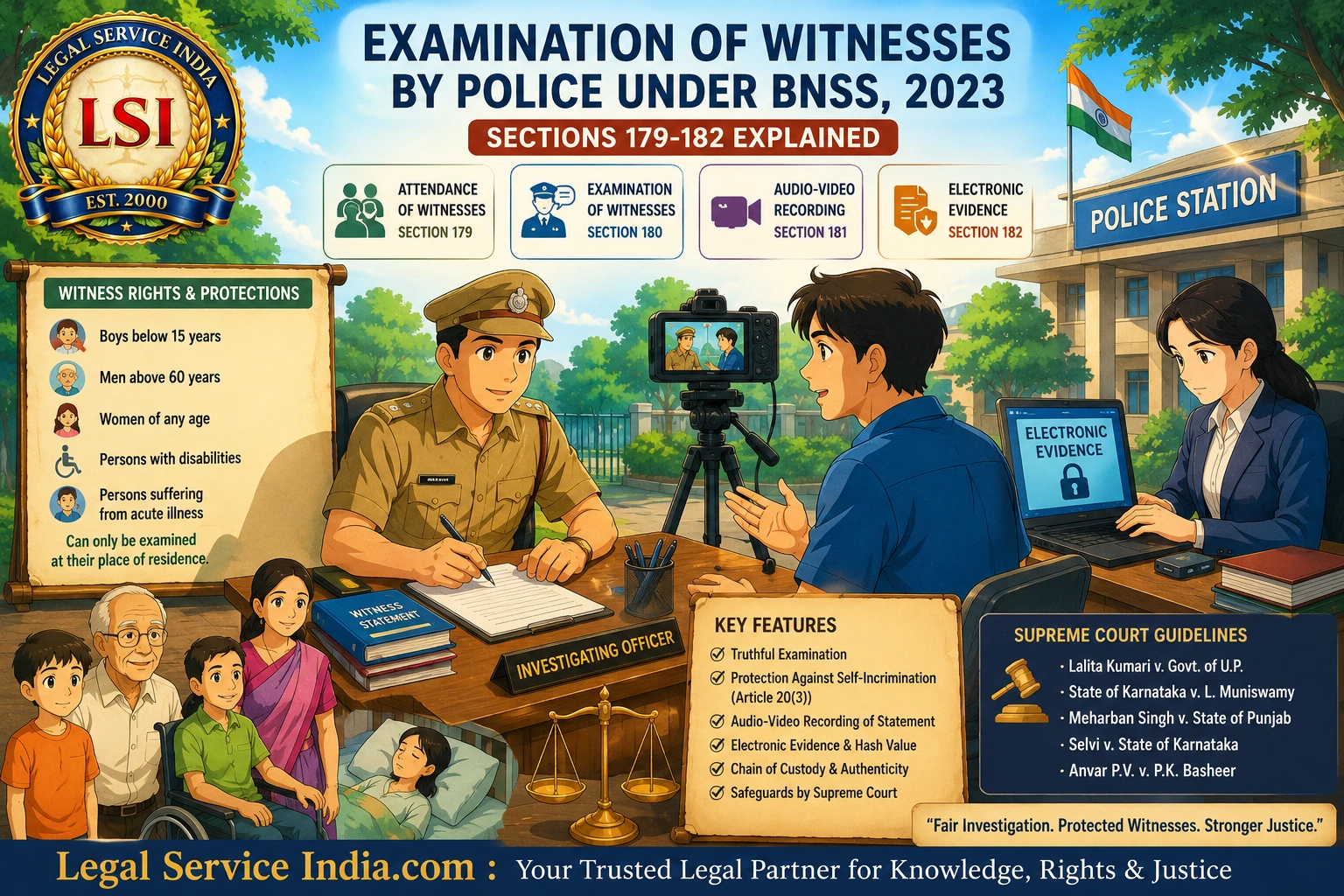
However, the law protects certain categories of persons from being required to appear at a police station. These persons can only be examined at their place of residence. They include:
- Boys below 15 years of age.
- Men above 60 years of age.
- Women of any age.
- Persons suffering from physical or mental disabilities.
- Persons suffering from an acute illness.
The inclusion of persons with acute illness is a new protection introduced under the BNSS.
If any of these exempted persons voluntarily wish to visit the police station to give their statement, they may do so.
Persons Exempted from Attending the Police Station
| Category | Protection Under Section 179 BNSS |
|---|---|
| Boys below 15 years | Can only be examined at their place of residence. |
| Men above 60 years | Can only be examined at their place of residence. |
| Women | Can only be examined at their place of residence. |
| Persons with physical or mental disabilities | Can only be examined at their place of residence. |
| Persons suffering from an acute illness | Can only be examined at their place of residence. |
Examination of Witnesses (Section 180 BNSS)
Section 180 empowers the I.O. to examine any person who appears to know the facts of the case. The examination is conducted orally.
A witness is legally bound to answer all questions truthfully. However, no person can be compelled to answer any question that may expose them to a criminal charge, penalty, or forfeiture. This protection reflects the constitutional safeguard against self-incrimination.
After the examination, the I.O. should record the statement in writing. A separate and accurate record should be maintained for each witness.
If the I.O. reasonably apprehends that a material witness may later resile from or alter their statement during trial, they may apply to the Judicial Magistrate to record the witness’s voluntary statement under Section 183 BNSS; the witness must appear voluntarily, and recording before a Magistrate enhances authenticity, safeguards against coercion or undue influence, and preserves the reliability of the evidence.
Any admission of fact made during examination of the accused may be brought into evidence only if it is voluntary, relevant, and not hit by the bar against self-incrimination under Article 20(3) of the Constitution. Such admissions are admissible under Sections 19 and 22, 23 (1), and 23 (2) of the BSA, 2023.
A witness’s statement may amount to an extrajudicial confession if it contains voluntary acknowledgment of guilt outside court. Courts treat such confessions cautiously, requiring corroboration before reliance.
A witness statement is crucial to authenticate material evidence. For example, if a person owns a CCTV system, his statement confirming ownership, lawful handover to police, and the hash value of the data establish chain of custody and integrity. This links physical/digital evidence to the BSA requirements under Sections 63 (electronic records) and 119 (presumptions).
If a witness later becomes an accused, the I.O. must re-examine the earlier statement under BNSS safeguards. Only voluntary and admissible parts under BSA may be used, while factual details such as ownership, custody, or hash values remain valid to support the authenticity of evidence.
Key Features of Section 180 BNSS
| Provision | Description |
|---|---|
| Power of Examination | The I.O. may orally examine any person acquainted with the facts of the case. |
| Duty of Witness | The witness must answer truthfully, subject to protection against self-incrimination. |
| Recording of Statement | A separate and accurate written statement should be maintained for every witness. |
| Statement Before Magistrate | The I.O. may request recording under Section 183 BNSS where there is apprehension that a witness may later resile. |
| Admissions | Only voluntary and legally admissible admissions may be relied upon under the BSA, 2023. |
| Extrajudicial Confession | Courts require corroboration before relying upon such confessions. |
| Authentication of Evidence | Witness statements help establish ownership, chain of custody, and integrity of physical and electronic evidence. |
| Witness Becoming an Accused | Earlier statements must be re-examined under BNSS safeguards, with only admissible portions being relied upon. |
Important Points at a Glance
- The examination of witnesses is governed by Sections 179, 180, 181, and 182 of the BNSS, 2023.
- An investigating officer can require attendance through a written order.
- Certain categories of persons are protected from being required to attend the police station.
- Witnesses are examined orally, and their statements should be accurately recorded in writing.
- Witnesses cannot be compelled to answer questions that may incriminate them.
- Statements may be recorded before a judicial magistrate under Section 183 BNSS where necessary.
- Voluntary admissions are admissible only in accordance with the Bharatiya Sakshya Adhiniyam, 2023.
- Witness statements play an important role in establishing the authenticity and chain of custody of electronic and physical evidence.
Recording Statements Through Audio-Video Electronic Means
One of the most significant changes introduced by the BNSS is the express recognition of audio-video electronic recording of witness statements.
Instead of relying only on handwritten statements, the I.O. may record the examination electronically. This improves transparency, reduces disputes regarding what was actually stated, and creates a more reliable record of the investigation.
Electronic recordings should be stored securely to prevent tampering. Proper access controls, secure storage, and an unbroken chain of custody should be maintained throughout the investigation.
To make the electronic record admissible in court, it should be accompanied by the certificate required under Section 63(4) of the Bharatiya Sakshya Adhiniyam, 2023 (BSA).
Two-Part Certification Framework Under BSA
Unlike the earlier law, which generally required a single certificate, the BSA now provides a stronger certification framework consisting of two parts.
- Part A is certified by the I.O., operating officer, or person controlling the recording device. This certificate confirms that the recording device was lawfully used and functioning properly.
- Part B is certified by a forensic or technical expert. This certificate confirms the hash value, metadata, and forensic integrity of the electronic recording.
Part A certificate must be generated by the I.O. at the time of recording, and the Part B certificate should be issued upon forensic verification/expert hash validation to prevent chain-of-custody challenges in court.
Where an in-house forensic expert is unavailable, certification may be obtained from a state or central forensic science laboratory or any authority notified under Section 79A of the Information Technology Act, 2000.
This aligns with the provisions of Section 63(4) of the Bharatiya Sakshya Adhiniyam, 2023, which requires a two-part certification process to ensure the forensic integrity and admissibility of electronic evidence.
Certificate Part, Signatories, and Responsibilities
| Certificate Part | Signatory | Role / Responsibility |
|---|---|---|
| Part A | I.O./Operating Officer/Controller | Certifies lawful possession and proper functioning of the recording device. |
| Part B | Forensic / Technical Expert | Certifies the hash value, metadata, and forensic integrity of the digital file. |
5. Specific Provisions for Sensitive Offences
In cases involving sexual offenses (specifically Sections 64 to 71, Sections 74 to 79, and Section 124 of the BNS):
Gender Sensitivity
- Gender Sensitivity: The statement of the victim shall be recorded by a woman police officer or any woman officer.
Mandatory Electronic Recording
- Mandatory Electronic Recording: In these specific cases, recording by audio-video electronic means is strongly encouraged and, where prescribed by law, should be followed to preserve the integrity of the statement. It is increasingly viewed by courts as a mandatory procedural safeguard to prevent the victim from being subjected to multiple traumatizing retellings.
Signing and Admissibility (Section 181 (1) BNSS)
- No Signature: Statements recorded under Section 181 (1) BNSS shall not be signed by the person making them.
Failure to comply with mandatory procedural safeguards may affect the evidentiary value of the statement and may invite judicial scrutiny of the investigation.
Evidentiary Limitation
Evidentiary Limitation: These statements are not substantive evidence. They are primarily used to contradict a witness in court (under Section 148 of the Bharatiya Sakshya Adhiniyam, 2023) or, with the permission of the Court, to aid the prosecution in re-examination to explain matters referred to in cross-examination. Therefore, a conviction cannot be based solely on a statement recorded under Section 180 BNSS.
Prohibition of Threats, Promises, or Inducements (Section 182 BNSS)
Section 182 prohibits the police from obtaining statements through threats, promises, inducements, or coercion. Such practices undermine the fairness of the investigation and violate the constitutional rights of individuals.
At the same time, if a person voluntarily wishes to make a statement, the I.O. may record it.
However, if the voluntary statement amounts to a confession, it must comply with the special safeguards provided under Section 183(4) of the BNSS. Generally, confessions intended to be used as evidence should be recorded before a magistrate in accordance with the law.
Key Principles Under Section 182 BNSS
| Principle | Explanation |
|---|---|
| Threats or Coercion Prohibited | Police cannot obtain statements through threats, promises, inducements, or coercion. |
| Voluntary Statements Permitted | A person may voluntarily make a statement before the I.O. |
| Confessional Statements | If the statement amounts to a confession, it must comply with Section 183(4) BNSS. |
| Recording Before Magistrate | Confessions intended to be used as evidence should generally be recorded before a magistrate in accordance with law. |
Examination Through Video Conferencing
Modern investigations often involve witnesses living in different parts of India or abroad. Section 180(3), read with Section 530 of the BNSS, permits witness examination through audio-video electronic means.
For example, if a witness resides in the United States, the I.O. may examine the witness through a secure video conferencing platform instead of requiring the witness to travel to India.
Before recording the statement, the I.O. should verify the witness’s identity using a government-issued identity document. Depending on applicable High Court rules, a local coordinator may also be required to facilitate the process.
Although formal requests under Mutual Legal Assistance Treaties (MLATs) continue to be available where necessary, the Supreme Court has clarified that “presence” in legal proceedings includes virtual presence.
Procedure for Video Conference Examination
- Examine the witness through audio-video electronic means as permitted under Section 180(3) read with Section 530 BNSS.
- Verify the witness’s identity using a government-issued identity document.
- Ensure compliance with applicable High Court rules.
- Arrange for a local coordinator wherever required.
- Use secure video conferencing technology for recording the statement.
- Maintain proper documentation of the electronic proceedings.
Supreme Court Recognition of Video Conferencing
In State of Maharashtra v. Dr. Praful B. Desai ((2003) 4 SCC 601), the Supreme Court of India affirmed that recording evidence through video conferencing is legally valid and satisfies the requirement of evidence being taken “in the presence of the accused” under Section 273 CrPC (now Section 308 BNSS). This landmark ruling recognized that technology enables the accused and counsel to see, hear, and interact with witnesses in real time, with clarity equal to or greater than physical presence. The Court further clarified that such testimony qualifies as both oral and electronic evidence under the Indian Evidence Act (now Bharatiya Sakshya Adhiniyam).
Legal Position on Virtual Presence
| Legal Aspect | Position |
|---|---|
| Relevant BNSS Provisions | Section 180(3) read with Section 530 BNSS. |
| Witness Location | Anywhere in India or abroad. |
| Identity Verification | Government-issued identity document. |
| Use of MLAT | Available where necessary. |
| Supreme Court Principle | Virtual presence satisfies the legal requirement of presence during recording of evidence. |
| Nature of Evidence | Recognized as valid oral and electronic evidence. |
Preservation of Electronic Recording Metadata
To strengthen authenticity, I.Os. should preserve metadata—including date, time, and GPS location—in the case diary whenever electronic recording is used.
- Date of recording.
- Time of recording.
- GPS location.
- Electronic recording details in the case diary.
Case Diary Management
Selection of Witnesses: While an I.O. may examine many persons during investigation, statements under Section 180 BNSS should ordinarily be reduced to writing only for those whose evidence is material to the case, ensuring relevance and admissibility under BSA.
Key Points for Selection of Witnesses
- Examine all persons necessary for a fair investigation.
- Record Section 180 BNSS statements only when the witness’s evidence is material to the case.
- Ensure that recorded statements satisfy the requirements of relevance and admissibility under the Bharatiya Sakshya Adhiniyam (BSA).
Part-I Case Diary (CD): The I.O. must invariably mention the names of all persons examined in the Case Diary, regardless of whether a formal 180 BNSS statement was recorded for them. This ensures transparency and prevents “padding” of the investigation.
Part-I Case Diary (CD) Requirements
| Requirement | Purpose |
|---|---|
| Mention the names of all persons examined. | Ensures complete transparency during investigation |
| Include persons even if no formal Section 180 BNSS statement was recorded. | Prevents “padding” of the investigation |
| Maintain an accurate case diary. | Strengthens the credibility of the investigation |
Important Changes Introduced by the BNSS
The BNSS has introduced several important improvements over the previous CrPC.
- The upper age limit for exemption from attendance has been reduced from 65 years to 60 years.
- The law now expressly recognizes the recording of witness statements through audio-video electronic means and gives special emphasis to electronic recording in sensitive offenses.
- The prohibition against obtaining the witness’s signature on the recorded statement continues under the new law.
BNSS Key Improvements Summary
| Area | Provision Under BNSS |
|---|---|
| Age Exemption | Reduced from 65 years to 60 years |
| Recording of Statements | Audio-video electronic recording expressly recognized |
| Sensitive Offences | Special emphasis on electronic recording |
| Witness Signature | Prohibition on obtaining the witness’s signature continues |
Protection Against Self-Incrimination
Every I.O. must respect the constitutional guarantee under Article 20(3) of the Constitution of India, which protects individuals from being compelled to incriminate themselves.
Statements obtained through coercion, threats, or inducements may be rejected by the court and may seriously affect the credibility of the investigation.
Constitutional Safeguards for Investigating Officers
- Respect the protection guaranteed under Article 20(3) of the Constitution of India.
- Avoid obtaining statements through coercion, threats, or inducements.
- Ensure that every statement is recorded voluntarily.
- Recognize that involuntary statements may be rejected by the court.
- Understand that improper recording practices can adversely affect the credibility of the investigation.
Practical Checklist for Investigating Officers
The following practical checklist provides essential guidance for Investigating Officers while examining and recording witness statements under the Bharatiya Nagarik Suraksha Sanhita, 2023 (BNSS), the Bharatiya Sakshya Adhiniyam, 2023 (BSA), and the Information Technology Act, 2000.
A. Before Recording the Statement
- Attendance: Issue a written order requiring the witness to attend (physically or virtually) under Section 179 of the BNSS, 2023.
- Identity Verification: Verify the witness’s identity using a reliable government-issued identity document (e.g., Aadhaar, Voter ID, Passport).
- Constitutional Safeguards: Respect the constitutional protection against self-incrimination under Article 20(3) of the Constitution. Statements must be voluntary and free from coercion, threat, inducement, or promise.
B. During Recording
- Record each witness’s statement separately, accurately, and preferably in the first person.
- Record the statement, as far as practicable, verbatim and in the witness’s own language.
- At the beginning of the statement, mention the witness’s name, age, parentage, address, police station, and case number.
- Do not obtain the witness’s signature on the statement (Section 181 BNSS).
- For witnesses who are deaf, mute, or otherwise require assistance, record the interpreter’s or special educator’s statement, wherever applicable.
- The statement may be recorded in question-and-answer form, where appropriate.
- Record statements promptly; any undue delay should be explained in the case diary.
- Prefer recording the statements of eyewitnesses at the earliest opportunity.
- Record the witness’s physical and mental condition, particularly if the witness is injured, traumatised, or otherwise vulnerable.
- Examine children, women, elderly persons, persons with disabilities, and other vulnerable witnesses with sensitivity, dignity, and appropriate safeguards.
- Record both the inculpatory and exculpatory portions of the witness’s statement relating to the accused fully and accurately, without omission or selective recording.
- Avoid recording statements from unrelated or irrelevant witnesses.
C. Electronic Recording (BNSS, BSA & IT Act)
- Where statements are recorded electronically, preserve the audio/video recording securely.
- Generate the SHA-256 hash value immediately after completion of the recording (Section 63, Bharatiya Sakshya Adhiniyam, 2023).
- Prepare the Section 63(4) BSA certificates in two stages:
- Part A: By the Investigating Officer at the time of recording.
- Part B: By the forensic or technical expert after verification of the electronic record.
- Record the make, model, serial number, or IMEI of the recording device.
- Maintain a proper chain of custody for all electronic records.
- Where an in-house forensic expert is unavailable, obtain certification from a State/Central Forensic Science Laboratory or a notified authority under Section 79A of the Information Technology Act, 2000, as applicable.
D. After Recording
- The Investigating Officer should sign the statement with the date and time, adding an appropriate endorsement such as: “Recorded by me and read over to the witness, who admitted it to have been correctly recorded.”
- Preserve all rough notes and original records for production before the court, if required.
- Ensure that copies of witness statements are supplied to the accused in accordance with the applicable provisions of law.
- Remember that statements recorded by the police are generally not substantive evidence, except to the limited extent permitted under the Bharatiya Sakshya Adhiniyam, 2023.
- Do not include witness statements in search and seizure lists, site plans (scene sketches), maps, or inquest reports.
Quick Reference Checklist
| Stage | Key Requirement |
|---|---|
| Before Recording | Issue an attendance order, verify identity, and ensure a voluntary statement. |
| During Recording | Record accurately, separately, promptly, and without witness signature. |
| Electronic Recording | Preserve recordings, generate SHA-256 hash, prepare Section 63(4) BSA certificates, and maintain chain of custody. |
| After Recording | Sign with endorsement, preserve records, supply copies where legally required, and avoid including statements in seizure documents. |
Examination of Witnesses by Police – Judicial Guidance
Indian courts have consistently delineated the scope and limitations of police powers while examining witnesses during investigation.
State of NCT of Delhi v. Navjot Sandhu (2005, Parliament Attack Case)
In State of NCT of Delhi v. Navjot Sandhu (2005, Parliament Attack Case), the Supreme Court held that statements recorded under Section 161 CrPC (now Section 180 BNSS) are not substantive evidence and can be used only for contradiction under Section 145 of the Indian Evidence Act (now Section 148 of the BSA).
Selvi v. State of Karnataka (2010)
In Selvi v. State of Karnataka (2010), the Court struck down coercive techniques such as narco-analysis, brain mapping, and polygraph tests, ruling that examination of witnesses or suspects must strictly respect the constitutional right against self-incrimination under Article 20(3).
Ram Bihari Yadav v. State of Bihar (1998)
Earlier, in Ram Bihari Yadav v. State of Bihar (1998), the Apex Court cautioned that careless, incomplete, or biased recording of witness statements can vitiate the fairness of investigation and lead to miscarriage of justice.
Vikas Kumar v. State of Haryana (Punjab & Haryana High Court, 2025)
More recently, in Vikas Kumar v. State of Haryana (Punjab & Haryana High Court, 2025), the Court directed police to record both incriminating and exculpatory statements of witnesses with equal diligence under Section 180 BNSS to ensure impartiality and transparency.
Key Judicial Principles
| Case | Principle Laid Down |
|---|---|
| State of NCT of Delhi v. Navjot Sandhu (2005) | Police statements are not substantive evidence and are primarily used for contradiction. |
| Selvi v. State of Karnataka (2010) | Coercive investigative techniques violate Article 20(3). |
| Ram Bihari Yadav v. State of Bihar (1998) | Improper recording of witness statements can affect the fairness of investigation. |
| Vikas Kumar v. State of Haryana (2025) | Both incriminating and exculpatory statements must be recorded impartially. |
Conclusion
Collectively, these rulings underscore that police examination of witnesses is a neutral fact-finding exercise, not a tool for securing conviction, and must scrupulously adhere to constitutional and procedural safeguards to uphold fair trial rights under Article 21 of the Constitution.
Key Principles for Investigating Officers
The examination of witnesses is a fact-finding exercise, not a means to obtain a confession.
- Statements recorded under Section 180 BNSS are not substantive evidence and are primarily used for contradiction as permitted by law.
- No statement shall be obtained through threats, coercion, promises, or inducements.
- The constitutional rights of every person, including protection against self-incrimination under Article 20(3), must be respected.
- When witness statements are recorded electronically, the integrity and chain of custody of the electronic record must be maintained to ensure admissibility.
Key BNSS, BSA & Other Provisions for Witness Examination
The following table summarizes the important statutory provisions governing witness examination under the Bharatiya Nagarik Suraksha Sanhita (BNSS) and the Bharatiya Sakshya Adhiniyam (BSA).
| Topic / Requirement | BNSS Provision | BSA Provision | Key Mandate |
|---|---|---|---|
| Attendance of Witnesses | Section 179 | — | Written order for attendance; boys below 15 years, men above 60 years, women, persons with disabilities, and persons with acute illness are ordinarily examined at their residence. |
| Oral Examination | Section 180 | — | Witnesses are examined orally and must answer truthfully, subject to the constitutional protection against self-incrimination. |
| Audio-Video Recording | Section 180(3) | Section 63(4) | Statements may be recorded electronically; preserve the recording and hash value, and obtain Part A (I.O.) and Part B (Expert) certificates. |
| No Signature on Statement | Section 181(1) | — | Statements recorded by police shall not be signed by the witness. |
| Use of Statement in Court | Section 181(2) | Section 148 | Police statements are not substantive evidence and are primarily used to contradict a witness as permitted by law. |
| Magistrate’s Recording | Section 183 | — | Voluntary statement before a judicial magistrate where the I.O. apprehends that a material witness may later resile from the earlier statement. |
| Prohibition of Coercion | Section 182 | — | No statement shall be obtained through threats, promises, inducements, or coercion. |
| Electronic Evidence Integrity | — | Section 63 | Maintain the integrity and chain of custody of electronic records to ensure admissibility. |
| Witness Confidentiality | Section 179 BNSS (read with the Juvenile Justice Act, POCSO Act & Witness Protection Scheme, 2018, etc.) | — | Maintain the confidentiality and safety of juvenile witnesses and any witness at risk of intimidation, retaliation, or harassment, in accordance with law. |
Important Takeaways from the Provisions
- Witness attendance must comply with statutory safeguards for vulnerable persons.
- Oral examination should always respect constitutional protections.
- Electronic recording requires proper preservation and certification.
- Police statements are not substantive evidence and have limited evidentiary use.
- Statements before a judicial magistrate may be recorded in appropriate cases.
- Threats, inducements, promises, and coercion are strictly prohibited.
- The integrity of electronic evidence must be preserved throughout the chain of custody.
- Witness confidentiality must be maintained wherever required by law.
16. Conclusion
The examination of witnesses under the BNSS is a cornerstone of criminal investigation. Although statements recorded under Section 180 BNSS are not substantive evidence, they remain vital for guiding investigations and ensuring consistency during trial. By modernizing investigative procedures through audio-video recording, strengthening the integrity of electronic records, and safeguarding vulnerable witnesses, the BNSS promotes greater transparency, accuracy, and fairness in criminal investigations. Upholding safeguards against coercion, self-incrimination, and the improper obtaining of witnesses’ signatures ensures that Investigating Officers (I.Os.) conduct professional, lawful, and credible investigations that strengthen public confidence in the criminal justice system.