Independence Day 2026: Four Questions the Government Must Answer
Introduction
Independence Day is more than a national celebration. It is a moment when India reflects on the meaning of freedom, democracy, constitutional values and the country’s future.
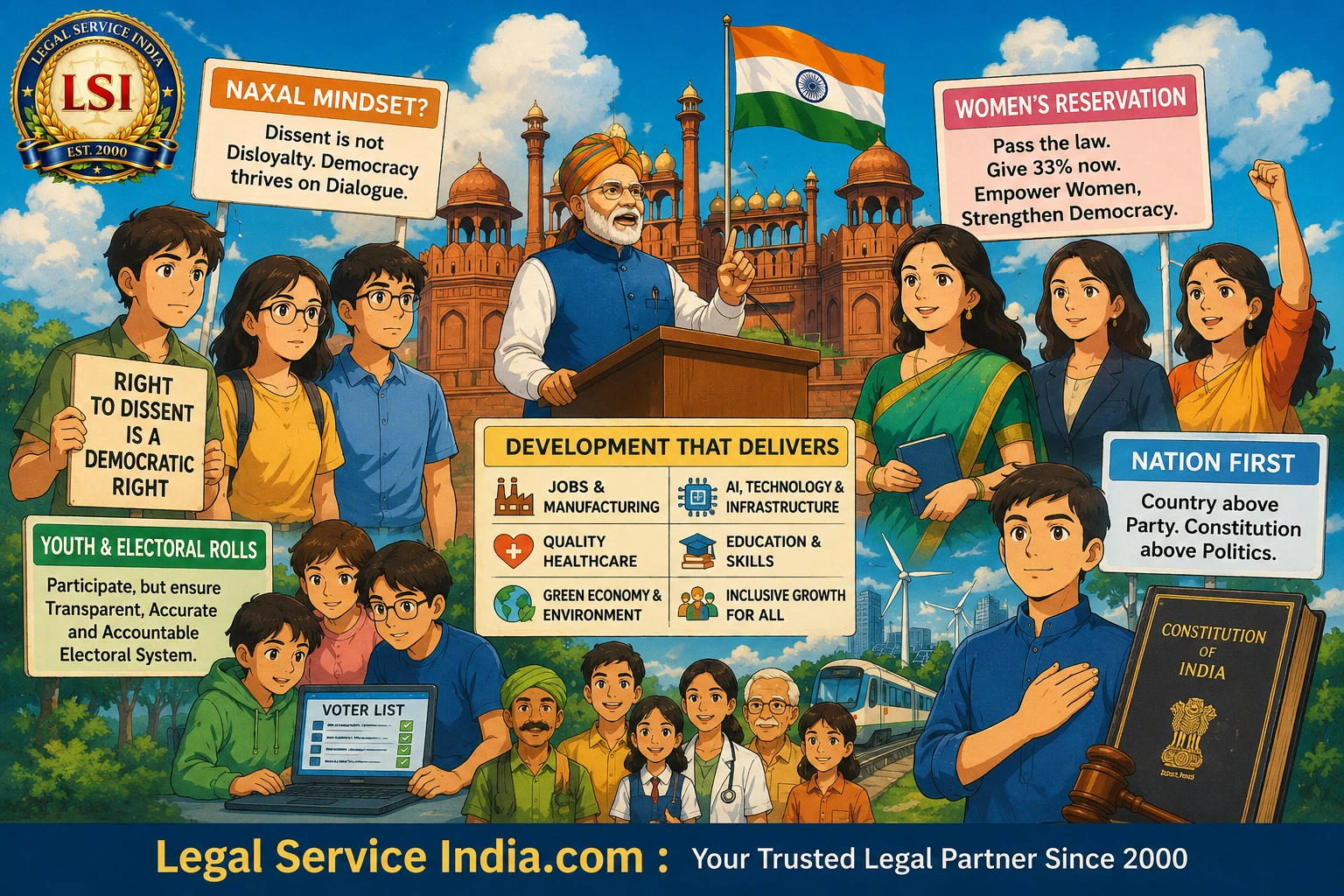
On Independence Day, the Prime Minister addressed the nation from the Red Fort, speaking about a range of issues concerning India’s development and future. Among the themes highlighted were the so-called “Naxal mindset”, women’s reservation, the participation of young people in electoral-roll preparation and the principle of “Nation First”.
These issues deserve serious public discussion—not merely political slogans.
The central question is simple: Are we building an India in which citizens are free to question, institutions remain accountable and development reaches ordinary people?
The “Naxal Mindset” Debate and the Right to Dissent
One of the most contentious aspects of the discussion concerns the reference to a “Naxal mindset”.
The concern is not simply about the terminology. It is about the broader message that such language may send in a democracy.
India is a country of enormous political, social and intellectual diversity. Students may disagree with the government. Academics may criticise public policy. Journalists may raise uncomfortable questions. Political opponents may challenge government decisions. Civil society organisations may protest.
None of these activities should automatically be treated as hostility towards the nation.
Democracy is not merely the right to vote once every few years. It also includes the freedom to question those in power, express disagreement and participate in public debate.
The commentary raises concerns about the functioning of institutions such as the Enforcement Directorate, the CBI and the Election Commission, as well as questions surrounding governors and vice-chancellors. It also refers to allegations of social intimidation involving people’s food choices, speech and political or social opinions.
These concerns should be examined through evidence, constitutional principles and institutional accountability—not simply through political rhetoric.
A strong democracy should be confident enough to tolerate criticism.
Women’s Reservation: From Promise to Implementation
Women’s political representation is another major issue.
The argument presented in the commentary is straightforward: if Parliament has already approved women’s reservation, why should women have to wait indefinitely for its implementation?
The Constitution (One Hundred and Sixth Amendment) Act, 2023, created a constitutional framework for reserving one-third of seats in the Lok Sabha and State Legislative Assemblies for women. The implementation mechanism is linked to delimitation and the publication of relevant figures following a census.
That makes the issue more complicated than simply passing a bill.
However, the broader democratic objective remains clear: women must have meaningful representation in India’s legislatures.
Women’s empowerment cannot remain confined to speeches and political promises. It must translate into greater participation in decision-making.
At the same time, concerns about delimitation and the possible political consequences of constituency restructuring deserve transparent public discussion. The commentary specifically raises apprehensions about whether future delimitation could affect political representation.
The debate, therefore, should focus on both sides of the issue: how to increase women’s representation and how to ensure that the process remains constitutionally sound, transparent and politically fair.
Electoral Rolls and the Role of Young Citizens
The Prime Minister’s appeal to young people to assist with electoral-roll preparation raises another important question.
The idea of citizens helping verify voter information may sound constructive. Accurate electoral rolls are essential to a functioning democracy.
But the responsibility for maintaining electoral rolls ultimately rests with the institutions legally entrusted with that task.
Every eligible citizen should be able to register and exercise the right to vote without facing arbitrary exclusion.
Errors in names, addresses or other voter details can have serious consequences.
The commentary therefore argues that young people should not become a substitute for an electoral administration that must itself be accurate, transparent and accountable.
Citizen participation can strengthen democracy, but institutional responsibility cannot be transferred to citizens.
“Nation First” or “Party First”?
The Prime Minister’s message that the nation should come before personal interest is difficult to disagree with.
The nation must come first.
But the principle should apply consistently to everyone—including governments and political parties.
India has witnessed significant political realignments over the years. Elected representatives have changed political affiliations, parties have split and alliances have shifted.
Every such development raises an important democratic question:
Is the decision being taken in the national interest or primarily in the interest of political power?
The Constitution belongs to the people of India, not to any individual party.
Governments come and go. Political parties rise and fall. Leaders change.
But the Republic remains.
That is why “Nation First” should mean constitutional institutions first, democratic accountability first and citizens first—not simply the interests of whichever party happens to be in government.
India’s Development: From Announcements to Outcomes
India has enormous economic potential.
The country has a young population, a large consumer market, ambitious entrepreneurs, talented professionals and a growing technological ecosystem.
But aspirations must eventually translate into measurable outcomes.
The commentary questions the progress of initiatives such as Smart Cities, Skill India, employment programmes, infrastructure development and the country’s ambition to become a global supplier.
These are legitimate areas for public scrutiny.
A government should not be judged solely by the number of announcements it makes. It should also be judged by implementation.
Key Questions on Government Performance
- How many sustainable jobs have been created?
- How much has manufacturing expanded?
- How many young people have obtained meaningful employment?
- Have infrastructure projects delivered the promised benefits?
- Have government schemes reached the people for whom they were designed?
These questions are not anti-national.
They are the basic questions citizens are entitled to ask.
Manufacturing and Jobs Must Go Together
India’s ambition to become a global manufacturing and supply hub cannot be separated from employment.
A country cannot become an economic powerhouse simply by announcing ambitious targets.
It requires factories, investment, research and development, skilled workers, reliable infrastructure and a business environment capable of supporting long-term production.
Most importantly, it requires jobs.
India’s demographic advantage will become a genuine economic advantage only when young people have access to quality education, practical skills and productive employment.
The commentary therefore argues that India’s development narrative must be evaluated against the realities faced by young Indians.
Healthcare: The Human Face of Development
Economic development is ultimately about improving people’s lives.
Healthcare is therefore one of the clearest measures of whether development is reaching ordinary citizens.
Modern hospitals, affordable medicines, qualified doctors, accessible treatment and adequate public-health infrastructure are essential components of a developed India.
The commentary points to the difficulties faced by patients seeking treatment at major public hospitals and argues that healthcare requires more than government announcements.
The question deserves wider attention:
What does ‘developed India’ mean if a poor family cannot afford quality medical treatment?
Economic growth and human development must move together.
Green Growth Must Also Protect the Environment
India needs development.
India also needs environmental protection.
These objectives should not be treated as mutually exclusive.
The discussion of the proposed Great Nicobar project illustrates the tension between infrastructure development and ecological conservation. The commentary points to differing estimates concerning the number of trees that could be affected by the project.
The larger lesson is more important than the numbers themselves.
Before major infrastructure projects are approved, environmental consequences must be carefully assessed.
Development should create prosperity without imposing an unacceptable ecological cost on future generations.
A genuinely green economy requires more than references to green technology. It requires sustainable planning, environmental safeguards and transparent decision-making.
Artificial Intelligence and Electric Vehicles: Ambition Needs Infrastructure
India’s technological ambitions are impressive.
Artificial intelligence, electric vehicles and advanced digital infrastructure could transform the economy.
But every technological revolution has a physical infrastructure behind it.
- Electric vehicles require electricity and charging infrastructure.
- AI requires data centres, computing capacity and enormous amounts of energy.
- Data centres can also require substantial water resources.
The commentary therefore asks an important planning question: Does India have sufficient energy and water infrastructure to support the scale of technological expansion being contemplated?
This is not an argument against technology.
It is an argument for responsible technology policy.
India should embrace AI and electric mobility—but it should simultaneously invest in renewable energy, electricity transmission, water management, storage capacity and sustainable infrastructure.
A Nation Is More Than Its Government
Perhaps the most important principle is that the country belongs to its citizens.
If that principle is accepted, then citizens must also be heard.
- The Opposition must have a voice.
- Students must have a voice.
- Women must have a voice.
- Academics must have a voice.
- Civil society must have a voice.
- Young Indians must have a voice.
A healthy democracy is not a one-way conversation in which the government speaks and citizens simply listen.
It is a dialogue.
The government must explain its decisions. Citizens must be able to question them. Opposition parties must be able to scrutinise them. Institutions must operate independently, and the media must be able to investigate matters of public importance.
As the commentary puts it, “Democracy requires dialogue.”
After Twelve Years, Citizens Deserve an Honest Report Card
After twelve years in power, the government can reasonably be asked to present a comprehensive report card.
Questions for the Government’s Report Card
- What happened to the Smart Cities programme?
- How many sustainable jobs have been created?
- What has been the measurable impact of Skill India?
- Has India’s manufacturing capacity expanded sufficiently?
- What is the state of public healthcare?
- How are India’s environmental commitments being implemented?
- Is the country adequately prepared for the energy and water demands associated with AI and data centres?
These questions should not be viewed as an attempt to weaken India.
On the contrary, demanding better performance from the government is part of strengthening the Republic.
The commentary emphasises that India has enormous potential, including its young population, entrepreneurs, scientists, workers and democratic institutions.
Independence Means More Than Freedom From Colonial Rule
Independence Day is a reminder of India’s historic struggle against colonial rule.
But independence also carries a deeper democratic meaning.
- Freedom means having the courage to speak.
- Freedom means being able to disagree.
- Freedom means questioning authority.
- Freedom means demanding accountability.
- And democracy means accepting that no political party owns the nation permanently.
Governments change.
Political parties change.
Leaders change.
India remains.
The Constitution remains the foundation of the Republic, and the people remain the ultimate source of democratic legitimacy.
Conclusion: India Needs Dialogue, Accountability and Cooperation
India’s future should not be reduced to a contest between political slogans.
The country needs serious discussion about employment, women’s representation, institutional independence, healthcare, manufacturing, technology, the environment and democratic freedoms.
- Citizens should participate.
- Governments should listen.
- Opposition parties should question.
- Institutions should remain independent.
- Development should be inclusive.
- Technology should serve society.
- Economic growth should create meaningful opportunities.
- And environmental protection should remain a national priority.
India does not need a democracy in which one side speaks and the other remains silent.
It needs a democracy in which disagreement is respected, institutions are accountable and citizens feel that the country truly belongs to them.
The ultimate measure of India’s progress should not merely be the promises made from the Red Fort.
It should be the everyday reality experienced by its citizens.
India’s strength lies not in the unquestioned power of any government, but in the freedom, dignity and participation of its people.
Let us therefore build an India in which development and democracy move together—and in which every citizen can genuinely feel proud to call India home.