





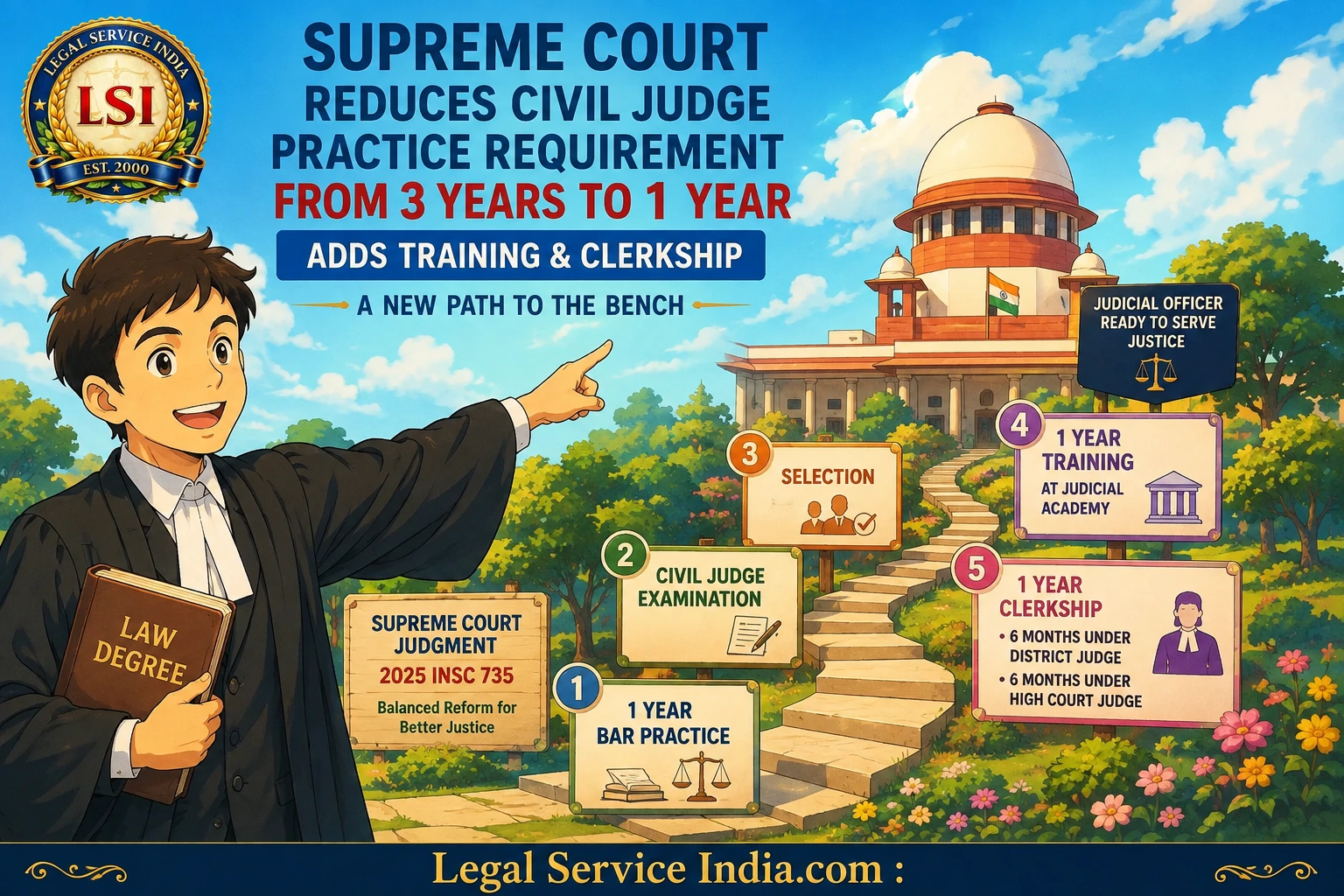
Supreme Court Reduces Civil Judge Practice Requirement from 3 Years to 1 Year; Adds Training & Clerkship
“A good judge is not shaped by years alone, but by the quality of experience behind those years. The Supreme Court’s new approach reminds us that young lawyers may reach the bench sooner—but they must still learn to see the courtroom through the eyes of both the advocate and the judge.” — Adv. Tarun Choudhury
Supreme Court Advocate
Introduction
In a significant development for thousands of young law graduates and judiciary aspirants across India, the Supreme Court has substantially modified the framework governing entry into the Civil Judge (Junior Division)/entry-level judicial service.
The Court has reduced the minimum period of prior practice at the Bar from three years to one year. At the same time, however, it has not abandoned the principle that a person entering the judiciary should possess meaningful exposure to the practical working of law.
Instead, the Court has created a structured professional-development model involving one year of intensive training at the State Judicial Academy followed by one year of clerkship under judicial supervision.
The decision, therefore, should not be understood simply as a relaxation from three years to one year. It is better understood as a redesign of the route through which a young advocate becomes a judicial officer.
The development is particularly important because the Supreme Court had, in its judgment dated 20 May 2025, restored the requirement of three years’ legal practice before a candidate could appear for entry-level judicial service examinations. That judgment is reported as 2025 INSC 735.
The latest decision modifies that framework while retaining the Court’s fundamental concern: a civil judge should not enter the courtroom without adequate exposure to the realities of litigation and judicial work.
What Has the Supreme Court Decided?
The Supreme Court has essentially adopted a middle path.
Instead of completely removing the requirement of prior professional exposure, the Court has:
- Reduced mandatory bar practice from three years to one year.
- Retained prior practice as an eligibility requirement.
- Introduced one year of intensive training at the concerned State Judicial Academy after selection.
- Introduced a further one-year structured clerkship under judicial supervision.
- The clerkship is structured as:
- six months under a District Judge/Higher Judicial Service judicial officer; and
- six months under a sitting High Court Judge.
- The Court has also created a transitional relaxation for recruitment notifications falling within the specified period, extending up to 31 March 2027.
Thus, the headline may say “3 years reduced to 1 year,” but the actual reform is considerably more nuanced.
The Court has moved from a model based predominantly on pre-recruitment experience to one combining limited pre-recruitment experience with substantial post-selection judicial training.
Why Is This Judgment So Important?
This judgment affects one of the most sensitive questions in judicial recruitment:
Should a person become a judge immediately after law school, or should the person first experience the legal profession?
This question has divided the legal community for years.
One school of thought argues that a judge must understand what actually happens inside a courtroom before deciding cases. A person who has never drafted a plaint, written a written statement, prepared evidence, examined a witness, argued an interim application or dealt with an anxious litigant may possess excellent academic knowledge but still lack practical judicial understanding.
The opposing concern is equally legitimate.
A three-year mandatory practice requirement can significantly delay entry into the judiciary, particularly for young graduates who have decided early in their careers that they want to become judicial officers.
The latest Supreme Court decision attempts to reconcile these two competing considerations.
The Background: Why Did the Three-Year Rule Come Into Existence?
The controversy cannot be understood without looking at the Supreme Court’s earlier decision.
On 20 May 2025, the Supreme Court restored the requirement that candidates seeking direct recruitment to entry-level judicial service must have at least three years of legal practice.
The decision overturned the earlier position that permitted fresh law graduates to enter the judicial service without prior bar experience. The judgment was delivered in the larger litigation concerning the All India Judges Association and judicial-service conditions. The decision is reported as 2025 INSC 735.
The rationale was straightforward.
A judge is not merely an individual who has successfully passed a competitive examination.
A judge exercises enormous authority.
A civil judge may determine disputes involving:
- property;
- matrimonial rights;
- injunctions;
- contracts;
- money claims;
- succession;
- criminal proceedings at the trial level;
- evidence;
- personal liberty;
- and the rights of ordinary citizens.
The Court therefore considered practical legal experience to be an important component of judicial preparedness.
But Why Did the Supreme Court Now Reduce Three Years to One?
This is where the latest decision becomes particularly interesting.
The Court has apparently recognized that three years of bar practice and practical judicial training are not necessarily the only way to produce a competent entry-level judge.
A carefully structured training system can itself provide exposure to:
- court procedure;
- evidence;
- case management;
- judicial writing;
- legal research;
- examination of witnesses;
- appreciation of pleadings;
- interaction with lawyers;
- understanding of litigants;
- ethics;
- judicial conduct;
- and the functioning of trial courts.
Therefore, instead of insisting that a young lawyer spend three years independently practicing at the Bar before becoming eligible to even compete, the Court has shifted part of that practical-development burden into the post-selection training process.
This is an important conceptual change.
One Year of Practice Is Still Mandatory
One possible misunderstanding should be immediately corrected.
The Supreme Court has not restored the old system of allowing fresh law graduates with zero practice to enter the judicial examination.
The latest framework retains a minimum period of one year of practice.
Therefore, the new position can broadly be understood as
LL.B. → Enrollment/Practice → One-year Bar experience → Judicial Service Examination → Selection → One-year Judicial Academy Training → One-year Judicial Clerkship → Judicial responsibility
This is materially different from both the old fresh-graduate model and the three-year practice model.
The New One-Year Training Requirement
The first major component after selection is one year of intensive training at the concerned State Judicial Academy.
This is perhaps the most important aspect of the new arrangement.
The Court is effectively saying:
If we are reducing the period of bar practice, we must strengthen institutional judicial training.
The training therefore cannot be treated as a ceremonial induction program.
It should ideally become a serious professional apprenticeship.
A judicial academy should expose trainee judicial officers to the realities of trial courts rather than merely teaching theoretical law.
What Should Judicial Academy Training Cover?
From a practitioner’s perspective, I would expect an effective training program to include at least the following:
1. Trial Management
A civil judge must know how to control proceedings without unnecessarily controlling the parties.
Judicial discipline and courtroom management are acquired partly through experience.
2. Evidence
Reading the Evidence Act or the Bharatiya Sakshya Adhiniyam is one thing.
Understanding how evidence actually emerges in a courtroom is another.
3. Examination and Cross-Examination
A judge should understand how questions are framed, how witnesses respond, and how inconsistencies emerge.
4. Interim Applications
Applications for:
- injunctions;
- stay;
- amendment;
- discovery;
- attachment;
- appointment of commissioners;
are the daily reality of civil litigation.
5. Judicial Writing
A good judicial order must be:
- reasoned;
- intelligible;
- legally sustainable;
- concise where possible;
- and sufficiently detailed where necessary.
6. Case Management
The modern trial judge cannot permit every case to continue indefinitely.
Judicial efficiency is increasingly becoming an essential component of access to justice.
7. Ethics
Judicial independence is inseparable from judicial ethics.
The trainee must understand not only what a judge can do but also what a judge must never do.
The Second Major Reform: One-Year Clerkship
The second component is even more interesting.
After the academy training, selected candidates will undergo a one-year clerkship under judicial supervision.
According to reports on the judgment, the clerkship will comprise:
Six months under a District Judge/Higher Judicial Service judicial officer and six months under a sitting High Court Judge.
This is an innovative feature.
Why?
Because judicial work cannot be fully learned from a classroom.
Why Clerkship Can Be Extremely Valuable
For more than 25 years, I have seen one fundamental difference between academic legal knowledge and courtroom knowledge.
The law on paper and the law in motion are not always the same thing.
A young judicial officer needs to understand how files actually move.
- How do lawyers seek adjournments?
- How are pleadings examined?
- How are issues framed?
- How is evidence recorded?
- How does a judge distinguish a genuine procedural difficulty from a delaying tactic?
- How does a judge identify the real controversy hidden beneath hundreds of pages?
These are skills acquired through exposure.
A structured clerkship can provide exactly that exposure.
Six Months With a District Judge: Why It Matters
The District Judiciary is where the overwhelming majority of litigants experience the justice system.
A trainee working with a district judge or judicial officer can observe:
- civil trials;
- criminal proceedings;
- interim applications;
- execution proceedings;
- evidence recording;
- arguments;
- administrative responsibilities;
- case management;
- and the enormous volume of litigation handled by trial courts.
This exposure can be invaluable.
A future civil judge should understand the pressures under which trial judges operate.
Six Months With a High Court Judge: Why Add This Layer?
The High Court component provides a different perspective.
A high court judge frequently deals with:
- appeals;
- revisions;
- writ petitions;
- supervisory jurisdiction;
- challenges to trial court orders;
- interpretation of precedent;
- questions of law;
- and scrutiny of judicial reasoning.
A trainee observing this process can learn an important lesson:
A trial court order is not the end of the legal journey. It must be capable of surviving appellate scrutiny.
This can improve the quality of judicial reasoning at the trial level.
Is the New System Better Than Three Years of Practice?
In my view, the answer is potentially yes—but only if implemented seriously.
There is an important distinction between practice experience and structured judicial training.
Three years at the Bar can teach a young lawyer:
- how clients behave;
- how litigation actually works;
- how lawyers prepare cases;
- how witnesses behave;
- how procedural tactics operate;
- and how difficult it can be for an ordinary litigant to navigate the system.
But three years at the bar do not automatically make someone a good judge.
Similarly, one year of academy training does not automatically produce judicial maturity.
The real strength of the new model lies in combining the two.
The New Model Is a Hybrid Model
The latest framework can therefore be described as a hybrid judicial-entry model.
Earlier Model
Three years of bar practice → Judicial examination → Selection
Fresh-Graduate Model
Law degree → Judicial examination → Selection
New Model
One year Bar practice → Judicial examination → Selection → One year Academy Training → One year Judicial Clerkship
This is a significant institutional experiment.
The Supreme Court has not simply relaxed the eligibility condition.
It has attempted to redistribute professional learning across the career pathway.
What About Post-Graduation in Law?
Another important aspect of the latest development is that the Supreme Court has rejected the argument that post-graduation in law should automatically be treated as equivalent to practical experience at the bar for civil judge recruitment.
The Court’s reasoning keeps an important distinction alive:
Academic specialization is not the same thing as professional courtroom experience.
A person may have an LL.M. and possess excellent theoretical knowledge, but that qualification does not necessarily demonstrate that the person has dealt with actual litigation.
The Supreme Court has therefore not accepted the proposition that an additional academic degree should simply substitute for practice.
That distinction is legally and institutionally significant.
Transitional Relaxation: What Happens to Candidates Caught in the Middle?
The Court has also addressed the practical difficulty created by the earlier three-year requirement.
Recruitment processes do not operate in a vacuum.
Notifications had already been issued.
Candidates had prepared for examinations.
Some candidates had become eligible under one framework but would have become ineligible under another.
The Supreme Court has therefore provided a transitional relaxation for civil judge recruitment notifications issued between 20 May 2025 and 31 March 2027. Candidates covered by the specified transition will not be disadvantaged merely because of the earlier three-year requirement.
This is important because judicial policy should not operate retrospectively in a manner that unfairly destroys legitimate opportunities already created under a previous recruitment framework.
What Changes From April 2027?
The new structure is expected to become the operative framework for future recruitment from April 2027, subject to implementation through the relevant judicial-service rules and recruitment notifications.
Reports indicate that the new system will combine:
- One year of bar practice
- Judicial Service Examination
- One-year academy training
- One-year structured clerkship
Therefore, judiciary aspirants should not interpret today’s judgment as meaning:
“A fresh law graduate can immediately sit for the civil judge examination.”
That would be an incorrect understanding of the decision.
A Major Message for Judiciary Aspirants
For young lawyers, the judgment provides both an opportunity and a warning.
The opportunity is obvious.
The waiting period before becoming eligible has effectively been reduced from three years to one year.
That means a young advocate can potentially attempt the judicial service examination significantly earlier in their career.
But the warning is equally important.
The Bar experience is not being discarded.
The Court continues to attach importance to practical legal exposure.
Therefore, the one year of practice should not be treated as a mere formality.
A candidate should actually learn:
- drafting;
- filing;
- pleadings;
- evidence;
- arguments;
- procedure;
- legal research;
- courtroom etiquette;
- and client interaction.
One year of meaningful practice can be more valuable than three years spent merely maintaining an enrollment.
What This Means for Law Colleges
The judgment also indirectly sends a message to law schools.
If young graduates are going to enter judicial service after comparatively limited bar exposure, law schools and judicial academies must work together more effectively.
Legal education cannot remain predominantly examination-oriented.
Students need exposure to:
- trial courts;
- legal aid;
- drafting;
- mediation;
- arbitration;
- evidence;
- criminal procedure;
- civil procedure;
- and actual judicial orders.
The quality of the future judiciary will depend partly on the quality of this pipeline.
What This Means for the Bar
There is another important dimension.
The three-year practice rule had been welcomed by many members of the Bar because it was seen as a way of ensuring that young judges understood the profession they would eventually regulate from the bench.
Reducing the period to one year may therefore generate concern among sections of the Bar.
That concern should not simply be dismissed.
A judge must understand the legitimate difficulties faced by advocates.
For example, a lawyer may seek time because:
- A document was supplied late;
- A witness has not appeared;
- Instructions are incomplete;
- A matter has been listed unexpectedly;
- or a genuine procedural problem has arisen.
At the same time, a judge must also recognize when adjournments are being used merely to delay proceedings.
That balance is best learned through practical exposure.
The new clerkship mechanism therefore becomes extremely important.
The Risk: Training Must Not Become a Mere Formality
This is where implementation will determine whether the judgment succeeds.
If “one year training” means merely attending lectures and passing internal assessments, the objective will be defeated.
Similarly, if clerkship means sitting in chambers and observing files without meaningful participation, the benefit will be limited.
The training must be
practical, supervised, measurable, and accountable.
There should ideally be structured assessment of:
- judgment writing;
- order writing;
- legal research;
- procedural understanding;
- case management;
- ethics;
- courtroom conduct;
- and appreciation of evidence.
The Supreme Court Has Chosen a Middle Path
The beauty of the judgment, in my assessment, lies in the fact that the court has avoided two extremes.
Extreme One
Allow completely inexperienced graduates to become judges immediately after law school.
Extreme Two
Insist on a rigid three-year bar requirement irrespective of whether a more effective institutional training model can provide equivalent or better practical exposure.
The Court has instead attempted:
limited bar experience, competitive selection, intensive judicial education, and supervised judicial apprenticeship.
That is a far more sophisticated model.
A Word of Caution for States and High Courts
The success of the judgment will ultimately depend upon implementation by:
- State Governments;
- High Courts;
- State Judicial Academies;
- recruiting authorities;
- and the judicial administration.
Recruitment rules must be amended clearly.
There should be no ambiguity regarding:
- how the one year of practice is calculated;
- what constitutes active practice;
- What documents establish practice
- when the practice period begins;
- how the training is structured;
- how clerkship postings are allocated;
- who evaluates trainees;
- and what happens if a trainee fails to meet the required standards.
A good judicial policy can fail because of poor implementation.
My Assessment as a Practicing Advocate
After more than two decades in the legal profession, I would say that courtroom maturity cannot be manufactured overnight.
But neither can we assume that three years of bar practice automatically produces judicial maturity.
I have seen young advocates with limited years of practice display extraordinary command over law, facts, and procedure.
I have also seen lawyers with decades of experience who may not necessarily possess the temperament required for judging.
The judicial office requires something more.
It requires:
knowledge, patience, independence, discipline, empathy, courage, analytical ability, and integrity.
The new system has the potential to develop these qualities if training is treated as a serious apprenticeship rather than bureaucratic induction.
What Should Judiciary Aspirants Do Now?
For candidates planning to appear for civil judge examinations, the practical lesson is simple.
Do not abandon practice merely because the eligibility requirement has been reduced.
Use that one year intelligently.
During the year, try to gain exposure to:
- Civil pleadings.
- Criminal proceedings.
- Evidence.
- Interim injunctions.
- Arguments.
- Drafting.
- Case law research.
- Courtroom procedure.
- Execution proceedings.
- Interaction with litigants and witnesses.
A candidate who combines this practical experience with serious examination preparation will enter the judicial service with a considerable advantage.
The Larger Constitutional Question
At the heart of the entire debate lies a constitutional question:
What kind of person should exercise judicial power over citizens?
The Constitution does not merely require technically qualified judges.
It requires an independent and competent judiciary.
Article 235 places the subordinate judiciary under the control of the High Court, while the constitutional scheme governing judicial appointments reflects the importance of competence, independence, and institutional standards.
The Supreme Court’s latest approach should therefore be viewed as part of the continuing effort to strengthen the subordinate judiciary.
The civil judge is often the first judicial officer encountered by an ordinary citizen.
For that citizen, the District Judiciary is not an abstract constitutional institution.
It is the justice system.
Final Takeaway
The latest Supreme Court decision should not be described simply as
“Three years reduced to one year.”
That headline is correct but incomplete.
The more accurate description is
The Supreme Court has reduced the pre-entry bar practice requirement to one year while replacing part of the earlier experience requirement with a structured two-year professional-development pathway consisting of judicial academy training and supervised clerkship.
This is therefore not merely a concession to young judiciary aspirants.
It is an attempt to redesign how India prepares its entry-level judges.
The real test will begin after the judgment.
If state judicial academies provide serious training, if clerkships expose candidates to real judicial work, and if the high courts rigorously supervise the process, the new model could prove more effective than a purely numerical three-year practice requirement.
But if training becomes a formality, the reduction from three years to one year may come at the cost of precisely the courtroom maturity that the Supreme Court has always considered essential.
In my considered view, the success of this judgment will depend not upon the number “one” or “three,” but upon the quality of the professional experience that lies behind those numbers.
Citation and Case Background
The latest ruling arises from the Supreme Court’s reconsideration of the framework laid down in All India Judges Association v. Union of India & Ors., in which the Court’s 20 May 2025 judgment restored the three-year practice requirement for entry-level judicial service. That earlier judgment is reported as 2025 INSC 735.
The present proceedings include Bhumika Trust v. Union of India, W.P.(C) No. 1110/2025, among the connected proceedings concerning the operation and review of the practice requirement.
Important: The latest order was pronounced on 21 August 2026. At the time of writing, contemporaneous legal reports describe the operative modifications, but an official reportable citation for today’s order should be checked against the Supreme Court’s final uploaded judgment before being cited as a formal SCC/AIR citation.
Frequently Asked Questions
1. Has the Supreme Court completely removed the three-year practice requirement?
No. The Court has reduced the requirement to one year of practice. The principle that some prior professional exposure is necessary has been retained.
2. Can a fresh LL.B. graduate immediately sit for the Civil Judge examination?
Under the new framework, one year of practice remains relevant as an eligibility requirement. Therefore, the judgment should not be interpreted as a return to unrestricted fresh-graduate entry.
3. What happens after selection?
Selected candidates will undergo one year of intensive training at the State Judicial Academy, followed by one year of structured clerkship.
4. What is the clerkship structure?
Reports indicate six months under a District Judge/Higher Judicial Service judicial officer and six months under a sitting High Court Judge.
5. Does an LL.M. replace the practice requirement?
No. The Supreme Court has rejected the contention that postgraduate legal education should automatically be treated as equivalent to practice at the bar for civil judge recruitment.
6. What about candidates affected by the earlier three-year rule?
The Court has provided a transitional relaxation for specified recruitment notifications issued from 20 May 2025 through 31 March 2027, thereby preventing candidates caught in the transition from being unfairly disadvantaged.
Conclusion
The Supreme Court has not merely shortened a waiting period for judiciary aspirants.
It has attempted something more ambitious: to redesign the apprenticeship through which a young lawyer becomes a judge.
The experiment deserves careful attention.
If properly implemented, the combination of one year at the Bar + one year of judicial academy training + one year of supervised clerkship could produce candidates who possess both the perspective of an advocate and the discipline of a judicial officer.
For thousands of young lawyers dreaming of the Bench, the door has opened earlier.
But the message from the Supreme Court remains clear:
Entering the judiciary may happen sooner. Becoming ready to judge must still be taken seriously.
Need Expert Legal Guidance?
Adv. Tarun Choudhury
Supreme Court Advocate | 25+ Years of Legal Experience
For professional legal guidance, consultation, or assistance relating to judicial service, civil judge recruitment, legal practice requirements, and other legal matters, you may contact:
- 📞 Call: 9650499965
- 💬 WhatsApp: 8851978611
Get experienced legal guidance backed by 25+ years of practice before the Supreme Court of India.
Frequently Asked Questions
1. What is the new Supreme Court civil judge practice requirement in 2026?
The Supreme Court has reduced the civil judge practice requirement from three years to one year. Candidates will now need one year of legal practice before becoming eligible for entry-level judicial service, subject to the applicable recruitment rules.
2. Can a fresh LL.B. graduate apply directly for the Civil Judge examination after this Supreme Court judgment?
No. The latest Supreme Court decision does not completely remove the prior practice requirement. A candidate must generally complete one year of legal practice before applying for civil judge recruitment under the new framework.
3. What training will candidates receive after being selected as civil judges?
Selected civil judge candidates will undergo one year of intensive training at the State Judicial Academy, followed by one year of structured judicial clerkship. The clerkship is intended to provide practical exposure to judicial proceedings and decision-making.
4. What is the new civil judge clerkship requirement under the Supreme Court judgment?
The new framework provides for a one-year clerkship after judicial training, reportedly comprising six months with a district judge or higher judicial service judge and six months with a sitting high court judge. This is intended to strengthen practical judicial experience before candidates assume full judicial responsibilities.
5. Can an LL.M. degree replace the one-year practice requirement for civil judge recruitment?
No. The Supreme Court has maintained a distinction between postgraduate legal education and practical experience at the Bar. An LL.M. degree cannot automatically be treated as equivalent to the required period of legal practice for civil judge recruitment.
Key Takeaways: Supreme Court Reduces Civil Judge Practice Requirement to 1 Year
- Supreme Court Civil Judge practice requirement reduced: The Supreme Court has reduced the minimum legal practice requirement for Civil Judge (Junior Division) recruitment from 3 years to 1 year.
- One year of bar practice remains important: The judgment does not restore direct entry for fresh LL.B. graduates without practice. Candidates must satisfy the applicable one-year practice requirement.
- Major change in judicial recruitment: The new framework shifts from relying primarily on pre-recruitment experience to a combination of bar practice, judicial training, and supervised clerkship.
- One year of mandatory judicial training: Selected candidates will undergo one year of intensive training at the concerned State Judicial Academy before proceeding through the new professional-development framework.
- One-year judicial clerkship introduced: Candidates will undergo one year of structured clerkship, designed to provide practical exposure to judicial functioning.
- District Judge and High Court exposure: The proposed clerkship structure includes six months under a District Judge/Higher Judicial Service judicial officer and six months under a sitting High Court Judge.
- LL.M. does not replace Bar practice: The Supreme Court has maintained that postgraduate legal education is not equivalent to practical experience at the Bar for civil judge recruitment.
- Transitional relief for judiciary aspirants: Candidates affected by the earlier three-year practice requirement have received transitional protection for specified recruitment notifications during the transition period.
- Why the judgment matters: The decision can allow young advocates to enter the judicial service earlier while still ensuring that they receive substantial practical judicial training after selection.
- Practical experience remains central: The Supreme Court’s approach recognizes that legal knowledge alone is insufficient for judicial office; courtroom exposure, judicial writing, evidence appreciation, case management, and professional ethics are equally important.
- New Civil Judge pathway: The emerging model can broadly be understood as
Law Degree → 1 Year Bar Practice → Civil Judge Examination → Selection → Judicial Academy Training → Judicial Clerkship → Judicial Responsibilities. - Implementation will determine success: The effectiveness of the new system will depend heavily on the quality of State Judicial Academy training, clerkship supervision, assessment, and implementation by high courts and state governments.
Civil Judge Recruitment Pathway at a Glance
| Stage | Requirement / Process | Purpose |
|---|---|---|
| 1 | Law Degree | Acquire foundational legal education. |
| 2 | 1-Year Bar Practice | Gain initial courtroom and professional experience. |
| 3 | Civil Judge Examination | Compete for entry-level judicial service. |
| 4 | Selection | Enter the judicial training pathway. |
| 5 | Judicial Academy Training | Develop judicial skills and institutional understanding. |
| 6 | Structured Judicial Clerkship | Gain supervised practical exposure to judicial work. |
| 7 | Judicial Responsibilities | Apply legal knowledge, courtroom experience, and judicial training |
