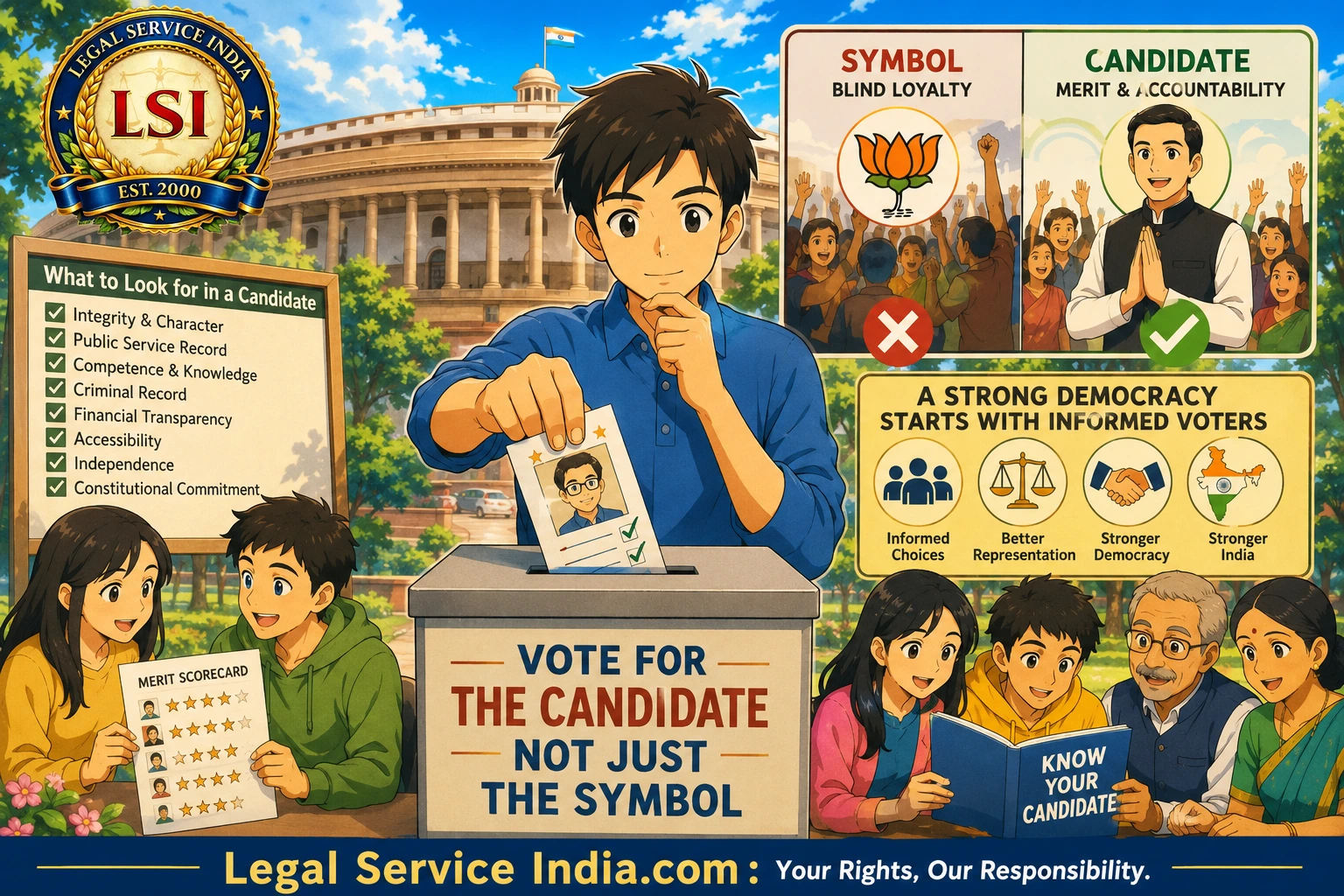
Your Vote Belongs to You: Why India Must Look Beyond the Party Symbol
By Adv. Tarun Choudhury
Supreme Court Advocate | 25+ Years of Legal Experience
Your Vote Belongs to You
Before you read further, ask yourself one honest question:
When you voted in the last election, did you vote for the candidate—or did you vote for the symbol?
Do not answer quickly.
Think about the candidate who actually appeared on the ballot.
Did you know his or her background?
Did you examine the candidate’s record?
Did you know what the candidate had achieved before entering politics?
Did you examine the candidate’s declared criminal cases, assets and liabilities?
Did you ask who financially supported the campaign?
Did you consider whether the candidate would have the courage to disagree with his own party when the interests of the people demanded it?
Or did you simply recognise the symbol and think:
“This is my party. This is my vote.”
If the second answer describes our voting behaviour, then perhaps we need to rethink something fundamental about Indian democracy.
Because your vote belongs to you—not to a political party.
A political party can ask for your vote.
A political candidate can earn your vote.
But neither should receive your vote automatically.
The Person You Send to Parliament Matters
A political party does not sit in Parliament.
Its symbol does not stand up and speak during a parliamentary debate.
Its symbol does not study a Bill.
Its symbol does not question a minister.
Its symbol does not examine the national budget.
Its symbol does not represent your constituency.
A person does.
That person will receive enormous constitutional authority in your name.
So why should we spend hours discussing political symbols but sometimes only minutes thinking about the individual who will actually exercise that power?
This is the central question.
If we are entrusting someone with the power to represent us, shouldn’t we first know who that person is?
The Most Powerful Question a Voter Can Ask
Before voting, ask yourself:
“If the party symbol disappeared, would I still vote for this candidate?”
This question is simple, but psychologically powerful.
It separates party loyalty from personal judgment.
Suppose you discover that the candidate has:
- an excellent public-service record;
- integrity;
- competence;
- knowledge of the constituency;
- a clean and transparent record;
- independence from powerful interests; and
- the ability to represent people effectively.
Then vote for that candidate with confidence.
But suppose the candidate has none of these qualities.
Should a symbol alone be enough to persuade you?
That is the question every voter should confront.
What Happens When We Vote for the Symbol Instead of the Person?
This is where the issue becomes much deeper.
When millions of voters automatically vote for a party symbol, the political party becomes extraordinarily powerful.
The candidate begins to understand something very important about his political future:
“My party’s support may matter more to my career than my personal relationship with the voters.”
Think about the consequences.
If the candidate believes that the party symbol delivered his victory, he may become primarily concerned with:
- keeping the party leadership happy;
- retaining the party’s confidence;
- securing the next ticket;
- protecting his political position;
- following the party leadership;
- maintaining political relationships; and
- advancing party interests.
The voter, who actually cast the vote, can gradually become secondary.
This creates a dangerous psychological shift.
Instead of:
People → Representative
the relationship can become:
Party Leadership → Representative → People
That is a serious weakening of the voter.
The Voter Should Not Become Important Only on Election Day
Think about this carefully.
On election day, political parties need you desperately.
They ask for your vote.
They appeal to you.
They campaign for your support.
They tell you that your vote matters.
But what happens after the election?
If the elected representative believes that his political future depends primarily upon the party leadership, the voter may become less important until the next election.
That is not the democratic relationship we should want.
The voter should not be merely important enough to elect the representative.
The voter should remain important throughout the representative’s entire term.
The representative should constantly remember:
“These people gave me the authority to represent them.”
That psychological connection is extremely important.
Who Does the Candidate Really Work For?
Here is another question worth asking:
“After winning, whom does the candidate feel he must satisfy?”
Ideally, the answer should be:
The Constitution. The law. The people.
But if the candidate’s political survival depends heavily on party leadership, another consideration can enter his thinking:
“What will my party leadership think?”
That does not mean every politician will behave this way.
It means the incentive structure can encourage it.
And incentives matter.
A representative who believes that voters carefully judge his personal performance has a reason to remain connected with voters.
A representative who believes that the party symbol will automatically carry him to the next election may have less personal incentive to build an independent relationship with the electorate.
We May Be Making Political Parties Stronger Than the Voters
This is the heart of my concern.
Political parties are necessary for democracy.
But political parties should be instruments of the people, not substitutes for the people.
When voters automatically transfer their loyalty from themselves to a party symbol, they may unintentionally strengthen the party’s control over the elected representative.
The party gives:
Ticket + Symbol + Organisation
The voter gives:
The Mandate
The candidate receives:
Political Power
Therefore, the candidate should remember where the ultimate democratic authority came from.
The party may have opened the door.
The voter walked the candidate through it.
The Candidate Should Fear Losing the Voter’s Trust—Not Merely Losing the Party Ticket
Imagine two political futures.
In the first, an MP thinks:
“If I lose my party’s favour, my political career is finished.”
In the second, the MP thinks:
“If I lose my people’s trust, my political career is finished.”
Which one produces a more accountable representative?
The answer is obvious.
Candidate-focused voting can change this psychology.
The MP begins to understand:
“My party can nominate me, but the people can reject me.”
That is healthy democratic pressure.
This Could Change How Political Parties Select Candidates
Now we reach an even more important consequence.
If voters become candidate-conscious, political parties will eventually have to become candidate-conscious too.
Today, a party may be tempted to ask:
“Who can win under our symbol?”
A candidate-focused electorate forces a different question:
“Who deserves to represent our party before the people?”
That changes everything.
A person with:
- strong public-service credentials;
- integrity;
- local respect;
- professional competence;
- grassroots experience;
- knowledge of public issues; and
- a good reputation
becomes electorally valuable.
Meanwhile, the value of merely being:
- a flatterer;
- a factional loyalist;
- a political insider;
- a wealthy aspirant; or
- someone with powerful connections
can decline.
The message to political parties becomes clear:
“Do not give us merely a person who is loyal to you. Give us a person whom the public can trust.”
The Party Ticket Should Be an Opportunity—Not a Guarantee
This distinction is crucial.
A party ticket should mean:
“We believe this person deserves to represent us.”
It should never mean:
“This person is entitled to the voter’s support.”
The voter should remain the final judge.
Even the most powerful political party should be forced to understand:
“Our symbol cannot permanently compensate for a candidate whom the electorate considers unsuitable.”
That is how political accountability begins.
What About Money and Heavy Advertising?
Here we must be fair.
A candidate spending money on legitimate campaigning is not automatically corrupt.
Advertising is part of modern elections.
But there is a psychological danger:
Visibility can be mistaken for merit.
The candidate whose face appears everywhere may begin to feel more familiar.
And human beings naturally tend to trust what they repeatedly see.
But familiarity is not competence.
A candidate can purchase visibility.
He cannot purchase integrity.
He can purchase advertisements.
He cannot purchase wisdom.
He can purchase campaign machinery.
He cannot purchase genuine public-service experience.
Therefore, voters must learn to distinguish:
“I have seen this candidate everywhere”
from:
“I have examined this candidate carefully.”
The Hidden Question Behind Campaign Money
There is another question that voters should ask:
“Who is paying for this political visibility?”
Again, financial support does not automatically mean wrongdoing.
But concentrated financial dependence can create potential obligations.
Imagine a candidate whose political campaign depends heavily on a small group of powerful individuals.
After winning, he may remember:
“They helped me when I needed them.”
That can create what we might call a debt of gratitude.
It may be financial.
It may be political.
It may be personal.
It may be organisational.
And it may influence political independence.
The fundamental question becomes:
When a representative has to choose between the public interest and the wishes of a powerful supporter, who should come first?
The answer should always be:
The public interest.
The Problem of Political “Godfathers”
Political patronage creates another potential dependency.
A candidate may require a powerful political figure to obtain:
- a party ticket;
- financial assistance;
- organisational support;
- campaign machinery;
- political connections;
- future opportunities.
Before election:
“I need you.”
After election:
“I owe you.”
That is precisely why voters should care about a candidate’s independence.
We should not want representatives who enter Parliament feeling that they belong to a political patron.
We should want representatives who enter Parliament knowing:
“I belong to the people who elected me.”
What Happens When a Candidate Wins With Too Many Obligations?
A winning candidate may find that his political hands are tied—not necessarily because he is corrupt, but because he has accumulated too many political dependencies.
He may worry:
“If I oppose this person, will I lose support?”
“If I challenge this party decision, will I get the next ticket?”
“If I disagree with an influential supporter, will it damage my political future?”
These questions can influence behaviour.
This is why independence should be one of the qualities voters examine before giving someone political power.
Candidate Merit Could Break This Cycle
Imagine a different political culture.
A party knows:
“If we nominate a weak candidate, our voters may reject him.”
Suddenly, candidate quality matters.
The party begins searching for:
- respected professionals;
- experienced public servants;
- honest community leaders;
- competent administrators;
- people with strong grassroots records;
- people with credible reputations.
Why?
Because the candidate has to win the voter—not merely carry the symbol.
This could create a positive cycle:
Voters demand merit
↓
Parties search for meritorious candidates
↓
Good candidates become politically valuable
↓
Flattery and patronage become less valuable
↓
Political competition becomes more candidate-focused
↓
The quality of representatives can improve
That is the real power of your vote.
It Could Also Give Honest Newcomers a Chance
Think about the talented Indian who has never entered politics.
Perhaps she is a doctor.
Perhaps he is a teacher.
Perhaps she is a lawyer.
Perhaps he is an engineer.
Perhaps someone has spent twenty years serving a community.
Perhaps someone has built an organisation that genuinely helps people.
Such people may not possess enormous political networks.
They may not have powerful godfathers.
They may not have enormous campaign budgets.
But they may possess something far more important:
the trust of ordinary people.
A candidate-merit culture can make that trust politically valuable.
We Must Be Careful With Criminal Allegations
Candidate scrutiny must also remain fair and lawful.
A person having a declared criminal case does not automatically mean that the person is guilty.
There is an essential difference between:
allegation, investigation, prosecution, trial and conviction.
A democratic society must respect the presumption of innocence and due process.
But that does not mean voters should remain unaware of what candidates have officially disclosed.
The solution is simple:
Do not believe rumours. Examine verified information.
The voter should look at the candidate’s declared affidavit and make an informed judgment.
The Five-Minute Test Before You Vote
You do not need to become a political expert.
Before voting, ask five questions:
1. Who Exactly Is This Candidate?
Know the person, not merely the symbol.
2. What Has This Person Actually Achieved?
Look for a record rather than promises.
3. What Does the Candidate’s Official Affidavit Disclose?
Examine relevant information such as declared criminal cases, assets and liabilities.
4. Who Supports and Finances the Candidate?
Think about independence and possible influence.
5. Would I Vote for This Person If the Symbol Disappeared?
If the answer is yes, you have probably made a candidate-based decision.
A Simple Candidate Merit Test
You can even score candidates yourself:
| Quality | Suggested Weight |
|---|---|
| Integrity and character | 15 |
| Criminal/ethical record | 15 |
| Public-service record | 10 |
| Competence and knowledge | 10 |
| Parliamentary performance | 10 |
| Independence | 10 |
| Accessibility to constituents | 10 |
| Financial transparency | 5 |
| Quality of policies | 10 |
| Constitutional commitment | 5 |
| Total | 100 |
The numbers are not a legal formula.
They are simply a way of forcing ourselves to think before we vote.
Candidate First Does Not Mean Party Blindness
There is an important balance.
I am not suggesting:
“Ignore political parties.”
That would be wrong.
Party ideology matters.
Government policies matter.
National issues matter.
Economic policies matter.
Constitutional questions matter.
But the party should be one part of the decision—not the entire decision.
The better approach is:
First examine the candidate. Then examine the party. Then make your final choice.
You may ultimately decide to vote for the party candidate.
That is perfectly legitimate.
But you should do so because you have chosen that candidate—not because the symbol made the decision for you.
The Most Powerful Change Is Psychological
The real reform begins inside the mind of the voter.
Instead of thinking:
“My party needs my vote.”
Think:
“The candidate needs to earn my vote.”
Instead of:
“The symbol tells me whom to support.”
Think:
“The symbol tells me which party the candidate represents; I must decide whether the candidate deserves my trust.”
Instead of:
“My party has won.”
Think:
“The person I elected now has a responsibility to me.”
This small change in thinking can have enormous consequences.
Your Vote Is Not a Loyalty Card
A political party should not be treated like a permanent membership card that automatically determines every vote.
Political parties may change.
Candidates may change.
Circumstances may change.
The performance of an elected representative may change.
Therefore, the voter must retain the freedom to judge independently.
Your vote is not a reward for lifelong political loyalty.
It is a decision about who should receive public power today.
The Final Question Every Voter Should Ask
Before pressing the voting button, imagine that the party symbol has disappeared.
Imagine there are simply five people standing before you.
No colours.
No flags.
No slogans.
No celebrity campaigning.
No massive advertisements.
No political machinery.
Only their names, their records, their character, their competence and their public service.
Then ask:
“Which person would I trust with the power to represent me?”
That is the candidate you should seriously consider.
Then bring the party back into the picture.
Ask:
“Does this person’s party and its policies also align with my principles?”
Now you are making a genuinely informed democratic choice.
Conclusion: Take Your Vote Back
The greatest danger of blind symbol voting is not merely that a weak candidate may get elected.
The deeper danger is that the political party can become stronger than the voter.
The candidate may become more concerned about pleasing the party leadership than serving the electorate.
He may worry more about securing the next party ticket than preserving the trust of the people.
He may become dependent upon political patrons or financiers.
And the citizen who gave him the mandate may gradually lose influence until the next election.
We can change that.
Not by eliminating political parties.
Not by rejecting ideology.
Not by telling people whom to vote for.
But by asking citizens to think before they surrender their judgment to a symbol.
Let the party compete for your support.
Let the candidate compete for your trust.
Let the candidate’s record compete with the candidate’s promises.
Let competence compete with money.
Let integrity compete with political connections.
And ultimately, let the voter decide.
Because the party may give a candidate a ticket.
The party may give him a symbol.
The party may give him an organisation.
But there is one thing the party cannot legitimately claim to own:
Your vote.
Your vote belongs to you.
And when you give it, you are not merely selecting a political colour.
You are selecting the person who will exercise public power in your name.
Therefore:
“Do Not Vote Merely for the Symbol. Know the Person Behind It.”
And remember:
“The Party May Give the Candidate the Symbol, but Only the People Should Give the Candidate Power.”
— Adv. Tarun Choudhury
Supreme Court Advocate | 25+ Years of Legal Experience