Introduction
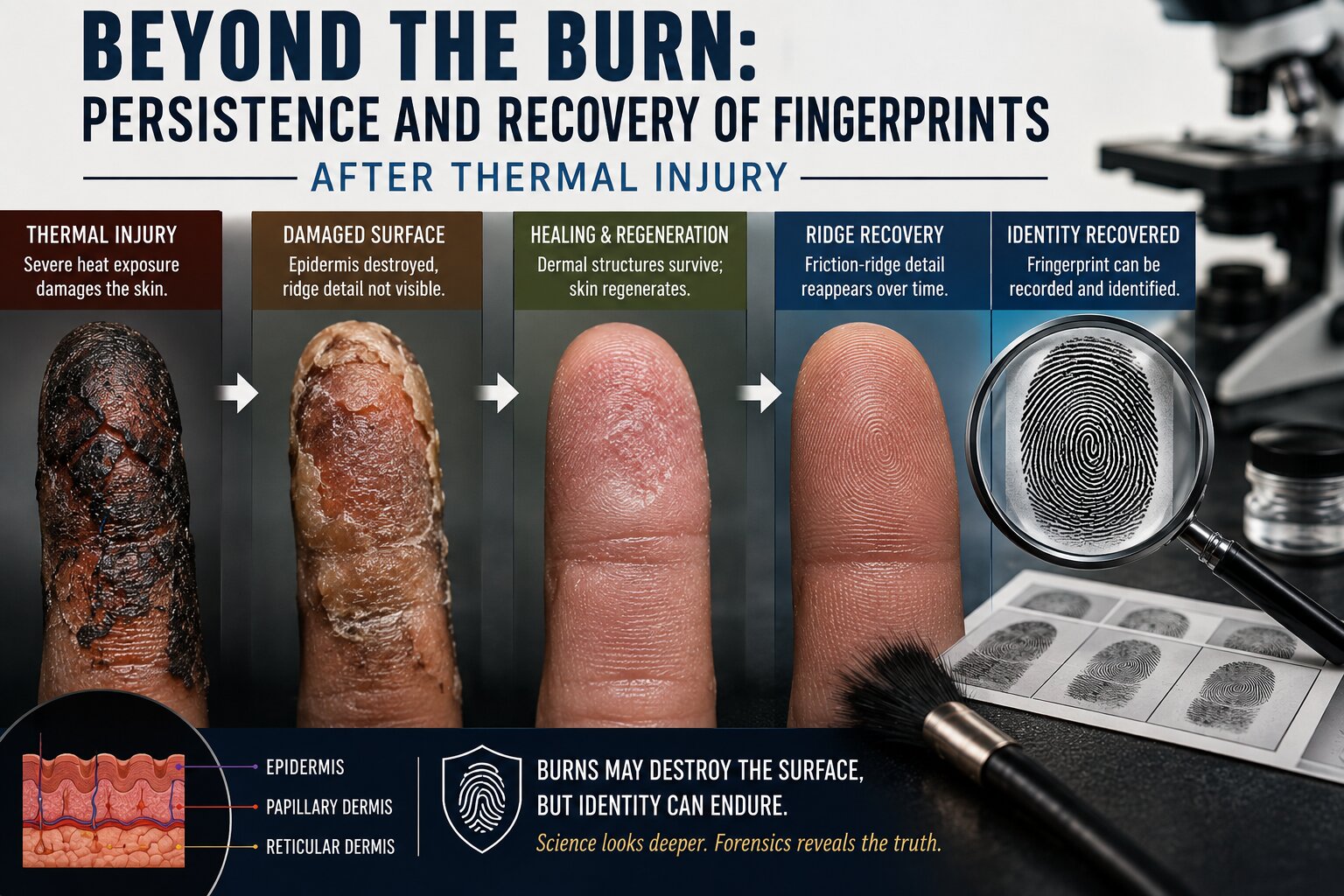
Fingerprints provide a unique and stable biometric marker established before birth, but while thermal injuries from high-temperature incidents can cause severe surface charring, blistering, or desiccation, visual damage does not automatically rule out identification. Because persistent friction-ridge patterns depend on deeper anatomical layers, FBI and INTERPOL guidelines emphasise assessing surviving dermal substrates, preserved inner skin surfaces, and underlying structures rather than assuming uniform destruction from external burnt epidermis alone.
The Anatomical Basis of Fingerprint Persistence
Finger skin consists of an outer epidermis and an inner dermis, with fingerprint persistence relying on the deeper dermal architecture. Because friction ridges are deeply anchored, damaging only the outer epidermal surface does not erase the underlying print pattern, meaning surface destruction does not equate to the loss of identifying information.
Ultimately, a burn’s depth dictates the forensic outcome:
- If the dermal structures remain intact, the original print can regrow.
- If deeper injuries destroy these regenerative structures, permanent scar tissue may result.
Burn Depth and the Fate of Friction-Ridge Detail
Modern burn assessment increasingly distinguishes superficial, superficial partial-thickness, deep partial-thickness, and full-thickness injuries. The traditional terminology of first-, second-, and third-degree burns remains widely used, but the depth-based terminology is more informative for understanding tissue preservation.
| Burn Depth | Primary Skin Area Affected | Potential Effect on Fingerprints |
|---|---|---|
| Superficial (First-Degree) | Outer skin (epidermis) | Temporary print obscurity; generally no permanent destruction |
| Superficial Partial-Thickness | Upper dermis | Temporary distortion; prints may remain recoverable |
| Deep Partial-Thickness | Deeper dermis | Some ridge details may survive, while others may be permanently altered. |
| Full-Thickness (Third-Degree) | All dermal layers | Original friction ridges in the injured area are permanently erased. |
Superficial (First-Degree) Burns
Affect only the outer skin (epidermis). They heal quickly without significant scarring, causing only temporary print obscurity rather than permanent destruction.
Superficial Partial-Thickness Burns
Extend into the upper dermis and cause blistering. Because deeper structures remain viable, prints may be temporarily distorted but are still recoverable as minimal scarring occurs.
Deep Partial-Thickness Burns
Reach deeper into the dermis, healing slowly with a high risk of scarring. Some ridge details may survive while others are permanently altered, requiring careful microscopic examination for residual structures.
Full-Thickness (Third-Degree) Burns
Destroy all dermal layers, permanently erasing the original friction ridges in the injured area. However, unique scar shapes, surviving peripheral skin, or adjacent unburned regions can still offer vital identification evidence.
The Forensic Significance of Scar Formation
A severe burn may destroy normal friction ridges while simultaneously creating a new and highly individual anatomical feature: the scar.
Scar tissue does not recreate the orderly friction-ridge architecture of undamaged skin. Deep burns are associated with fibrosis, hypertrophic scarring, contracture, and other permanent morphological changes.
From an identification standpoint, therefore, the relevant proposition is not that a scar is equivalent to a fingerprint. It is that the scar itself may constitute corroborative identifying evidence when its location, morphology, configuration, or extent can be reliably compared with antemortem medical records, photographs, or other documentation.
INTERPOL’s DVI framework expressly recognises scars, tattoos, and surgical implants among physical indications that may assist in identifying human remains.
The evidentiary value of such features should nevertheless be assessed within the overall identification framework and should not be overstated where the feature is common or insufficiently documented.
Postmortem Recovery of Friction-Ridge Detail from Burnt Remains
The most important practical lesson in burnt-remains examination is that visual severity should not determine whether fingerprint recovery is attempted.
The FBI’s guidance on burnt remains records that the external surfaces of hands may appear severely damaged while viable skin remains on the inner surfaces. It further describes circumstances in which the epidermis may separate from the dermis and in which the dermal ridge arrangement remains sufficiently preserved to permit recording.
Depending upon the condition of the remains and the authority of the forensic pathologist or medical examiner, recovery may involve several complementary approaches:
Careful Inspection and Cleaning
The hands should be examined systematically for viable epidermal and dermal areas before destructive manipulation is undertaken.
Recovery of Separated Epidermis
Where the epidermis has separated from the finger, its internal surface may retain useful ridge detail. The FBI describes the recovery of such impressions from the inside of epidermal skin even where the external surface has been severely charred.
Examination of Exposed Dermis
Where the epidermis is unusable, the underlying dermal ridge structure may sometimes be exposed and recorded. The FBI documents powder-and-lifter techniques and photographic recording of viable dermal ridge detail.
Rehydration Where Appropriate
Controlled rehydration techniques may improve the pliability and recordability of certain burnt tissues. The FBI specifically describes carefully controlled brief boiling intervals for exposed dermal tissue in particular circumstances and cautions that boiling should not simply be assumed to restore damaged epidermis.
Photographic Documentation
High-resolution photography is indispensable where conventional impression-taking is difficult. INTERPOL’s DVI guidance recognises digital photography, ink, powder processing, and transparent-slide methods among the approaches used in friction-ridge examination.
Documentation of Thermal Shrinkage
Heat-damaged tissue may undergo substantial dimensional change. FBI guidance notes that burnt fingers and skin may shrink dramatically, in some cases to approximately half their original size. Such shrinkage must be recorded because scale differences can materially affect subsequent comparison and database searching.
These procedures must be undertaken by appropriately trained personnel and in accordance with applicable medico-legal authority, evidence-preservation requirements, and local standard operating procedures.
The Importance of the Inner Surface
One of the most significant practical observations in postmortem fingerprint recovery is the potential preservation of tissue on the palmar and inner surfaces of the hands and fingers.
The FBI’s burnt-remains guidance specifically warns against rejecting fingerprint recovery merely because the outside of the hand appears severely burnt. It describes cases in which the external epidermis was damaged while the ridge arrangement on the inside remained sufficiently preserved for recording.
This has substantial operational significance.
A burnt hand should not be regarded as a homogeneous object. Different anatomical surfaces may have experienced markedly different thermal exposure. Accordingly, the examination should be regional rather than purely global: every potentially viable area should be assessed before the remains are considered unsuitable for friction-ridge identification.
Thermal Shrinkage and the Problem of Scale
Heat does more than destroy tissue. It can alter its dimensions.
The contraction of burnt fingers can produce impressions substantially smaller than ordinary antemortem fingerprints. The FBI has documented shrinkage of burnt skin of up to approximately 50 per cent in severe cases and emphasises the importance of recording the fact that an impression originated from a burnt body so that the fingerprint examiner can account for the altered scale during examination.
This point has an important methodological consequence:
A size discrepancy should not automatically be interpreted as a discrepancy in identity.
The examiner must distinguish morphological incompatibility from distortion caused by thermal contraction, tissue deformation, pressure, recording technique, or other postmortem changes.
Multimodal Identification When Fingerprints Are Inadequate
The forensic identification process should never become dependent upon a single biometric modality when the condition of the remains permits a broader examination.
INTERPOL identifies fingerprints, DNA, and forensic odontology as primary methods within its DVI framework and also recognises physical characteristics such as scars and surgical implants as potentially valuable identifying information.
Accordingly, where friction-ridge detail is incomplete or unavailable, investigators should consider:
- DNA profiling from appropriately selected biological material;
- forensic odontology, including comparison of antemortem and postmortem dental records and radiographs;
- radiological comparison of skeletal anatomy, pathological conditions, fractures, or surgical implants;
- scar and tattoo documentation;
- medical records and surgical history;
- anthropological examination of skeletal characteristics; and
- personal effects and other contextual evidence, interpreted cautiously and not substituted for scientifically stronger primary identifiers.
INTERPOL’s current DVI framework emphasises the collection of postmortem fingerprints, dental information, DNA, and distinctive physical features, followed by systematic reconciliation with corresponding antemortem information.
The objective is consequently not to find one surviving characteristic at any cost but to construct a scientifically defensible identification from convergent evidence.
Evidentiary Caution: What Burns Do—and Do Not—Prove
The proposition that “fire destroys fingerprints” is therefore an oversimplification. Equally problematic would be the opposite proposition that fingerprints can always be recovered from burnt remains.
Both statements are scientifically inadequate.
The recoverability of friction-ridge detail depends upon multiple variables, including:
- depth and distribution of the burn;
- duration and intensity of thermal exposure;
- degree of charring and desiccation;
- anatomical location;
- preservation of epidermal or dermal structures;
- postmortem decomposition;
- mechanical damage during recovery;
- tissue contraction and distortion; and
- the techniques employed by the examiner.
Moreover, burn depth itself may be difficult to determine solely from external appearance, and burn wounds can evolve over time. Clinical literature emphasises that thermal injury is dynamic and that the apparent depth at an early stage may not accurately represent the eventual extent of tissue destruction.
Forensic conclusions should therefore be expressed cautiously. The appropriate question is not whether “the fingerprint survived” as an all-or-nothing proposition, but what friction-ridge information remains demonstrable, how reliably it can be recorded, and whether it can be compared with an appropriate antemortem or reference record.
10. Implications for Forensic Practice
Several principles emerge from the anatomical and operational evidence.
First, a burnt hand should not be rejected on visual inspection alone. The FBI’s postmortem guidance provides direct practical evidence that apparently devastated hands can retain recoverable friction-ridge information.
Second, burn depth matters more than the superficial appearance of damage. Superficial injuries may permit recovery or regeneration, whereas deeper injuries progressively compromise the structures required for restoration of the original ridge configuration.
Third, the epidermis is not the only potential source of friction-ridge information. Depending upon the condition of the remains, separated epidermal tissue and exposed dermal structures may provide recoverable impressions.
Fourth, thermal distortion must be documented rather than ignored. Shrinkage and deformation can affect apparent scale and morphology and therefore must be communicated to the examiner conducting the comparison.
Finally, identification should be multidisciplinary. Where fingerprints are compromised, DNA, odontology, radiology, scars, implants, and other established identifiers may provide independent or corroborative evidence. This is consistent with the internationally recognised DVI framework.
11. Conclusion
Burn injury affects fingerprint identification along a continuum determined by the depth of tissue destruction: superficial and superficial partial-thickness burns leave underlying dermal structures intact for full ridge regeneration, whereas deep partial-thickness and full-thickness burns permanently alter or erase the original patterns with scar tissue. However, severe external hand damage rarely results in total loss of identity, as examiners can often recover viable evidence from shed skin’s inner surface, exposed dermal ridges, intact underlying tissue, or surviving patches of skin using FBI-established postmortem techniques.
When friction-ridge detail is completely destroyed, identification shifts to alternative INTERPOL Disaster Victim Identification (DVI) standards such as DNA, forensic odontology, radiology, or surgical implants. Ultimately, thermal damage alters how physical identity is expressed rather than erasing it entirely, requiring forensic examiners to methodically preserve and evaluate whatever surviving evidence remains.
References
- Federal Bureau of Investigation, Laboratory Division, Burnt Remains: Postmortem Fingerprinting Series. FBI BioSpecs.
- INTERPOL, Disaster Victim Identification (DVI), including the 2023 DVI framework and identification procedures.
- INTERPOL, Fingerprints: Science Behind Fingerprints and Identification.
- INTERPOL DVI Ridgeology Sub-Working Group, Position Statement Concerning the Use of Antemortem Fingerprints for Humanitarian Purposes to Identify Unknown Deceased Persons.
- INTERPOL, DVI Guide: Special Considerations for Primary Identification Methods—Friction Ridge Impressions.
- StatPearls, Acute and Chronic Thermal Burn Evaluation and Management. NCBI Bookshelf.
- StatPearls, Burn Classification. NCBI Bookshelf.
- Altintas MA, Altintas AA, Knobloch K, Guggenheim M, Zweifel CJ, Vogt PM. Differentiation of superficial-partial vs. deep-partial thickness burn injuries in vivo by confocal laser-scanning microscopy. Burns. 2008.
- The Permanence of Friction Ridge Skin and Persistence of Friction Ridge Skin and Impressions: A Comprehensive Review and New Results. Journal of Forensic Identification. 2019.
- Classification of Burn Depth. National Center for Biotechnology Information/PMC.
- Improving the Histologic Characterisation of Burn Depth. Burns & Trauma.
- The Evaluation and Management of Thermal Injuries: 2014 Update. PMC.
Authors
| Author | Designation |
|---|---|
| Md. Imran Wahab, IPS | Inspector General of Police, West Bengal, India |
| Christine Loewenhagen | Senior Crime Scene Specialist, City of Mesa Police Department, Arizona, USA |