





Abstract
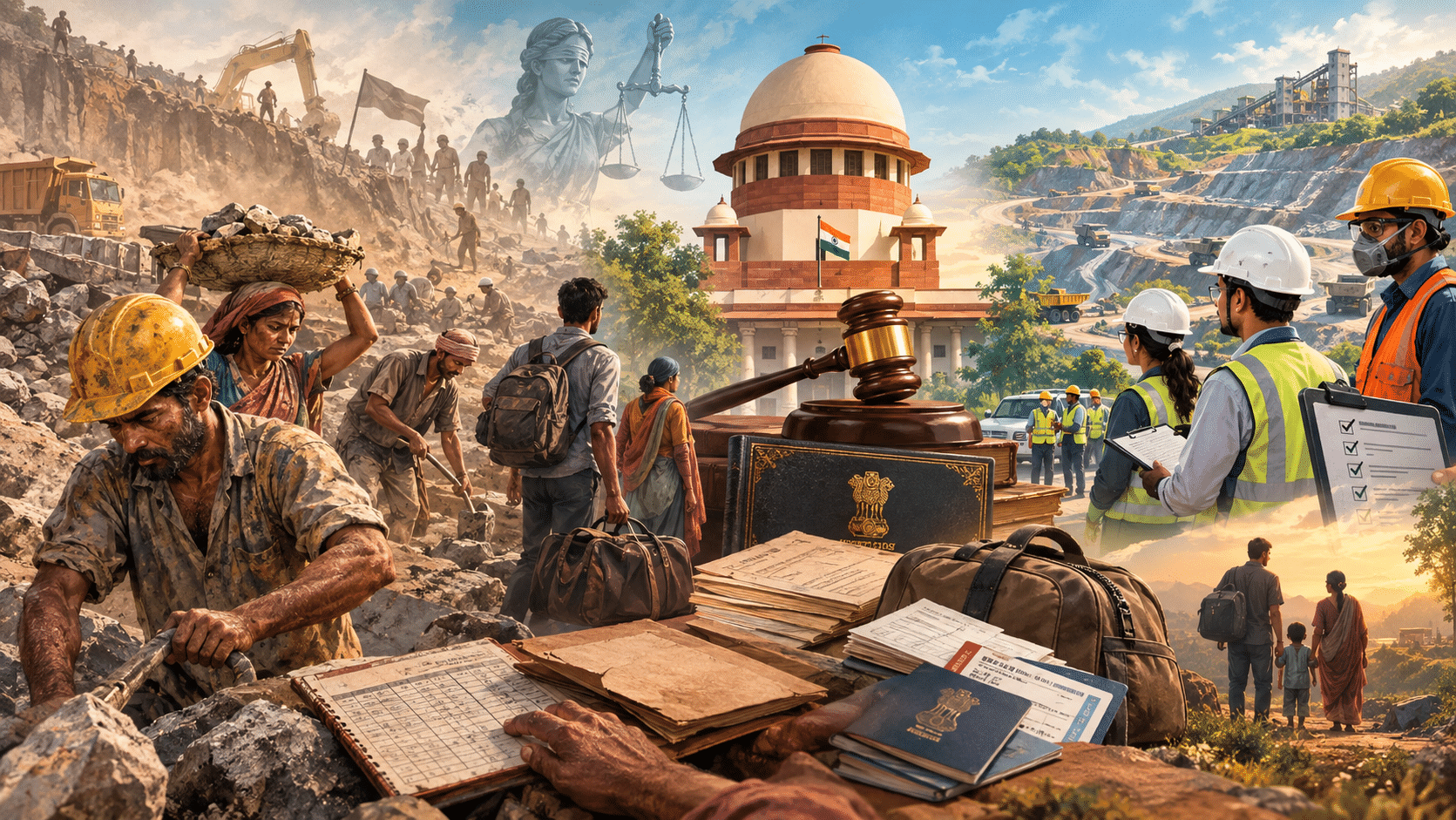
Mining and quarrying have contributed significantly to India’s economic and infrastructural development, but the workers employed in these sectors continue to face serious occupational and economic vulnerabilities. This article examines the development of Indian labour law from the constitutional decisions in People’s Union for Democratic Rights v. Union of India and Bandhua Mukti Morcha v. Union of India to the Occupational Safety, Health and Working Conditions Code, 2020. It focuses on bonded labour, economic dependence, contract labour, migrant workers, occupational safety and the enforcement of labour rights.
The article argues that Indian labour law has developed considerably over the last four decades. The legal framework now contains more detailed provisions dealing with workplace safety, health, contract labour, migrant workers and mines. However, the existence of legal protection has not automatically removed exploitation.
Problems such as weak enforcement, unclear responsibility between contractors and principal employers, lack of worker awareness, migration and economic dependence can still make workers vulnerable. The article therefore argues that the main challenge is no longer only the creation of legal rights but their effective implementation.
The experience of mine and quarry workers shows that meaningful labour protection requires clear accountability, effective inspections, accessible remedies, occupational-health measures and protection for workers who report violations.
Keywords
Bonded Labour, Quarry Workers, Mine Workers, Labour Exploitation, Occupational Safety, Contract Labour, Migrant Workers, OSH Code 2020, Human Dignity, Labour Law.
1. Research Question
To what extent has Indian labour law addressed the exploitation of quarry and mine workers from Bandhua Mukti Morcha to the Occupational Safety, Health and Working Conditions Code, 2020, and why does exploitation continue despite four decades of legal development?
2. Introduction & Thesis
Mining and quarrying have an important place in India’s economic development. The materials obtained from mines and quarries are used in construction, roads, housing, manufacturing and infrastructure. Because of this, these industries are generally discussed in terms of production, employment and economic growth. However, behind this economic activity is a workforce that often performs physically demanding and hazardous work.
Mine and quarry workers may be exposed to dust, noise, heavy machinery, falling materials, vehicles, explosives and other workplace hazards. Some of these risks can cause immediate accidents, while others can affect workers’ health gradually over a long period. Occupational safety, therefore, is not simply a technical requirement in these industries. It is directly connected with the worker’s health, dignity and ability to earn a livelihood.
The problem becomes more complicated when workers are employed through contractors. A worker may be recruited and paid by one person but perform work at a site controlled by another. In some situations, more than one contractor may be involved. This can make responsibility difficult to identify. If wages are withheld or a worker is injured because proper safety measures were not followed, the worker may not know which party should be approached. For the worker, however, the contractual structure is not the main concern. The worker needs to know who is responsible and how the violation can be addressed.
Migration can create another layer of vulnerability. Workers may move from one district or State to another because employment opportunities are limited in their home areas. Once they migrate, they may be unfamiliar with local authorities, may face language difficulties or may depend on a contractor for employment, transportation or accommodation. Migration by itself is not exploitation. However, these circumstances can make it harder for workers to understand and exercise their rights.
Economic dependence is equally important. A worker may technically be free to leave employment but may have very few realistic alternatives. A person supporting a family, repaying a debt or waiting for unpaid wages may find it extremely difficult to leave a job even when the working conditions are poor. This distinction between formal freedom and practical freedom became particularly important in Indian constitutional labour jurisprudence during the early 1980s.
In People’s Union for Democratic Rights v. Union of India, (1982) 3 SCC 235, the Supreme Court examined labour conditions in construction projects connected with the Asian Games. The Court’s interpretation of Article 23 was significant because it did not understand forced labour only in terms of physical force. Economic circumstances and payment below legally prescribed minimum wages were also considered relevant to the constitutional protection against forced labour.
The importance of the judgment lies in its broader understanding of coercion. A worker may not be physically prevented from leaving employment, but the economic circumstances surrounding the employment can still be relevant when examining whether the worker is genuinely free. At the same time, this does not mean that every low-paid or poor worker is automatically a victim of forced labour. The circumstances of the individual employment relationship remain important. Two years later, the Supreme Court considered a situation directly involving quarry workers in Bandhua Mukti Morcha v. Union of India, (1984) 3 SCC 161, AIR 1984 SC 802. The case concerned allegations of bonded labour among workers employed in stone quarries in Faridabad.
The significance of Bandhua Mukti Morcha went beyond the particular quarry workers involved in the case. The Court approached bonded labour through constitutional rights, human dignity and the responsibility of the State. The case demonstrated that labour exploitation could not always be treated as an ordinary private dispute between an employer and an employee. A worker living in poverty, lacking education and depending on an employer or contractor may not have the practical ability to approach a court or government authority. The Supreme Court’s approach recognised this difficulty and emphasised that the State has an important role in identifying and addressing serious labour exploitation.
The legal framework has continued to develop since these decisions. India has moved from relying on individual statutes and constitutional litigation towards a more consolidated system of labour regulation. The Occupational Safety, Health and Working Conditions Code, 2020 is an important part of this development. The OSH Code is Act No. 37 of 2020 and was enacted to consolidate and amend laws regulating occupational safety, health and working conditions. It contains provisions concerning employer duties, workplace safety, contract labour, inter-State migrant workers and mines.
The Code therefore represents a significant development in the legal regulation of workplace conditions. However, the existence of a detailed legal framework does not automatically mean that exploitation has disappeared. A worker does not experience a statute as a document. A worker experiences a workplace. If safety equipment is not provided, the existence of a legal requirement does not itself prevent an accident. If wages are withheld, a legal right does not automatically put the money into the worker’s hands. If a migrant worker does not know where to complain, the existence of a complaint mechanism may have little practical value. This creates the central problem examined in this article.
Indian labour law has undoubtedly developed since PUDR and Bandhua Mukti Morcha. The question is whether this legal development has been sufficient to change the conditions that make mine and quarry workers vulnerable to exploitation. The thesis of this article is that Indian labour law has made substantial progress in recognising and regulating labour exploitation, but the continuing vulnerability of mine and quarry workers shows that legal protection depends heavily on implementation. The OSH Code provides a more consolidated and detailed framework, but its effectiveness depends on whether employers comply with their duties, whether authorities inspect workplaces effectively, whether contractors and principal employers are held accountable, and whether workers can actually access remedies.
The article therefore traces the development from the constitutional principles established in PUDR and Bandhua Mukti Morcha to the modern framework under the OSH Code. It examines contract labour, migrant workers, occupational safety, economic dependence and the particular provisions dealing with mines. The purpose is not to suggest that all mine or quarry workers are exploited, but to understand why legal protection can remain incomplete even when substantial legislation exists.
3. Literature Review
The existing literature shows that labour exploitation in mining and quarrying cannot be understood only through the traditional concept of bonded labour. Modern labour vulnerability can take different forms, including contract-based employment, occupational hazards, economic dependence and migration. These issues can also overlap.
3.1 Contract Labour and Occupational Safety
Heather Jackson and Michael Quinlan, in their 2024 review, “Contract Labour in Mining and Occupational Health and Safety: A Critical Review,” examine the relationship between contract labour and occupational health and safety in mining. Their research is useful because it draws attention to the way employment arrangements can affect workplace safety. Contract labour is not automatically exploitative or unsafe. However, when responsibility for workers is divided between contractors and principal employers, safety management can become more complicated.
A contractor may recruit and pay workers while another organisation controls the actual workplace. The contractor may be responsible for some aspects of employment, while the principal employer controls machinery, supervision and the working environment. This division can create uncertainty about responsibility. The review therefore helps explain why occupational safety cannot be considered separately from the structure of employment.
For Indian mine and quarry workers, this is particularly relevant because workers may perform the same physical work as directly employed workers while having a different contractual relationship. The legal system therefore has to ensure that the use of a contractor does not become a reason for weaker protection.
3.2 Occupational Health in India
Rajat Kumar Saha’s article, “Occupational Health in India,” takes a broader view of occupational health. It highlights the importance of preventing workplace-related illness rather than focusing only on accidents. This distinction is particularly important in mining and quarrying. An accident may happen suddenly and can often be connected to a specific event. Occupational illness may develop slowly. Continuous exposure to dust, noise or other hazards can affect a worker over time, and the worker may not immediately understand the connection between the workplace and the health problem.
This makes preventive occupational-health measures important. Workers need information about workplace risks, appropriate protective measures and access to health monitoring. The literature therefore supports the view that occupational safety should not be understood only as preventing immediate accidents. It also involves protecting workers from conditions that can damage their health over the longer term.
3.3 Economic Dependence and Labour Exploitation
Economic dependence is another important part of the discussion. A worker may accept difficult employment because they need income. That fact alone does not establish forced labour or bonded labour. The issue becomes more serious when economic pressure is combined with debt, recruitment advances, withheld wages, threats or restrictions on leaving employment.
This distinction is important because it prevents every difficult employment situation from being incorrectly described as bonded labour. At the same time, it is also important not to ignore economic circumstances.
A worker who is technically free to leave may still have very limited practical choices. This is one reason why the constitutional reasoning in PUDR and Bandhua Mukti Morcha remains relevant to contemporary labour conditions.
3.4 Migrant Workers and Vulnerability
Migration itself is not exploitation. Workers move in search of employment for many legitimate reasons. However, migration can make enforcement more difficult. A migrant worker may be away from family support, unfamiliar with local authorities and dependent on a contractor for employment. The worker may also face language or documentation problems. These factors do not automatically establish a violation of labour rights. They simply show why migrant workers may require practical access to information and complaint mechanisms.
3.5 Research Gap
The existing literature provides useful discussions of contract labour, occupational health and labour vulnerability. Judicial decisions have also established important constitutional principles concerning forced and bonded labour. However, these issues are often examined separately. The actual experience of a mine or quarry worker may involve several of them at the same time. A worker could be a migrant, employed through a contractor, economically dependent on wages and exposed to occupational hazards. The research gap addressed by this article is therefore the relationship between legal development and practical enforcement.
India has developed substantially more detailed labour protections than existed four decades ago. The more difficult question is whether these protections are consistently reaching workers at the workplace. This article attempts to connect the constitutional principles established in the 1980s with the modern statutory framework under the OSH Code and to examine why the existence of law does not necessarily eliminate vulnerability.
4. Legal & Policy Analysis
4.1 People’s Union for Democratic Rights v. Union of India
People’s Union for Democratic Rights v. Union of India, (1982) 3 SCC 235, is an important decision in the development of Indian constitutional labour law. The case concerned workers engaged in construction projects connected with the Asian Games. The Supreme Court examined Article 23 of the Constitution, which prohibits trafficking and forced labour. One of the important features of the judgment was the Court’s understanding that forced labour cannot be limited to situations where physical force is used. Economic circumstances can also be relevant.
The judgment connected payment below legally prescribed minimum wages with the constitutional protection against forced labour. This does not mean that every violation of minimum-wage law automatically becomes forced labour. Rather, the Court recognised that the economic circumstances in which labour is performed can be relevant to understanding whether the worker is genuinely free. This reasoning is significant for vulnerable workers in mining and quarrying. A worker may not be physically confined and may still have extremely limited practical alternatives because of poverty, debt or lack of employment opportunities. The case therefore shifted attention from a narrow question — whether physical force was used — towards the broader circumstances surrounding the employment relationship.
4.2 Bandhua Mukti Morcha v. Union of India
The Supreme Court’s decision in Bandhua Mukti Morcha v. Union of India, (1984) 3 SCC 161, AIR 1984 SC 802, is particularly important for this article because it directly concerned stone-quarry workers. The case raised allegations of bonded labour and poor living and working conditions among quarry workers in Faridabad. The Court did not approach the matter simply as a contractual dispute. Instead, it examined the situation through constitutional rights and the responsibility of the State to protect vulnerable workers. The case is important because a worker suffering from poverty, illiteracy and economic dependence may not be in a realistic position to use ordinary legal procedures.
This problem is particularly serious in cases of bonded labour. If a worker depends on the same person for employment, wages or an advance, expecting that worker to independently challenge the relationship through a formal legal process may be unrealistic. The significance of Bandhua Mukti Morcha therefore lies not only in its treatment of bonded labour but also in its recognition that vulnerable workers require an effective State response.
4.3 Human Dignity and Labour
The two cases also demonstrate the connection between labour conditions and human dignity. A worker does not lose constitutional rights because the worker is poor or employed in an informal occupation. Economic production cannot by itself justify conditions that seriously violate basic rights. This principle remains relevant to mining and quarrying because the economic importance of these industries does not remove the need for safe and dignified working conditions.
4.4 Development from Judicial Recognition to Statutory Regulation
The decisions of the 1980s were important, but judicial recognition alone could not regulate every aspect of employment. Over time, Parliament developed legislation dealing with different aspects of labour, including occupational safety, contract labour and migrant workers. The result was a broad but fragmented legal framework. Different laws applied to different categories of workers and establishments. Different authorities were responsible for different areas of enforcement. The labour-code approach attempted to address this fragmentation.
The OSH Code represents an important stage in this process because it consolidates laws dealing with occupational safety, health and working conditions into one broader framework. However, consolidation should not be confused with complete resolution of labour exploitation. A consolidated law can make regulation more organised, but it cannot by itself guarantee compliance.
4.5 Occupational Safety, Health and Working Conditions Code, 2020
The OSH Code, Act No. 37 of 2020, was enacted to consolidate and amend laws regulating occupational safety, health and working conditions. The Code specifically contains provisions relevant to mines, contract labour and inter-State migrant workers. Its significance for this research is therefore direct. It attempts to address not only the existence of employment but also the conditions under which work takes place.
4.6 Section 6: Duties of the Employer
Section 6 of the OSH Code sets out important duties of employers. Among other requirements, employers are required to ensure that the workplace is free from hazards likely to cause injury or occupational disease and to comply with occupational-safety standards. The provision also deals with health examinations and the issuing of appointment letters.
For mines, the Code provides for additional responsibilities concerning safe systems of work, safe access and exit, handling and storage of substances, information and training and other safety-related matters. This is important because the duty is preventive. The employer is not expected merely to respond after an accident has happened. The legal framework requires steps to reduce risks before harm occurs. However, the effectiveness of Section 6 depends on actual compliance. A safety obligation written in legislation does not itself make machinery safe or eliminate dust exposure. There must be monitoring and enforcement.
4.7 Appointment Letters and Accountability
The requirement of appointment letters is also relevant to vulnerable workers. Written documentation can make it easier to establish who employs the worker and what the employment relationship is. This can be particularly useful where contractors are involved. However, documentation should not be treated as a complete solution. A worker can receive an appointment letter and still face unsafe working conditions or unlawful treatment. The appointment letter is therefore best understood as one part of a wider accountability system.
4.8 Workplace Health and Welfare
The OSH Code also contains provisions concerning health, safety and welfare facilities. This matters in mining and quarrying because workplace safety involves more than preventing major accidents. Conditions such as ventilation, drinking water, sanitation, cleanliness and exposure to harmful substances can affect workers’ health.
For quarry workers, dust exposure is particularly relevant. The purpose of occupational-health regulation should therefore be preventive. Workers should not have to wait until they develop serious health problems before authorities or employers take action.
4.9 Contract Labour and Principal Employer Responsibility
Contract labour is one of the most important issues in understanding modern labour vulnerability. The OSH Code contains a specific framework for contract labour. Section 53 is particularly relevant because it places responsibility on the principal employer for providing specified welfare facilities to contract labour employed in the establishment. This provision is important because the use of a contractor should not mean that workers lose access to basic workplace welfare. The principal employer may not be the person who directly pays the worker, but the worker is still performing work at the establishment. The legal framework therefore recognises that responsibility cannot simply disappear because the employment relationship is divided between different parties. At the same time, enforcement remains important. A legal provision identifying responsibility is useful only if workers can rely on it when a violation occurs.
4.10 Inter-State Migrant Workers
The OSH Code also contains provisions dealing specifically with inter-State migrant workers. Sections 59 and 60 provide a framework concerning the application of the Code to establishments employing inter-State migrant workers and prescribe responsibilities concerning their working conditions and other protections. This is relevant to mining and quarrying because workers may travel significant distances in search of employment. A migrant worker may be unfamiliar with the local administrative system and may depend on a contractor. The legal recognition of migrant workers is therefore important, but recognition alone is not enough. Workers must know what protections are available, and authorities must have practical mechanisms for identifying violations and responding to complaints.
4.11 Provisions Concerning Mines
The OSH Code contains a separate framework for mines. Section 67 deals with the management of mines and provides for a sole manager with prescribed qualifications who is responsible for the management, control, supervision and direction of the mine. This is important because safety requires clear responsibility. When several people or organisations are involved in a mining operation, there should still be identifiable responsibility for the management and supervision of the mine.
4.12 Section 68 and the Position of Certain Quarries
Section 68 requires particular attention when discussing quarry workers. The provision deals with situations in which the Code does not apply to certain categories of mines, subject to the conditions and exceptions specified in the provision. The section includes mines engaged in the extraction of materials such as kankar, murrum, laterite, boulder, gravel, ordinary sand, ordinary clay, building stone, slate, road metal, earth, fuller’s earth and limestone, subject to the statutory conditions. This is an important point because it would be inaccurate to say that every quarry worker is covered by every provision of the OSH Code in exactly the same manner. The legal position depends on the nature of the mining or quarrying operation and whether the conditions attached to the statutory exception are satisfied. This makes accurate classification and enforcement important. At the same time, the existence of such an exception does not mean that workers in those operations have no legal protection at all. Other applicable laws and legal obligations may still be relevant depending on the circumstances.
The important point for this research is that the OSH Code must be examined carefully rather than treated as a completely uniform framework covering every quarry in exactly the same way.
4.13 Contractual Structure and the Enforcement Problem
One of the continuing problems in labour protection is the division of responsibility. Suppose a worker is recruited by a contractor but works at a mine controlled by another entity. The worker may receive wages from one party, instructions from another and safety equipment from a third. In such a situation, the worker may have difficulty identifying where to complain. The OSH Code attempts to address this problem through provisions dealing with contract labour and principal-employer responsibility. However, legislation alone cannot solve the practical difficulty.
Workers need accessible information. Authorities need to be able to identify the relevant parties. Inspections must examine the actual working relationship rather than relying only on formal documents.
4.14 Occupational Health and Long-Term Risk
Mining and quarrying also demonstrate why occupational health cannot be reduced to accident prevention. A serious accident is visible. Long-term exposure to dust or other hazards may not be. A worker may continue working for years before developing symptoms. By that stage, identifying the cause and obtaining an effective remedy may be difficult. This is why preventive health measures are important. Employers and regulators need to consider not only whether an accident occurred but also whether workers are being exposed to conditions that can cause illness over time. The literature on occupational health in India supports this broader understanding of workplace protection.
4.15 Economic Dependence and Contemporary Exploitation
The constitutional reasoning of PUDR and Bandhua Mukti Morcha remains relevant because economic dependence can take different forms. A worker may receive an advance, become indebted and continue working because of that debt. Another worker may not have a debt but may depend entirely on one contractor for employment and accommodation. Another may be afraid to complain because wages have been withheld. These situations are not automatically bonded labour. The legal question requires examination of the actual circumstances. However, the presence of several forms of economic control can indicate serious vulnerability and should not be ignored simply because the worker is not physically confined.
4.16 The Enforcement Gap
The most important weakness in labour protection is often the distance between law and implementation. A legal right must be supported by institutions capable of enforcing it. This requires effective workplace inspections, trained officials, reliable employment records, clear responsibility between contractors and principal employers, accessible complaint mechanisms, protection against retaliation and meaningful remedies.
Without these elements, even detailed legislation may have limited practical impact. The problem is particularly serious for workers who have limited bargaining power. A worker who fears losing employment may hesitate to complain even when a clear legal violation exists. This is why enforcement should not depend entirely on individual complaints. Proactive inspection is particularly important in sectors where workers may be reluctant or unable to report violations themselves.
4.17 Why the Absence of Complaints Does Not Prove the Absence of Exploitation
It would be a mistake to assume that workers are satisfied simply because there are no formal complaints. Silence can have many explanations. A worker may fear dismissal. The worker may be waiting for unpaid wages. The worker may not know where to complain. A migrant worker may be unfamiliar with the local administration. A worker may also believe that complaining will not produce any result.
Therefore, the number of complaints cannot be the only measure of whether labour protection is working. A functioning system needs both accessible complaints and proactive monitoring.
4.18 Four Decades: What Has Changed and What Has Not
The legal development from the 1980s to the OSH Code shows substantial change. In the period of PUDR and Bandhua Mukti Morcha, constitutional litigation played an important role in bringing hidden labour exploitation to the attention of the State and the courts.
Today, the legal framework is more detailed. There are specific statutory duties concerning workplace safety, appointment letters, contract labour, migrant workers and mines. The problem, however, has not disappeared. Instead, vulnerability can appear in different forms. The traditional bonded-labour situation involving debt and direct control may still exist in some circumstances, but modern workers can also experience vulnerability through informal employment, contractor dependence, migration and hazardous working conditions. The legal response therefore has to be broad enough to recognise different forms of vulnerability without treating every difficult employment relationship as forced labour.
4.19 Limits of Legal Consolidation
The OSH Code is an important development, but consolidation should not be confused with enforcement. Bringing several areas of regulation into one Code can improve the organisation of labour law. It can make responsibilities easier to identify. It can provide a more coherent statutory structure. But none of these changes automatically guarantees that every employer will comply.
The real test is whether the law changes conditions at the workplace. For mine and quarry workers, this means safer working conditions, proper training, occupational-health protection, clear employment relationships and practical access to remedies.
4.20 The Continuing Relevance of Bandhua Mukti Morcha
The factual circumstances of Bandhua Mukti Morcha belong to a particular period. Modern employment arrangements may be different. However, the central constitutional concern remains relevant: whether workers can genuinely exercise freedom when their economic circumstances leave them with very limited alternatives. The case should not be used to label every vulnerable worker as a bonded labourer. Its continuing importance lies in its insistence that the actual circumstances of workers matter.
A legal system that looks only at formal employment documents may miss the reality of economic dependence. This is particularly relevant in industries where workers have limited bargaining power and where employment is organised through contractors.
5. Actionable Conclusion
The journey from People’s Union for Democratic Rights and Bandhua Mukti Morcha to the OSH Code, 2020 shows a clear development in Indian labour law.
The Supreme Court first strengthened the constitutional understanding of labour exploitation by recognising that forced labour could not be understood only through physical force and by bringing bonded labour within the broader framework of fundamental rights and human dignity. Bandhua Mukti Morcha was particularly important because it dealt directly with quarry workers and demonstrated the difficulty vulnerable workers face when they are expected to protect their rights through ordinary legal procedures.
Over the following decades, labour regulation became broader and more detailed. The OSH Code represents an important stage in that development. It creates specific duties for employers, provides protections relating to contract labour and migrant workers and contains a separate framework concerning mines.
However, the existence of these provisions does not by itself establish that mine and quarry workers are adequately protected. The central problem remains implementation. A worker does not experience Section 6 as a legal provision. The worker experiences whether the workplace is actually safe. A contract worker does not experience Section 53 as a statutory rule. The worker experiences whether welfare facilities are actually available. A migrant worker does not benefit from legal recognition merely because the Code contains provisions concerning inter-State migrant workers. The protection becomes meaningful only when the worker can understand, access and enforce it.
Practical Priorities
This leads to several practical priorities.
- Worker Identification and Documentation: First, workers need to be properly identified and documented. This is particularly important for contract and migrant workers. If workers remain outside the formal regulatory system, it becomes harder for authorities to monitor their conditions.
- Clear Responsibility: Second, responsibility must be clear. The involvement of a contractor should not create a situation where the principal employer and contractor continuously shift responsibility to each other. Workers should be able to identify who is responsible for their employment, safety and welfare.
- Effective Inspection: Third, inspection needs to focus on actual conditions. Checking whether documents exist is not enough. Inspectors need to examine machinery, protective equipment, working conditions, training, exposure to hazards and other practical aspects of the workplace.
- Preventive Occupational Health: Fourth, occupational health should be treated as a preventive issue. A worker should not have to become seriously ill before the workplace’s health risks receive attention. Regular health monitoring and preventive measures are particularly important in occupations involving prolonged exposure to dust and other hazards.
- Accessible Complaint Mechanisms: Fifth, complaint mechanisms need to be accessible. A worker should not need advanced legal knowledge or significant financial resources to report an unsafe workplace or unpaid wages. This is especially important for migrant and contract workers.
- Protection Against Retaliation: Sixth, workers need protection when they complain. If reporting a violation creates a serious risk of dismissal or loss of livelihood, workers may remain silent. An effective enforcement system therefore needs credible protection against retaliation.
- Rehabilitation in Bonded-Labour Cases: Seventh, bonded-labour cases require more than immediate release. Where bonded labour is identified, rehabilitation is important because the economic circumstances that created the vulnerability may otherwise remain. At the same time, labour enforcement needs to remain legally precise. Not every poor worker is a bonded labourer. Not every contractor-based employment relationship is exploitative. Not every migrant worker is unable to exercise their rights.
The purpose of labour law is not to classify every difficult employment situation as forced labour. The purpose is to identify genuine violations and provide effective protection where workers’ rights have been breached. Section 68 of the OSH Code also shows why legal analysis must be careful. Certain categories of mines are subject to statutory exceptions and conditions. Therefore, the question is not simply whether a worker is employed at a quarry. It is necessary to examine the nature of the operation and determine which legal provisions apply.
This is another reason why effective enforcement requires trained officials and accurate information. The four-decade development can ultimately be understood through three stages:
| Stage | Core Development |
|---|---|
| Recognition | Recognition of labour exploitation as a constitutional issue. |
| Regulation | Development of detailed statutory protections. |
| Implementation | Ensuring that those protections operate effectively at the workplace. |
The first stage involved the recognition of labour exploitation as a constitutional issue. The second involved the development of detailed statutory protections. The third, which remains the major challenge, is ensuring that those protections operate effectively at the workplace. The OSH Code provides an important legal foundation for this third stage, but it cannot perform the work of enforcement institutions.
The success of labour law should therefore be measured not only by the number of rights written into legislation but by whether those rights make a practical difference.
For a mine or quarry worker, meaningful protection means being able to work without avoidable risks, receiving the wages legally due, having access to basic welfare facilities, knowing who is responsible for the employment relationship, receiving appropriate occupational-health protection and having a realistic way to seek help when something goes wrong.
The history from Bandhua Mukti Morcha to the OSH Code therefore does not represent a story in which the law has failed to develop. The opposite is true. Indian labour law has developed substantially. The unresolved problem is the distance between legal protection and lived experience. Reducing that distance requires more than another legal provision. It requires effective inspection, clear accountability, accessible remedies, worker awareness and consistent enforcement.
Ultimately, the central lesson is straightforward: creating a legal right is only the beginning of protecting a worker. The right must be understandable, accessible, enforceable and visible in the conditions in which the worker actually performs the job. For India’s mine and quarry workers, that is the point at which four decades of legal development will have its real meaning.
6. References
- People’s Union for Democratic Rights v. Union of India, (1982) 3 SCC 235.
- Bandhua Mukti Morcha v. Union of India, (1984) 3 SCC 161, AIR 1984 SC 802.
- Heather Jackson & Michael Quinlan, “Contract Labour in Mining and Occupational Health and Safety: A Critical Review,” The Economic and Labour Relations Review, Vol. 35, Issue 3, pp. 576–613 (2024).
- Rajat Kumar Saha, “Occupational Health in India,” Annals of Global Health, Vol. 84, Issue 3, pp. 330–333 (2018).
- Occupational Safety, Health and Working Conditions Code, 2020, Act No. 37 of 2020.

