





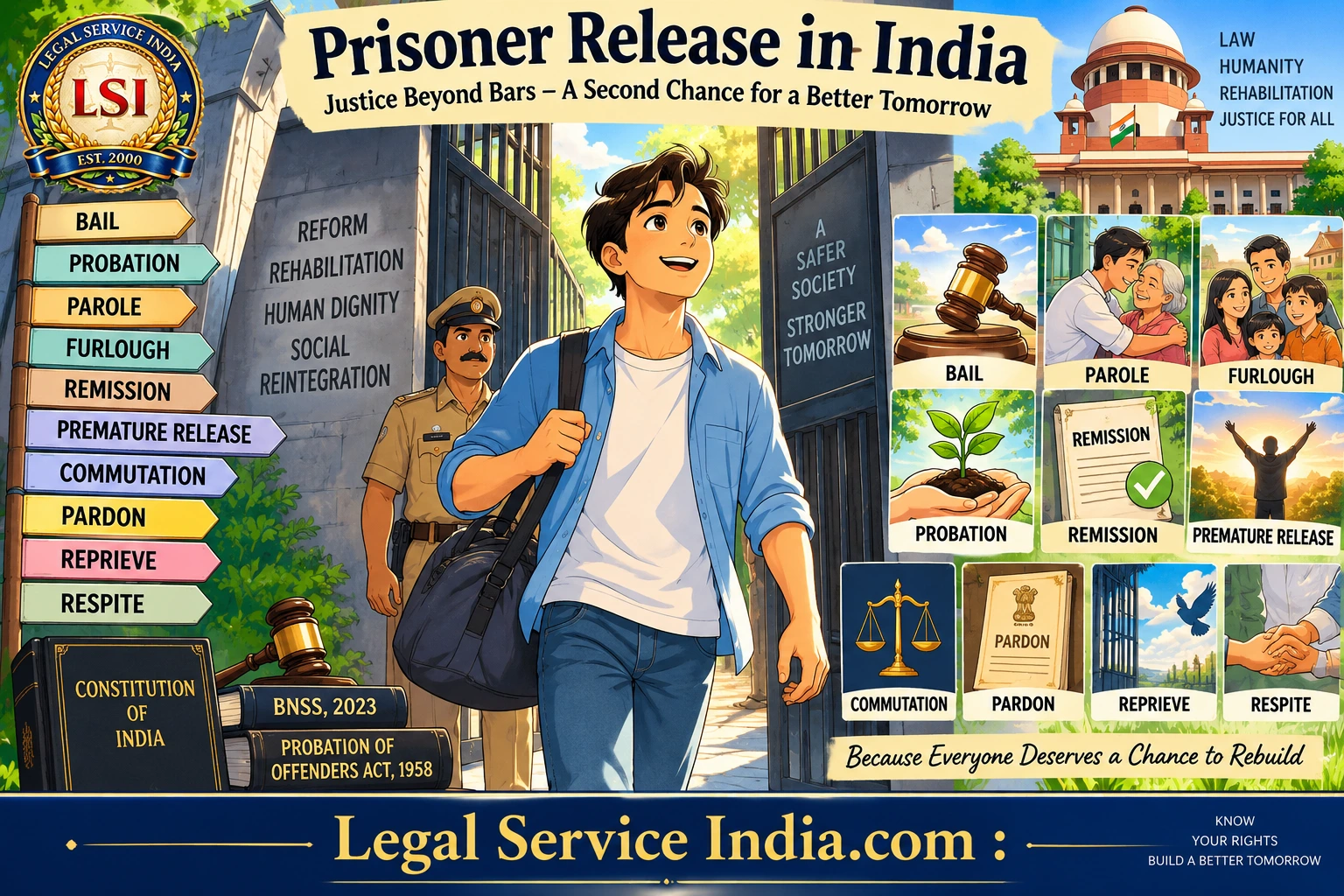
Introduction
Release from prison is a critical component of the criminal justice system. A prisoner may be released through various mechanisms depending on the sentence, conduct in custody, statutory provisions, health, family circumstances, and executive or judicial discretion.
Indian jurisprudence recognises that punishment extends beyond mere confinement. While public safety, victim rights, and crime severity remain primary considerations, the law actively incorporates principles of reformation, rehabilitation, human dignity, and social reintegration.
Forms of Prisoner Release
2.1. Completion of Sentence
The primary form of release occurs when a prisoner serves the full sentence assigned by the court, accounting for any lawfully earned remissions. Detaining a prisoner beyond their lawful term violates the fundamental right to life and personal liberty under Article 21 of the Constitution.
Key Precedent: In Rulda Singh v. State of Haryana (2000), the Supreme Court ruled that detaining a prisoner even a single day beyond the lawful period is a severe constitutional violation.
2.2. Release on Bail
Bail applies primarily to undertrials and appellants whose convictions are not yet final. It allows the accused to remain out of custody while guaranteeing their appearance during court proceedings. Statutory guidelines are governed by the Bharatiya Nagarik Suraksha Sanhita, 2023 (BNSS).
- Key Precedent: State of Rajasthan v. Balchand (1977) established the foundational doctrine of “bail, not jail”.
- Key Precedent: Satender Kumar Antil v. CBI (2022) issued binding directives to prevent unnecessary arrests and minimise undertrial detention.
2.3. Probation
Probation allows eligible offenders to serve their sentence within the community under supervision rather than inside a correctional facility. The Probation of Offenders Act, 1958, empowers courts to consider the offender’s age, character, and offence severity.
Key Precedent: In MCD v. State of Delhi (2005), the Supreme Court emphasised the reformative role of probation in preventing first-time offenders from turning into hardened criminals.
2.4. Parole
Parole is a conditional, temporary release granted for specific, urgent reasons—such as critical family illness, death, marriage, or other exceptional personal circumstances. It is governed by state-specific prison rules, and the period spent on parole usually does not count toward the total sentence served.
Key Precedent: In Asfaq v. State of Rajasthan (2017), the Supreme Court distinguished parole (a temporary response to specific emergencies) from furlough.
2.5. Furlough
Furlough is a periodic release granted to long-term eligible prisoners to maintain family and social ties. Unlike parole, furlough is generally treated as a reformative incentive earned through good prison conduct, and the period spent on furlough typically counts as part of the sentence served.
Key Precedent: State of Maharashtra v. Suresh Pandurang Darvakar (2006) affirmed furlough as a vital mechanism to prevent the desensitising effects of prolonged isolation.
2.6. Premature Release
Premature release involves discharging a convict before they complete their full term, evaluated under state remission policies and statutory guidelines. Decision-making bodies evaluate sentence duration, conduct, repeat-offence risks, and rehabilitation potential.
- Key Precedent: Laxman Naskar v. Union of India (2000) established five objective criteria for premature release assessments.
- Key Precedent: Home Secretary, State of MP v. Ramray (2022) reaffirmed that premature release applications must strictly align with applicable executive policy.
2.7. Remission
Remission reduces the quantum of a sentence without altering the underlying conviction or penalty type. It may be earned through good behaviour under prison rules or granted by the government under statutory provisions in the BNSS, 2023.
- Key Precedent: Maru Ram v. Union of India (1980) delineated the statutory powers of executive remission relative to life imprisonment terms.
- Key Precedent: In Bilkis Yakub Rasool v. Union of India (2024), the Supreme Court held that remission powers must be exercised non-arbitrarily and strictly by the competent state government where the crime was tried.
2.8. Commutation of Sentence
Commutation alters a harsher form of punishment into a less severe one (e.g., changing a death sentence to life imprisonment).
Key Precedent: Shatrughan Chauhan v. Union of India (2014) established that undue, unexplained delays by the executive in deciding mercy petitions warrant commuting a death sentence to life imprisonment.
2.9. Constitutional Pardon
Articles 72 and 161 of the Constitution grant the President and Governors the authority to pardon, commute, suspend, or remit sentences. A full pardon completely wipes out both the conviction and the sentence.
- Key Precedent: Kehar Singh v. Union of India (1989) detailed the expansive executive power under Article 72.
- Key Precedent: Epuru Sudhakar v. Govt. of AP (2006) confirmed that executive clemency is subject to judicial review if challenged on grounds of arbitrariness, mala fides, or irrelevant considerations.
2.10. Reprieve
Reprieve temporarily postpones the execution of a sentence (most commonly the death penalty) to allow the prisoner time to pursue legal remedies or mercy petitions.
Key Precedent: Triveniben v. State of Gujarat (1989) emphasised procedural safeguards and the constitutional implications of execution delays.
2.11. Respite
Respite reduces a sentence or delays execution due to special, compassionate grounds, such as severe physical disability or pregnancy.
2.12. Medical & Humanitarian Release
When a prisoner suffers from a severe or terminal medical condition requiring care unavailable inside the prison system, courts may grant temporary release, interim bail, or sentence suspension under Article 21 rights to basic healthcare.
2.13. Special Government Release Schemes
State governments periodically notify special remission policies on historic occasions or national holidays for specific demographics (e.g., elderly, infirm, or long-serving prisoners), excluding serious or specified offences.
Key Precedent: State of Haryana v. Jagdish (2010) established that the remission policy most favourable to the prisoner (at the time of conviction or consideration) must be applied consistently.
Comparative Summary of Release Types
| Mechanism | Primary Objective | Who Can Benefit | Decision-Making Authority | Nature of Release | Key Legal Basis |
|---|---|---|---|---|---|
| Bail | To secure liberty of an accused while ensuring appearance during investigation or trial | Mainly undertrials/accused persons | Courts | Release pending investigation or trial | Bharatiya Nagarik Suraksha Sanhita, 2023 (BNSS) |
| Anticipatory Bail | To protect a person from unnecessary arrest in appropriate cases | Persons apprehending arrest for a non-bailable offence | High Court or Court of Session | Protection from arrest, subject to conditions | Section 482, BNSS |
| Default/Statutory Bail | To protect liberty when investigation is not completed within the prescribed period | Eligible undertrial accused | Courts | Release on statutory grounds, subject to conditions | Section 187, BNSS |
| Probation | To reform offenders without sending them to prison or by releasing them under supervision | Suitable first-time or less serious offenders | Courts | Community-based supervision instead of, or in place of, imprisonment | Probation of Offenders Act, 1958 |
| Parole | To permit temporary release for specified and compelling reasons, such as serious family circumstances | Eligible convicted prisoners | Competent executive/prison authority under applicable state rules | Temporary release for a limited period | State Prison/Parole Rules |
| Furlough | To maintain family and social ties and encourage good conduct and rehabilitation | Eligible sentenced prisoners | Competent executive/prison authority | Temporary release, generally linked to prescribed eligibility and conduct requirements | State Prison/Furlough Rules |
| Remission | To reduce the period of sentence without necessarily changing the nature of the conviction | Convicted prisoners satisfying prescribed conditions | Appropriate Government | Reduction of sentence | BNSS, 2023, particularly provisions relating to remission |
| Suspension of Sentence | To temporarily stop the operation of a sentence in appropriate circumstances | Convicted persons, particularly during appeal or other proceedings | Appellate/competent court or appropriate authority, depending on circumstances | Temporary suspension of sentence, often accompanied by release on bail | BNSS, 2023, and appellate jurisdiction |
| Commutation | To substitute a lesser form of punishment for a more severe punishment | Convicted prisoners | Appropriate Government | Change in the nature of the sentence | BNSS, 2023 |
| Premature Release | To release a prisoner before completion of the full sentence on reformative and policy grounds | Eligible long-term/sentenced prisoners | Appropriate government under applicable policy and rules | Release before completion of sentence | Applicable state policy/rules and BNSS provisions |
| Pardon. | To completely forgive the punishment in an appropriate case | Convicted persons | President of India/Governor of a State | May completely extinguish the legal consequences of the sentence | Articles 72 and 161, Constitution of India |
| Reprieve | To temporarily postpone execution of a sentence, particularly in capital cases | Persons sentenced to death | President/Governor under constitutional powers | Temporary postponement of execution | Articles 72 and 161 |
| Respite | To grant a lesser sentence because of special circumstances, such as physical disability or pregnancy | Eligible convicted persons | President/Governor | Reduction or modification based on special circumstances | Articles 72 and 161; statutory provisions where applicable |
| Clemency/Executive Mercy | To provide humanitarian or constitutional relief from punishment | Convicted prisoners, including death-row prisoners | President/Governor | May take the form of pardon, reprieve, respite or remission | Articles 72 and 161 |
4. Conclusion
The Indian framework for prisoner release integrates administrative rules, statutory powers, and constitutional safeguards to balance punitive justice with human dignity. By subjecting executive release mechanisms to judicial oversight, the law ensures that prison confinement remains focused on rehabilitation and successful reintegration into society.

