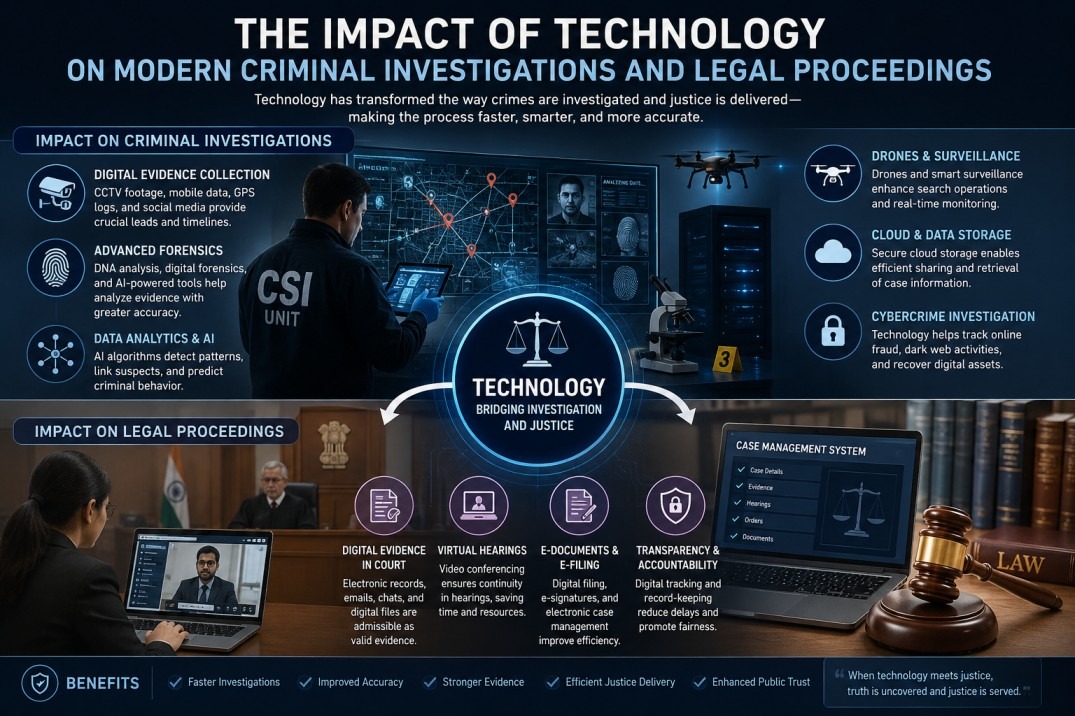
The Impact of Technology on Modern Criminal Investigations and Legal Proceedings
How AI, DNA profiling, digital forensics, CCTV, electronic evidence and surveillance are transforming criminal investigations and court proceedings in India.
The evolution of technology has significantly reshaped the landscape of modern criminal investigations and legal proceedings. From the introduction of forensic science techniques to the integration of artificial intelligence (AI) and digital surveillance, technological advancements have transformed how crimes are detected, analysed, prosecuted, and adjudicated. This research explores the multifaceted impact of technology on the criminal justice system, emphasising its role in enhancing investigative precision, streamlining legal processes, and fostering transparency and accountability.
In the realm of criminal investigations, modern tools such as DNA profiling, facial recognition systems, digital forensics, and geolocation tracking have enabled law enforcement agencies to solve complex cases more efficiently. Technologies like automated fingerprint identification systems (AFIS) and closed-circuit television (CCTV) networks have also become pivotal in gathering and verifying evidence.
Furthermore, the use of big data analytics and AI has allowed for predictive policing and pattern recognition, aiding in the prevention of crime and identification of suspects.
Technology in Legal Proceedings
In legal proceedings, technology has modernised courtrooms through virtual hearings, electronic filing systems, and digital evidence presentation, especially after the COVID-19 pandemic accelerated the adoption of e-justice platforms. Legal professionals now rely on advanced databases, legal research tools, and case management software to prepare arguments and track proceedings.
Challenges and Legal and Ethical Issues
However, this transformation is not without challenges. Concerns related to data privacy, cybercrime, algorithmic bias, and the admissibility of digital evidence raise complex legal and ethical issues.
Critical Analysis Of Technology In Criminal Justice
This paper critically analyses both the opportunities and risks posed by technology in criminal justice. Through examination of landmark case laws, real-world examples, and emerging legal frameworks, it seeks to offer a balanced perspective on how technology continues to redefine justice delivery.
Introduction
The integration of technology into the criminal justice system marks one of the most transformative developments in modern legal history. With rapid advancements in digital tools, artificial intelligence (AI), forensic science, and data analytics, the way criminal investigations are conducted and legal proceedings are managed has been profoundly altered. Where once investigations relied heavily on witness testimony, physical evidence, and manual procedures, modern tools now enable law enforcement agencies and legal institutions to solve crimes with greater speed, precision, and efficiency.
The transformation is visible at every stage of the criminal justice process. In the investigative phase, technologies such as DNA sequencing, biometric identification, cyber forensics, and global positioning systems (GPS) have equipped investigators with the means to gather, preserve, and analyse evidence in ways that were previously unimaginable. Surveillance tools like closed-circuit television (CCTV) and body-worn cameras have also played a crucial role in both deterring crime and documenting interactions between law enforcement and the public. Predictive policing software, which utilises algorithms and historical crime data to forecast potential criminal activity, represents a shift towards data-driven crime prevention, though not without controversy.
In the courtroom, digital innovation has brought about a new era of legal practice. Virtual courtrooms, electronic case management systems, online legal databases, and digital evidence presentation have streamlined litigation processes and improved access to justice. Particularly after the COVID-19 pandemic, the adoption of video conferencing tools and remote hearings has enabled the legal system to continue functioning during times of crisis. Judges, lawyers, and court staff are now able to process cases faster and more transparently, supported by digital documentation and real-time case tracking.
However, the integration of technology in criminal justice also raises significant concerns. Issues such as data privacy, cybercrime, AI biases, and the admissibility and reliability of digital evidence continue to challenge lawmakers and legal practitioners. There is also the risk of overreliance on technological tools without adequate human oversight, which can result in unjust outcomes. For instance, facial recognition systems have been criticised for racial and gender bias, leading to wrongful identifications and arrests.
Furthermore, the digital divide—the gap between those with access to modern technology and those without—poses a threat to the equitable administration of justice. Marginalised communities may face disadvantages in navigating digital legal systems, especially when court services become increasingly dependent on internet access and digital literacy.
This research aims to critically analyse the impact of technology on modern criminal investigations and legal proceedings. By examining both the benefits and drawbacks of various technological applications and referencing relevant case laws and real-world examples, this paper seeks to provide a nuanced understanding of how innovation is reshaping the pursuit of justice. While technology has the potential to make the justice system more accurate, efficient, and accessible, it also demands careful regulation and ethical oversight to ensure that the fundamental principles of fairness, transparency, and human rights are upheld. As the legal landscape continues to evolve, it becomes imperative to strike a balance between technological advancement and the core values of the rule of law.
Evolution of Investigative Technology in Indian Criminal Law
The evolution of investigative technology in Indian criminal law reflects a broader global trend in which the administration of justice increasingly relies on scientific and technological advancements. From traditional, rudimentary policing methods to sophisticated digital tools and forensic science, India’s criminal justice system has undergone a significant transformation over the past century. This evolution has been instrumental in enhancing the efficiency, reliability, and transparency of criminal investigations, thereby strengthening the rule of law.
Early Methods of Investigation
In the colonial era and for much of post-independence India, criminal investigations were largely dependent on eyewitness testimonies, confessions (often extracted through coercion), and circumstantial evidence. Police investigations were manual, time-consuming, and prone to human error or manipulation. Forensic techniques were minimal or non-existent, and there was a general reliance on the experience and discretion of the investigating officer rather than on scientific analysis.
Investigative procedures were primarily guided by the Indian Penal Code (IPC), 1860 [2], and the Code of Criminal Procedure (CrPC), 1973 [3]. However, these laws provided only a broad procedural framework without detailed technical guidance. The absence of modern investigative tools often led to wrongful arrests, prolonged detentions, and a high rate of acquittals due to lack of conclusive evidence.
Emergence of Forensic Science in India
The turning point in India’s investigative capabilities came with the introduction and institutionalisation of forensic science. The establishment of the first forensic science laboratory in Calcutta (now Kolkata) in 1915 marked the beginning of a scientific approach to criminal investigations. Subsequently, forensic science laboratories (FSLs) were established in other parts of the country, offering services such as chemical analysis, fingerprint matching, ballistic examination, and handwriting verification.
Development of Fingerprint Identification
In particular, the development of the Fingerprint Bureau in Kolkata in 1897 is considered a milestone. India was among the first countries to use fingerprinting as a method of criminal identification. The method gained legal acceptance and became a regular part of police procedure.
The Criminal Law (Amendment) Act, 2005 [4], and subsequent policy changes further promoted the use of scientific methods in crime detection. With advancements in DNA profiling, toxicology, serology, and cyber forensics, the credibility and success of criminal investigations began to improve considerably.
Integration of DNA Profiling and Biological Evidence
DNA profiling revolutionised the criminal justice system by enabling investigators to identify suspects or establish innocence with a high degree of accuracy. In India, DNA technology began to be used in the late 1990s and became more mainstream in the 2000s. Its significance has grown in cases of sexual assault, homicide, and paternity disputes.
One landmark case that underscored the value of DNA evidence was the Priyadarshini Mattoo case (1996) [5]. The initial trial resulted in an acquittal due to lack of direct evidence, but the Delhi High Court later convicted the accused in 2006 after giving considerable weight to the DNA evidence. This case highlighted the need for scientific rigour in investigations and led to greater advocacy for the institutionalisation of DNA testing.
The proposal for a specific law on DNA use—the DNA Technology (Use and Application) Regulation Bill, 2019—aims to regulate the collection, storage, and use of DNA samples to ensure that the technology is used ethically and without infringing on privacy rights.
Digital Forensics and Cybercrime Investigation
As crimes became more complex and technology-driven, the need for digital forensics emerged. Cybercrime—ranging from hacking and identity theft to online financial fraud and cyberstalking—posed new challenges for investigators. The Information Technology Act, 2000, provided a legal framework to address computer-related offences and recognised digital evidence.
Digital forensics involves recovering and analysing data from computers, mobile devices, and cloud platforms. These techniques are now routinely used in cases involving financial crimes, terrorism, and child pornography. Investigative agencies such as the Cyber Crime Investigation Cell, the Central Bureau of Investigation (CBI), and the National Cyber Crime Reporting Portal have been instrumental in combating cybercrime using advanced tools.
A notable example is the Aarushi Talwar murder case (2008) [6], where digital forensics played a critical role in analysing mobile phone records and email data. Although the case drew criticism for its handling, it illustrated the growing role of digital footprints in modern investigations.
Surveillance Technologies: CCTV and Phone Tapping
Surveillance has become an indispensable tool for both preventive and investigative policing. CCTV cameras are now widely used in public spaces, government buildings, and even private residences. Their utility was particularly evident in high-profile cases such as the 2012 Delhi gang rape case (Nirbhaya case) [7], where CCTV footage was critical in identifying the perpetrators.
However, surveillance practices also raise concerns about privacy. Phone tapping and interception of communications, though allowed under Section 5(2) of the Indian Telegraph Act, 1885 [8], and Section 69 of the Information Technology Act, 2000, require careful judicial and administrative oversight. The Supreme Court, in People’s Union for Civil Liberties (PUCL) v. Union of India (1997) [9], laid down guidelines to prevent the misuse of phone tapping by ensuring that only authorised officers could approve such actions and only under specific circumstances.
Artificial Intelligence and Predictive Policing
In recent years, the use of artificial intelligence (AI) in law enforcement has begun to take root. AI tools can analyse vast datasets to identify patterns, predict potential criminal activity, and even assist in facial recognition. The Delhi Police has adopted facial recognition software to identify repeat offenders and missing persons. Similarly, predictive policing—using statistical models to predict where crimes are likely to occur—has been experimented with in cities like Hyderabad.
However, AI-driven investigations are fraught with ethical issues. There are concerns about algorithmic bias, lack of transparency, and accountability. Critics argue that over-reliance on such tools may result in discriminatory policing, particularly against marginalized communities.
Legal Framework and Judicial Attitude
Indian courts have gradually accepted the role of modern investigative tools, subject to constitutional safeguards. In Selvi v. State of Karnataka (2010) [10], the Supreme Court held that narco-analysis, polygraph tests, and brain mapping could not be conducted without the consent of the accused, as it would violate the right against self-incrimination under Article 20(3) of the Constitution.
In contrast, the courts have consistently upheld the admissibility of scientifically valid evidence such as DNA, fingerprints, and digital records, provided proper chain of custody and procedural integrity are maintained.
To strengthen the legal framework, the Criminal Procedure (Identification) Act, 2022, was enacted, replacing the outdated Identification of Prisoners Act, 1920. This new law allows for the collection of biometric and behavioural data from convicts and certain categories of accused persons, including retina and iris scans, enhancing investigative capacity.
Institutional Developments and Training
The modernisation of investigative technology requires not only tools but also trained personnel. To address this, the government has invested in specialised training programmes through institutions like the National Institute of Criminology and Forensic Science (NICFS) and state forensic science laboratories.
The National Crime Records Bureau (NCRB) maintains national databases on crime statistics and fingerprint records through systems like the Automated Fingerprint Identification System (AFIS). The introduction of the Crime and Criminal Tracking Network & Systems (CCTNS) project aims to integrate crime records across police stations nationwide, allowing real-time data sharing and inter-agency coordination.
The evolution of investigative technology in Indian criminal law has brought about a paradigm shift in the way crimes are investigated and prosecuted. From fingerprints and forensic labs to DNA profiling, digital surveillance, and AI-driven tools, technology has become a critical pillar of modern policing and legal practice. However, its successful implementation requires not just technological adoption but also legal reform, judicial scrutiny, ethical oversight, and continuous training.
India stands at a crossroads where it must harness the potential of these innovations while upholding constitutional rights and ensuring justice for all. A balanced, well-regulated approach to investigative technology—supported by legal safeguards, institutional readiness, and public trust—can significantly enhance the credibility and efficiency of the criminal justice system in the years to come.
Admissibility and Challenges of Technological Evidence in Indian Criminal Law
The advancement of technology has significantly transformed the criminal justice system in India. With the growing use of electronic devices, digital platforms, and forensic science, law enforcement agencies increasingly rely on technological evidence to investigate and prosecute crimes. This includes a wide range of materials such as emails, phone records, CCTV footage, digital photographs, biometric data, and DNA profiles. While these forms of evidence have added scientific credibility and accuracy to criminal investigations, their admissibility in court remains subject to legal scrutiny and procedural rigour.
In Indian law, the admissibility of technological or electronic evidence is primarily governed by the Indian Evidence Act, 1872, which was amended by the Information Technology Act, 2000, to include provisions for electronic records. Section 65B[11] of the Indian Evidence Act is central to this framework, as it lays down the criteria for admitting electronic records as evidence. According to this section, any information stored in electronic form must be accompanied by a certificate verifying the authenticity of the data, signed by a responsible official. Without this certificate, electronic records—such as printouts of emails or copies of CCTV footage—are generally inadmissible in court as secondary evidence.
This requirement has been the subject of considerable judicial interpretation. In the landmark case of State (NCT of Delhi) v. Navjot Sandhu (2005) [12], the Supreme Court allowed the admission of electronic records even in the absence of a Section 65B certificate, provided they were otherwise deemed authentic. However, this position was later reversed in Anvar P.V. v. P.K. Basheer (2014) [13], where the Court held that the certificate under Section 65B is mandatory for the admissibility of electronic evidence. This interpretation was reaffirmed in Arjun Panditrao Khotkar v. Kailash Kushanrao Gorantyal (2020) [14], where the Court emphasised the procedural sanctity of the certificate and clarified that electronic records cannot be accepted without strict compliance with the legal requirement, unless the original device is produced in court.
Forms and Challenges of Technological Evidence
Technological evidence in India comes in several forms, each carrying its own set of challenges. Digital data such as emails, call logs, or data extracted from mobile phones must be properly authenticated and preserved. Often, the chain of custody—the process of documenting the control, transfer, and analysis of the evidence—is not properly maintained, raising doubts about the integrity of the evidence. The lack of standard protocols across jurisdictions and the limited technical knowledge among investigating officers further complicates the process. Moreover, the risk of tampering with electronic data and the ease with which it can be manipulated make it crucial to establish robust verification mechanisms.
Forensic evidence, particularly DNA and fingerprint analysis, has gained prominence in serious crimes such as sexual assaults and homicides. While DNA profiling is generally considered highly reliable, the process demands strict adherence to scientific standards in the collection, handling, and storage of biological samples. Any lapse may result in contamination, compromising the evidentiary value. Furthermore, the scarcity of well-equipped forensic laboratories and the mounting backlog of cases delay analysis, hampering timely justice.
Surveillance evidence, such as CCTV recordings and intercepted phone calls, has also become increasingly common in criminal trials. While such evidence can be decisive, its use must comply with constitutional and statutory requirements. Phone tapping, for example, is regulated under Section 5(2) of the Indian Telegraph Act, 1885, and Section 69 of the Information Technology Act, 2000, which mandate proper authorisation from competent authorities. In People’s Union for Civil Liberties (PUCL) v. Union of India (1997) [15], the Supreme Court held that phone tapping amounts to a breach of privacy unless conducted under legally sanctioned procedures. With the right to privacy now recognised as a fundamental right following the Supreme Court’s judgement in Justice K.S. Puttaswamy v. Union of India (2017) [16], the collection and use of personal data must meet the test of legality, necessity, and proportionality.
The use of emerging technologies such as facial recognition software, iris scans, and artificial intelligence for predictive policing presents new challenges. These systems, while innovative, raise concerns over accuracy, algorithmic bias, and lack of transparency. In a country as diverse as India, errors in biometric identification or predictive policing algorithms could lead to wrongful arrests and systemic bias against marginalised communities. The absence of a comprehensive legal framework governing these technologies adds to the uncertainty surrounding their admissibility and ethical use.
Institutionally, the criminal justice system in India is not fully equipped to handle the complexity of technological evidence. Investigators often lack adequate training in handling digital evidence or operating forensic tools. There is also a shortage of qualified forensic experts and infrastructure, resulting in delays and inefficiencies. Many judges and legal practitioners also struggle with the technicalities of such evidence, leading to misinterpretation or unwarranted rejection of otherwise valid materials. The lack of digital literacy within the legal system poses a serious challenge to the effective use of technological tools.
Privacy concerns and human rights implications further complicate the admissibility of technological evidence. Digital surveillance, mass data collection, and forensic profiling, if not carefully regulated, can lead to misuse and violations of constitutional protections such as the right to life and personal liberty under Article 21 [17]. The absence of a robust data protection law in India exacerbates this problem, as citizens have limited safeguards against unauthorised surveillance or data breaches.
To address these concerns, it is essential to implement a comprehensive legal and institutional framework for handling technological evidence. Standard protocols for evidence collection and authentication must be enforced nationwide. Investment in forensic infrastructure and training for police, prosecutors, and judges is also necessary to build technical capacity. Further, enacting a strong data protection law will ensure that the use of technology in criminal justice respects individual rights and maintains public trust.
In conclusion, while technological evidence has transformed criminal investigations in India, its admissibility remains a complex interplay of legal requirements, technical standards, and constitutional values. To fully realise the benefits of modern investigative tools, India must strive for legal clarity, institutional preparedness, and a human rights-centric approach that safeguards justice while embracing innovation.
Challenges and Concerns
Despite progress, several challenges hinder the effective use of technology in Indian criminal investigations:
Lack of Infrastructure: Many police stations and forensic labs are under-resourced, leading to delays in evidence processing.
Backlogs: Courts and forensic labs suffer from heavy case backlogs, affecting the timely delivery of justice.
Privacy Concerns: With growing data collection, concerns over surveillance, privacy, and data protection have intensified.
Admissibility and Chain of Custody: Mishandling of digital or biological evidence can lead to its rejection in court.
Ethical Misuse: There is always a risk of misuse or manipulation of forensic tools by corrupt or poorly trained officers.
Legal and Structural Reforms Needed
To fully integrate technology in criminal investigations without compromising rights, several legal and structural reforms are needed.
Reform Area
Proposed Measure
Updating the Indian Evidence Act
Explicit provisions for AI-based evidence, blockchain logs, and deepfake detection must be incorporated.
Data Protection Laws
Enactment of the Digital Personal Data Protection Act, 2023 [18], must include robust enforcement mechanisms, especially for law enforcement agencies.
Judicial Oversight
All surveillance and predictive policing tools must be used only with magistrate approval, backed by necessity and proportionality tests.
Capacity Building
Law enforcement, prosecutors, and judges need specialised training in digital forensics, cybercrime laws, and data ethics.
Independent Oversight Authorities
India must create a regulatory body akin to the UK’s Information Commissioner’s Office (ICO) for overseeing the ethical use of investigative technology.
Global Collaboration
Cross-border crimes require mutual legal assistance treaties (MLATs), international cooperation, and real-time data-sharing agreements with tech companies.
Conclusion
The integration of technology into the criminal justice system has fundamentally reshaped the investigation and adjudication of crimes in India and across the world. From forensic advancements and digital evidence to artificial intelligence and virtual courtrooms, modern innovations have significantly strengthened the pursuit of justice. Technology has not only made criminal investigations more accurate and efficient but has also enhanced the transparency and accountability of legal proceedings.
The evolution of investigative tools—such as DNA profiling, digital forensics, automated fingerprint identification, facial recognition systems, and closed-circuit television (CCTV) surveillance—has enabled law enforcement agencies to gather and analyse evidence with scientific precision. In landmark cases such as the Priyadarshini Mattoo case (1996) and the Nirbhaya case (2012), forensic and digital evidence played a pivotal role in securing convictions and restoring public confidence in the justice system. DNA testing, mobile phone tracking, and CCTV footage have become indispensable tools in unravelling complex criminal conspiracies and corroborating or contradicting witness testimonies.
Technology and the Judiciary
The judiciary has also adapted to the changing technological landscape. The use of video conferencing for court hearings, especially during the COVID-19 pandemic, was a testament to the resilience and adaptability of the legal system. Initiatives such as the e-Courts Mission Mode Project have improved court management and increased accessibility to justice. Online filing of cases, digital documentation, and real-time case tracking have enhanced efficiency and reduced administrative burdens on both litigants and the courts.
Evidence-Based Justice and Legal Research
Moreover, technology has supported the transition toward a more evidence-based, impartial justice system. Legal professionals now have access to comprehensive online databases, AI-driven legal research tools, and digital case law libraries that aid in faster and more accurate interpretation of statutes and precedents. Predictive analytics, when applied cautiously, has the potential to identify crime trends and support effective law enforcement strategies.
Challenges Of Technology In Criminal Justice
Despite these remarkable achievements, the incorporation of technology into the criminal justice process is not without challenges. Issues such as data privacy, cybercrime, admissibility of electronic evidence, algorithmic bias, and digital illiteracy among police and judicial officers require urgent attention. As laid out in Anvar P.V. v. P.K. Basheer (2014) and reaffirmed in Arjun Panditrao Khotkar v. Kailash Kushanrao Gorantyal (2020), Indian courts have clarified that electronic records must meet stringent evidentiary requirements, such as compliance with Section 65B of the Indian Evidence Act. The legal recognition of technological evidence must be balanced with procedural fairness and constitutional protections.
Privacy and Constitutional Protections
Importantly, the Supreme Court’s judgement in Justice K.S. Puttaswamy v. Union of India (2017) established the right to privacy as a fundamental right, which now serves as a critical safeguard against the misuse of surveillance technology and digital evidence. Legal and ethical frameworks must evolve in tandem with innovation to ensure that individual rights are not compromised in the name of efficiency.
The Way Forward For India
Going forward, India must invest in building technological infrastructure within its law enforcement and judicial institutions. This includes:
Equipping police with proper training in cybercrime investigation and digital forensics.
Expanding forensic science laboratories.
Enhancing digital literacy among judges and prosecutors.
Enacting robust data protection legislation to offer legal clarity on the boundaries of state surveillance and private data usage.
Additionally, enacting robust data protection legislation would offer legal clarity on the boundaries of state surveillance and private data usage.
Final Perspective
In conclusion, technology has brought about a transformative shift in how criminal investigations are conducted and how legal proceedings are carried out. When deployed responsibly and ethically, technological tools can serve as powerful allies in the delivery of justice. The path ahead lies in ensuring that these tools are used to uphold constitutional values, preserve human dignity, and enhance public trust in the rule of law. As India continues to modernise its legal system, it must do so with a vision rooted in fairness, accessibility, and innovation.
References
Indian Evidence Act, 1872 (as amended by the Information Technology Act, 2000)