





Abstract
The Maternity Benefit Act, 1961, has been the primary legislation in India to protect the rights of working women during maternity. After more than five decades, parliament amended the law and brought the Maternity Benefits (Amendment) Act, 2017. This amendment increased the period of paid maternity leave from twelve weeks to twenty-six weeks, which was seen as a historic and progressive step towards women’s empowerment.
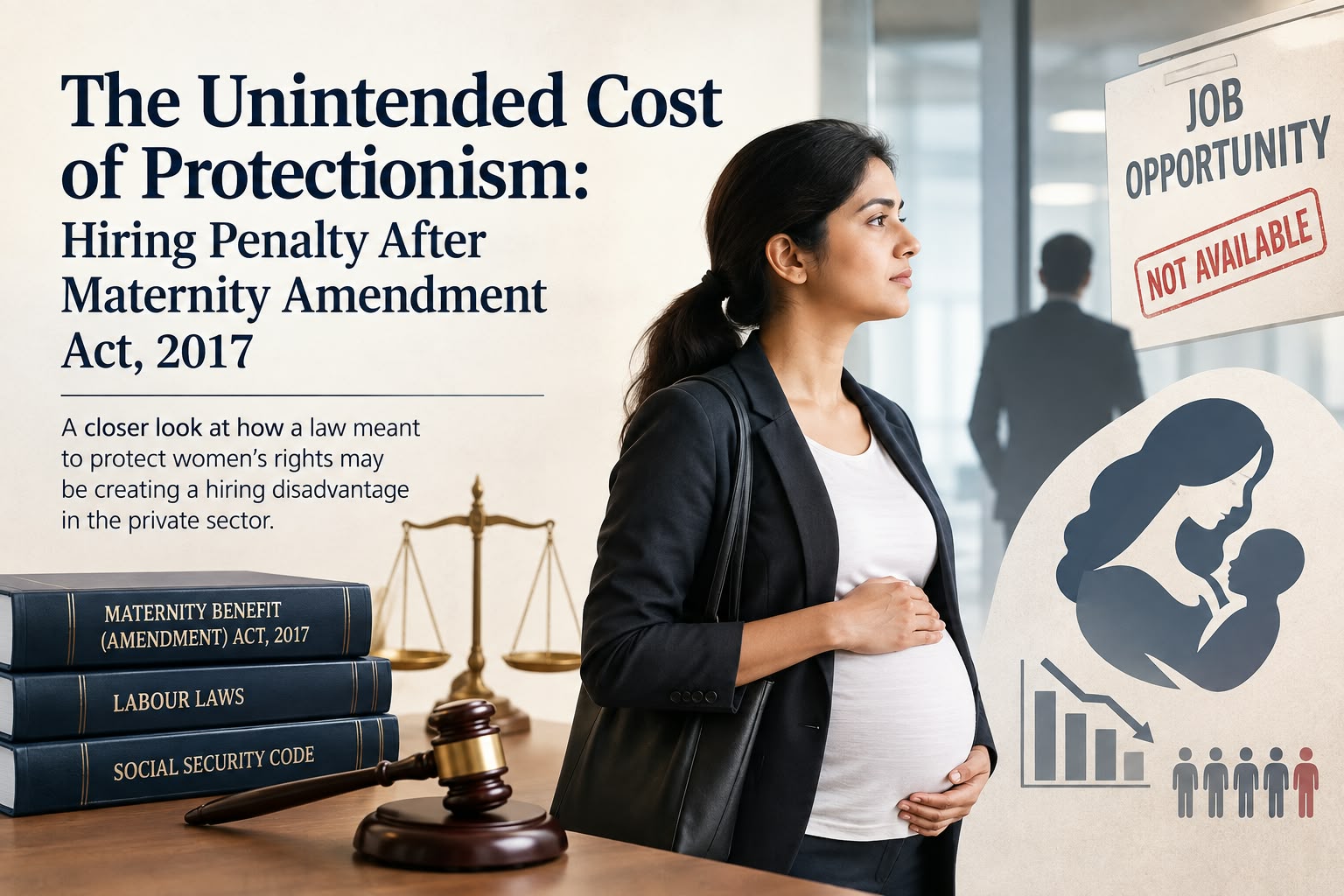
The Maternity Benefit (Amendment) Act, 2017 was introduced with the noble intention of increasing paid maternity leave from 12 weeks to 26 weeks for 2 children. It also provides the crèche facility if there are more than 50 employees. The aim was good—to help women continue their jobs after childbirth. But this good law created a new problem. Because the full salary for 6 months has to be paid by the company only, many small companies started avoiding hiring women, especially young women. This is called “Hiring Penalty.” It is a current situation which the company bears. This paper makes clear the understanding of the assessment of the statistical surveys and discrimination against gender—especially in the private sector. This concept is covered under the “CODE ON SOCIAL SECURITY.”
Introduction
Nowadays, the participation of women in any formal employment in India has remained low. To upgrade the numbers from low to high participation and to provide better health care to mother and child, parliament amended the old law and brought in the Maternity Benefit (Amendment) Act, 2017. This act is concerned with the women’s employment ratio in the company. India has one of the lowest female labor force participation rates in the world.
The intention was protection. But, there is a concept called “Unintended Cost of Protectionism”—when a law made to protect a group makes them less employable. This is exactly what happened. According to this act, all the costs related to maternity facilities have to be borne by the employer only. Unlike in many countries like Singapore or Australia, where the government shares the cost, in India the employer pays all the costs. Here this article also includes all the arguments related to these matters that happened earlier.
No doubt, the intention of the Parliament was very good. It wanted to ensure the health of the mother and child and also ensure job security. But when we see the ground reality, especially in industrial clusters like Surat, Tirupur, and Silvassa, a different picture comes out. Many small factory owners and startup founders feel that 26 weeks of fully paid leave without work is a very high cost for them. The main focus of this article is not to criticize the law but to study its unintended side effect—how a law made to protect women is becoming a reason for employers to avoid hiring them. We call this the Hiring Penalty.
The objective of this article is to see this unintended cost of protectionism created after the Maternity Benefit (Amendment) Act, 2017, with the help of CMIE DATA & Supreme Court judgements.
Research Methodology
This research article follows doctrinal research methodology. The research is primarily based on library and secondary data. First, we have studied the bare provisions of the Maternity Benefit (Amendment) Act, 2017 in detail. We have studied what the amendment says about the duration of leave, crèche facilities, and work from home concept.
To understand the actual impact of the Maternity Benefit (Amendment) Act, 2017, on the hiring of women, we have used analytical data from CMIE. CMIE stands for Centre for Monitoring Indian Economy. CMIE regularly publishes data on employment and unemployment in India through its consumer pyramids and household surveys. We have used CMIE data from the financial year 2018-19, which is the first full year after the implementation of the Maternity Benefit (Amendment) Act, 2017, to see whether there was any fall in women’s employment.
Add on to this. We have studied the three landmark judgments of the Supreme Court of India that are directly related to the concept of hiring penalty and protectionism. These cases are “Municipal Corporation of Delhi vs. Female Worker (muster roll) & Anr. (2000),” “Anuj Garg & Ors. vs. Hotel Association of India (2008),” and the other case of “Deepika Singh vs. Central Administrative Tribunal (2022).” These three cases were decided by the Supreme Court, and they laid down important principles about maternity benefits and about how protection should not become discrimination.
The scope of this study is limited to the formal private sector, where the Maternity Benefit (Amendment) Act, 2017, applies. The act applies to the establishments with 10 (ten) or more employees. Women working in the unorganized sector are not covered under this act, so they are outside the scope of this study. This also focuses on the age group of 25 to 35 years, which is generally considered the childbearing age and where the hiring penalty is felt the most.
Major Arguments of This Maternity Benefits Case
The debate around the Maternity Benefits (Amendments) Act, 2017, has two sides. One side supports the Amendments and says it is necessary, while on the other hand it talks about its unintended side effects.
Supportive Side of This Maternity Benefit (Amendment) Act, 2017
[Positive Side]
The supporters of the Maternity Benefits (Amendment) Act, 2017, give certain arguments. The first and foremost, they say that twenty-six weeks’ leave is necessary for the health of both the mother and her child. The World Health Organization recommends exclusive breastfeeding for six months, so that twenty-six weeks of leave matches that requirement.
Also, they say that this long leave will help the women to continue their jobs even during maternity leave and also after the childbirth. Earlier many women used to resign from their jobs because the twelve weeks were not sufficient to handle the new born child.
Add on to this, they say that this amendment will improve India’s position in the global ranking for gender equality, and it will help to increase women’s empowerment.
At last they say that the Maternity Benefit is not a charity, but it is a legal right of women workers under Article 21 and Article 42 of the constitution.
Arguments and the Problem of the Hiring Penalty under the Maternity Benefit (Amendment) Act, 2017
[Negative Side]
The other side of this, especially for small employers, gives arguments about cost and hiring penalty. So the biggest argument is about the cost burden. Under the Maternity Benefit (Amendment) Act, 2017, the employer alone only has to bear the cost of paying the full salary for twenty-six weeks, and there is no role of government in between, so the government does not contribute anything to the paid maternity leave. In many countries, the government shares the cost of maternity, but in India under this act, it is purely 100% employer liability. For example, if a woman employee has a monthly income of Rs. 40,000, then she gets paid approx. Rs. 260,000, which is for six and a half months, i.e., twenty-six weeks, without taking any work from her. In certain cases the employer has to appoint or hire a temporary employee for her work, and also that person also gets paid for that work.
Also, if we add the crèche facility cost required under the Maternity Benefit (Amendment) Act, 2017 the overall or the total cost for one maternity goes up to Rs.2.5 lakhs to Rs.3 lakhs. For a small company with a limited budget, it is a very huge amount.
By seeing these results on cost, employers start doing what is called statistical discrimination. Statistical discrimination means the employer does not have any personal bias against the women, but the employer looks at the financial risks of the company. He thinks that if he hires a young female aged 24 to 27 years, there is a high possibility that she will take the maternity leave in the next one or two years, and he is entitled to bear the cost under the Maternity Benefits (Amendment) Act, 2017. So they avoid hiring any young-aged women in their company and prefer the male candidates for the same position, so the employer does not have to bear the maternity costs.
Another debate on this topic is about the coverage. This Act applies only to establishments with 10 (ten) or more employees in a particular organization. So a large number of women who work in unorganized sectors, like domestic workers, agricultural workers, and home-based workers, are not covered in it. So the benefit of the Maternity Benefit (Amendment) Act, 2017, goes only to the small section of women who are in formal sectors.
Thus, the Maternity Benefit (Amendment) Act, 2017, though good in intention, has created an unintended cost of protectionism.
Analytical Surveys Related to This Topic by CMIE
To understand whether the hiring penalty is actually happening after the Maternity Benefit (Amendment) Act, 2017. We have to see the CMIE data and the related surveys.
CMIE, Centre For Monitoring Indian Economy is one of the most reliable private organization in India that tracks employment data. CMIE conducts a consumer pyramid household survey and publishes employment and unemployment data every month. It also shows the data for the financial years 2017-18 and 2018-19, which are immediately after the amendment of the Maternity Benefit Act, 2017.
The CMIE data is concerning with the trend. According to the data of financial year 2018-19, it showed the employment of women in a formal private sector in the age group of 20 to 30 years showed a decline of about 10% to 12% compared to the financial year 2017-18. This is the age group that is most affected by maternity-related considerations. During the same period, CMIE data shows the employment of men in the same age group of 20 to 30 years did not show such a decline; in fact, it remained stable or increased slightly.
the work-from-homeCMIE data also shows the sector-wise impact. In sectors where the small and medium enterprises are dominant, like manufacturing, textiles, and IT start-ups, the fall in hiring of young women is more visible after the Maternity Benefit (Amendment) Act, 2017. Many small employers were told during CMIE surveys that due to increased cost under the Maternity Benefit (Amendment) Act, 2017, they are now more cautious while hiring women.
The other noticeable point from the CMIE data is that after the Maternity Benefit Act, many companies have started keeping women on contractual or informal basis to avoid coming under the purview of the Act. This is also a form of hiring penalty because women are not getting permanent jobs.
Therefore, CMIE data clearly indicates that there is a correlation between the implementation of the Maternity Benefit (Amendment) Act, 2017 and fall in hiring of women in childbearing age. It proves that the financial burden under this Act, is acting as a disincentive for employers to hire women.
It is important to mention that CMIE data does not say that employers hate women. It only shows that the cost structure under the Maternity Benefit (Amendment) Act, 2017 has made hiring women more costly than hiring men, which has resulted in statistical discrimination.
Landmark Judgments of Hiring Penalty
The Supreme Court of India has dealt with similar issues where protection of women was used as a ground to deny them employment. The following three judgments are very relevant for understanding the hiring penalty after the Maternity Benefit (Amendment) Act, 2017.
| Case | Year | Reported Citation |
|---|---|---|
| Municipal Corporation Of Delhi Vs Female Worker (Muster Roll) & Anr. | 2000 | (2000) 3 SCC 224 |
| Anuj Garg & Ors. Vs Hotel Association Of India | 2008 | (2008) 3 SCC 321 |
| Deepika Singh Vs Central Administrative Tribunal | 2022 | SCC Online SC 1088 |
Case 1: Municipal Corporation Of Delhi Vs Female Worker (Muster Roll) & Anr. (2000) 3 SCC 224 – Supreme Court
Facts of the Case
Thus case was about women workers working on muster roll, which means daily wage basis, in the municipal corporation of Delhi. These women were doing work like cleaning and other manual work. They claimed maternity leave under the Maternity Benefit Act. The municipal corporation of Delhi refused to give them maternity leave. MCD argued that muster roll workers are not regular employees; they are only daily wagers, So the Maternity Benefit Act does not apply to them. The industrial tribunal decided in favor of women, but MCD went to high court and then to supreme court.
The question raised that the female workers who were working on muster roll on a daily wage basis are entitled to maternity benefit under the Maternity Benefit Act ?
The judgment was given by the Supreme Court that this case is in favor of women workers. The Supreme Court held female workers working on muster roll are entitled to the maternity benefits. The court said that the Maternity Benefit Act is a social welfare legislation and it must be given a broad interpretation.
The court said that it is not just a statutory benefit but it is a part of social justice and it is connected to Article 21 of the constitution which guarantees right to life and dignity. The court even said that if a women is a casual worker or muster roll worker, she cannot be denied maternity benefit. The court directed Municipal Corporation of Delhi to grant Maternity leave to all muster roll women workers.
This judgment is important because it expanded the scope of maternity benefit to even daily wage workers. However, this judgment also started the debate about who will bear the cost. The judgment made maternity benefit available to more women, but it did not discuss cost sharing. When the Maternity Benefit (Amendment) Act, 2017 increased leave to 26 weeks, the cost question became even more important. If even muster roll workers are entitled to 26 weeks paid leave under the Maternity Benefit (Amendment) Act, 2017, the burden on employer becomes very high.
Case 2: Anuj Garg & Ors. Vs Hotel Association Of India (2008) 3 SCC 321 – Supreme Court
Facts of the Case
In this case the validity of section 30 of Punjab Excise Act, 1914 was challenged. Section 30 prohibited employment of women in hotels and bars where liquor and intoxicating drugs are served. The hotel Association argued that this ban was made to protect women because working in bars is not safe for them. Anuj Garg, who was running a hotel, challenged this provision saying that it is discriminatory.
The question raised here before the Supreme Court was whether banning women from working in hotels and bars in the name of the protection is constitutionally valid? Does such protection violate Article 14, 15 and 16 of the constitution ?
The judgment was given by the court that this provision is unconstitutional. The court gave very important concept called “sex stereotyping”. The court explained that it means the state acts as a father and says women are weak and need protection, and therefore they should not be allowed to work in certain places. The court said that this kind of protection actually results in discrimination. The court also said that company should create safe workplace for women and not to ban women from hiring in the organization.
This judgment is the soul of our research topic “unintended cost of protectionism”. The title of this article itself comes from the judgement. The Maternity Benefit (Amendment) Act, 2017 was made to protect women, but if this protection results in hiring penalty where employers avoid hiring women, then it becomes romantic paternalism. The judgment in Anuj Garg case teaches us that any of the protective law, including the Maternity Benefit (Amendment) Act, 2017 should be made in such a way that it encourages women empowerment and does not create barriers for the women to get hired in the organizations.
Case 3: Deepika Singh Vs Central Administrative Tribunal (2022) SCC Online SC 1088
Fact of the Case
Deepika Singh was a working as a nurse in post graduate institute of medical education and research, Chandigarh. She had two children from her husband’s first marriage who were not her biological children. Later she had a biological child. When she applied for maternity leave for her children under the maternity rules, her application was rejected. The department argued that since she already had two surviving children (even though they were not her biological children), she approached Central Administrative Tribunal, but petition was rejected. Then she approached high court, which also rejected. Finally she went to Supreme Court.
The question raised here, whether maternity benefit can be denied on the ground of atypical family structure, and whether maternity is a part of reproductive rights and Article 21 ?
The court gave answer to this question that this case is in favor of Deepika Singh. The Supreme Court allowed her appeal and directed the department to grant the maternity leave. The court held that maternity leave is a part of reproductive rights and it is protected under the Article 21 and Article 15(3) of the constitution which allows special provisions for women. The court said that family structure in India are changing and include step-children, adopted children, etc.. and law must be interpreted broadly to include them. Most importantly, the Supreme Court made such a strong observation that laws and rules should not be framed in such a way that women are seen as a liability or a burden by employers. The court said that denying employment to women because of the motherhood or maternity pf equality and dignity.
Add on to these this case is the most recent judgment on the topic of maternity. It shows that the Supreme Court wants to give fill protection to the maternity. And at the same time, the observation of the court that women should not be seen as liability is the most important for the Maternity Benefit (Amendment) Act, 2017. If under the Maternity Benefit (Amendment) Act, 2017 employers start seeing women as liability due to cost, then it goes against the spirit of the Deepika Singh judgment. Therefore, the government needs to find a cost-sharing model under the Maternity Benefit (Amendment) Act, 2017 so that the women are not seen as costly employees.
After referring all above cases, As an individual’s perception it conclude that the Supreme Court is in a favour of the women employment and not the unemployment of the women in the organizations. Add on to this it is the view point of an individual which depends on the different statistical data, any kind of Maternity related survey. And also as an individual I prefer the women employment rate must be stable and increasing every year, And also provide some facilities and safe environment at a workplace. So as recommendation the government that they should implement some scheme like- ESIC policy which shows the contribution from the employees and also from the government. So likewise government should introduced the Maternity related scheme for any kind of organization.
Conclusion and Suggestions
After studying the Maternity Benefit (Amendment) Act, 2017, CMIE data and the three landmark judgments of the Supreme Court , we can come to the following conclusion. The maternity Benefit (Amendment) Act , 2017 increased leave to twenty – six (26) weeks with good intentions, but CMIE data of 2018-19 shows that after the Maternity Benefit (Amendment) Act, 2017, employment of women in age group of twenty (20) to thirty (30) years fell by ten to twelve percent in private sector, while male employment did not fall. This proves hiring penalties.
The Supreme Court in Municipal Corporation of Delhi vs Female Workers (muster roll) (2000) has held that even daily wage women are entitled to Maternity Benefits. In Anuj Garg vs Hotel Association of India (2008), the Supreme court has held that protection which results in discrimination is unconstitutional and it is romantic paternalism. In Deepika Singh vs Central Administrative Tribunal (2022), the Supreme court has held that maternity is a reproductive right and women should not seen as burden by employers.
Measures to Remove Hiring Penalty
Therefore, to remove hiring penalty under the Maternity Benefit (Amendment) Act, 2017,we suggest the following certain measures :
- The first thing is that, there should be the cost-sharing under the Maternity Benefit (Amendment) Act, 2017. The Indian government should pay fifty percent of salary through ESIC fund. This will reduce the burden on the employers as indicated by Supreme Court judgments that women should not be a burden.
- The other one is that, there is a CMIE data should be regularly monitoring by the Ministry of labour to check impact of the Maternity Benefit (Amendment) Act, 2017 on women hiring. If CMIE data shows continuous fall, government should introduced cost-sharing model.
- Add on to this , as per the third principle laid down in Anuj Garg judgment, protectionism approach under the Maternity Benefit (Amendment) Act, 2017 should be replaced by empower approach where both the employer and government share the responsibility.
- At last, maternity under the Maternity Benefit (Amendment) Act, 2017 should be treated as shared responsibility of employer, government and society, not only the employer. Only then hiring penalty can be removed and objective of the Maternity Benefit (Amendment) Act, 2017 can be achieved.
References
- Centre for Monitoring Indian Economy. (2019). Employment and unemployment data 2018-19: Consumer Pyramids Household Survey, CMIE Government of India.
- The Maternity Benefit (Amendment) Act, 2017 (Act No. 6 of 2017). Ministry of Law and Justice. labour.gov.in
- Municipal Corporation of Delhi vs. Female Workers (Muster Roll) & Anr., (2000) 3 S.C.C. 224 (India).
- Anuj Garg & Ors. vs. Hotel Association of India & , (2008) 3 S.C.C. 321 (India).
- Deepika Singh Vs Central Administrative Tribunal (2022) SCC Online SC 1088 (India).

