





Introduction
The concept of euthanasia and the right to die with dignity has generated significant legal, ethical, medical, and philosophical debates worldwide. Euthanasia refers to the intentional ending of a person’s life to relieve unbearable suffering caused by terminal illness or irreversible medical conditions. The issue raises a fundamental question: whether an individual has the right to choose death as an aspect of personal autonomy and human dignity.
In India, the debate revolves around the interpretation of Article 21 of the Constitution, which guarantees the right to life and personal liberty. While the Constitution protects life, courts have been called upon to determine whether this protection includes the right to die with dignity. The recognition of passive euthanasia by the Supreme Court has marked a significant development in balancing individual autonomy with the state’s obligation to preserve life.
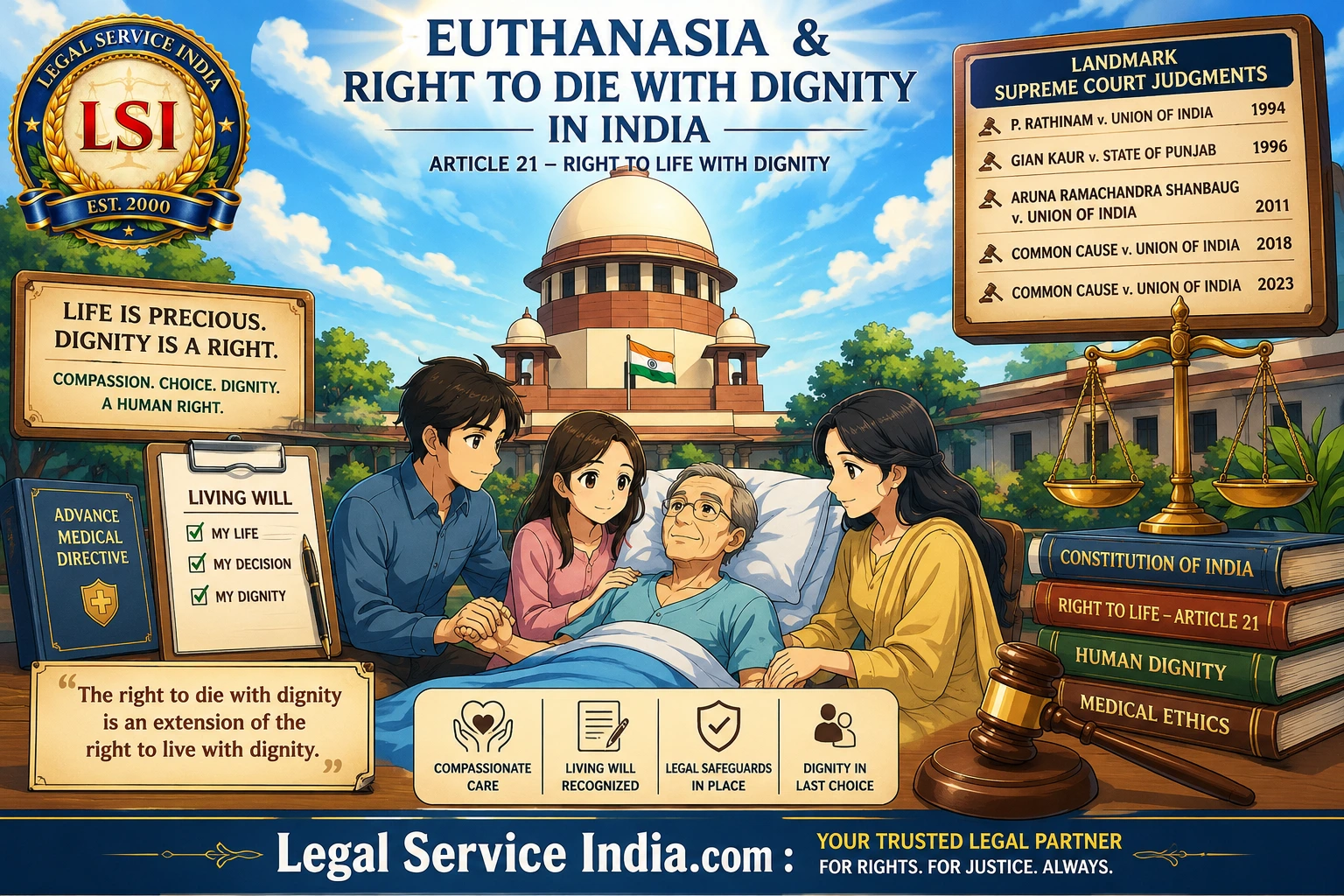
Judicial Perspective / Case Laws
| Case | Year | Key Principle | Significance |
|---|---|---|---|
| P. Rathinam v. Union of India | 1994 | The right to life includes the right to die. | Recognised personal autonomy; later overruled. |
| Gian Kaur v. State of Punjab | 1996 | The right to life does not include the right to die. | Recognised the concept of death with dignity in terminal illness. |
| Aruna Ramachandra Shanbaug v. Union of India | 2011 | Passive euthanasia permitted under judicial supervision. | First legal recognition of passive euthanasia in India. |
| Common Cause v. Union of India | 2018 | The right to die with dignity is recognised under Article 21. | Legalised passive euthanasia and living wills. |
| Common Cause v. Union of India | 2023 | Simplified procedural safeguards. | Made living wills and withdrawal of life support more accessible. |
1. P. Rathinam v. Union of India (1994)
The Supreme Court held that the “right to life” under Article 21 includes the “right not to live” or the right to die. Consequently, Section 309 of the Indian Penal Code (attempt to commit suicide) was declared unconstitutional.
Significance
- The judgement recognised personal autonomy but was later overruled.
2. Gian Kaur v. State of Punjab (1996)
A constitution bench overruled P. Rathinam and held that the right to life does not include the right to die. However, the Court observed that the right to die with dignity in the context of terminal illness may be distinguished from suicide.
Significance
- Introduced the concept of dignified death while rejecting a general right to die.
3. Aruna Ramachandra Shanbaug v. Union of India (2011)
The Supreme Court allowed passive euthanasia under strict judicial supervision. Aruna Shanbaug had remained in a persistent vegetative state for over four decades after a brutal assault.
Significance
- For the first time, passive euthanasia was legally recognised in India.
4. Common Cause v. Union of India (2018)
The Supreme Court held that the right to die with dignity is a fundamental right under Article 21. The court legalised passive euthanasia and recognised the validity of “living wills” or advance medical directives.
Significance
- Established a comprehensive legal framework for passive euthanasia and end-of-life decisions.
5. Common Cause v. Union of India (2023)
The Supreme Court simplified procedural requirements for executing living wills and obtaining approval for withdrawal of life support.
Significance
- Made the exercise of the right to die with dignity more practical and accessible.
Critical Analysis
The recognition of passive euthanasia reflects the growing emphasis on individual autonomy and bodily integrity. A terminally ill patient experiencing unbearable suffering may reasonably seek relief through withdrawal of life-sustaining treatment.
However, euthanasia remains controversial due to concerns about misuse, coercion, and the vulnerability of elderly and disabled persons. Critics argue that legalising euthanasia may create pressure on patients to choose death to avoid becoming a burden on their families.
Religious and cultural traditions in India generally regard life as sacred and oppose intentional termination of life. Furthermore, inadequate healthcare infrastructure and limited access to palliative care may influence patients’ decisions, raising questions about whether consent is genuinely voluntary.
The distinction between active and passive euthanasia also remains contentious. While passive euthanasia involves withdrawing treatment, active euthanasia entails a deliberate act causing death. Many scholars argue that the ethical difference between the two is often unclear since both ultimately result in the patient’s death.
Key Judicial Takeaways
- Article 21 has evolved to recognise the right to die with dignity in limited circumstances.
- Passive euthanasia is legally permissible under the framework laid down by the Supreme Court.
- Living wills and advance medical directives have legal recognition.
- Active euthanasia continues to remain illegal in India.
- The courts have consistently emphasised strict procedural safeguards to prevent misuse.
Comparative Analysis of Euthanasia Laws
The legal position on euthanasia varies considerably across different jurisdictions. The table below provides a comparative overview.
| Country | Legal Position |
|---|---|
| Netherlands | Permits active and passive euthanasia under strict conditions. |
| Belgium | Legalised euthanasia for adults and, in limited circumstances, minors. |
| Canada | Allows Medical Assistance in Dying (MAiD) subject to statutory safeguards. |
| Switzerland | Permits assisted suicide under regulated conditions. |
| United Kingdom | Active euthanasia remains illegal; passive euthanasia may be permitted in certain cases. |
| India | Passive euthanasia and living wills are recognised; active euthanasia remains illegal. |
The international experience demonstrates that jurisdictions permitting euthanasia generally impose stringent procedural safeguards to prevent abuse while respecting patient autonomy.
Suggestions and Recommendations
The following measures can help strengthen India’s legal and healthcare framework concerning euthanasia and end-of-life care.
- Comprehensive Legislation: Parliament should enact a dedicated euthanasia law instead of relying solely on judicial guidelines.
- Strengthening Palliative Care: Improved access to pain management and end-of-life care should be ensured across the country.
- Clearer Living Will Procedures: Uniform and simplified procedures should be implemented nationwide.
- Medical Ethics Committees: Independent ethics committees should review euthanasia requests to prevent misuse.
- Public Awareness: Greater awareness about advance directives and end-of-life rights should be promoted.
- Periodic Judicial Review: Courts should continue monitoring the implementation of euthanasia guidelines to ensure constitutional safeguards.
- Protection of Vulnerable Groups: Additional safeguards should be introduced for elderly, disabled, and economically disadvantaged patients.
Key Policy Recommendations at a Glance
| Recommendation | Objective |
|---|---|
| Comprehensive Legislation | Create a clear statutory framework governing euthanasia. |
| Strengthening Palliative Care | Ensure quality end-of-life care and pain management. |
| Clearer Living Will Procedures | Simplify implementation across all states and union territories. |
| Medical Ethics Committees | Prevent misuse through independent review. |
| Public Awareness | Promote understanding of advance directives and patient rights. |
| Periodic Judicial Review | Maintain constitutional safeguards through continued oversight. |
| Protection of Vulnerable Groups | Provide additional safeguards for at-risk individuals. |
Conclusion
The debate on euthanasia and the right to die with dignity reflects the tension between preserving life and respecting personal autonomy. Through landmark decisions such as Gian Kaur, Aruna Shanbaug, and Common Cause, the Supreme Court of India has progressively recognised that dignity extends not only to living but also to the process of dying. While passive euthanasia and living wills are now legally recognised, active euthanasia remains prohibited.
A balanced legal framework that safeguards vulnerable individuals while respecting personal choice is essential. Strengthening palliative care, ensuring informed consent, and enacting comprehensive legislation can help India uphold both the sanctity of life and the dignity of death.
References
Books
- H.M. Seervai, Constitutional Law of India, Universal Law Publishing.
- V.N. Shukla, Constitution of India, Eastern Book Company.
- P. Ishwara Bhat, Fundamental Rights: A Study of Their Interrelationship, Eastern Book Company.
- Ratanlal & Dhirajlal, The Indian Penal Code, LexisNexis.
Journal Articles
- Bhatia, Gautam, “The Right to Die with Dignity under Article 21,” National Law School Journal.
- Singh, M.P., “Euthanasia and Constitutional Rights in India”, Journal of Indian Law Institute.
- Pal, R.M., “Passive Euthanasia and Human Dignity”, Indian Bar Review.
Cases Cited
| Case | Citation |
|---|---|
| P. Rathinam v. Union of India | (1994) 3 SCC 394 |
| Gian Kaur v. State of Punjab | (1996) 2 SCC 648 |
| Aruna Ramachandra Shanbaug v. Union of India | (2011) 4 SCC 454 |
| Common Cause v. Union of India | (2018) 5 SCC 1 |
| Common Cause v. Union of India | 2023 SCC OnLine SC 373 |
Key Takeaways
The following key takeaways summarise the current legal position on euthanasia and the right to die with dignity in India. These points highlight the constitutional principles, landmark Supreme Court judgements, and policy considerations governing passive euthanasia, living wills, and end-of-life decisions.
- The Right to Die with Dignity is protected under Article 21 of the Indian Constitution, but only in limited circumstances recognised by the Supreme Court.
- Passive euthanasia is legal in India, allowing withdrawal or withholding of life-sustaining treatment under judicially approved safeguards.
- Active euthanasia remains illegal in India, as intentionally causing a patient’s death is prohibited under existing criminal law.
- The Supreme Court’s landmark judgements in P. Rathinam, Gian Kaur, Aruna Shanbaug, and Common Cause have progressively shaped India’s euthanasia jurisprudence.
- Living Wills (Advance Medical Directives) are legally valid, enabling competent individuals to specify their end-of-life medical preferences in advance.
- The 2023 Common Cause judgement simplified the procedure for executing living wills and withdrawing life support, making the process more practical and accessible.
- Indian courts distinguish between the “right to die” and the “right to die with dignity”, recognising dignity in the natural process of dying rather than a general right to end one’s life.
- Strict procedural safeguards are mandatory to prevent coercion, misuse, and abuse of vulnerable patients seeking passive euthanasia.
- Ethical concerns remain central, including patient autonomy, informed consent, protection of vulnerable individuals, religious beliefs, and the sanctity of human life.
- India’s legal framework differs from countries such as the Netherlands, Belgium, Canada, and Switzerland, where various forms of active euthanasia or physician-assisted dying are legally permitted under statutory regulations.
- Experts recommend a comprehensive parliamentary law on euthanasia to replace reliance on judicial guidelines and provide greater legal certainty.
- Expanding palliative care and pain management services is essential to ensure that end-of-life decisions are made freely and not due to inadequate medical support.
- Medical ethics committees and uniform nationwide procedures can strengthen transparency, accountability, and protection against misuse.
- Public awareness of living wills and advance medical directives remains crucial for safeguarding patient autonomy and informed healthcare decisions.
- The future of euthanasia law in India lies in balancing constitutional rights, medical ethics, patient dignity, and societal interests, while ensuring robust legal safeguards for vulnerable persons.
Quick Reference Summary
| Topic | Current Legal Position in India |
|---|---|
| Right to Die with Dignity | Protected under Article 21 in limited circumstances recognised by the Supreme Court. |
| Passive Euthanasia | Legal under judicially approved safeguards. |
| Active Euthanasia | Remains illegal. |
| Living Wills | Legally recognised through Supreme Court judgements. |
| Procedural Safeguards | Mandatory to prevent misuse and protect vulnerable patients. |
| Future Reforms | Comprehensive legislation, stronger palliative care, ethics committees, and greater public awareness are recommended. |

