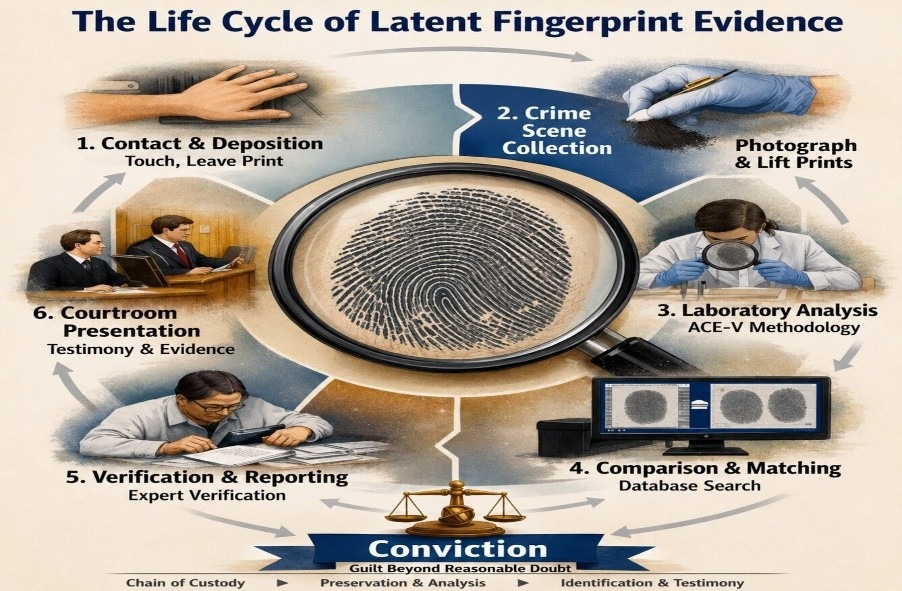
Introduction
Latent fingerprints are among the most valuable forms of physical evidence in criminal investigations. Popular portrayals often make fingerprint identification appear instantaneous: a print is discovered, scanned, matched, and a suspect is identified. In reality, the process is far more systematic. A latent fingerprint passes through a complete evidentiary life cycle—from deposition and persistence at the crime scene to recognition, documentation, development, recovery, laboratory examination, database searching, interpretation, and ultimately presentation in court.
The evidentiary value of a fingerprint depends not merely on the ridge pattern itself, but on every decision made throughout this process. Poor documentation, inappropriate processing, contamination, inadequate preservation, breaks in the chain of custody, or cognitive bias can reduce the reliability and legal value of otherwise useful evidence.
The life cycle may therefore be summarized as:
Deposition → Persistence → Recognition → Documentation → Development → Visualization → Photography → Recovery/Preservation → Examination → Evaluation → Court Presentation
Each stage presents an opportunity either to preserve information or to lose it.
Contact and Deposition: The Beginning of the Evidence
The life of a latent fingerprint begins when friction-ridge skin comes into contact with a surface. The fingers and palms contain friction ridges with numerous pores through which natural skin secretions are released. When the ridges touch another surface, some of this material is transferred, potentially leaving an impression.
Fingerprint residue is chemically complex. It may contain water, inorganic salts, amino acids, proteins, lipids, fatty acids, and other substances. The composition and quantity of residue can vary between individuals and even between successive impressions deposited by the same person.
The mechanics of contact are equally important. Pressure, movement, twisting, pulling, pushing, and the duration of contact can influence the quality of the resulting impression. A controlled contact may produce relatively clear ridge detail, whereas excessive movement or pressure may cause distortion, smearing, or partial transfer.
Consequently, a poor latent print is not necessarily the result of poor forensic processing. Its limitations may have originated at the moment of deposition.
The Surface Matters
The nature of the receiving surface strongly influences both the persistence of a latent print and the method used to develop it.
| Surface Type | Examples | Fingerprint Characteristics and Processing |
|---|---|---|
| Non-porous surfaces | Glass, metal, many plastics | Generally do not absorb fingerprint residue. Techniques such as powder processing or cyanoacrylate fuming may be used. |
| Porous surfaces | Paper, cardboard, unfinished wood | Can absorb components of fingerprint residue. Chemical techniques designed to react with specific components may be particularly useful. |
| Semi-porous surfaces | Glossy paper, varnished wood | Exhibit characteristics of both categories and may require carefully selected processing methods. |
Non-porous surfaces, such as glass, metal, and many plastics, generally do not absorb fingerprint residue. The material remains primarily on the surface and may be developed using techniques such as powder processing or cyanoacrylate fuming.
Porous surfaces, including paper, cardboard, and unfinished wood, can absorb components of fingerprint residue. Because the material may penetrate the substrate, chemical techniques designed to react with specific components of the residue can be particularly useful.
Semi-porous surfaces, such as glossy paper or varnished wood, exhibit characteristics of both categories and may require carefully selected processing methods.
Environmental conditions further affect persistence. Heat, humidity, moisture, sunlight, airflow, dust, repeated handling, and other contaminants may alter or degrade the residue. Thus, the age and condition of a print cannot be assessed solely by its visible appearance.
Crime Scene Recognition and Documentation
Finding a fingerprint is only the beginning. The examiner must determine which surfaces are likely to have been touched during the relevant activity.
Important areas may include:
- Entry and exit points
- Doors and windows
- Cabinets and drawers
- Containers
- Moved objects
- Vehicles
- Other frequently handled surfaces
The examination should be guided by the circumstances of the scene rather than by an assumption that every possible surface is equally important.
Context is therefore critical. A fingerprint on an object commonly handled by household members may have limited investigative significance, whereas a print found on a damaged entry point or an object apparently used during the commission of an offence may be more relevant.
Documentation preserves the original circumstances of the evidence. It should record the location, condition, orientation, appearance, and subsequent processing of the impression. This documentation creates a permanent connection between the physical evidence at the scene and its later examination.
“Matching” in the chart refers to the comparative phase evaluated by the examiner clarifies this distinction.
Photography: The Golden Rule of Preservation
Before an impression is lifted, moved, or subjected to additional processing, it should be photographed in its original position whenever practicable.
Forensic photography should preserve both the impression and its context. Overall and mid-range photographs can establish the relationship between the evidence and the surrounding scene, while close-up photographs document the ridge detail itself.
A suitable scale should be included where appropriate, and lighting should be selected according to the characteristics of the surface and impression. High-quality photography is particularly important because subsequent handling may alter or destroy the original impression.
Photography is therefore not simply an illustration of the evidence. It is an important preservation step.
Development of Latent Prints
Most latent fingerprints cannot be clearly observed with the naked eye. Development techniques are therefore used to make ridge detail visible.
There is no single universal method suitable for every fingerprint. Processing decisions should consider the substrate, the suspected composition of the residue, environmental exposure, contamination, previous processing, and the condition of the evidence.
Common Development Techniques
- Powder Processing
- Cyanoacrylate Fuming
- Ninhydrin
- 1,2-Indanedione/Zinc Chloride
- Blood Enhancement
- Vacuum Metal Deposition
6.1. Powder Processing
Fingerprint powders adhere to residue and can provide contrast between the ridge detail and the background. Powder processing is particularly useful on suitable non-porous surfaces. However, excessive powder may increase background or obscure fine ridge detail, while insufficient application may fail to reveal available information.
6.2. Cyanoacrylate Fuming
Cyanoacrylate, commonly known as superglue, can be used to develop latent impressions on appropriate non-porous surfaces. Vapour polymerization deposits material preferentially on components associated with the fingerprint residue, making ridge detail visible.
6.3. Ninhydrin
Ninhydrin is commonly used on porous materials such as paper and cardboard. It reacts with amino acids associated with fingerprint residue and can produce the characteristic purple coloration known as Ruhemann’s Purple.
6.4. 1,2-Indanedione/Zinc Chloride
This process is used for suitable porous materials and can produce fluorescent ridge detail when examined under appropriate forensic lighting.
6.5. Blood Enhancement
When fingerprints are deposited in blood, reagents such as Leuco Crystal Violet (LCV) and Amido Black may be used under appropriate circumstances to enhance ridge detail.
6.6. Vacuum Metal Deposition
Vacuum Metal Deposition (VMD) uses controlled deposition of metals under vacuum conditions and can be useful for certain smooth, non-porous or flexible materials.
The choice of method should always be evidence-driven rather than based on a fixed assumption that the same sequence will work for every item.
Forensic Light Sources
Before applying physical or chemical processing, examiners may examine evidence using forensic light sources or Alternate Light Sources (ALS).
Specific wavelengths, often combined with appropriate filters, can enhance the visibility of certain fingerprint residues through fluorescence or contrast. One advantage of optical examination is that it can often be performed without physically altering the evidence.
This supports an important forensic principle: where appropriate, methods that preserve the original condition of the evidence should be considered before techniques that may alter it.
Sequential Processing
Latent fingerprint development may involve more than one technique. Sequential processing can sometimes reveal additional information that was not adequately visualized during an earlier stage.
However, additional processing does not automatically mean additional information. A subsequent technique may enhance an impression, but it may also alter, obscure, or diminish ridge detail that was already present.
Research comparing black and magnetic powders illustrates this point. Different processing sequences produced different outcomes, demonstrating that the order of techniques can influence the final result.
Sequential processing should therefore be treated as a deliberate evidentiary decision. Before applying another method, the examiner should consider the substrate, the quality of the developed impression, the previous processing, and the potential benefit and risk of further treatment.
Recovery, Lifting and Packaging
After development and photography, the impression may be physically recovered when appropriate. Depending on the circumstances, methods can include lifting tape, gel lifters, or other recovery techniques.
Where the entire object can be safely transported, it may be preferable to submit the object itself for further examination rather than attempting unnecessary recovery at the scene.
Packaging is equally important. Evidence must be protected against rubbing, contamination, moisture, and other sources of damage. Every transfer, handling event, and storage stage should be documented to maintain an appropriate chain of custody.
Fingerprint Evidence Chain of Custody
The basic evidentiary chain can therefore be expressed as:
Deposition → Discovery → Photography → Preservation/Lifting → Laboratory Examination → ACE-V Analysis → Court Presentation
Laboratory Examination and ACE-V
Once the evidence reaches the laboratory, the examiner may use the ACE-V methodology:
| Stage | Meaning |
|---|---|
| A — Analysis | Assessment of the unknown latent print. |
| C — Comparison | Comparison of the latent print with a known impression or candidate print. |
| E — Evaluation | Assessment of the evidence and formulation of a conclusion. |
| V — Verification | Independent review of the examination and conclusion. |
10.1. Analysis
The examiner first evaluates the unknown latent print independently of a known suspect print.
The assessment includes:
- overall quality and clarity;
- distortion or smearing;
- substrate effects;
- quantity and quality of visible ridge detail; and
- whether sufficient information exists for further examination.
This initial assessment is important because it helps reduce the risk that expectations about a particular suspect will influence the interpretation of the unknown print.
10.2. The Three Levels of Detail
Fingerprint examination traditionally considers three levels of information.
| Level | Information Considered |
|---|---|
| Level 1 | General pattern, such as loops, whorls, and arches. |
| Level 2 | Ridge characteristics or minutiae, including ridge endings and bifurcations, together with their sequence and spatial relationships. |
| Level 3 | Finer characteristics such as pore structure, ridge edges, and ridge thickness, when sufficiently clear and reliable. |
The significance of these levels depends on the quality of the impression. Not every latent print contains sufficient detail at all three levels.
10.3. Comparison
The examiner then compares the latent impression with an appropriate known impression or candidate identified through a database search.
The comparison considers the sequence, location, spatial relationship, and other characteristics of the available ridge detail. The process is not simply a matter of counting matching points; the overall quality, quantity, and arrangement of the observed information must be considered.
10.4. Evaluation
Following comparison, the examiner reaches a conclusion based on the information available.
The principal conclusions include:
- Identification/Individualization: sufficient agreement exists to conclude that the impressions originated from the same source;
- Exclusion: significant differences demonstrate that the impressions did not originate from the same source; or
- Inconclusive: insufficient information exists to support either conclusion.
10.5. Verification
A second qualified examiner independently reviews the examination and conclusion. Depending on laboratory policy, verification may be conducted with or without knowledge of the first examiner’s conclusion.
Independent verification provides an additional safeguard against error and can help reduce the effects of cognitive bias.
11. AFIS and Database Searching
When investigators do not have a known suspect, Automated Fingerprint Identification Systems (AFIS) can be used to search large fingerprint databases.
AFIS analyses the submitted print and generates potential candidates based on similarities in ridge characteristics. Importantly, AFIS does not make the final identification. It is a candidate-generating system.
The final conclusion remains the responsibility of a qualified examiner, who must independently evaluate the latent print against the candidate print using an appropriate examination methodology.
Thus:
AFIS suggests candidates; the examiner evaluates the evidence.
12. Courtroom Presentation and Legal Scrutiny
The final stage of the fingerprint life cycle is courtroom presentation.
At this stage, the prosecution must be able to demonstrate that the evidence was properly discovered, documented, developed, preserved, examined, and maintained through an appropriate chain of custody.
The expert may be required to explain:
- where and how the print was discovered;
- how it was photographed and developed;
- how it was recovered and preserved;
- how the chain of custody was maintained;
- what methodology was employed;
- what ridge characteristics were observed;
- how the comparison was conducted; and
- how the final conclusion was reached.
The court is therefore concerned not only with the final fingerprint image but with the complete history of the evidence.
13. Scientific Reliability, Bias and Error
Fingerprint examination is a scientific discipline, but it is not immune from human error.
Examiners may be influenced by contextual information, particularly when they know details about a suspect, confession, or investigative theory. Cognitive and contextual bias can potentially affect the interpretation of ambiguous ridge detail.
Procedures such as independent verification, blind review, and approaches including Linear Sequential Unmasking (LSU) may help reduce such risks.
Modern forensic examination also recognizes that rigid numerical thresholds alone cannot adequately capture the complexity of latent prints. The quality, quantity, and arrangement of ridge characteristics should be considered collectively.
Forensic conclusions should therefore be expressed responsibly. Claims such as “100% certainty” or “zero error rate” should not be made unless scientifically justified. The language of a forensic report should communicate both the strength and the limitations of the evidence.
14. Maintaining Evidence Integrity
Four principles are particularly important throughout the fingerprint life cycle.
14.1. Chain of Custody
Every transfer, handling, and storage event should be documented. Unexplained gaps may raise questions regarding the integrity of the evidence.
14.2. Appropriate Sequential Processing
Where appropriate, less intrusive or non-destructive examination should be considered before physical or chemical techniques that may alter the evidence.
14.3. Preservation of Original Context
The impression should be documented in situ before lifting, movement, or additional processing whenever practicable.
14.4. Methodological Independence
Examination and verification should be conducted independently and systematically, with appropriate safeguards against cognitive bias.
Limitations of Latent Fingerprint Evidence
Latent fingerprint evidence has significant practical and legal limitations.
Crime-scene impressions are often partial, faint, distorted, smudged, contaminated, or affected by weather and surface characteristics. A fingerprint may contain insufficient information for a reliable conclusion.
The examination process also involves human judgment. Although technology such as AFIS can assist investigators, final interpretation remains dependent upon trained examiners. Human error and contextual bias therefore remain important considerations.
Evidence can also be compromised before examination. Improper collection, handling, packaging, storage, contamination, or documentation may reduce its evidentiary value. Questions concerning alteration, substitution, or planting of evidence make a reliable chain of custody especially important.
The central lesson is that fingerprint evidence should not be treated as infallible simply because it is based on a well-established forensic discipline.
Fingerprint Evidence in Law: India and the United States
16.1. Indian Framework
In India, expert opinion concerning fingerprints is recognized within the law of evidence. Under the Indian Evidence Act, 1872, expert opinion relating to finger impressions was primarily addressed through Section 45, while Section 73 dealt with the court’s power to compare relevant impressions. Court power to compare signatures or finger impressions (formerly Section 73 IEA) is now mapped under Section 73 of the BSA as well.
The Bharatiya Sakshya Adhiniyam, 2023, which came into effect in 2024, carries forward the framework concerning expert opinion, with Section 39 addressing expert opinions.
Indian courts have historically approached fingerprint evidence with caution, particularly concerning the circumstances in which impressions were obtained, preserved, and connected to the accused.
Emperor v. Kangali Charan (1898) is recognized as an important early milestone in the judicial use of fingerprint evidence in British India.
In Mohd. Aman v. State of Rajasthan (1997), the Supreme Court emphasized the importance of establishing the integrity of fingerprints recovered during investigation and addressing concerns relating to their collection and handling.
In Musheer Khan v. State of Madhya Pradesh (2010), the Court treated fingerprint expert evidence within the broader evidentiary framework and emphasized the need for supporting circumstances rather than treating expert opinion as automatically conclusive.
The broader Indian position is therefore one of cautious acceptance: fingerprint evidence may be highly persuasive, but its weight depends upon the quality of the impression, the reliability of the examination, and the integrity of the surrounding evidence.
16.2. United States Framework
Fingerprint evidence also has a long history of judicial acceptance in the United States.
In People v. Jennings (1911), the Illinois Supreme Court upheld fingerprint evidence, representing an important early judicial recognition of the technique.
Later, Daubert v. Merrell Dow Pharmaceuticals (1993) established important principles for assessing the reliability and admissibility of expert scientific evidence under the Federal Rules of Evidence.
In United States v. Crisp (2003) and United States v. Mitchell (2004), federal courts considered the admissibility and reliability of fingerprint examination under modern evidentiary standards.
The U.S. approach therefore combines longstanding judicial acceptance with continuing scrutiny of methodology, expert qualifications, reliability, and the potential for error.
From Evidence to Proof
A fingerprint does not become powerful evidence merely because ridge detail can be visualized. Its evidentiary value develops through a chain of scientifically and procedurally controlled decisions.
The process begins with contact and deposition. It continues through persistence, recognition, documentation, development, visualization, photography, recovery, preservation, laboratory examination, comparison, evaluation, and verification. It ultimately reaches courtroom presentation, where the entire history of the evidence may be examined.
At every stage, the central objective remains the same: preserve as much reliable information as possible while minimizing alteration, contamination, error, and bias.
Life Cycle of Latent Fingerprint Evidence
The life cycle of latent fingerprint evidence can therefore be represented as:
| Stage | Process |
|---|---|
| 1 | Contact |
| 2 | Deposition |
| 3 | Persistence |
| 4 | Discovery |
| 5 | Documentation |
| 6 | Development |
| 7 | Visualization |
| 8 | Photography |
| 9 | Recovery/Preservation |
| 10 | ACE-V Examination |
| 11 | AFIS Assistance |
| 12 | Verification |
| 13 | Courtroom Scrutiny |
Contact → Deposition → Persistence → Discovery → Documentation → Development → Visualization → Photography → Recovery/Preservation → ACE-V Examination → AFIS Assistance → Verification → Courtroom Scrutiny
This perspective is important because the final quality of a fingerprint conclusion is not determined solely in the laboratory. It is shaped by everything that happened to the evidence before the examiner ever saw it.
Conclusion
Latent fingerprint evidence is a continuous process governed by scientific discipline and procedural integrity, not an isolated lab test. Its reliability depends on every stage of its lifecycle—scene recognition, documentation, chemical or physical development, forensic photography, packaging, analysis, database matching, independent verification, and courtroom presentation.
Handled meticulously, latent prints serve as powerful tools to both identify suspects and exonerate the innocent.
References
- Croxton, R. S., Baron, M. G., Butler, D., Kent, T., & Sears, V. G. (2010). Variation in amino acid and lipid composition of latent fingerprints. Forensic Science International, 199(1–3), 93–102. https://doi.org/10.1016/j.forsciint.2010.03.019
- De Alcaraz-Fossoul, J., Mestres Patris, C., Balaciart Muntaner, A., Barrot Feixat, C., & Gené Badia, M. (2013). Determination of latent fingerprint degradation patterns: A real fieldwork study. International Journal of Legal Medicine, 127(4), 857–870. https://doi.org/10.1007/s00414-012-0797-0
- Bumbrah, G. S., Sharma, R. M., & Jasuja, O. P. (2016). Emerging latent fingerprint technologies: A review. Research and Reports in Forensic Medical Science, 6, 39–50. https://doi.org/10.2147/RRFMS.S94192
- Frick, A. A., Spindler, X., & Bleay, S. M. (2022). Chemistry of fingerprint residue. In Encyclopedia of Forensic Sciences (3rd ed., Vol. 1, pp. 521–529). Elsevier. https://doi.org/10.1016/B978-0-12-823677-2.00065-9
- Girod, A., Ramotowski, R., & Weyermann, C. (2012). Composition of fingermark residue: A qualitative and quantitative review. Forensic Science International, 223(1–3), 10–24. https://doi.org/10.1016/j.forsciint.2012.05.018
- Yamashita, B., & French, M. (2010). Latent print development. In A. Rowland & B. Yamashita (Eds.), The Fingerprint Sourcebook (pp. 7-1–7-67). National Institute of Justice, U.S. Department of Justice.
- Sodhi, G. S., & Kaur, J. (2001). Powder method for detecting latent fingerprints: A review. Forensic Science International, 120(3), 172–176. https://doi.org/10.1016/S0379-0738(00)00465-5
- Maceo, A. V. (2010). Documentation of friction ridge impressions: From the scene to the conclusion. In A. Rowland & B. Yamashita (Eds.), The Fingerprint Sourcebook (pp. 10-1–10-25). National Institute of Justice, U.S. Department of Justice.
- Hutchins, L. A. (2010). The preservation of friction ridge information. In A. Rowland & B. Yamashita (Eds.), The Fingerprint Sourcebook (pp. 8-1–8-22). National Institute of Justice, U.S. Department of Justice.
- Moreno, S., Brown, G., Klein, M., Wang, Q., Markiewicz, J. T., Alemán, E. A., Rushton, C. G., & Quiñones, R. (2021). Chemical composition effect on latent print development using black fingerprint powders. Forensic Chemistry, 26, Article 100366. https://doi.org/10.1016/j.forc.2021.100366
- Bandey, H. L. (2004). The Powders Process, Study 1: Evaluation of Fingerprint Brushes for Use with Aluminum Powder (Publication No. 54/04). Home Office Police Scientific Development Branch.
- Bossers, L. C. A. M., Roux, C., Bell, M., & McDonagh, A. M. (2011). Methods for the enhancement of fingermarks in blood. Forensic Science International, 210(1–3), 1–11. https://doi.org/10.1016/j.forsciint.2011.04.006
- Oklahoma State Bureau of Investigation. (2024). OSBI CSD Latent Evidence Unit Quality Manual and Procedures (Rev. 02). Oklahoma State Bureau of Investigation.
- Loewenhagen, C. (2026). Comparative effectiveness of black and magnetic powders in single and sequential latent fingerprint development. Journal of Forensic Identification, 76(2), 65–77.
Authors
- Md. Imran Wahab, IPS — Inspector General of Police, West Bengal
- Christine Loewenhagen — Senior Crime Scene Specialist, City of Mesa Police Department, Arizona, USA