





Introduction
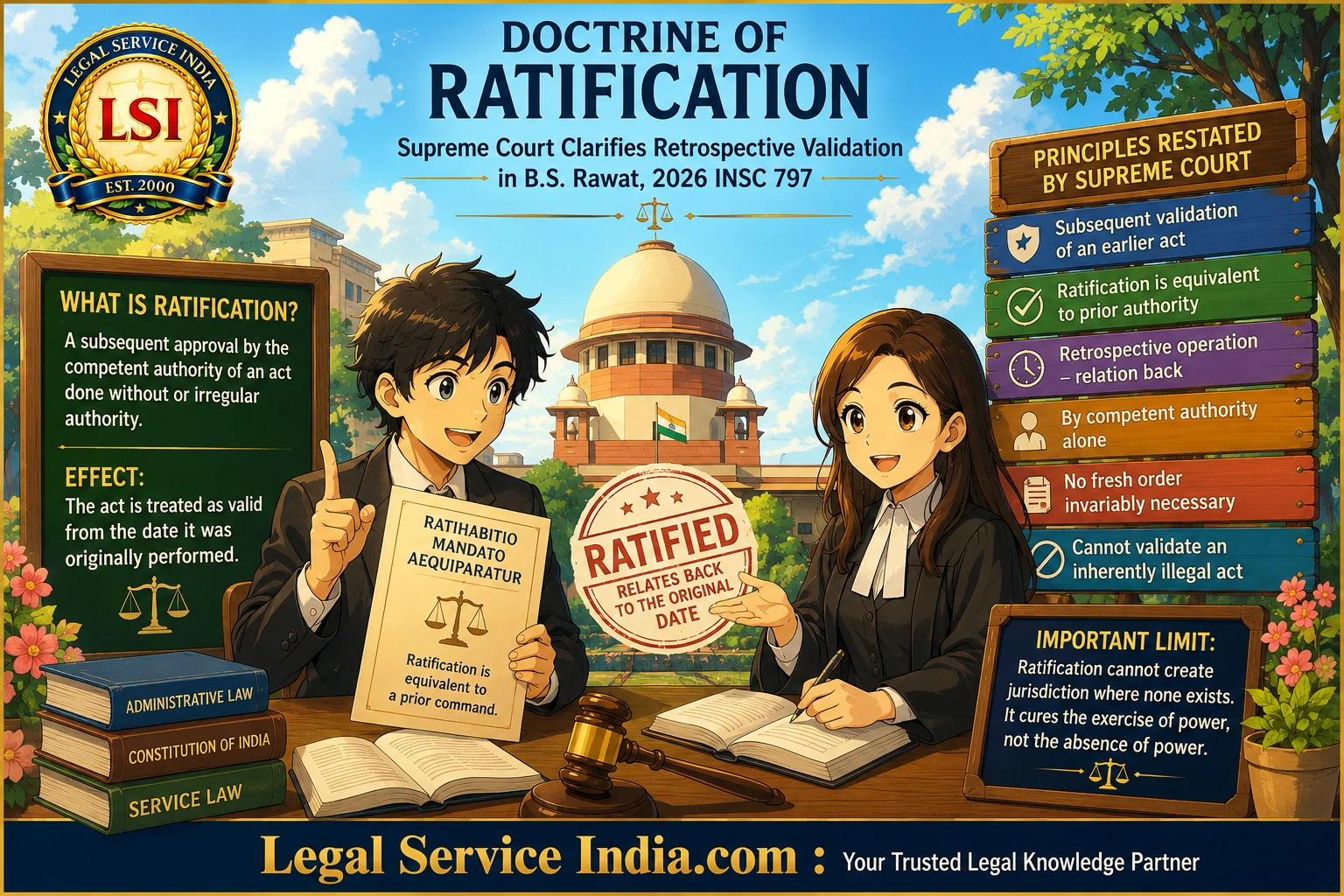
The doctrine of ratification is a legal mechanism by which a competent authority subsequently approves an act that was initially performed without authority or with an irregular exercise of authority. Upon valid ratification, the law treats the earlier act as effective from the date it was originally performed, rather than only from the date of subsequent approval. The Supreme Court restated these principles in Delhi Technological University v. B.S. Rawat, 2026 INSC 797; C.A. No. 9308/2024 etc., decided on 4 August 2026 by a Bench of Pamidighantam Sri Narasimha and Alok Aradhe, JJ., while also distinguishing curative ratification from the independent rule against approbation and reprobation.
The doctrine is founded on the maxim ratihabitio mandato aequiparatur — a subsequent ratification is equivalent to a prior command. The Court traced this to the broader maxim omnis ratihabitio retrotrahitur et mandato priori aequiparatur, which imports the principle of relation back: a ratified act is deemed valid from the date of the original, unauthorised act, and not merely from the date of ratification.
Supreme Court Observation
The Apex Court quoted at para 18 of the judgement this:
“the confirmation of a previous act done either by the party himself or by another” — Black’s Law Dictionary
Meaning and Juridical Basis
Ratification presupposes that an act has been performed on behalf of, or purportedly on behalf of, a person, institution or authority possessing the ultimate legal power to perform that act. The initial defect lies in the absence, irregular exercise or improper delegation of authority — not necessarily in the substance of the act itself.
Ratification therefore has two essential elements: first, an earlier act performed without proper authority or irregularly; and second, subsequent approval or adoption by the authority legally competent to perform that act.
Essential Elements Of Ratification
- an earlier act performed without proper authority or irregularly; and
- subsequent approval or adoption by the authority legally competent to perform that act.
The doctrine cannot be used to create jurisdiction where none exists — it cures a defect in the exercise of an existing power; it does not confer a power that the statute has expressly withheld.
Principles Restated by the Supreme Court in B.S. Rawat
At paragraph 19, the Court drew together the ratification jurisprudence of five earlier decisions and distilled six propositions, which may be summarised as follows.
- Subsequent Validation of an Earlier Act Ratification is the subsequent approval of an act initially done without authority; its effect is to transform an otherwise defective act into a valid one. This is particularly relevant in administrative institutions where an officer acts under apparent, assumed or irregularly delegated authority, and the statutory authority competent to take the decision later adopts it.
- Ratification Is Equivalent to Prior Authority Once the competent authority ratifies the earlier act, the law treats the act as though the necessary authority existed when it was originally performed — a direct application of ratihabitio mandato aequiparatur. The consequence is not merely prospective approval; ratification supplies, in law, the authority that was absent at the beginning.
- Retrospective Operation and Relation Back Ratification relates back to the date of the original act; it is treated as valid from its initial date, not merely from the date of approval. In B.S. Rawat itself, the Board of Management’s ratification at its 26 September 2016 meeting was held to relate back to 25 May 2016, the date on which the acting Vice-Chancellor had purported to accept the resignation — with the consequence, recorded at paragraph 25, that no resignation remained in existence for the employee to withdraw when he attempted to do so.
- Ratification by the Competent Authority Alone Only the authority possessing the legal power to perform the original act can ratify it; approval by a subordinate, or by a delegate without the relevant power, cannot constitute valid ratification. Competence must be examined by reference to the statute, rules or governing instrument — the question is not whether the approving body is superior in a general administrative sense, but whether it possesses the specific legal power in question. This is precisely the finding at paragraph 16: the power to appoint under Section 23(2)(ix) of the 2009 Act carried with it, as its necessary concomitant, the power to accept resignation, and an officer holding mere additional charge of the Vice-Chancellorship could not exercise it.
- No Fresh Order Is Invariably Necessary The competent authority need not repeat the entire original decision through a fresh order; an express resolution, decision or approval adopting the earlier act may suffice, provided the approving authority demonstrates conscious awareness and adoption of the earlier act, rather than mere silence or routine confirmation.
- Ratification Cannot Validate an Inherently Illegal Act The doctrine cures a defect of authority, not substantive illegality. An act prohibited by statute, contrary to public policy, or void for jurisdictional reasons cannot be validated merely by subsequent approval. An act performed by the wrong officer, but capable of being lawfully performed by the competent authority, may be ratified; an act which no authority was legally permitted to perform cannot be made lawful by ratification.
Analysis of the Authorities Cited
The Supreme Court in B.S. Rawat relied principally on five decisions in formulating the general principles of ratification, for the connected doctrine that an employee who has consciously accepted and acted upon a resignation cannot later resile from it on a technical ground of authority.
Sri Parmeshwari Prasad Gupta v. Union of India
In Sri Parmeshwari Prasad Gupta v. Union of India, (1973) 2 SCC 543, the Supreme Court recognised that an irregularly convened or improperly authorised decision could subsequently be adopted by the competent body — treating subsequent approval as capable of curing an initial procedural or authority-related defect. Its doctrinal importance lies in the distinction between an invalid exercise of an existing power and an act wholly beyond power.
High Court of Judicature for Rajasthan v. P.P. Singh
In High Court of Judicature for Rajasthan v. P.P. Singh, (2003) 4 SCC 239, the Court applied the principle that an administrative decision taken irregularly may be validated by approval of the authority competent under the governing legal framework — reinforcing both that ratification must come from the authority legally empowered to take the original decision, and that its effect relates back rather than operating only prospectively.
Maharashtra State Mining Corporation v. Sunil
In Maharashtra State Mining Corporation v. Sunil S/o Pundikarao Pathak, (2006) 5 SCC 96, the Court explained that ratification may validate an earlier order passed by an authority lacking proper authorisation, where the competent authority subsequently adopts that order — preventing technical defects in internal decision-making from defeating an otherwise lawful substantive decision, while not permitting ratification of action beyond the statutory framework.
National Institute of Technology v. Pannalal Choudhury
In National Institute of Technology v. Pannalal Choudhury, (2015) 11 SCC 669, the Court treated the approval of the competent governing body as sufficient ratification of earlier administrative action — especially relevant to statutory educational institutions, where powers are distributed among a Board, Director, Chairman and other officers.
Notably, B.S. Rawat cites this decision twice: once among the five ratification authorities and again among the authorities on the consequences of an employee’s own conduct in accepting a resignation.
Municipal Commissioner, Jamnagar Municipal Corporation v. R.M. Doshi
In Municipal Commissioner, Jamnagar Municipal Corporation v. R.M. Doshi, (2024) 20 SCC 742, the Court reaffirmed the retrospective character of ratification and the requirement that approval must emanate from the competent authority, placing ratification within a structured framework rather than treating it as an informal equitable device.
The Consummated-Transaction Line: M. Jeyanthi, New Victoria Mills, and Anil Padegaonkar
Three further authorities — Director General of Police v. M. Jeyanthi, (2021) 14 SCC 677; New Victoria Mills v. Shrikant Arya, (2021) 13 SCC 771; and Bharat Petroleum Corporation Ltd. v. Anil Padegaonkar, (2020) 5 SCC 474 — were relied upon by the appellant-University and referred to collectively in the judgment for the proposition that an employee who has acted upon, and accepted the consequences of, his own resignation cannot later found a challenge on a technical infirmity in the mode of its acceptance.
These decisions supply the doctrinal backbone for paragraph 24 of B.S. Rawat and are useful additions wherever counsel needs authority for the ‘cake and eat it too’ principle beyond Reichel and Gopal Chandra Misra alone.
Dr Suman V. Jain v. Marwadi Sammelan
Dr. Suman V. Jain v. Marwadi Sammelan through its Secretary, 2024 SCC OnLine SC 161, was cited by the appellant-University in the same bracket of authority and may be pleaded alongside the ratification and consummated-transaction cases discussed above, though the Rawat judgment does not separately elaborate its facts.
Bhartiben Chandrakantbhai Thakor v. State of Gujarat — The Distinguished Authority
The respondent-employee in the Delhi appeal relied on Bhartiben Chandrakantbhai Thakor v. State of Gujarat, 2023 SCC OnLine SC 208, in support of reinstatement.
Because the appeal ultimately succeeded on the independent grounds of valid ratification and a consummated transaction, the Court did not find it necessary to distinguish this authority in detail.
Practitioners citing B.S. Rawat for an employer should be alert that Thakor remains available to an employee seeking reinstatement in a case where ratification is absent or contested and should be prepared to distinguish it on facts rather than assume it has been overruled.
Ratification and Delegation
Ratification must be distinguished from delegation. Delegation transfers or authorises the exercise of power before the act is performed; ratification occurs after an act has already been performed without proper authority.
In B.S. Rawat, the Board of Management had, on 27 May 2015, delegated all its powers to the Vice-Chancellor pending appointment of a Chairman — but the officer who later accepted the respondent’s resignation held only additional charge of the Vice-Chancellorship, and the delegation did not extend to him. A valid delegation may prevent the defect from arising in the first place; ratification, by contrast, operates retrospectively to cure the defect once it has arisen.
Ratification and Void Acts
The most important limitation on the doctrine is that ratification cannot cure an act that is void ab initio for want of substantive jurisdiction. The Court’s approach in B.S. Rawat illustrates the boundary precisely: the acting Vice-Chancellor’s want of authority was a curable defect because the Board of Management itself possessed, and could lawfully have exercised, the power to accept the resignation. Ratification therefore operates within the boundaries of legality; it is not a substitute for jurisdiction, statutory compliance or constitutional validity.
Ratification and Estoppel — the Independent Principle of Approbation and Reprobation
Ratification is also distinct from estoppel. Ratification validates an earlier act through the subsequent decision of the competent authority; estoppel may prevent a person from asserting a position inconsistent with his own earlier representation or conduct. At paragraph 20, the Court articulated a second and independent principle: a resignation, even where accepted in the first instance by one not clothed with authority, may nonetheless become a consummated and irrevocable transaction where both sides have, by their conduct, treated it as final. On this footing, an employee is precluded — not by curative ratification, but by the ordinary rule against approbation and reprobation — from later impugning the very transaction he brought about and from which he has taken the benefit.
The Court traced this principle to the House of Lords decision in Reichel v. Bishop of Oxford, (1889) 14 AC 259, as applied in Union of India v. Gopal Chandra Misra, (1978) 2 SCC 301.
“consummated the arrangement by his own conduct before he purported to revoke” — Lord Halsbury in Reichel v. Bishop of Oxford, as recorded at para 21 of B.S. Rawat
Lord Watson, in the same decision, held that a party who has done all that lay in his power to complete a transaction cannot later be permitted to upset it merely because a formal step of acceptance was still awaited — a proposition the Rawat Court applied directly to the respondent’s own conduct in requesting an advanced relieving date and accepting his no-dues, last-pay and experience certificates.
Thus the legal analysis in any ratification dispute may involve two distinct questions: was the defective act subsequently ratified by the competent authority, and, even if ratification is disputed, is the claimant precluded by his own conduct from challenging the transaction? The two principles must not be conflated — ratification concerns the legal status of the act, while approbation and reprobation concern the conduct and equitable position of the person challenging it.
The Principle of Consummated Transactions
The rule against approbation and reprobation is not based on ratification; it rests on the principle that a person cannot simultaneously accept the benefits of a transaction and reject its burdens. In B.S. Rawat, the Court found this reinforced by the respondent’s own subsequent conduct — using the experience certificate issued by DTU to secure fresh employment at the National Institute of Technology, Calicut — which the Court treated as confirming that his earlier conduct was a conscious treatment of the resignation as final, not mere delay or inadvertence.
This principle must nonetheless be applied cautiously in public employment: conduct cannot ordinarily validate an act expressly forbidden by statute. It becomes relevant where conduct demonstrates conscious acceptance of the transaction and where permitting a subsequent challenge would produce an inconsistent or inequitable result.
Resignation and Withdrawal
The connected Kerala appeal in B.S. Rawat turned on a different question: the effectiveness of a resignation under Statute 30 of the First Statutes of the National Institute of Technology, 2009, which the Court held (relying on Raj Kumar v. Union of India, AIR 1969 SC 180) takes effect on the date of acceptance by the appointing authority, without any requirement of communication to the employee and independent of the notice period.
Non-communication of an Acceptance Already Made Does Not Keep the Resignation Alive for Withdrawal
The Court further held, following Gopal Chandra Misra and Air India Express Ltd. v. Captain Gurdarshan Kaur Sandhu, (2019) 17 SCC 129, that the general right to withdraw a prospective resignation yields wherever a special statutory or regulatory provision governs the subject — as it did here, through Statute 30 and the Office Memorandum dated 11 February 1988, which preserves to the competent authority a discretion to refuse withdrawal, subject only to recording and communicating reasons. Relevant factors in any withdrawal dispute include:
| Factor | Question to Be Considered |
|---|---|
| Acceptance of resignation | whether the resignation has been accepted; |
| Competent authority | whether acceptance is by the competent authority; |
| Communication requirement | whether the applicable rule requires communication; |
| Notice period | whether the notice period affects acceptance or only relieving; |
| Right or discretion | whether withdrawal is a matter of right or of official discretion; |
| Consequential benefits | whether the employee has already acted upon the resignation and accepted consequential benefits. |
Interplay with Administrative Finality
The doctrine of ratification promotes administrative finality. Public institutions frequently act through committees, officers holding additional charge, and internal administrative mechanisms; if every decision were rendered permanently vulnerable by an initial defect in authority, governance would become excessively uncertain. Ratification addresses this problem while preserving legality — it allows the competent authority to adopt an earlier decision, but only where that authority itself could lawfully have made the decision in the first place. B.S. Rawat illustrates this balance well: the Board of Management’s ratification cured the defect in the acting Vice-Chancellor’s acceptance precisely because the power to accept resignation always resided in the Board and was never truly absent from the institution — only irregularly exercised.
Practitioner Checklist — Safeguards for Application
- Identify the precise source of the original power and the statute, rule or governing instrument from which it derives.
- Determine whether the original officer lacked authority altogether or merely exercised an existing power irregularly.
- Identify the authority legally competent to perform the original act, and verify that the approving body itself possessed that specific power — not merely general administrative seniority.
- Record the earlier act with sufficient clarity, and ensure the ratifying authority consciously adopts or approves it rather than merely noting it.
- Examine whether the statute prescribes a particular form or procedure for ratification.
- Determine whether third-party rights have intervened between the original act and the ratification.
- Exclude acts prohibited by statute or beyond jurisdiction — ratification cannot cure substantive illegality.
- Separately consider whether the party’s own conduct has consummated the transaction, giving rise to an independent bar under the rule against approbation and reprobation.
- Distinguish ratification from delegation, estoppel, waiver and acquiescence in pleadings, since each carries a different evidentiary burden.
- Where resignation or service-law facts are involved, check the governing service rule for a specific effective-date provision before relying on the general law on withdrawal.
Conclusion
The doctrine of ratification is a rule of retrospective validation, not an unlimited power of administrative cure. Its operation depends on the existence of lawful substantive power in the competent authority, a conscious subsequent approval, and the absence of statutory prohibition. B.S. Rawat’s restatement is significant because it brings together the principal propositions governing ratification — subsequent approval may equal prior authority; the effect generally relates back; only the competent authority can ratify; a fresh order is not invariably required; and ratification cannot validate an inherently illegal or ultra vires act — while properly preserving the independent principle that a person who has knowingly consummated and benefited from a transaction may be precluded from later challenging it on a technical ground.
For practitioners, the newly verified authorities set out above — particularly the consummated-transaction line running through M. Jeyanthi, New Victoria Mills and Anil Padegaonkar, and the distinguished authority of Bhartiben Chandrakantbhai Thakor — considerably strengthen the toolkit available on both sides of a ratification dispute, and should be pleaded together with the core five ratification decisions rather than in isolation.

