Abstract
Transformation of Juvenile Justice in India
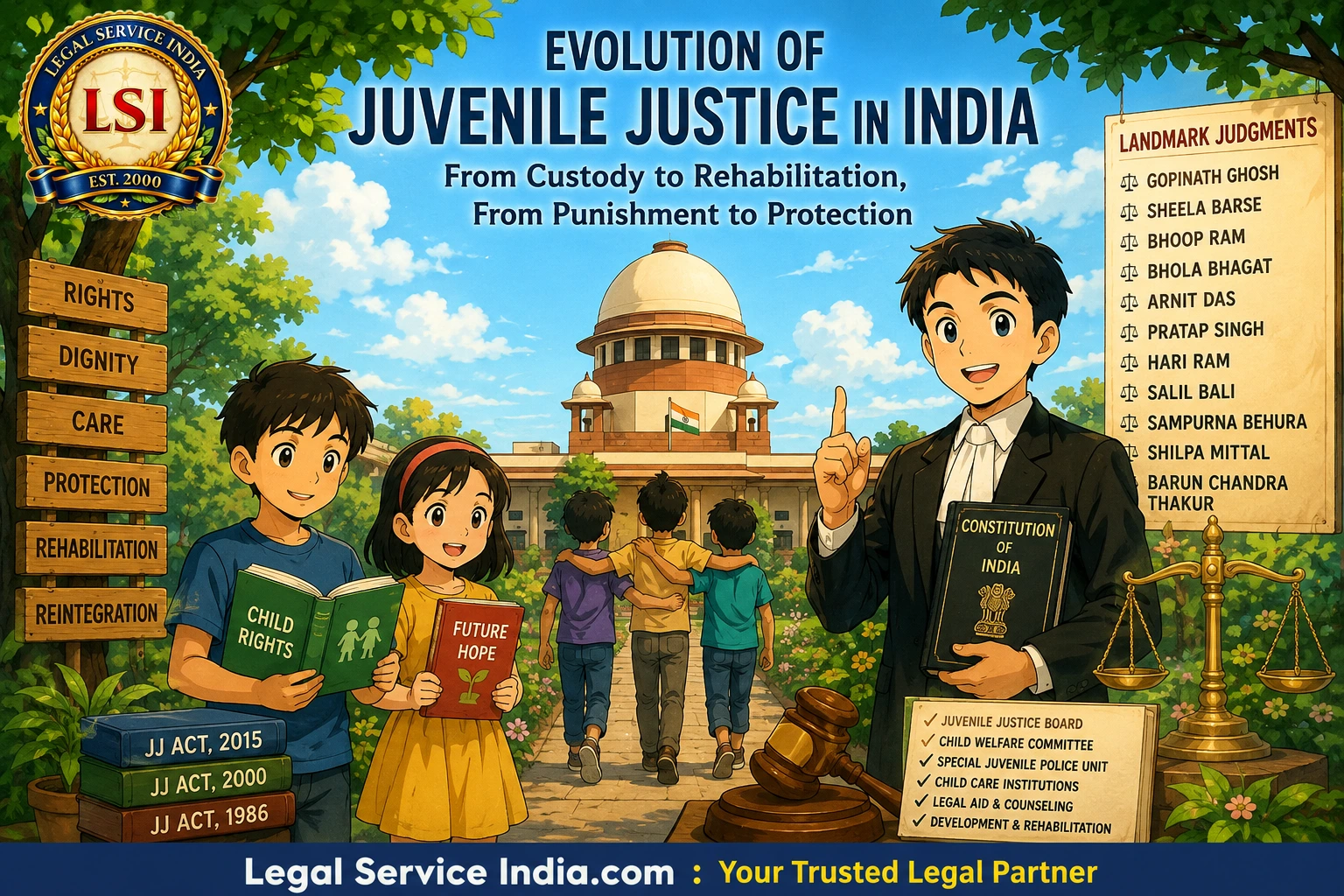
The juvenile justice system in India has undergone a profound transformation over the last four decades. While successive legislatures have provided the statutory framework through the Juvenile Justice Act, 1986, the Juvenile Justice (Care and Protection of Children) Act, 2000 and the Juvenile Justice (Care and Protection of Children) Act, 2015, the Supreme Court of India and the High Courts have played a decisive role in shaping the philosophy, interpretation, institutional architecture and implementation of juvenile justice.
Evolution From Custody To Rehabilitation
Beginning with landmark interventions concerning children detained in adult prisons and the determination of juvenility, Indian judicial jurisprudence progressively moved from a custody-orientated approach towards one founded on dignity, welfare, rehabilitation, development and reintegration. Decisions such as Gopinath Ghosh v. State of West Bengal, Sheela Barse v. Union of India, Bhoop Ram v. State of Uttar Pradesh, Bhola Bhagat v. State of Bihar, Arnit Das v. State of Bihar, Pratap Singh v. State of Jharkhand and Hari Ram v. State of Rajasthan established and reinforced the principle that children require a distinct and protective justice framework.
Constitutional And Systemic Dimensions Of Juvenile Justice
The Supreme Court subsequently addressed constitutional and systemic dimensions of juvenile justice. Salil Bali v. Union of India upheld the legislative framework based on eighteen years as the threshold for juvenile justice, while Sampurna Behura v. Union of India marked a decisive shift towards institutional accountability by examining the functioning of Juvenile Justice Boards, Child Welfare Committees, Special Juvenile Police Units, Child Care Institutions and other statutory mechanisms.
Age Determination and Heinous Offences
Contemporary jurisprudence has further developed the concepts of age determination, “heinous offences” and developmental assessment. Shilpa Mittal v. State of NCT of Delhi, Rishipal Singh Solanki v. State of Uttar Pradesh, Barun Chandra Thakur v. Master Bholu and Child in Conflict with Law through his Mother v. State of Karnataka demonstrate the judiciary’s continuing engagement with the exceptional statutory mechanism applicable to children aged sixteen to eighteen years alleged to have committed heinous offences.
Role Of High Courts In Juvenile Justice
The High Courts have complemented this national jurisprudence by translating constitutional and statutory principles into operational safeguards, including protection against wrongful detention of children in adult prisons, monitoring of Juvenile Justice Boards and Child Welfare Committees, ensuring child-friendly procedures and scrutinising preliminary assessments.
Judicial Transformation of Indian Juvenile Justice
This article argues that, over approximately four decades, judicial intervention has transformed Indian juvenile justice from a predominantly custodial and punitive model into a rights-based, welfare-orientated, rehabilitative and reintegrative framework. The central proposition is that the judiciary has not merely interpreted juvenile justice legislation; it has helped shape its constitutional philosophy and institutional character.
Introduction
Juvenile justice represents one of the most significant departures from conventional criminal justice. A child who comes into conflict with law cannot simply be regarded as a smaller version of an adult offender. Childhood is a distinct stage of physical, psychological, emotional and social development. A child’s ability to understand consequences, exercise judgement, resist peer influence and respond to social circumstances is different from that of an adult.
Consequently, a justice system dealing with children must respond not merely to the alleged offence but also to the child’s age, developmental stage, family circumstances, social environment, vulnerability and prospects of rehabilitation.
India’s constitutional framework provides a strong foundation for this approach. Article 14 guarantees equality before law. Article 15(3) expressly permits the State to make special provisions for children. Article 21 protects life and personal liberty and has been judicially interpreted to encompass dignity and fair procedure. Articles 39(e) and 39(f) require the State to protect children from abuse and exploitation and to ensure opportunities for healthy development in conditions of freedom and dignity.
India’s ratification of the United Nations Convention on the Rights of the Child (UNCRC) in 1992 further strengthened this framework. Yet constitutional text and legislation alone do not explain the development of India’s juvenile justice system. A substantial part of that development has occurred through judicial intervention. Over approximately four decades, the Supreme Court and High Courts have progressively addressed questions concerning:
- determination of juvenility;
- treatment of children in custody;
- prohibition against detention in adult prisons;
- speedy justice;
- legal assistance;
- rehabilitation;
- age determination;
- the eighteen-year threshold;
- functioning of Juvenile Justice Boards and Child Welfare Committees;
- institutional accountability;
- heinous offences;
- preliminary assessment;
- developmental capacity; and
- reintegration of children into society.
The trajectory can therefore be described as:
From custody and punishment to rights, welfare, rehabilitation and reintegration.
Constitutional Foundations of Juvenile Justice
Article 14 and Substantive Equality
The constitutional guarantee of equality does not necessarily require identical treatment of all persons. Children constitute a distinct class because of their age, vulnerability and developmental characteristics. Article 15(3) expressly recognises the constitutional legitimacy of special measures for children.
The separate juvenile justice system is therefore not an exception to equality. It is an expression of substantive equality, recognising that children require treatment appropriate to their developmental status.
Article 21 and the Right to Dignity
Article 21 has been central to the evolution of child-centred justice. The Supreme Court’s expansive interpretation of Article 21 has recognised dignity, humane treatment, fair procedure and protection against arbitrary deprivation of liberty as fundamental constitutional values. These principles have particular significance for children. The deprivation of liberty of a child can have serious consequences for education, family relationships, psychological development and future social integration. Accordingly, juvenile justice jurisprudence has increasingly treated detention not simply as a legal consequence but as an intervention requiring strict justification.
Articles 39(e) and 39(f)
The Directive Principles reinforce the constitutional commitment to child welfare. Article 39(e) directs the State to ensure that the tender age of children is not abused. Article 39(f) requires that children be given opportunities and facilities to develop in a healthy manner and in conditions of freedom and dignity. The Supreme Court’s early juvenile justice jurisprudence repeatedly drew upon these constitutional values while interpreting child-protection legislation.
International Child Rights and Juvenile Justice
India’s ratification of the UNCRC marked an important development in the country’s child-rights framework.
Four provisions are particularly relevant to juvenile justice.
Article 3 — Best Interests
The best interests of the child must be a primary consideration in actions concerning children.
Article 12 — Participation
Children capable of forming views have the right to express those views in matters affecting them.
Article 37 — Deprivation of Liberty
Detention of children should be a measure of last resort and for the shortest appropriate period.
Article 40 — Child Justice
Children alleged to have violated penal law must be treated consistently with their dignity, age and the objective of reintegration.
These principles find substantial reflection in the principles contained in Section 3 of the Juvenile Justice (Care and Protection of Children) Act, 2015. The judiciary has therefore operated within a constitutional and international framework in which juvenile justice is fundamentally connected with dignity, development, welfare and reintegration.
The Beginning of the Judicial Transformation
The roots of contemporary juvenile justice jurisprudence can be traced to the 1980s. At that time, India’s juvenile justice framework was fragmented, and implementation was inconsistent across states. Children could find themselves within ordinary criminal proceedings or even confined in adult prisons. The Supreme Court’s interventions began to challenge this approach.
Jayendra v. State of Uttar Pradesh: Recognising the Significance of Juvenility
In Jayendra v. State of Uttar Pradesh, (1981) 4 SCC 149, the Supreme Court dealt with the consequences of juvenility in the context of criminal proceedings and sentencing.
The case contributed to the developing recognition that a person’s age at the relevant time could fundamentally affect the legal consequences of the criminal process.
Juvenility was therefore emerging as a substantive legal status rather than merely a factual circumstance.
Umesh Chandra v. State of Rajasthan: Age and Juvenile Jurisdiction
In Umesh Chandra v. State of Rajasthan, (1982) 2 SCC 202, the Court addressed questions concerning age and the application of the special juvenile framework. The case contributed to the growing jurisprudence that determination of age can determine the jurisdiction, procedure and consequences applicable to an accused person.
The underlying principle was simple but fundamental:
Before subjecting a person to the ordinary criminal justice system, the law must first determine whether that person is legally a child.
Gopinath Ghosh v. State of West Bengal: Juvenility as a Substantive Protection
Gopinath Ghosh v. State of West Bengal, (1984) 1 SCC 228, is one of the foundational cases in Indian juvenile justice jurisprudence. The accused raised the issue of juvenility before the Supreme Court at a relatively late stage. The Court nevertheless considered the question. The judgement demonstrated that technical procedural considerations should not defeat the substantive protection available to children under juvenile legislation. The Court also referred to the constitutional commitment contained in Article 39(f).
The importance of Gopinath Ghosh lies in establishing an important judicial attitude:
Courts must remain vigilant to the possibility of juvenility and must not allow procedural technicalities to defeat child-protective legislation.
This approach subsequently influenced the jurisprudence concerning delayed claims of juvenility.
Sheela Barse v. Union of India: The Constitutional Turning Point
If one judgement can be described as a turning point in the judicial development of juvenile justice, it is the series of orders in Sheela Barse v. Union of India.
The Supreme Court confronted the reality that children were being detained in jails.
In its August 1986 decision, the Court emphasised that children should not be confined in jails and recognised the harmful and dehumanising consequences of incarceration for their growth and development.
The Court also connected the issue with the fundamental right to speedy trial under Article 21 and issued directions concerning children in detention. In another order in November 1986, the Court directed District Judges and judicial authorities to ascertain how many children were confined in jails and the circumstances of their detention. The significance of Sheela Barse was transformative. The judicial question was no longer simply:
“What offence has the child allegedly committed?”
It became:
“How must the constitutional state treat a child who comes into contact with the justice system?”
The answer increasingly became:
with dignity, care, protection and a specialised child-sensitive process.
Bhoop Ram and Bhola Bhagat: Strengthening the Beneficial Approach
In Bhoop Ram v. State of Uttar Pradesh, (1989) 3 SCC 1, the Supreme Court reinforced the consequences of juvenility in relation to sentencing.
In Bhola Bhagat v. State of Bihar, (1997) 8 SCC 720, the Court continued the beneficial approach towards juvenile justice legislation.
Together, this line of cases established that juvenile legislation should not be interpreted in a manner that defeats its protective purpose.
The jurisprudence was therefore moving away from a purely punitive understanding of criminal responsibility towards a model based on protection and reform.
Arnit Das v. State of Bihar: Beneficial Construction
In Arnit Das v. State of Bihar, (2000) 5 SCC 488, the Supreme Court examined the interpretation and application of juvenile justice legislation. The case is significant for its recognition of the beneficial character of juvenile justice legislation. The Court’s approach reinforced the proposition that juvenile justice law must be understood in the context of its social purpose rather than through a narrow criminal-law lens. This became particularly important as the Juvenile Justice Act, 2000, was implemented across India.
Pratap Singh v. State of Jharkhand: Constitution Bench and Juvenility
The Constitution Bench judgment in Pratap Singh v. State of Jharkhand, (2005) 3 SCC 551, considered questions concerning the application of juvenile justice legislation and the relevant point of time for determining juvenility.
The case is important because it clarified the legal significance of age at the relevant stage and reinforced the existence of a distinct statutory regime for children in conflict with law.
Juvenile justice was thereby increasingly separated from ordinary criminal jurisprudence.
Hari Ram v. State of Rajasthan: Strengthening the Protective Framework
In Hari Ram v. State of Rajasthan, (2009) 13 SCC 211, the Supreme Court reinforced the beneficial interpretation of juvenile justice legislation.
The Court emphasised the relevance of the child’s age at the time of commission of the offence and the protective nature of juvenile justice legislation.
The judgement became particularly significant in the transition from the Juvenile Justice Act, 2000, to the more developed framework that ultimately emerged in the JJ Act, 2015.
The underlying philosophy was increasingly clear:
Juvenile justice is not ordinary criminal justice with a lower age threshold; it is a distinct system based on the developmental status and welfare of the child.
Age Determination: The Gateway to Juvenile Justice
Determination of age has remained one of the most important questions before Indian courts.
A finding that an accused was below eighteen years at the relevant time can fundamentally change:
- the forum;
- the procedure;
- the nature of inquiry;
- the permissible orders;
- the maximum consequences;
- the rehabilitation framework.
Therefore, age determination is not a peripheral evidentiary question.
It is the gateway to the juvenile justice system.
Babloo Pasi v. State of Jharkhand
In Babloo Pasi v. State of Jharkhand (2008) 13 SCC 133, the Supreme Court dealt with questions concerning determination of age and the evidentiary material relevant to juvenility.
The decision contributed to the developing judicial approach that age must be determined through the statutory framework rather than through assumptions or ordinary criminal trial procedures.
Ashwani Kumar Saxena v. State of Madhya Pradesh
In Ashwani Kumar Saxena v. State of Madhya Pradesh, (2012) 9 SCC 750, the Court examined the process of age determination under the juvenile justice framework.
The judgement emphasised that the inquiry into age is distinct from a criminal trial and should follow the statutory rules governing juvenility.
Rishipal Singh Solanki v. State of Uttar Pradesh
The Supreme Court’s decision in Rishipal Singh Solanki v. State of Uttar Pradesh further clarified the operation of Section 94 of the JJ Act, 2015, and the approach to age determination.
The case demonstrates the continuing importance of documentary evidence and the statutory hierarchy prescribed for determining whether a person was a child at the relevant time.
The jurisprudence therefore establishes:
Correct age determination is the first safeguard against wrongful entry of a child into the adult criminal justice system.
Salil Bali v. Union of India: The Eighteen-Year Threshold
The debate surrounding juvenile justice intensified following the 2012 Delhi gang-rape case and public demands for lowering the age of juvenile protection.
In Salil Bali v. Union of India, (2013) 7 SCC 705, the Supreme Court considered constitutional challenges to the juvenile justice framework and the eighteen-year threshold.
The Court declined to interfere with Parliament’s legislative choice and upheld the framework. The decision reinforced the legitimacy of a separate juvenile justice system for persons below eighteen years.
The importance of Salil Bali goes beyond the numerical age threshold. The judgement recognised that juvenile justice must be understood within a rehabilitative and reformative framework rather than solely through the lens of retribution. It also demonstrated the importance of implementation of the existing framework.
From Individual Rights to Systemic Accountability: Sampurna Behura v. Union of India
The next major transformation came through Sampurna Behura v. Union of India (2018) 4 SCC 433. The case represented a major expansion of judicial intervention.
The Supreme Court examined whether the statutory juvenile justice machinery was actually functioning effectively across India.
Key Deficiencies Examined by the Supreme Court
The Court addressed deficiencies involving:
- Juvenile Justice Boards;
- Child Welfare Committees;
- Special Juvenile Police Units;
- Child Care Institutions;
- vacancies;
- training;
- infrastructure;
- inspection;
- rehabilitation;
- social investigation;
- legal aid;
- institutional registration and monitoring.
The Court’s judgement began from a fundamental constitutional question: what can a citizen do when the State fails to fulfil its constitutional and statutory obligations?
The answer was particularly significant for juvenile justice. The Court moved beyond deciding an individual case and examined the functioning of the system itself. This was a major transition:
From individual protection to institutional accountability.
The Significance of Continuing Judicial Monitoring
The Sampurna Behura jurisprudence illustrates the importance of continuing judicial oversight in child protection. A statutory right is meaningless if:
- The JJB is vacant;
- The CWC is not functional;
- The SJPU is ineffective;
- The CCI lacks basic facilities;
- Legal aid is unavailable;
- Social investigation is inadequate;
- Rehabilitation plans are not prepared;
- Aftercare is unavailable.
The Institutional Ecosystem of Juvenile Justice
The Supreme Court therefore recognised that the effectiveness of juvenile justice depends upon the functioning of an entire institutional ecosystem.
| Institutional Requirement | Importance for Child Protection |
|---|---|
| Juvenile Justice Board (JJB) | Ensures appropriate handling of children in conflict with law. |
| Child Welfare Committee (CWC) | Addresses the care and protection needs of children. |
| Special Juvenile Police Unit (SJPU) | Provides specialised institutional support within the police system. |
| Child Care Institution (CCI) | Provides institutional care and protection where required. |
| Legal Aid | Ensures access to legal assistance and justice. |
| Rehabilitation and Aftercare | Supports the child’s long-term rehabilitation and reintegration. |
This is one of the most important contributions of judicial intervention. Juvenile justice is not merely a matter for the criminal court. It is a multi-institutional child protection responsibility.
High Courts: Translating Constitutional Principles into Practice
While the Supreme Court has developed national principles, the High Courts have played an equally important role in translating those principles into state-level practice. High Courts have exercised:
- writ jurisdiction;
- public interest jurisdiction;
- suo motu jurisdiction;
- criminal revisional jurisdiction;
- continuing monitoring;
- contempt jurisdiction;
to address deficiencies in juvenile justice implementation.
Judicial and Institutional Structure
| Level | Role |
|---|---|
| Supreme Court | Constitutional principles and national jurisprudence |
| High Courts | State-level interpretation and monitoring |
| State Administration | Implementation through the relevant juvenile justice institutions |
| JJB / CWC / DCPU / SJPU / CCI | Operational delivery of child protection and juvenile justice services |
| Child | Ultimate beneficiary of the constitutional and statutory protection |
This makes the High Courts essential actors in converting judicial doctrine into institutional practice.
Delhi High Court: Preventing Children from Entering Adult Prisons
The Delhi High Court has played a particularly important role in protecting children from inappropriate criminal justice processes.
In Court on its Own Motion v. Department of Women and Child Development, W.P.(Crl.) No. 8889/2011, the Court examined concerns relating to persons who may have been juveniles at the time of the alleged offence but had entered the adult criminal justice and prison system.
The proceedings resulted in directions concerning identification of juveniles, age determination and safeguards against wrongful detention in adult prisons.
Operationalising the Principle Established by Sheela Barse
The case illustrates the operationalisation of the constitutional principle established by Sheela Barse.
The Supreme Court established:
Children should not be confined in adult jails.
The High Court addressed the practical question:
What mechanisms must operate at the arrest, production and detention stages to ensure that a child does not enter an adult prison in the first place?
This illustrates the complementary role of the High Courts.
High Courts and Institutional Implementation
High courts across the country have also monitored implementation of the Supreme Court’s directions concerning juvenile justice institutions.
The implementation questions frequently include:
- constitution of JJBs;
- appointment of Members;
- functioning of CWCs;
- child-friendly premises;
- availability of infrastructure;
- staffing;
- legal aid;
- social investigation;
- inspection of CCIs;
- rehabilitation services;
- compliance with Supreme Court directions.
Recent proceedings before High Courts continue to demonstrate that institutional deficiencies remain a live concern. For example, the Himachal Pradesh High Court has recently examined the need for child-friendly premises for Juvenile Justice Boards and referred to the Supreme Court’s directions in Sampurna Behura.
This demonstrates the continuing relevance of judicial monitoring even after the enactment of the JJ Act, 2015.
Shilpa Mittal v. State of NCT of Delhi: The Meaning of “Heinous Offence”
The JJ Act, 2015, introduced a special mechanism for children aged sixteen to eighteen years alleged to have committed heinous offences.
The classification is significant because it can trigger the preliminary assessment mechanism under Section 15 and potentially lead to consideration of transfer to the Children’s Court under the statutory scheme.
In Shilpa Mittal v. State of NCT of Delhi, (2020) 2 SCC 787, the Supreme Court examined the meaning and scope of “heinous offence”.
The Court declined to expand the statutory category beyond what the legislation expressly provided.
This was important because the exceptional mechanism applicable to older children could not be triggered merely through an expansive interpretation of the term “heinous”.
The judgement therefore reinforced a crucial principle:
Exceptional treatment of children must remain within the boundaries established by Parliament.
Barun Chandra Thakur v. Master Bholu: Developmental Assessment
The next major stage in judicial development concerned Section 15 of the JJ Act, 2015. In Barun Chandra Thakur v. Master Bholu, the Supreme Court examined the preliminary assessment conducted in relation to a child alleged to have committed a heinous offence.
The Court clarified the nature and importance of the preliminary assessment.
Section 15 requires consideration of:
- the child’s mental capacity to commit the alleged offence;
- the child’s physical capacity to commit the alleged offence;
- the child’s ability to understand the consequences of the alleged offence; and
- the circumstances in which the alleged offence was committed.
The Court made it clear that the preliminary assessment is not a trial. Its purpose is not to determine guilt. Rather, it requires a specialised assessment of the child’s developmental and cognitive capacities and the circumstances surrounding the alleged conduct.
This represents a significant conceptual development.
The question is no longer simply:
“What offence is alleged?”
It becomes:
“What was the developmental capacity of the child, what did the child understand, and what circumstances shaped the alleged conduct?”
This is the emergence of developmental justice within Indian juvenile jurisprudence.
The 2024 Supreme Court Decision: Further Development of Section 14 and Section 15
In Child in Conflict with Law through his Mother v. State of Karnataka, 2024 INSC 387, the Supreme Court further examined the statutory architecture governing children aged sixteen to eighteen years alleged to have committed heinous offences.
The Court considered questions concerning Sections 14, 15, 19 and 101 of the JJ Act, 2015.
Among the issues examined was the time period prescribed under Section 14(3) for completion of preliminary assessment and the relationship between the Juvenile Justice Board and Children’s Court.
The decision demonstrates that contemporary juvenile justice jurisprudence has moved beyond broad questions of constitutional protection and now addresses the detailed procedural architecture through which developmental assessment and transfer-related processes operate.
This is particularly important because procedural interpretation can directly affect whether a child remains within the specialised juvenile justice system.
From Age-Based Justice to Developmental Justice
The judicial trajectory reveals an important conceptual evolution.
Earlier jurisprudence primarily focused upon:
Was the person below the statutory age?
Contemporary jurisprudence increasingly asks:
What was the child’s developmental capacity, and what circumstances surrounded the alleged conduct?
This does not eliminate accountability. Rather, it changes the nature of accountability.
A child may be held responsible within a system that simultaneously recognises:
- immaturity;
- developmental limitations;
- vulnerability;
- capacity for change;
- family and social circumstances;
- potential for rehabilitation.
The move towards developmental assessment is therefore consistent with the central philosophy of juvenile justice.
The Child as a Rights-Holder
One of the most profound transformations produced by judicial intervention is the recognition of the child as a rights-holder.
The child in conflict with law does not lose constitutional rights because of an allegation of offending behaviour.
The child continues to possess:
- dignity;
- equality;
- personal liberty;
- access to legal assistance;
- protection against degrading treatment;
- the right to participate;
- the right to privacy;
- the right to rehabilitation;
- the right to family and social reintegration.
The juvenile justice process must therefore balance accountability with rights.
Welfare as a Core Principle
The word “welfare” is central to understanding the transformation of juvenile justice.
Welfare does not mean absence of accountability.
It means that the legal response must consider the whole child.
This includes:
- education;
- family relationships;
- health;
- psychological well-being;
- safety;
- social environment;
- skills;
- future opportunities;
- rehabilitation needs.
A welfare-orientated system therefore asks not only:
What happened?
but also:
Why did it happen?
What does the child need?
What can prevent recurrence?
How can the child be reintegrated?
Rehabilitation and Reintegration
Rehabilitation has progressively become the central objective of juvenile justice. The purpose of intervention is not merely to impose a sanction.
It is to facilitate:
- behavioural change;
- education;
- counselling;
- family restoration;
- vocational development;
- social skills;
- community reintegration;
- prevention of reoffending;
- restoration of dignity.
The JJ Act’s principles of rehabilitation, restoration, institutionalisation as a measure of last resort and fresh start reflect this philosophy. Judicial jurisprudence has strengthened the understanding that the ultimate objective is not simply to complete a legal proceeding but to give the child an opportunity to return to a constructive life.
Juvenile Justice and Child Protection
Modern juvenile justice cannot be separated from the broader child protection system.
A child in conflict with the law may simultaneously have experienced:
- abuse;
- neglect;
- abandonment;
- trafficking;
- exploitation;
- homelessness;
- violence;
- family breakdown;
- substance exposure;
- lack of parental care.
Consequently, the CCL framework and the broader child protection framework must operate together. This requires effective coordination among:
Juvenile Justice Board + Child Welfare Committee + District Child Protection Unit + Special Juvenile Police Unit + Child Care Institution + legal services + health and mental-health services + family and community.
The judiciary’s systemic jurisprudence increasingly supports this integrated approach. “`
28. Institutional Accountability and the Role of the State
The judicial transformation also changed the understanding of state responsibility. The State is not merely required to enact a juvenile justice law. It must create the institutional conditions necessary to implement that law. This includes:
| Institution | Core Responsibility |
|---|---|
| Police | Child-sensitive arrest, identification and production |
| SJPU | Specialised juvenile justice response |
| JJB | Inquiry, preliminary assessment and rehabilitation-orientated orders |
| CWC | Care, protection and restoration |
| DCPU | District-level coordination |
| CCI | Care, protection, education and rehabilitation |
| Legal Services Authorities | Effective legal assistance |
| State Government | Infrastructure, appointments, resources and monitoring |
| High Courts | State-level judicial oversight |
| Supreme Court | Constitutional and systemic oversight |
The result is a shift from:
“Who will decide the child’s case?”
to:
“Does the entire system have the capacity to protect the child’s rights?”
29. Four Decades of Judicial Transformation: A Timeline
| Period | Key Jurisprudential Development |
|---|---|
| 1981–1984 | Recognition of juvenility as legally significant; age and jurisdiction |
| 1986 | Protection from adult prisons; speedy trial and child-sensitive detention through Sheela Barse |
| 1989–2000 | Beneficial interpretation and strengthening of separate juvenile justice |
| 2005 | Constitution Bench jurisprudence on juvenility |
| 2008–2012 | Development of age-determination jurisprudence |
| 2009 | Strengthening of rehabilitative interpretation through Hari Ram |
| 2013 | Constitutional affirmation of the eighteen-year framework through Salil Bali |
| 2018 | Systemic institutional accountability through Sampurna Behura |
| 2020 | Restrictive interpretation of “heinous offence” through Shilpa Mittal |
| 2021–2022 | Further development of age determination and preliminary assessment |
| 2022 | Developmental assessment under Section 15 through Barun Chandra Thakur |
| 2024 | Further procedural development of Sections 14, 15 and 19 |
The trajectory can be summarised as:
Age → Juvenility → Protection → Rights → Welfare → Rehabilitation → Institutional Accountability → Developmental Justice → Reintegration
30. Supreme Court and High Courts: Complementary Roles
The judicial contribution can broadly be understood through two complementary levels.
Supreme Court
The Supreme Court has primarily:
- established constitutional principles;
- interpreted juvenile justice legislation;
- protected children from adult criminal justice;
- developed age-determination jurisprudence;
- interpreted the eighteen-year threshold;
- defined the scope of “heinous offence”;
- developed preliminary assessment jurisprudence;
- addressed systemic implementation.
High Courts
The High Courts have primarily:
- implemented constitutional principles at the state level;
- monitored JJBs and CWCs;
- addressed institutional vacancies;
- protected children from wrongful detention;
- scrutinised age determination;
- examined preliminary assessments;
- monitored Child Care Institutions;
- ensured child-friendly procedures;
- exercised continuing and suo motu jurisdiction.
The distinction can therefore be expressed as:
The Supreme Court has shaped the doctrine; the High Courts have helped translate that doctrine into institutional practice.
31. The Six Major Transformations
The cumulative judicial jurisprudence can be understood through six major transformations.
31.1 From Offender to Child
The child is no longer viewed solely through the alleged offence.
31.2 From Punishment to Welfare
The legal response increasingly considers the child’s overall development and well-being.
31.3 From Custody to Care
Children are to be protected from unnecessary and inappropriate incarceration, particularly in adult prisons.
31.4 From Age Alone to Developmental Capacity
Contemporary jurisprudence recognises developmental and cognitive considerations, particularly in preliminary assessment.
31.5 From Individual Adjudication to Systemic Accountability
Through Sampurna Behura, judicial intervention expanded to institutional functioning.
31.6 From Juvenile Justice to Integrated Child Protection
A child in conflict with law may simultaneously be a child in need of protection, requiring a coordinated response.
32. Continuing Challenges
Despite four decades of judicial development, significant implementation challenges remain.
These include:
- vacancies in JJBs and CWCs;
- inadequate training;
- shortage of specialised personnel;
- inadequate child-friendly infrastructure;
- delays in social investigation;
- inconsistent quality of preliminary assessments;
- weak rehabilitation planning;
- insufficient aftercare;
- inadequate mental health and psychosocial services;
- institutionalisation where family-based solutions may be possible;
- gaps in inter-departmental coordination;
- data quality and monitoring challenges.
The continued need for judicial intervention itself demonstrates the persistent gap between:
law in the books and law in practice.
The next phase of juvenile justice therefore requires not merely additional jurisprudence but effective implementation of existing constitutional and statutory principles.
33. Towards a Rights, Welfare, Rehabilitation and Reintegration Model
The future of juvenile justice should be built around four mutually reinforcing pillars.
Rights
Every child must be treated with dignity and must enjoy constitutional and statutory safeguards.
Welfare
Decision-making must consider the child’s safety, development, family circumstances and overall well-being.
Rehabilitation
The system should address the causes and circumstances underlying offending behaviour and provide opportunities for positive behavioural and social change.
Reintegration
Children should, wherever appropriate and safe, be restored to family and community life and provided opportunities for education, skills and productive citizenship.
Thus:
Rights + Welfare + Rehabilitation + Reintegration = Child-Centred Juvenile Justice
34. Conclusion
The evolution of juvenile justice in India over the past four decades demonstrates the transformative potential of constitutional adjudication. The journey began with fundamental questions of age, custody and protection.
Through Gopinath Ghosh, the Supreme Court established that juvenility could not be defeated by procedural technicalities.
Through Sheela Barse, the Court confronted the deeply problematic practice of keeping children in adult jails and connected juvenile justice with dignity, liberty and speedy justice.
Through Bhoop Ram, Bhola Bhagat, Arnit Das, Pratap Singh and Hari Ram, the court progressively strengthened the separate and beneficial character of juvenile justice.
Through Salil Bali, the constitutional legitimacy of the eighteen-year framework was affirmed.
Through Sampurna Behura, judicial intervention expanded dramatically—from protecting individual children to examining the functioning of the entire juvenile justice system.
Through Shilpa Mittal, the Court restrained an expansive interpretation of “heinous offence”.
Through Rishipal Singh Solanki, the jurisprudence concerning age determination was further developed.
Through Barun Chandra Thakur, developmental capacity became central to the understanding of preliminary assessment.
And through the 2024 decision in Child in Conflict with Law through his Mother v. State of Karnataka, the Supreme Court continued to refine the procedural architecture surrounding preliminary assessment and the role of the Children’s Court.
The High Courts, in turn, have taken these constitutional principles into the operational realities of States and districts—addressing institutional deficiencies, child-friendly procedures, age determination, detention, JJBs, CWCs and Child Care Institutions.
The cumulative judicial trajectory can therefore be expressed as:
- From custody to care;
- from punishment to welfare;
- from the offender to the child;
- from age to developmental capacity;
- from individual adjudication to institutional accountability; and
- from juvenile justice to integrated child protection.
After approximately four decades of judicial intervention, the central question of Indian juvenile justice is no longer merely how the State should respond to a child who has allegedly committed an offence.
The deeper constitutional question is:
How can the State hold a child accountable while simultaneously protecting the child’s dignity, welfare, development and right to a second chance?
That question lies at the heart of India’s contemporary juvenile justice framework.
The judiciary has played a foundational role in answering it.
It has not replaced the legislature or the executive. Parliament creates the statutory framework; governments establish and administer institutions; professionals implement rehabilitation and care.
But through constitutional interpretation, precedent, directions, continuing mandamus and institutional monitoring, the judiciary has helped ensure that juvenile justice remains anchored in the constitutional understanding that a child is not merely an offender to be dealt with but a rights-holder with the capacity to develop, change and reintegrate into society.
Thus, the four-decade judicial journey can ultimately be understood as a transformation:
From Custody and Punishment → to Rights, Welfare, Rehabilitation and Reintegration.
And that transformation remains one of the most significant developments in India’s child-rights jurisprudence.
References
Constitutional and International Instruments
- Constitution of India, Articles 14, 15(3), 21, 39(e), 39(f), 45 and 51(c).
- United Nations Convention on the Rights of the Child, 1989, particularly Articles 3, 12, 37 and 40.
- United Nations Standard Minimum Rules for the Administration of Juvenile Justice, 1985 (Beijing Rules).
- United Nations Guidelines for the Prevention of Juvenile Delinquency, 1990 (Riyadh Guidelines).
- United Nations Rules for the Protection of Juveniles Deprived of their Liberty, 1990.
- Committee on the Rights of the Child, General Comment No. 24 (2019): Children’s Rights in the Child Justice System.
Indian Legislation
- Children Act, 1960.
- Juvenile Justice Act, 1986.
- Juvenile Justice (Care and Protection of Children) Act, 2000.
- Juvenile Justice (Care and Protection of Children) Act, 2015.
- Juvenile Justice (Care and Protection of Children) Model Rules, 2016.
- Protection of Children from Sexual Offences Act, 2012, where relevant to child protection and juvenile justice.
Principal Supreme Court Cases
- Jayendra v. State of Uttar Pradesh, (1981) 4 SCC 149.
- Umesh Chandra v. State of Rajasthan, (1982) 2 SCC 202.
- Gopinath Ghosh v. State of West Bengal, (1984) 1 SCC 228.
- Sheela Barse & Anr. v. Union of India & Ors., (1986) 3 SCC 596.
- Sheela Barse & Ors. v. Union of India & Ors., (1987) 1 SCC 76.
- Bhoop Ram v. State of Uttar Pradesh, (1989) 3 SCC 1.
- Bhola Bhagat v. State of Bihar, (1997) 8 SCC 720.
- Arnit Das v. State of Bihar, (2000) 5 SCC 488.
- Pratap Singh v. State of Jharkhand, (2005) 3 SCC 551.
- Babloo Pasi v. State of Jharkhand, (2008) 13 SCC 133.
- Hari Ram v. State of Rajasthan, (2009) 13 SCC 211.
- Ashwani Kumar Saxena v. State of Madhya Pradesh, (2012) 9 SCC 750.
- Salil Bali v. Union of India, (2013) 7 SCC 705.
- Sampurna Behura v. Union of India, (2018) 4 SCC 433.
- Shilpa Mittal v. State of NCT of Delhi, (2020) 2 SCC 787.
- Satya Deo @ Bhoorey v. State of Uttar Pradesh, (2020) 10 SCC 555.
- Rishipal Singh Solanki v. State of Uttar Pradesh, (2022) 8 SCC 602.
- Barun Chandra Thakur v. Master Bholu, 2022 INSC 716.
- Child in Conflict with Law through his Mother v. State of Karnataka & Anr., 2024 INSC 387.
Selected High Court Jurisprudence
- Court on its Own Motion v. Department of Women and Child Development & Ors., Delhi High Court, W.P.(Crl.) No. 8889/2011.
- Proceedings of the Delhi High Court concerning implementation of safeguards for children in conflict with law and prevention of their detention in adult prisons.
- Proceedings before various High Courts concerning implementation of the Supreme Court’s directions in Sampurna Behura v. Union of India, particularly relating to JJBs, CWCs, child-friendly infrastructure and institutional functioning.
- Recent proceedings of the Himachal Pradesh High Court concerning child-friendly premises and implementation of the Sampurna Behura directions.
Policy and Institutional References
- Ministry of Women and Child Development, Government of India, Juvenile Justice (Care and Protection of Children) Act, 2015 and Rules issued thereunder.
- Ministry of Women and Child Development, Government of India, Mission Vatsalya Guidelines.
- National Commission for Protection of Child Rights, guidelines, advisories and reports concerning juvenile justice and child protection.
- Supreme Court of India, judgements and continuing directions concerning implementation of juvenile justice legislation.
Written By: Junaid ul Islam, Child Protection Systems Specialist, LLM (International & Humanitarian Laws), PhD (Juvenile Justice Laws) (P)