





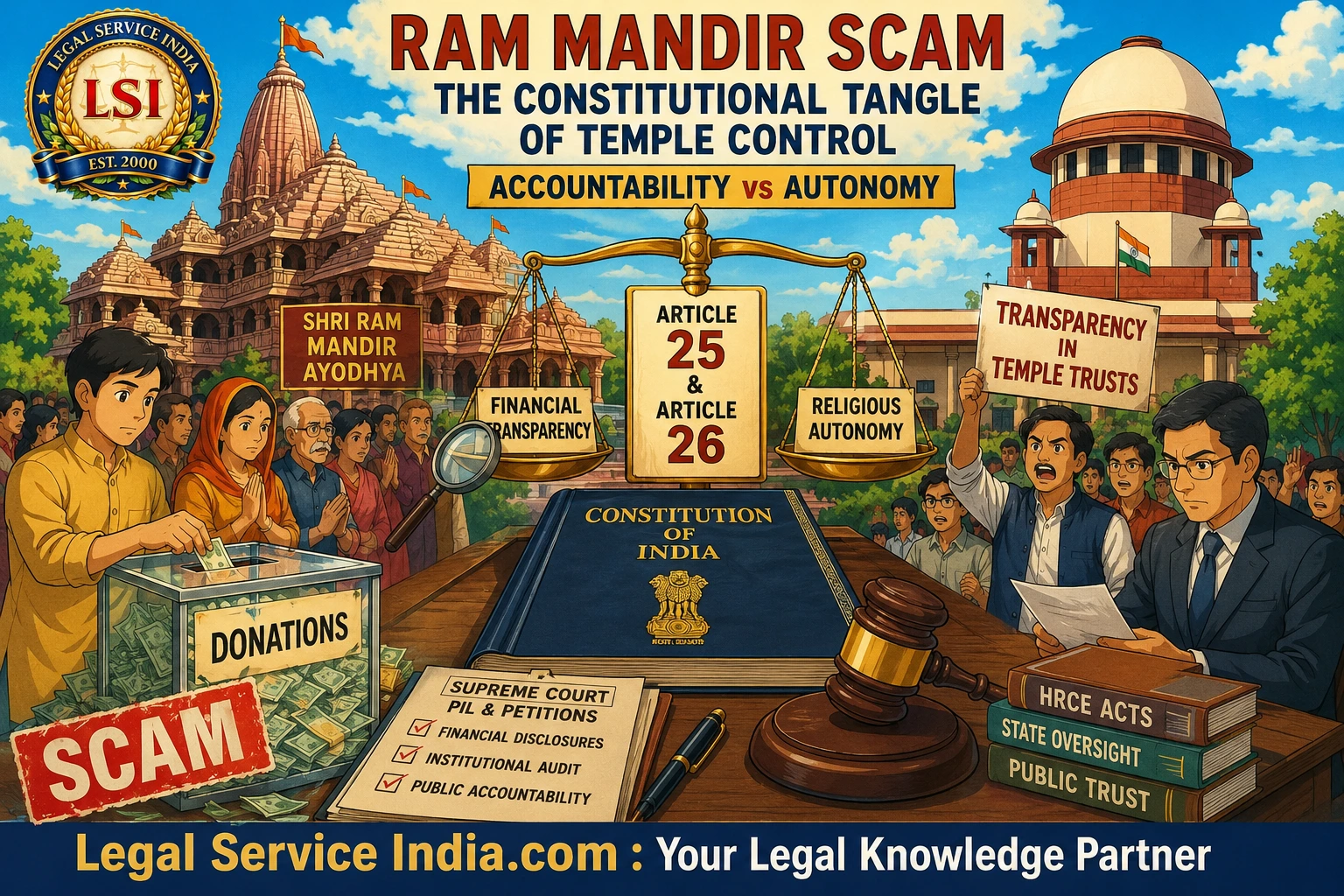
The Ram Mandir Scam Exposes the Constitutional Tangle of Temple Control
The ongoing storm surrounding the newly constructed Ram Mandir in Ayodhya has rapidly escalated beyond a localized criminal investigation. Following explosive allegations of cash pilferage from donation boxes, the Uttar Pradesh government’s Special Investigation Team (SIT) has arrested multiple accounting staff members, and senior trust officials have resigned. Concurrently, the Supreme Court of India is processing public interest litigations—including petitions from lawmakers like RJD MP Sudhakar Singh—demanding comprehensive financial disclosures and institutional audits of the Shri Ram Janmabhoomi Teerth Kshetra Trust. While public discourse remains predictably hyper-fixated on the optics of the embezzlement, the structural crisis runs much deeper. This controversy has brought back into sharp relief a foundational, unresolved dilemma of Indian secularism: the complex legal tug-of-war over who should oversee India’s massive religious institutions.
The Internal Textual Friction
At the absolute core of this institutional friction lies a profound textual tension within the Indian Constitution itself, specifically between Article 25 and Article 26. Under Article 25, the state guarantees every individual the fundamental right to freedom of conscience and the right to freely profess, practice, and propagate religion. Crucially, however, Article 25(2)(a) empowers the state to regulate or restrict any “economic, financial, political, or other secular activity” associated with religious practice. For decades, state legislatures have leaned heavily upon this sub-clause to enact laws—such as various Hindu Religious and Charitable Endowments (HRCE) Acts—placing thousands of wealthy shrines under state-appointed bureaucratic boards.
Yet, immediately adjacent to this power sits Article 26, which grants explicit corporate rights to “religious denominations” to establish institutions and manage their own affairs in matters of religion, including the administration of property in accordance with law. The boundary between where a purely “secular” administrative activity ends and a protected “essential religious practice” begins has been contested for generations.
The Case for Public Accountability
The current financial irregularities in Ayodhya provide potent ammunition to both sides of this enduring debate. Proponents of state intervention argue that robust, statutory government oversight is a necessary protective shield for the public interest. Shrines of national scale manage vast public trusts funded by millions of everyday citizens. In the case of the Ayodhya shrine, cash donations alone have soared past thousands of crores. Advocacy for transparent governance structures—such as the implementation of senior, independent chief executive officers or external state audits—is framed not as an infringement on faith, but as a secular mandate to protect devotees from internal administrative malfeasance. Without standardized, public-facing accountability mechanisms, sprawling religious trusts remain deeply vulnerable to localized fraud.
The Demand for Denominational Autonomy
Conversely, the Ayodhya incident has paradoxically re-energized the “Free Hindu Temples” movement led by organizations like the Vishwa Hindu Parishad (VHP). Their counter-argument hinges on the principle of denominational autonomy under Article 26. Autonomy advocates argue that state bureaucratic encroachment is inherently discriminatory, pointing out that minority religious institutions in India enjoy robust protections from government takeovers under Article 30. They maintain that the solution to trust mismanagement is professionalized, independent auditing and professional internal governance, rather than political absorption. In their view, if a secular state steps in to directly control the finances and administration of a shrine, it systematically erodes the constitutional separation intended by the framers.
A History of Judicial Tightropes
This ideological clash is not happening in a legal vacuum; it directly traces its roots to decades of shifting judicial boundaries. The Supreme Court has historically struggled to reconcile these overlapping clauses. In landmark rulings like Venkataramana Devaru v. State of Madras (1958), the apex court relied on the doctrine of harmonious construction to balance social reform under Article 25 with denominational control under Article 26. Earlier, the seven-judge bench in the foundational Shirur Mutt case (1954) had established the “essential religious practices” test to separate core spiritual rituals from secular administrative functions. Today, the judiciary is forced to re-examine this very equilibrium. The apex court is currently grappling with the broader institutional fallout of the Sabarimala review petitions, where a rare nine-judge bench has been tasked with finally determining whether an individual’s fundamental rights under Article 25 can systematically override a religious denomination’s corporate autonomy under Article 26.
Forging a Harmonized Legal Doctrine
What the Ayodhya donation scandal fundamentally proves is that India’s unique, asymmetric model of secularism cannot rely on ad hoc arrangements or political convenience. The Indian state does not practice a strict, Western separation of church and state; instead, it maintains a doctrine of “principled distance,” intervening to correct social evils or protect public funds. However, when the line between regulatory auditing and outright administrative control becomes blurred, institutional instability inevitably follows.
As the Supreme Court resumes regular hearings on these urgent trust petitions, the judiciary has a generational opportunity to lay down clear, permanent guidelines. India urgently needs a harmonized legal doctrine that enforces absolute financial transparency and rigorous anti-fraud measures without compromising the fundamental denominational autonomy guaranteed by the Constitution. Until that delicate equilibrium is established, the altars of India’s grandest shrines will continue to double as battlegrounds for its highest courts.
