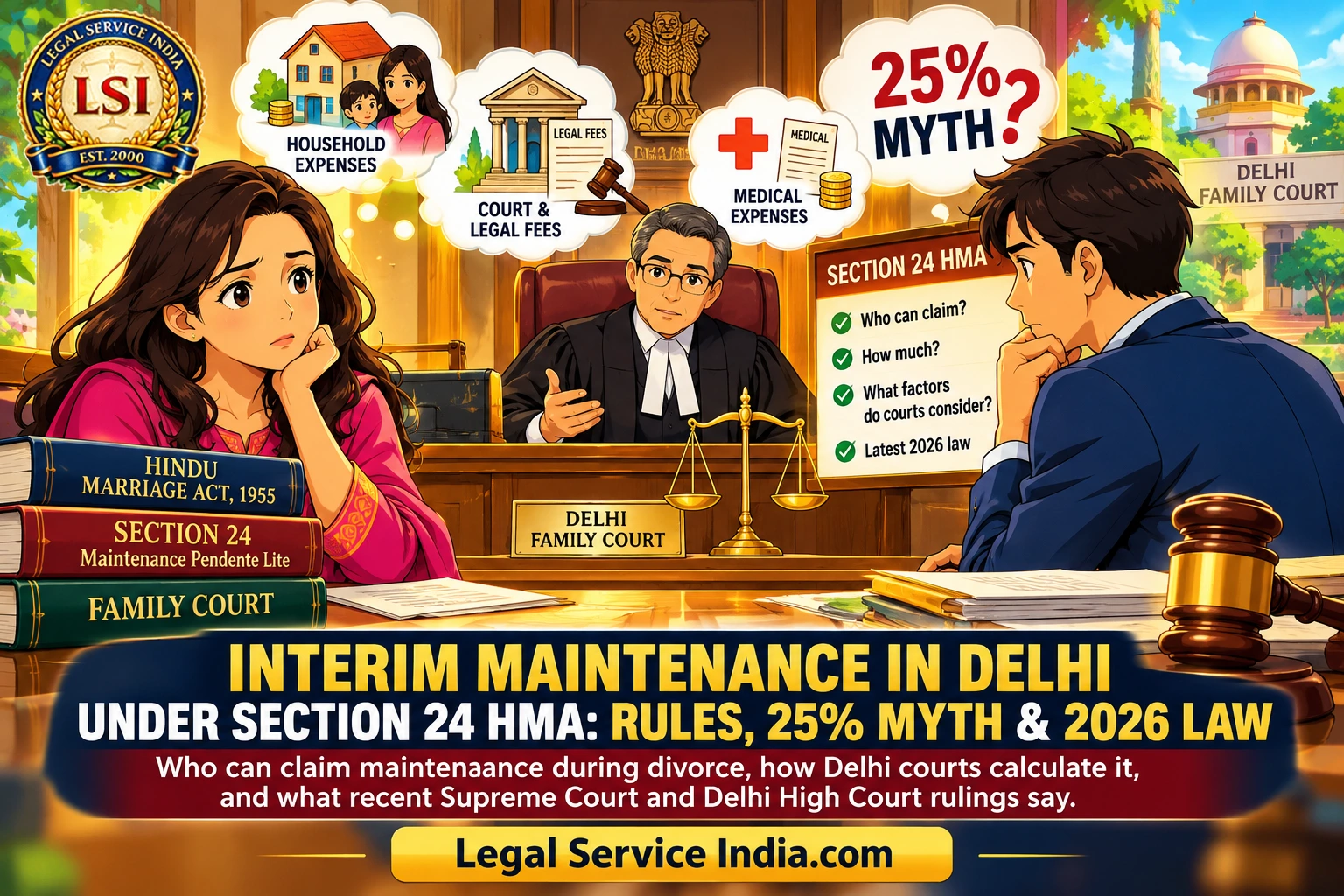
Interim Maintenance During Divorce Proceedings in Delhi: Section 24 HMA Explained
When a marriage breaks down and a divorce case reaches the Family Court, the legal dispute is not limited to whether the marriage should end. There is often a more immediate question:
How will the financially weaker spouse manage while the case is still going on?
A divorce proceeding may take considerable time. During that period, one spouse may continue to earn a substantial income while the other may have little or no independent income. The financially weaker spouse may also have to meet legal fees, court-related expenses, rent, medical costs, and ordinary household expenses.
This is precisely where Section 24 of the Hindu Marriage Act, 1955 (HMA) becomes important.
Section 24 provides for maintenance pendente lite, meaning maintenance during the pendency of a matrimonial proceeding. It also enables the Court to award the necessary expenses of the proceeding.
But there is an important point that is often misunderstood.
Section 24 HMA does not prescribe that a wife automatically receives 25% of her husband’s income. Nor is maintenance automatically denied merely because the applicant is educated or employed.
The Court has to examine the actual financial circumstances of both spouses.
For someone involved in a divorce case in Delhi, that distinction can make a substantial difference.
Also Read: Contested Divorce in Delhi: Grounds, Procedure, Evidence & Supreme Court Law 2026
What Is Section 24 HMA?
Section 24 of the Hindu Marriage Act deals with maintenance pendente lite and expenses of proceedings.
In simple terms, where either spouse does not have sufficient independent income to support himself or herself and meet the necessary expenses of the matrimonial litigation, the court may direct the other spouse to provide financial assistance.
The provision is deliberately worded in gender-neutral terms.
It applies to “either the wife or the husband.”
The Court can therefore award:
- a reasonable monthly amount for support during the proceeding; and
- expenses necessary for conducting the matrimonial case.
The section also says that, as far as possible, an application for interim maintenance should be disposed of within 60 days from the date of service of notice.
That 60-day requirement is intended to encourage speedy determination. It does not mean that maintenance automatically becomes payable merely because 60 days have passed.
Also Read: Where to File Divorce Petition? Delhi High Court Clarifies Section 19 HMA Jurisdiction
Who Can Claim Interim Maintenance in a Delhi Divorce Case?
Either spouse can apply.
A wife may seek maintenance from her husband. A husband may also seek maintenance from his wife where his own independent income is insufficient and the wife has the financial capacity to provide support.
The gender-neutral language of Section 24 has been recognized by the Supreme Court, including in Rajnesh v. Neha (2021) 2 SCC 324.
But being legally eligible to apply is not the same thing as automatically receiving maintenance.
The applicant has to establish financial insufficiency.
That is why the central question is not simply
“Who earns more?”
The more relevant question is
Does the applicant have sufficient independent income to support himself or herself and meet the necessary expenses of the litigation, having regard to the financial circumstances of both parties?
What Can a Court Award Under Section 24?
There are two separate aspects of relief.
1. Monthly Interim Maintenance
The court can award a reasonable monthly amount during the pendency of the matrimonial proceeding.
The purpose is not to punish the earning spouse or to make both parties financially identical.
The court generally looks at the broader financial circumstances, including
- income of both spouses;
- reasonable needs;
- standard of living during the marriage;
- assets;
- liabilities;
- dependent family members;
- medical requirements;
- children’s needs;
- employment and professional circumstances; and
- other relevant financial obligations.
The Supreme Court has repeatedly emphasized that maintenance cannot be determined by a mechanical formula.
2. Litigation Expenses
Section 24 also permits the court to award the expenses of the proceeding.
This is important because a spouse who lacks sufficient independent income should not be placed at a practical disadvantage merely because the other spouse has greater financial resources.
Reasonable legal fees and other necessary litigation expenses may therefore be considered separately from the monthly maintenance amount.
A person seeking such expenses should ideally give the court a realistic estimate rather than simply making a large, unexplained demand.
Is There a 25% Rule for Interim Maintenance?
No.
This is probably the most common misconception surrounding maintenance in divorce cases.
There is no provision in the Hindu Marriage Act stating that a wife is entitled to 25% of her husband’s income.
The figure of 25% appears in earlier Supreme Court decisions, including Dr. Kulbhushan Kumar v. Raj Kumari (1970) 3 SCC 129 and Kalyan Dey Chowdhury v. Rita Dey Chowdhury (2017) 14 SCC 200.
But those cases do not create a universal mathematical formula.
In Kalyan Dey Chowdhury, for example, the Supreme Court was dealing with permanent alimony under Section 25 and considered 25% of the husband’s net salary appropriate on the facts before it. The amount was ultimately modified in light of the husband’s subsequent circumstances.
The Supreme Court subsequently made the position considerably clearer in Rajnesh v. Neha:
There is no straitjacket formula for determining maintenance.
Therefore, a pleading that simply says
“The wife is entitled to 25% of the husband’s salary.”
overstates the law.
Twenty-five percent may sometimes be used as a broad comparative reference when examining quantum, but it is not a statutory entitlement.
The better approach is to place the complete financial circumstances before the court.
How Do Delhi Courts Decide the Amount of Maintenance?
There is no single calculation that works in every case.
The Supreme Court’s decisions in Jasbir Kaur Sehgal v. District Judge, Dehradun, (1997) 7 SCC 7 and Rajnesh v. Neha, together with the Delhi High Court’s decision in Bharat Hegde v. Saroj Hegde, 140 (2007) DLT 16, provide the broad framework.
The Court may consider:
| Factor | What the Court May Consider |
|---|---|
| Income of Both Spouses | Salary is only one component. Business income, professional receipts, rent, investments, and other sources may also matter. |
| Standard of Living | The Court does not ordinarily look at maintenance in isolation from the lifestyle enjoyed during the marriage. |
| Reasonable Needs | Rent, food, transport, clothing, medical expenses and other genuine needs may be relevant. |
| Liabilities | Genuine loans and financial responsibilities may be considered, although simply showing EMIs does not automatically mean that the entire amount should be deducted from available income. |
| Dependants | Responsibilities towards children, elderly parents or other genuine dependants may affect the assessment. |
| Assets | Property, investments, savings and other assets may be relevant where they affect the financial capacity of either spouse. |
The objective is to arrive at a figure that is reasonable and realistic in the circumstances of the particular case.
Can a Working Wife Claim Interim Maintenance?
Yes.
But the answer requires an important qualification.
Employment does not automatically disqualify a wife from Section 24 maintenance.
At the same time, employment does not automatically create an entitlement either.
The Court has to determine whether the wife’s actual independent income is sufficient for her support and necessary litigation expenses in the circumstances of the case.
The Supreme Court explained this distinction in Manish Jain v. Akanksha Jain (2017) 15 SCC 801 and Shailja v. Khobbanna (2018) 12 SCC 199.
There is a difference between:
- being capable of earning, and
- actually earning sufficient income to support oneself in the circumstances of the marriage.
That distinction is extremely important in Delhi matrimonial litigation.
Being Educated Does Not Automatically Defeat a Maintenance Claim
A frequently raised defense is
“She is highly educated. She can easily get a job.”
That argument, by itself, is insufficient.
The court has to examine the actual circumstances.
For example, a spouse may have a professional qualification but:
- currently have no employment;
- have interrupted her career;
- have left employment because of family responsibilities;
- be earning substantially less than before marriage;
- have limited employment opportunities; or
- have an income that is inadequate in relation to the circumstances of the marriage.
The Supreme Court in Shailja made the distinction between earning capacity and actual sufficient income particularly important.
The Delhi High Court has applied this principle in recent cases.
Recent Delhi High Court Decision: Himanshu Verma v. Chandni Verma
In Himanshu Verma v. Chandni Verma, 2025:DHC:5068-DB, decided on 1 July 2025, the Delhi High Court considered the argument that the wife was capable of earning.
The Court did not accept the proposition that educational qualification or mere earning capacity automatically defeats a claim under Section 24.
The court upheld interim maintenance of ₹25,000 per month.
The case reinforces an important proposition:
A spouse cannot necessarily be denied maintenance merely because he or she possesses the qualifications to earn.
The actual financial circumstances still have to be examined.
But an Earning Spouse May Still Be Denied Maintenance
The reverse proposition is equally important.
Section 24 is not intended to provide an additional income to a spouse who already has sufficient independent financial resources.
A recent Delhi High Court decision illustrates this.
In Brijesh Rajkumar Suiri v. Navita Brijesh Suri, decided on 16 September 2026, the wife had been earning ₹7,000 per month while working at a Bata showroom from March 2020 until June 2024.
The husband’s income was assessed at approximately ₹22,000 per month.
The High Court did not simply follow the general principle that maintenance ordinarily runs from the date of the application. It examined the wife’s actual income during the relevant period.
The Court declined maintenance for the period during which she was earning and confined the ₹5,000 monthly award to the period beginning 1 July 2024, after she became unemployed.
The significance of the decision is considerable.
Rajnesh does not mean that the date of application mechanically determines maintenance irrespective of the applicant’s actual financial position.
The facts still matter.
Also Read: File Legal Notice in India: Complete Guide to Drafting, Procedure, Cost & Legal Rights
A High-Income Husband and an Earning Wife: Shikha Badhani
Another recent Delhi case demonstrates the other side of the equation.
In Shikha Badhani v. Hemant Badhani, decided on 10 September 2025, the wife was herself earning approximately ₹1.25 lakh per month.
The husband, however, had an annual income exceeding ₹1 crore.
The Delhi High Court enhanced the overall maintenance awarded for the wife and child to ₹1.50 lakh per month.
The Court did not treat the wife’s employment as automatically ending the inquiry.
The relevant question was whether her own income was sufficient when viewed against the matrimonial standard of living and the very substantial disparity between the parties.
This is an important practical lesson.
A person cannot simply say:
“She has a salary, therefore she gets nothing.”
Nor can the applicant say:
“He earns more, therefore I automatically receive a fixed percentage.”
Neither proposition accurately represents the law.
What If the Spouse Is Hiding Income?
This is one of the most important issues in actual maintenance litigation.
A respondent may disclose a surprisingly low salary while simultaneously maintaining a lifestyle that appears inconsistent with that income.
The Court can examine the surrounding evidence.
Relevant material may include:
- bank statements;
- income-tax returns;
- salary slips;
- business records;
- property ownership;
- rent received;
- investment accounts;
- vehicles;
- foreign income;
- company directorships;
- substantial expenditure; and
- other evidence showing actual financial capacity.
The Supreme Court in Jasbir Kaur Sehgal recognized that where parties do not disclose their true financial position, some degree of estimation may become necessary.
The same principle applies to the applicant.
A person seeking maintenance is also expected to make a truthful disclosure of income, assets and liabilities.
Financial Disclosure Is Extremely Important in Delhi
Delhi has developed detailed procedures for financial disclosure in matrimonial cases through the Kusum Sharma line of decisions.
The Supreme Court subsequently adopted a nationwide framework in Rajnesh v. Neha.
A Section 24 application should therefore not be treated as a simple application stating:
“My husband earns ₹2 lakh and I need ₹80,000.”
The Court needs evidence.
Depending upon the case, relevant documents may include:
- salary slips;
- bank statements;
- income-tax returns;
- Form 16;
- employment records;
- business records;
- property documents;
- investment statements;
- loan documents;
- EMI details;
- medical expenses;
- school fees;
- evidence of dependants; and
- details of previous maintenance proceedings.
If income is disputed, documentary evidence can become decisive.
What If the Husband Says He Earns Very Little?
A claim of low income is not necessarily conclusive.
The Court may examine whether the declared income is consistent with the evidence and the person’s actual financial circumstances.
This is particularly relevant where:
- the person operates a business;
- income is received through family enterprises;
- bank transactions indicate greater financial activity;
- substantial assets are owned;
- the lifestyle is inconsistent with the declared salary; or
- income is received from multiple sources.
At the same time, the Court should not simply assume that every respondent earns a high income because he appears financially comfortable.
The assessment has to be evidence-based.
From Which Date Is Interim Maintenance Payable?
This question frequently arises in Delhi Family Courts.
In Rajnesh v. Neha, the Supreme Court directed that maintenance should ordinarily be awarded from the date of the application.
The reasoning is straightforward.
If an application filed in 2024 is decided only in 2026, awarding maintenance only from the date of the final order could deprive the applicant of financial support during the very period for which the application was made.
But this is not an inflexible rule that overrides the facts.
The 2026 Brijesh Rajkumar Suiri decision illustrates why.
Where the applicant had sufficient independent income during part of the relevant period, the Court may examine that period separately.
Therefore, the safer proposition is:
| General Rule | Important Qualification |
|---|---|
| Maintenance ordinarily runs from the date of the application. | The Court can determine entitlement for particular periods on the basis of the actual financial circumstances. |
What Does the 60-Day Rule Mean?
Section 24 states that an application for maintenance pendente lite should, as far as possible, be disposed of within 60 days from service of notice.
This provision was intended to prevent a financially dependent spouse from waiting indefinitely for interim relief.
However, the wording matters.
It says “as far as possible.”
The expiry of 60 days does not mean that maintenance is automatically granted.
Nor does it create a fixed sum payable from the 61st day.
The Court still has to decide the application on its merits.
What About Maintenance for Children?
Personal maintenance under Section 24 should be distinguished from maintenance and education of minor children under Section 26 HMA.
In many matrimonial cases, both issues arise together.
For example, a mother may seek:
- her own interim maintenance under Section 24;
- school fees and other expenses for the child under Section 26; and
- litigation expenses.
These are different legal heads and should ideally be presented separately.
Can Maintenance Also Be Claimed Under Other Laws?
A spouse may have remedies under more than one statutory provision.
Depending upon the facts, these may include:
- Section 24 HMA;
- Section 25 HMA;
- Section 18 of the Hindu Adoptions and Maintenance Act, 1956;
- Section 20 of the Protection of Women from Domestic Violence Act, 2005; and
- Section 144 of the Bharatiya Nagarik Suraksha Sanhita, 2023.
The existence of multiple remedies does not mean that a person can obtain double recovery for the same financial need.
In Rajnesh v. Neha, the Supreme Court emphasized disclosure of previous maintenance proceedings and appropriate adjustment of overlapping awards.
A party should therefore disclose every previous maintenance application and order.
Section 24 HMA and Section 25 HMA Are Not the Same
This distinction is essential.
| Provision | What It Deals With |
|---|---|
| Section 24 HMA | Maintenance during the matrimonial proceeding and expenses of that proceeding. |
| Section 25 HMA | Permanent alimony and maintenance at or after the decree. |
Section 25 expressly permits the Court to consider the conduct of the parties and other circumstances.
An interim maintenance order under Section 24 therefore does not automatically determine what permanent alimony should ultimately be awarded.
What Happens in a Void Marriage?
The Supreme Court addressed an important issue in Sukhdev Singh v. Sukhbir Kaur, 2025 INSC 197.
The case concerned a marriage declared void under Section 11 HMA.
The Supreme Court held that a spouse of a marriage declared void can seek permanent alimony under Section 25 because the expression any decree
is wide enough to include a decree of nullity.
The Court also recognized that Section 24 relief can be considered while a Section 11 proceeding is pending, even where the Court may have a prima facie view that the marriage is void.
The decision is important because it demonstrates that the interim and permanent remedies under Sections 24 and 25 cannot be treated as interchangeable.
It also makes clear that the conduct of the parties can be relevant to the Court’s discretion.
Does Section 24 Maintenance Stop After a Divorce Decree?
This question has acquired particular importance in Delhi.
Ordinarily, Section 24 concerns maintenance during the proceeding, while Section 25 becomes relevant after the decree.
But what happens when the divorce decree itself is challenged in an appeal?
The Delhi High Court considered this question in a significant decision dated 14 July 2026 in MAT.APP.(F.C.) 306/2025.
The Division Bench held that an appeal is a continuation of the matrimonial proceeding.
Consequently, the Court held that Section 24 relief could continue during the pendency of the appeal.
The Court distinguished Sukhdev Singh v. Sukhbir Kaur, observing that the Supreme Court decision had not decided the specific question of whether Section 24 continues during an appeal against a divorce decree.
30% Is Not a Statutory Maintenance Rule
An important detail should not be missed.
The Delhi High Court did not create a new 30% maintenance rule.
The Family Court had already directed payment calculated at 30% of the husband’s gross salary after statutory deductions. The High Court continued that existing direction from the date of the appellate application until disposal of the appeal.
Therefore:
- 30% is not a statutory formula.
- The case is authority on the continuation of the proceeding during appeal, not on a fixed percentage of salary.
What Did Parvin Kumar Jain Actually Decide?
Parvin Kumar Jain v. Anju Jain, 2024 INSC 961, is another important Supreme Court decision arising from a long-running matrimonial dispute.
The case should, however, be read carefully.
The Delhi High Court had dealt with the continuation of Sections 24 and 26 issues following withdrawal of the divorce petition.
The Supreme Court ultimately exercised its power under Article 142 of the Constitution, dissolved the marriage and substituted a comprehensive financial arrangement involving permanent alimony and the child’s financial interests.
The decision therefore should not be cited for the broad proposition that:
Every accrued Section 24 claim survives indefinitely after the matrimonial proceeding ends.
That proposition goes further than the Supreme Court’s actual decision.
The precise procedural history and the relief ultimately granted by the Supreme Court matter.
What If Interim Maintenance Is Not Paid?
A maintenance order is not merely an expression of sympathy. It is a judicial order capable of enforcement.
Section 28A HMA provides for enforcement of decrees and orders under the Act.
Depending upon the circumstances, appropriate execution and other enforcement remedies may be available.
Practical Advice for Unpaid Maintenance
The practical advice is simple:
Do not allow unpaid maintenance to accumulate indefinitely without taking steps for enforcement.
At the same time, there is no universal rule that a defence is automatically struck off immediately after a single missed payment. The remedy depends upon the circumstances and the order passed by the Court.
What Documents Should You Prepare for a Section 24 Application?
If you are seeking or defending interim maintenance in a Delhi divorce case, prepare the financial record carefully.
| Financial Area | Documents and Information |
|---|---|
| Income | Keep salary slips, tax returns, business income records and other proof of earnings. |
| Bank Accounts | Bank statements can become important where the declared income is disputed. |
| Property and Investments | Disclose relevant property, investments and other significant assets. |
| Liabilities | Provide documentary proof of genuine loans and financial obligations. |
| Household Expenses | Prepare a realistic monthly expenditure statement. |
| Children’s Expenses | Keep school fees, medical bills, tuition and other significant expenses separately. |
| Existing Maintenance Orders | Disclose earlier proceedings and orders. |
| Litigation Expenses | Give the Court a realistic estimate of the expenses required to conduct the case. |
The credibility of the financial disclosure can materially influence the Court’s assessment.
Common Misconceptions About Section 24 HMA
“Only a Wife Can Claim Interim Maintenance.”
Incorrect. Section 24 expressly applies to either spouse.
“An Educated Wife Cannot Receive Maintenance.”
Incorrect. Education or earning capacity alone does not defeat a claim.
“A Working Wife Cannot Claim Maintenance.”
Incorrect. The Court examines whether her actual income is sufficient in the circumstances.
“A Wife Automatically Gets 25% of Her Husband’s Salary.”
Incorrect. There is no binding 25% formula.
“The Husband Can Simply State a Low Income.”
Incorrect. The Court can examine documentary and surrounding evidence.
“Maintenance Always Starts From the Date of the Order.”
Incorrect. Rajnesh v. Neha says it should ordinarily run from the date of application, subject to the facts.
“Maintenance Automatically Ends on the Day a Divorce Decree Is Passed.”
Not necessarily in Delhi where an appeal is pending. The Delhi High Court’s July 2026 ruling recognizes that the matrimonial proceeding can continue at the appellate stage for Section 24 purposes.
“Section 24 and Permanent Alimony Are the Same.”
Incorrect. Section 24 deals with pendente lite maintenance; Section 25 concerns permanent alimony and maintenance at or after the decree.
What Is the Current Legal Position in Delhi?
As of 5 October 2026, the following propositions provide a reasonably safe summary of the law.
- Section 24 HMA is gender-neutral. Either spouse can apply.
- There is no automatic 25% rule. Quantum depends upon the circumstances of the parties.
- Employment is not an automatic bar. But an applicant with sufficient independent income may not qualify.
- Earning capacity and actual sufficient income are different concepts.
- Financial disclosure is fundamental. Courts can examine bank statements, tax records, salary records, assets and liabilities.
- Income can be estimated where the evidence is incomplete or unreliable.
- Maintenance ordinarily runs from the date of application, following Rajnesh v. Neha, but the Court can examine the applicant’s actual financial circumstances for particular periods.
- The 60-day requirement is intended to promote speedy disposal, but it does not create an automatic entitlement.
- Section 24 and Section 25 serve different purposes.
- A void marriage does not necessarily prevent interim or permanent financial relief, subject to the principles explained in Sukhdev Singh.
- In Delhi, a pending appeal against a divorce decree can keep Section 24 relief alive, according to the Division Bench decision of 14 July 2026.
No Fixed 25% or 30% Maintenance Formula
And importantly:
Neither 25% nor 30% is a statutory maintenance formula.
Final Word
A Section 24 application is sometimes treated as a routine application filed along with a divorce petition. In reality, it can become one of the most consequential financial aspects of matrimonial litigation.
For the financially weaker spouse, interim maintenance may determine whether he or she can realistically continue the litigation.
For the respondent, an exaggerated or unsupported claim can create a substantial and sometimes unnecessary financial burden.
The answer, therefore, cannot be found in a percentage alone.
A Delhi Family Court will look at the actual financial picture: what each spouse earns, what each owns, what each genuinely spends, what liabilities actually exist, what standard of living the marriage supported, whether there are children, whether income has been properly disclosed and, importantly, what the evidence shows.
That is why a strong Section 24 application is not simply a request for money.
It is a carefully documented presentation of the financial realities of the marriage.
If you are already involved in divorce proceedings in Delhi, the precise facts of your case—including income, employment, assets, liabilities, children, previous maintenance orders and the stage of the proceedings—can materially affect both entitlement and quantum.
A case-specific assessment is therefore essential before filing or defending a Section 24 application.
Need Legal Advice on Interim Maintenance in Your Delhi Divorce Case?
Section 24 HMA is not a simple 25% formula. The amount of interim maintenance and litigation expenses can depend upon income, assets, liabilities, standard of living, employment, children’s needs, previous maintenance orders and the stage of the matrimonial proceedings.
If you are seeking interim maintenance, facing a maintenance claim, dealing with concealed income, or wondering whether maintenance can continue during an appeal against a divorce decree, the way your financial facts and documents are presented can make a significant difference.
Do not rely solely on general information available online when your divorce maintenance, litigation expenses or financial rights are actually at stake.
Speak Directly With an Experienced Supreme Court Advocate
Adv. Tarun Choudhury
Supreme Court Advocate | 25+ Years of Legal Experience
Get professional legal guidance regarding:
- Section 24 HMA interim maintenance
- Maintenance during divorce proceedings in Delhi
- Litigation expenses in matrimonial cases
- Maintenance claims by wife or husband
- Maintenance where the spouse is earning
- Concealment or disputed disclosure of income
- Maintenance during an appeal after divorce
- Section 24 versus Section 25 HMA
- Financial disclosure, assets and liabilities
- Strategy for filing or defending a maintenance application
📞 Call: 9650499965
💬 WhatsApp: 8851978611
✉️ Email: [email protected]
Your financial position during divorce should not be left to guesswork. If a Section 24 HMA application is pending—or you are considering filing one—seek advice based on the actual facts, documents and financial circumstances of your case.
Contact Adv. Tarun Choudhury for a case-specific legal consultation.
Important Authorities
- Rajnesh v. Neha, (2021) 2 SCC 324
- Jasbir Kaur Sehgal v. District Judge, Dehradun, (1997) 7 SCC 7
- Manish Jain v. Akanksha Jain, (2017) 15 SCC 801
- Shailja v. Khobbanna, (2018) 12 SCC 199
- Dr. Kulbhushan Kumar v. Raj Kumari, (1970) 3 SCC 129
- Kalyan Dey Chowdhury v. Rita Dey Chowdhury, (2017) 14 SCC 200
- Bharat Hegde v. Saroj Hegde, 140 (2007) DLT 16
- Kusum Sharma v. Mahinder Kumar Sharma, Delhi High Court
- Parvin Kumar Jain v. Anju Jain, 2024 INSC 961
- Sukhdev Singh v. Sukhbir Kaur, 2025 INSC 197
- Himanshu Verma v. Chandni Verma, 2025:DHC:5068-DB
- Xxx v. Yyy, MAT.APP.(F.C.) 306/2025, Delhi High Court, 14 July 2026
- Brijesh Rajkumar Suiri v. Navita Brijesh Suri, Delhi High Court, 16 September 2026
Disclaimer: This article provides general legal information and does not constitute legal advice. The entitlement to interim maintenance, its quantum and the date from which it becomes payable depend upon the facts, evidence and procedural stage of the individual case.
Frequently Asked Questions
1. What is interim maintenance under Section 24 HMA in Delhi?
Under Section 24 of the Hindu Marriage Act, 1955, either the wife or husband can seek interim maintenance during divorce proceedings if they do not have sufficient independent income to support themselves and meet the necessary litigation expenses. The Delhi Family Court considers the income, financial circumstances, reasonable needs and liabilities of both spouses.
2. How is interim maintenance calculated under Section 24 HMA in a Delhi divorce case?
There is no fixed percentage or 25% rule for interim maintenance in Delhi. Courts consider factors such as the income and assets of both spouses, standard of living during the marriage, reasonable monthly needs, liabilities, dependants and other relevant circumstances. The Supreme Court in Rajnesh v. Neha has specifically rejected a rigid formula for calculating maintenance.
3. Can a working wife claim interim maintenance under Section 24 HMA?
Yes. A working wife can claim interim maintenance in Delhi if her independent income is not sufficient for her support and necessary litigation expenses. However, employment does not automatically guarantee maintenance. The Court examines her actual income and the overall financial circumstances of both spouses. Similarly, a husband may claim Section 24 maintenance where the statutory requirements are satisfied.
4. Can interim maintenance continue during an appeal after a divorce decree in Delhi?
Yes, potentially. In a significant Delhi High Court decision of 14 July 2026, the Court held that an appeal against a divorce decree is a continuation of the matrimonial proceeding and that Section 24 HMA interim maintenance can continue during the pendency of the appeal. However, this does not create a fixed 30% maintenance rule; the continuation and quantum depend upon the facts and orders in the particular case.
5. From which date is interim maintenance payable under Section 24 HMA?
The Supreme Court in Rajnesh v. Neha directed that maintenance should ordinarily be awarded from the date of the maintenance application, rather than automatically from the date of the final order. However, the Court can examine the applicant’s actual financial circumstances for different periods. For example, a recent Delhi High Court decision considered the applicant’s actual employment income before determining the period for which maintenance was payable.
Key Takeaways: Interim Maintenance During Divorce Proceedings in Delhi
- Section 24 of the Hindu Marriage Act, 1955 allows either spouse to seek interim maintenance during divorce proceedings when they do not have sufficient independent income to meet their support and necessary litigation expenses.
- Interim maintenance in a Delhi divorce case is not automatically fixed at 25% of the other spouse’s income. There is no statutory 25% formula under Section 24 HMA; courts determine the amount based on the facts and financial circumstances of each case.
- A working wife can claim interim maintenance if her actual independent income is insufficient for her support and the reasonable expenses of the matrimonial proceedings. Merely being employed does not automatically disqualify her.
- A husband can also claim maintenance under Section 24 HMA. The provision is gender-neutral and applies equally where either spouse lacks sufficient independent income.
- Delhi courts consider the overall financial position of both spouses, including income, assets, liabilities, standard of living, reasonable needs, dependants and other financial obligations while determining interim maintenance.
- Concealment of income or assets can affect the maintenance determination. Courts may require financial disclosure and can assess income where the disclosed figures do not appear credible.
- Litigation expenses are separate from monthly maintenance. Section 24 HMA permits the court to award reasonable expenses required for pursuing or defending the matrimonial proceeding in addition to a monthly maintenance amount.
- Interim maintenance is ordinarily considered from the date of the maintenance application, following the principle stated in Rajnesh v. Neha. However, the actual financial circumstances of the parties can affect the period for which maintenance is awarded.
- The 60-day period mentioned in Section 24 is not an automatic entitlement to maintenance. The statute says the application should, as far as possible, be decided within 60 days from service of notice.
- Interim maintenance can potentially continue during an appeal in Delhi. A July 2026 Delhi High Court decision treated an appeal as a continuation of the matrimonial proceeding for Section 24 purposes. The 30% figure in that case should not, however, be misunderstood as a universal maintenance formula.
- Section 24 and Section 25 HMA serve different purposes. Section 24 concerns maintenance pendente lite and litigation expenses during proceedings, while Section 25 deals with permanent alimony at the time of or after a decree.
- A spouse’s earning capacity is not the same as actual sufficient income. Courts examine whether the spouse actually has adequate independent income to meet reasonable needs rather than treating mere educational qualifications or capacity to earn as an automatic bar.
- Maintenance under other laws may overlap with Section 24 HMA, including remedies under the Hindu Adoptions and Maintenance Act, the Domestic Violence Act and Section 144 BNSS. Courts take overlapping maintenance orders into account to prevent double recovery.
- Financial disclosure is central to maintenance proceedings in Delhi. Income, assets, liabilities, bank records, employment details and other financial information may become important in determining the appropriate amount.
- The correct approach is fact-specific rather than formula-driven. There is no automatic entitlement based solely on gender, employment status or a fixed percentage of the other spouse’s salary.
Summary
Section 24 HMA interim maintenance in Delhi is a gender-neutral, fact-specific remedy for a spouse who lacks sufficient independent income, covering reasonable monthly support and litigation expenses, with courts considering actual income, assets, liabilities, standard of living, financial disclosure and the circumstances of the matrimonial proceeding rather than applying an automatic 25% formula.