





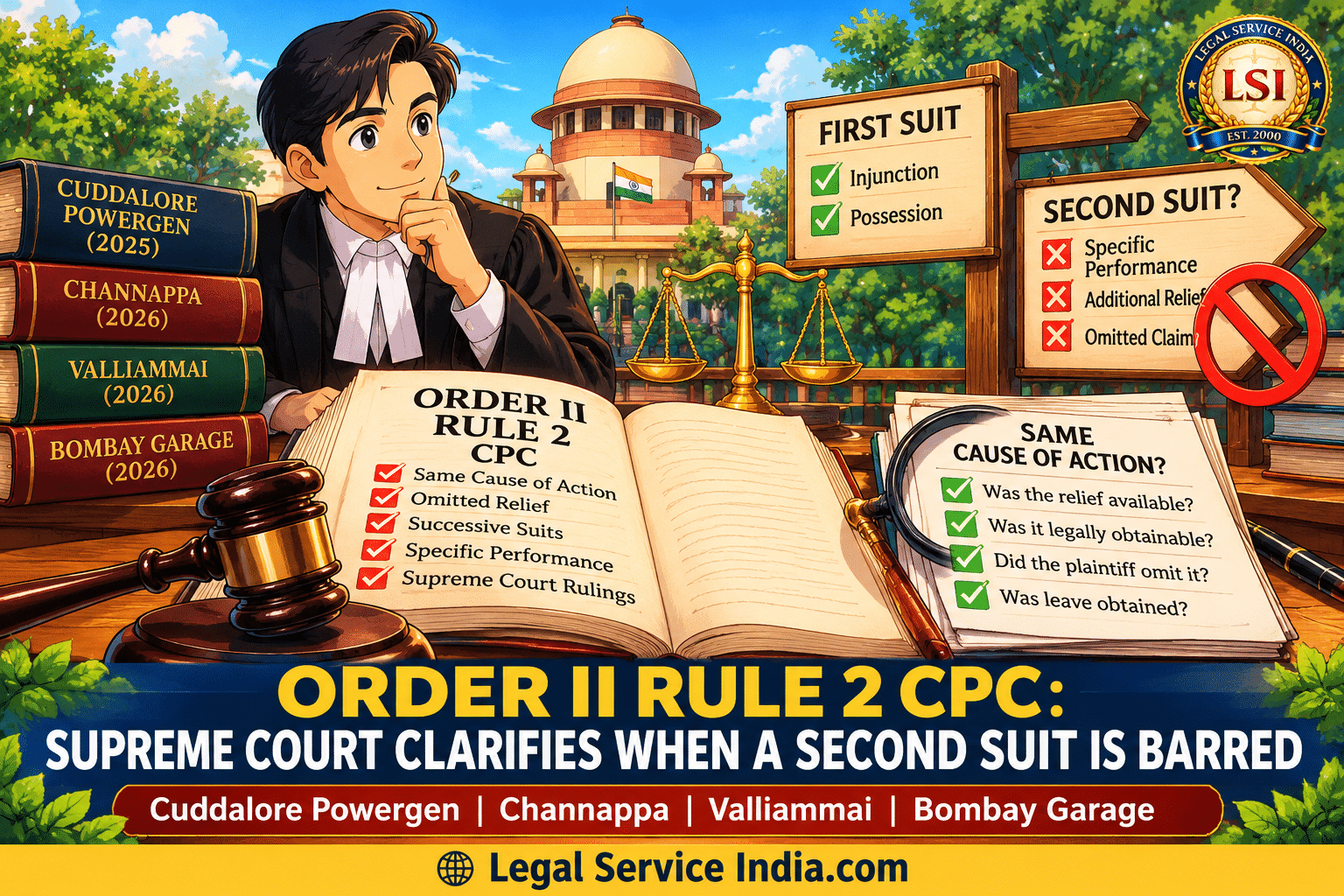
One Cause, One Suit – The Doctrine of Complete Claim Under Order II Rule 2 CPC After Cuddalore Powergen, Channappa, Valliammai and Bombay Garage
The Question
Order II Rule 2 of the Code of Civil Procedure, 1908 is often described as a rule against splitting claims. That description is accurate but incomplete. The rule does not compel a plaintiff to carry every grievance arising from one transaction into one plaint. It asks a narrower and more exacting question: did the second suit rest on the same cause of action that founded the first, and was the omitted relief both open to the plaintiff and legally obtainable when the first suit was filed?
Four recent Supreme Court decisions now frame the inquiry: Cuddalore Powergen Corporation Ltd. v. Chemplast Cuddalore Vinyls Ltd. (2025 INSC 73), Channappa v. Parvatewwa (2026 INSC 343), S. Valliammai v. S. Ramanathan (2026 INSC 372) and Bombay Garage Ahmedabad Ltd. v. J.P. Iscon Pvt. Ltd. (2026 INSC 1066, decided 29 September 2026).
The Rule and Its Three Sub-Rules
| Provision | Situation | Consequence |
|---|---|---|
| Rule 2(1) | Every suit must include the whole of the claim the plaintiff is entitled to make in respect of the cause of action. A portion may be relinquished to bring the suit within the jurisdiction of a court. | Foundation of the rule; “the cause of action” is read as “the particular cause of action”. |
| Rule 2(2) | The plaintiff omits to sue for, or intentionally relinquishes, a portion of the claim. | No later suit for that portion. The sub-rule has no leave mechanism. |
| Rule 2(3) | The plaintiff is entitled to more than one relief on the same cause of action but omits some of them. | No later suit for the omitted relief, unless leave of the Court was obtained when the first suit was instituted. |
The Explanation treats an obligation and a collateral security for its performance, and successive claims under the same obligation, as one cause of action. In Cuddalore the Court emphasised that leave is contemplated only by sub-rule (3), and that sub-rules (2) and (3) address two distinct situations: omission of part of a claim, and omission of one of several reliefs.
The Test and the Burden
Gurbux Singh and the Three Elements
The governing test is the one laid down in Gurbux Singh v. Bhooralal, AIR 1964 SC 1810, which Cuddalore and Bombay Garage both treat as the Constitution Bench authority. A defendant who pleads the bar must establish three things: first, that the second suit concerns the same cause of action as the first; second, that on that cause of action the plaintiff was entitled to more than one relief; and third, that the plaintiff omitted the relief now claimed without leave of the Court.
Gurbux Singh adds two evidentiary rules. The defendant must prove the precise cause of action in the earlier suit, which ordinarily means producing the earlier plaint in evidence. And because the plea is a technical bar, it cannot be presumed from inferential reasoning. S. Nazeer Ahmed v. State Bank of Mysore, (2007) 11 SCC 75, applies the same discipline, and Coffee Board v. Ramesh Exports Pvt. Ltd., (2014) 6 SCC 424, requires both plaints to be read as a whole rather than by comparing the cause-of-action paragraphs alone.
What Counts as the “Same” Cause of Action
Cuddalore draws on Mohammad Khalil Khan v. Mahbub Ali Mian, AIR 1949 PC 78, to restate the tests. The cause of action is every fact the plaintiff must prove, if traversed, to obtain judgment. If materially different evidence supports the two claims, the causes of action are likely different. And the identity required is identity in substance, not technical resemblance. Cuddalore (para 47) condenses the position into seven propositions, of which the most useful in practice are these:
- Order II Rule 2 does not require every cause of action arising from one transaction to be joined in one suit.
- The bar is raised by the defendant, who must prove the three Gurbux Singh elements and produce the earlier plaint.
- Because the bar is technical, it must be established satisfactorily and cannot rest on inference.
- The stage of the first suit is immaterial: the bar can apply even where the first suit is still pending (paras 48–51, following Virgo Industries).
Doctrinal formulation: the same property, agreement or commercial relationship does not by itself make the causes of action the same. The inquiry is whether the second claim is founded on facts that gave occasion for, and formed the foundation of, the first suit.
Entitled and Available: The Date of the First Suit
Cuddalore’s most important contribution is the distinction between a plaintiff being entitled to a relief and that relief being available. The bar operates on reliefs the plaintiff was entitled to avail when the first suit was filed. Where obtaining the relief was impossible on that date, the Court said Order II Rule 2 must not be applied in a manner bogged down by technicality (paras 73–75). The decisions below show the principle at work.
Inbasagaran v. S. Natarajan
Inbasagaran v. S. Natarajan, (2015) 11 SCC 12. The plaintiff learned of the defendant’s title through the Housing Board transfer only after suing for injunction. The specific-performance cause of action arose later, so the bar did not apply.
Rathnavathi v. Kavita Ganashamdas
Rathnavathi v. Kavita Ganashamdas, (2015) 5 SCC 223. The injunction suit rested on a threat of dispossession. The sale to a third party surfaced in the written statement, and the specific-performance claim rested on non-performance after a legal notice. The causes of action were different, and merely similar pleadings do not raise the bar.
Cuddalore Powergen, 2025 INSC 73
Cuddalore Powergen, 2025 INSC 73. The plaintiff sued for injunction in 2008. Registration of sale deeds in the village was blocked by a Government Order of 1986 and a TNEB notification, which the Madras High Court quashed on 5 March 2008. Specific performance was therefore not available when the first suit was filed. The Court held the second suit not barred and restored the plaint. Note that the impediment was an executive order, not a statute.
Ramjilal and National Security Assurance
Ramjilal v. Board of Revenue, AIR 1964 Raj 114, approved in Cuddalore. A plaintiff need not seek a relief that was impossible to obtain from the defendant. National Security Assurance Co. v. S.N. Jaggi, AIR 1971 All 421, an Allahabad High Court decision also approved there, holds that a claim barred at the time of the earlier suit but revived later by an enactment is not hit by the rule.
The practical test follows. Ask on what date the first suit was instituted, what the first plaint itself pleaded, and whether on those facts the omitted relief was both accrued and legally obtainable. A later refusal, a subsequent disclosure of a third-party sale, fresh dispossession, or an intervening legal impediment points towards a distinct cause of action.
Injunction First, Specific Performance Later
Cuddalore itself explains why the cases divide: the variance turns on when the plaintiff learned of the defendant’s refusal to perform (para 64). Where refusal was already known and pleaded, the bar applies. Where it surfaced only through the defence, it does not.
Virgo Industries (Eng.) Pvt. Ltd. v. Venturetech Solutions Pvt. Ltd.
Virgo Industries (Eng.) Pvt. Ltd. v. Venturetech Solutions Pvt. Ltd., (2013) 1 SCC 625.
The injunction plaints already pleaded that the defendant was finding an excuse to cancel the agreement. That furnished a complete cause of action for specific performance, which was omitted without leave, so the later suits were barred.
Vurimi Pullarao v. Vemari Vyankata Radharani
Vurimi Pullarao v. Vemari Vyankata Radharani, (2020) 14 SCC 110.
The injunction plaint recited the agreement, payment, possession, demand and the defendant’s failure to perform. The cause of action for specific performance had arisen, and the later suit was barred.
Sucha Singh Sodhi v. Baldev Raj Walia
Sucha Singh Sodhi v. Baldev Raj Walia, (2018) 6 SCC 733 (R.K. Agrawal and A.M. Sapre JJ.).
The injunction suit had been withdrawn with leave. The Court held that the causes of action for injunction and for specific performance are independent, and set aside the dismissal of the second suit.
Bombay Garage Ahmedabad Ltd. v. J.P. Iscon Pvt. Ltd.
Bombay Garage Ahmedabad Ltd. v. J.P. Iscon Pvt. Ltd. (Pardiwala and K. Vinod Chandran JJ., 29 September 2026).
The plaintiff sued for an injunction on an alleged oral agreement to sell, then withdrew on a pursis citing settlement talks and filed for specific performance. The Court held the second suit barred: the first plaint disclosed the defendant’s refusal, specific performance was available, and no leave was obtained at institution. It drew a clear line between the two provisions. Liberty under Order XXIII Rule 1(3) permits a fresh suit on the subject matter withdrawn, but it cannot operate as leave under Order II Rule 2(3) for a relief that was already available and omitted. The Court also found no concluded oral contract on the evidence, so the decree failed on the merits too.
The Gurinderpal Point
Gurinderpal v. Jagmittar Singh, (2004) 11 SCC 219, is frequently cited for the bar. It points the other way. A three-Judge Bench there held the bar not attracted, inferring liberty to sue from the plaintiff’s withdrawal. Bombay Garage declined to follow that inference as impermissible against Gurbux Singh. A plaintiff relying on Gurinderpal will argue that a two-Judge Bench cannot depart from a three-Judge Bench; the answer lies in the Constitution Bench hierarchy. Counsel should be ready for the argument on either side.
Declaration, Title and Possession: Channappa
Channappa (D) through LRs v. Parvatewwa (D) through LRs, 2026 INSC 343 (Dipankar Datta J., 9 April 2026), carries the doctrine beyond contract. In 2002 the plaintiff sued for a declaration that an adoption deed of 1961 was void, with an injunction. While that suit was pending, she filed a second suit in 2007, after an alleged dispossession, for a declaration of ownership and recovery of possession. The Supreme Court held the second suit barred by Order II Rule 2 and by constructive res judicata. She had herself pleaded that the defendant asserted rights under the adoption deed, and she knew her title was disputed. She ought to have sought declaration of title and consequential possession in the first suit.
Two further holdings matter. First, the Court held that an interlocutory order rejecting an Order II Rule 2 objection does not attain finality and may be challenged in the appeal against the final decree under Section 105 CPC. Second, it held that the High Court had exceeded its Section 100 jurisdiction by overturning concurrent findings. The proposition for practice is simple: where the defendant has already denied the plaintiff’s title, a bare injunction suit is a risk, because the declaratory and consequential reliefs are already apparent.
VII. Pleading, Proof and the Rejection of a Plaint
Alka Gupta v. Narender Kumar Gupta, (2010) 10 SCC 141, holds that a suit cannot be dismissed under Order II Rule 2 unless the defendant pleads the bar and an issue is framed. It also separates the doctrines: Order II Rule 2 concerns reliefs that ought to have been claimed on the same cause of action, while constructive res judicata concerns grounds of attack and defence that ought to have been raised.
S. Valliammai v. S. Ramanathan, 2026 INSC 372 (B.V. Nagarathna and Ujjal Bhuyan JJ., April 2026), then settles the threshold question. The Madras High Court had rejected a plaint under Order VII Rule 11(d) as barred by Order II Rule 2. The Supreme Court set that aside, holding that the Order II Rule 2 plea cannot be a basis or ground for rejecting a plaint.
It distinguished a “bar to sue”, which results in dismissal after the earlier suit and the cause of action are examined, from a “suit barred by law”, which can lead to rejection at the threshold. The bar is therefore a matter for trial. The order of the Trial Court refusing rejection was restored.
Readers should not soften this into a rule that Order II Rule 2 may be considered at the threshold where the bar appears from the plaint. The Court’s language is categorical. The earlier authorities on Rule 11 (Saleem Bhai, (2003) 1 SCC 557; Ram Prakash Gupta, (2007) 10 SCC 59; Chhotanben, (2018) 6 SCC 422) establish that only the plaint, read as a whole, is germane at that stage.
A Point of Friction
Cuddalore (paras 52–56) discussed how plaints are to be read for Order II Rule 2 in the context of an Order VII Rule 11(d) application, although it decided the appeal on the availability of the relief. Valliammai is a later decision of a Bench of equal strength.
VIII. Practitioner’s Checklist
For the Plaintiff
- Before filing an injunction suit, ask whether the facts already show repudiation, denial of title, or dispossession. If so, plead the larger relief or seek leave under Rule 2(3) in that suit.
- Do not rely on liberty obtained later at the time of withdrawal under Order XXIII Rule 1(3) to cure an omission (Bombay Garage).
- If the larger relief was not available, plead why: a later disclosure, a legal impediment, a fresh event. Cuddalore, Inbasagaran and Rathnavathi are the anchors.
- Where the defendant disputes title, frame the first suit to include declaration and consequential relief (Channappa).
For the Defendant
- Plead the bar expressly and press for an issue (Alka Gupta).
- Prove the earlier plaint in evidence. Without it the plea is not maintainable (Gurbux Singh; S. Nazeer Ahmed).
- Establish all three Gurbux elements, and show from the first plaint itself that the omitted relief was accrued and available on the date of institution.
- Do not seek rejection of the plaint under Order VII Rule 11(d) on this ground (Valliammai). Take the plea to trial as a preliminary issue where appropriate.
Citation Table
| Case | Citation / Case Details |
|---|---|
| Cuddalore Powergen v. Chemplast Cuddalore Vinyls | 2025 INSC 73; C.A. 372–373/2025; 15.01.2025 |
| Channappa v. Parvatewwa | 2026 INSC 343; C.A. 4330/2026; 09.04.2026 |
| Sucha Singh Sodhi v. Baldev Raj Walia | (2018) 6 SCC 733; 13.04.2018 |
| Alka Gupta v. Narender Kumar Gupta | (2010) 10 SCC 141; AIR 2011 SC 9 |
| Gurbux Singh v. Bhooralal | AIR 1964 SC 1810 |
| Mohammad Khalil Khan v. Mahbub Ali Mian | AIR 1949 PC 78 |
| S. Nazeer Ahmed v. State Bank of Mysore | (2007) 11 SCC 75 |
| Coffee Board v. Ramesh Exports | (2014) 6 SCC 424 |
| Virgo Industries v. Venturetech Solutions | (2013) 1 SCC 625 |
| Vurimi Pullarao v. Vemari Vyankata Radharani | (2020) 14 SCC 110 |
| Inbasagaran v. S. Natarajan | (2015) 11 SCC 12 |
| Rathnavathi v. Kavita Ganashamdas | (2015) 5 SCC 223 |
| Saleem Bhai; Ram Prakash Gupta; Chhotanben | (2003) 1 SCC 557; (2007) 10 SCC 59; (2018) 6 SCC 422 |
| Ramjilal v. Board of Revenue; National Security Assurance Co. v. S.N. Jaggi | AIR 1964 Raj 114; AIR 1971 All 421 |
| S. Valliammai v. S. Ramanathan | 2026 INSC 372 |
| Bombay Garage Ahmedabad v. J.P. Iscon | 29.09.2026; 2026 INSC 1066 |
| Gurinderpal v. Jagmittar Singh | (2004) 11 SCC 219 — Holding is that the bar was not attracted; later declined in Bombay Garage. |
Conclusion
Order II Rule 2 is a doctrine against the fragmentation of a single cause of action. It is not a rule against filing more than one suit about the same property or agreement. Its operation depends on three cumulative findings, each of which the defendant must prove from the earlier plaint: identity of the cause of action, entitlement to more than one relief on it, and omission without leave. The decisive date is the institution of the first suit.
Cuddalore requires that the omitted relief have been both claimable and obtainable on that date. Bombay Garage and Channappa show how firmly the bar applies where repudiation or a denial of title is already on the record, and that later liberty to withdraw will not rescue the plaintiff.
Valliammai ensures that the plea is tried rather than used to shut the door on a plaint. The doctrine is neither a technical trap nor a matter of discretion: it is a structured inquiry into the earlier pleadings, the reliefs then available, and the presence or absence of leave.

