





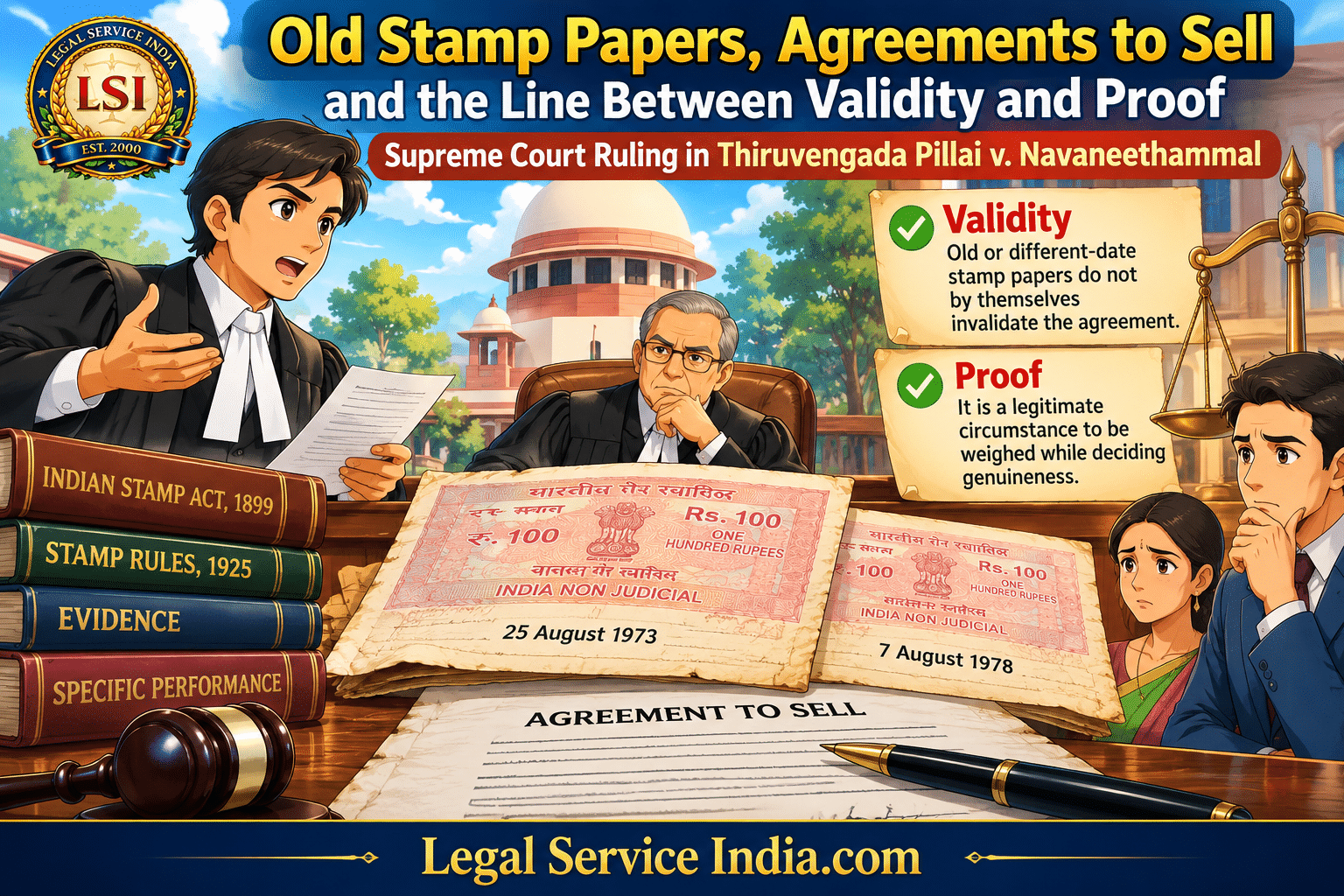
Old Stamp, Fresh Doubt: Old Stamp Papers, Agreements to Sell, and the Line Between Validity and Proof
I. The Question in a Nutshell
An agreement to sell is produced in court. It is written on stamp papers bought years before its date, perhaps on two different dates. The opposing counsel rises and says the document is a nullity. The judge, more quietly, begins to wonder whether it was ever executed on the date it claims.
These are two separate questions, and a great deal of litigation goes wrong by blending them.
The Supreme Court separated them in Thiruvengada Pillai v. Navaneethammal & Anr., (2008) 4 SCC 530 : AIR 2008 SC 1541, decided on 19 February 2008 by R.V. Raveendran and P. Sathasivam, JJ.
The rule it laid down can be stated in two sentences:
- Use of old stamp papers, or of stamp papers bought on different dates, does not by itself invalidate the agreement.
- It is, however, a legitimate circumstance that may be weighed, with other facts, in deciding whether the document is genuine.
II. The Dispute and Its Journey
The plaintiff sued for specific performance on an agreement dated 5 January 1980. He pleaded a price of Rs. 3,000, of which Rs. 2,000 was paid as advance, together with delivery of possession.
The first defendant, a village woman, denied the agreement and had meanwhile sold the property to a relative by a sale deed dated 11 February 1980.
The agreement was written on two stamp papers, one purchased on 25 August 1973 and the other on 7 August 1978, in two different names.
Trial Court (28.2.1984)
Dismissed the suit. It held the agreement to be a later creation, fabricated on old stamp papers the plaintiff happened to hold.
First Appellate Court (12.1.1987)
Decreed the suit. It placed the burden of proving forgery on the defendants and found no marked difference between the disputed and admitted thumb impressions.
High Court, Second Appeal (17.2.1999)
Restored the dismissal. It found the burden misplaced, the thumb impression pale and unclear, and the stamp papers suspicious.
Supreme Court (19.2.2008)
Dismissed the plaintiff’s appeal, but on a reasoned footing that rejected the High Court’s reliance on invalidity while upholding its doubt about genuineness.
| Court | Date | Decision |
|---|---|---|
| Trial Court | 28.2.1984 | Dismissed the suit; held the agreement to be a later creation. |
| First Appellate Court | 12.1.1987 | Decreed the suit and placed the burden of proving forgery on the defendants. |
| High Court, Second Appeal | 17.2.1999 | Restored the dismissal and found the stamp papers and thumb impression suspicious. |
| Supreme Court | 19.2.2008 | Dismissed the appeal while distinguishing document validity from genuineness. |
III. Validity: What the Stamp Act Actually Says
1. There Is No Expiry Date on a Stamp Paper
The respondent argued that stamp papers more than six months old had ‘expired’. The Court rejected this at paragraph 11.
The Indian Stamp Act, 1899 prescribes no period within which a stamp paper must be used.
Section 54 permits a refund of unused stamp paper if it is surrendered to the Collector within six months of purchase, and that is all it does.
The six-month window governs refunds, not use.
2. Two Papers, Two Dates: No Rule Against It
The second argument was that stamp papers bought on different dates cannot lawfully be combined.
At paragraph 12 the Court observed that some States require stamp vendors to issue consecutively numbered papers, and in some cases to endorse the sheets, when a single sheet of the required value is unavailable.
The Indian Stamp Rules, 1925, as applicable to Tamil Nadu, contain no such requirement.
They require only that, where several sheets make up the duty, a portion of the instrument be written on each.
The Stamp Act being a fiscal enactment meant to secure revenue, the Court held that an instrument not intended for registration is not invalid merely because it is written on two papers bought by the same person on different dates.
3. Even an Irregularity Is Curable, Not Fatal
The Court then added a fallback.
Even if the use of such papers were an irregularity, the document would only be treated as not duly stamped.
The consequence is the one the Act itself provides: the document may be received in evidence on payment of the deficient duty and penalty under section 35 or 37.
An agreement on plain paper can be cured the same way, and there is no reason to treat a defectively stamped one more harshly.
The Court closed the paragraph with the distinction that organises the whole judgment: admissibility of a document and proof of its genuineness are different issues.
Practitioner’s Caution on Scope
The Court’s reasoning was tied to the Indian Stamp Rules, 1925 as they applied in Tamil Nadu, and it referred expressly to an instrument that is not intended to be registered.
Rules on vendor endorsements, purchaser names and serial numbers differ from State to State.
IV. Genuineness: When Old Stamps Weigh in the Balance
Having cleared the validity objection, the Court turned at paragraph 13 to what old stamps can legitimately prove. Its reasoning is practical.
A person fabricating a back-dated agreement faces an immediate difficulty: stamp paper of the old date is hard to obtain. Tampering with the vendor’s date, seal and entries is therefore common in forged documents.
When an agreement bears the date 5 January 1980 but rests on papers bought in 1973 and 1978, one available inference is that the plaintiff could not obtain stamp paper bearing a date before the rival sale and used what he had.
The Court then drew the limit on that inference. It also recognised that a lay person unfamiliar with stamp law may bona fide use old, unused papers lying with him.
The upshot is captured in the Court’s own formulation that the circumstance may cast doubt, but that cannot be a clinching evidence.
Thiruvengada Pillai, para 13
The judgment is more measured. The circumstance may cast doubt, and it does so as one piece of evidence among others.
In the case itself the doubt arose from the combination of facts, not from the stamp papers alone. Pleadings that treat old stamp papers as automatically suspicious overstate the holding. So do pleadings that treat them as irrelevant.
What Actually Sank the Agreement
At paragraphs 16 and 17 the Court listed the circumstances that, taken together, created doubt and displaced the plaintiff’s three witnesses:
- the old stamp papers, bought in 1973 and 1978 for a document dated 1980;
- a thumb impression that the High Court had found pale and unclear;
- the recital that possession was delivered, which was untrue, since possession stayed with the first defendant and then passed to the second;
- the title deeds, which were never handed to the plaintiff;
- attesting witnesses who were close relatives of the plaintiff, one of whom was not examined, and an unsatisfactory scribe;
- the improbability that an illiterate elderly woman would agree to sell to the plaintiff and sell to someone else barely a month later.
The lesson for the propounder is that stamp-paper history is only one thread.
A plaintiff whose agreement is consistent on possession, title deeds, independent witnesses and conduct can survive an old-stamp objection. One whose agreement is weak on those points is unlikely to be saved by an innocent explanation of the stamp papers.
V. The Thumb Impression and the Limits of Judicial Comparison
The first appellate court had compared the disputed thumb mark with the admitted one and found no marked difference.
The Supreme Court examined the statutory frame at paragraph 14: section 45 of the Evidence Act makes expert opinion on finger impressions relevant, and section 73 allows the court to compare an admitted impression with a disputed one.
It surveyed the authorities, namely State (Delhi Administration) v. Pali Ram, (1979) 2 SCC 158, Murari Lal v. State of M.P., (1980) 1 SCC 704, O. Bharathan v. K. Sudhakaran, (1996) 2 SCC 704, Ajit Savant Majagvai v. State of Karnataka, (1997) 7 SCC 110 and Lalit Popli v. Canara Bank, (2003) 3 SCC 583.
The line of cases permits comparison by the court but counsels caution, and Murari Lal stresses that the court cannot shirk the duty where no expert is called.
The Workable Test for Thumb Impression Comparison
At paragraph 15 the Court reconciled them with a workable test:
- Where both impressions are clear and the court can identify their characteristics, it may record a finding without an expert.
- Where the disputed impression is smudgy, vague or faint and the person positively denies it, the court should hesitate to decide on its own comparison.
- If the court does compare, it must study the characteristics, similarities and dissimilarities with care, and its judgment must give reasons. A casual glance, or a bare remark that there is no marked difference, is not a valid finding.
- In the case at hand the first defendant had positively denied the impression, and the disputed mark was pale. The first appellate court’s casual comparison was therefore unsound.
VI. Burden: The Propounder Proves
At paragraph 17 the Court corrected the first appellate court’s allocation of the burden.
The appellate court had reasoned that whoever alleges forgery must prove it. The Supreme Court held that this overlooks a basic rule: the party who propounds a document must prove it.
The plaintiff alleged an agreement, the defendant denied it, and the burden lay on the plaintiff to prove execution.
The defendant was not required to prove a negative, nor to apply for a fingerprint expert to disprove the plaintiff’s case.
The plaintiff in turn had examined himself, the scribe and one attesting witness, and the court held that the surrounding circumstances nonetheless raised a doubt that displaced that evidence.
VII. The Wider Stamp-Law Landscape
1. Section 36 and the Timing of Objections: Javer Chand
A party who wishes to attack a document on stamp grounds must act when it is tendered.
In Javer Chand v. Pukhraj Surana, AIR 1961 SC 1655 : (1962) 2 SCR 333, a Constitution Bench held that once a document has been admitted in evidence after the court has judicially considered the question, section 36 bars the trial court, the appellate court and the revisional court from going behind that admission on the ground of insufficient stamp.
The High Courts have since applied this to hold that a document marked subject to objection, without a judicial determination, does not attract the bar.
The practical rule is that the objection should be taken at the time of tendering and a ruling obtained.
2. Inadmissible Is Not Void: In Re: Interplay (2023)
A seven-Judge Bench of the Supreme Court in In Re: Interplay between Arbitration Agreements under the Arbitration and Conciliation Act, 1996 and the Indian Stamp Act, 1899, 2023 INSC 1066 : [2023] 15 SCR 1081 (Curative Petition (C) No. 44 of 2023, decided 13 December 2023), held that an unstamped or insufficiently stamped instrument is inadmissible in evidence under section 35, but is not void or void ab initio, and that the defect is curable under the procedure the Stamp Act provides.
It overruled the five-Judge Bench decision in N.N. Global Mercantile Pvt. Ltd. v. Indo Unique Flame Ltd., (2023) 7 SCC 1, which had treated such an instrument as void.
Two cautions.
- First, the holding of Re: Interplay arose in the context of arbitration agreements, so its direct authority is on that footing.
- Second, its central reasoning, that section 35 speaks of admissibility and not validity, runs in the same direction as paragraph 12 of Thiruvengada Pillai.
I offer it as a consistent and reinforcing line of reasoning and not as a ruling on agreements to sell.
VIII. Practitioner’s Checklist
For the Party Propounding the Agreement
- Lead evidence on the stamp papers: the vendor, the vendor’s register and the purchaser’s name, and an honest explanation of why old papers were used.
- Make the recitals true. Possession, advance, and delivery of title deeds should match what actually happened, and any gap needs a plausible explanation.
- Prefer independent attesting witnesses and a scribe with no tie to you; examine every attesting witness who is available.
- If the executant denies the thumb impression, seek an expert’s opinion early. Do not rely on the court to compare a faint impression.
- If the document is later held deficiently stamped, be ready to pay duty and penalty so that it can be received in evidence.
For the Party Resisting It
- Object when the document is tendered, ask for a judicial ruling, and ensure it is not marked simply “subject to objection” with the issue left open.
- Plead and prove fabrication by the cumulative circumstances: stamp dates against the agreement date, possession, title deeds, witness relationships and conduct.
- Do not argue that old or mixed-date stamp papers make the agreement invalid. That ground is closed by paragraphs 11 and 12. Argue weight instead.
- Remember that the burden of proving execution stays with the propounder.
IX. Citation Table
| Case | Citation / Bench | Legal Proposition |
|---|---|---|
| Thiruvengada Pillai v. Navaneethammal & Anr. | SC, 19.02.2008; Raveendran & Sathasivam JJ.; (2008) 4 SCC 530 : AIR 2008 SC 1541 : (2008) 2 SCALE 630 | Core authority: paras 11–13 (stamp paper), 14–16 (thumb impression), 17 (burden) |
| State (Delhi Admn.) v. Pali Ram | (1979) 2 SCC 158 | Court may compare writings, but prudence favours expert (as cited in para 14.1 of the judgment) |
| Murari Lal v. State of M.P. | (1980) 1 SCC 704 | Court’s duty to compare where no expert is called (as cited in para 14.2) |
| O. Bharathan v. K. Sudhakaran | (1996) 2 SCC 704 | Caution on judge’s own comparison reiterated (as cited in para 14.1) |
| Ajit Savant Majagvai v. State of Karnataka | (1997) 7 SCC 110 | Comparison under s. 73 Evidence Act; extreme caution (as cited in para 14.1) |
| Lalit Popli v. Canara Bank | (2003) 3 SCC 583 | Follows Murari Lal (as cited in para 14.2) |
| Javer Chand v. Pukhraj Surana | Constitution Bench, 25.04.1961; AIR 1961 SC 1655 : (1962) 2 SCR 333 | Section 36: admission in evidence cannot be reopened; objection must be judicially decided when tendered |
| In Re: Interplay between Arbitration Agreements under the Arbitration and Conciliation Act, 1996 and the Indian Stamp Act, 1899 | 7 Judges, 13.12.2023; 2023 INSC 1066 : [2023] 15 SCR 1081 : Curative Pet. (C) No. 44 of 2023 | Unstamped / insufficiently stamped instrument is inadmissible, not void; defect is curable |
| N.N. Global Mercantile v. Indo Unique Flame Ltd. | 5 Judges; (2023) 7 SCC 1 | The contrary view, overruled in Re: Interplay |

