





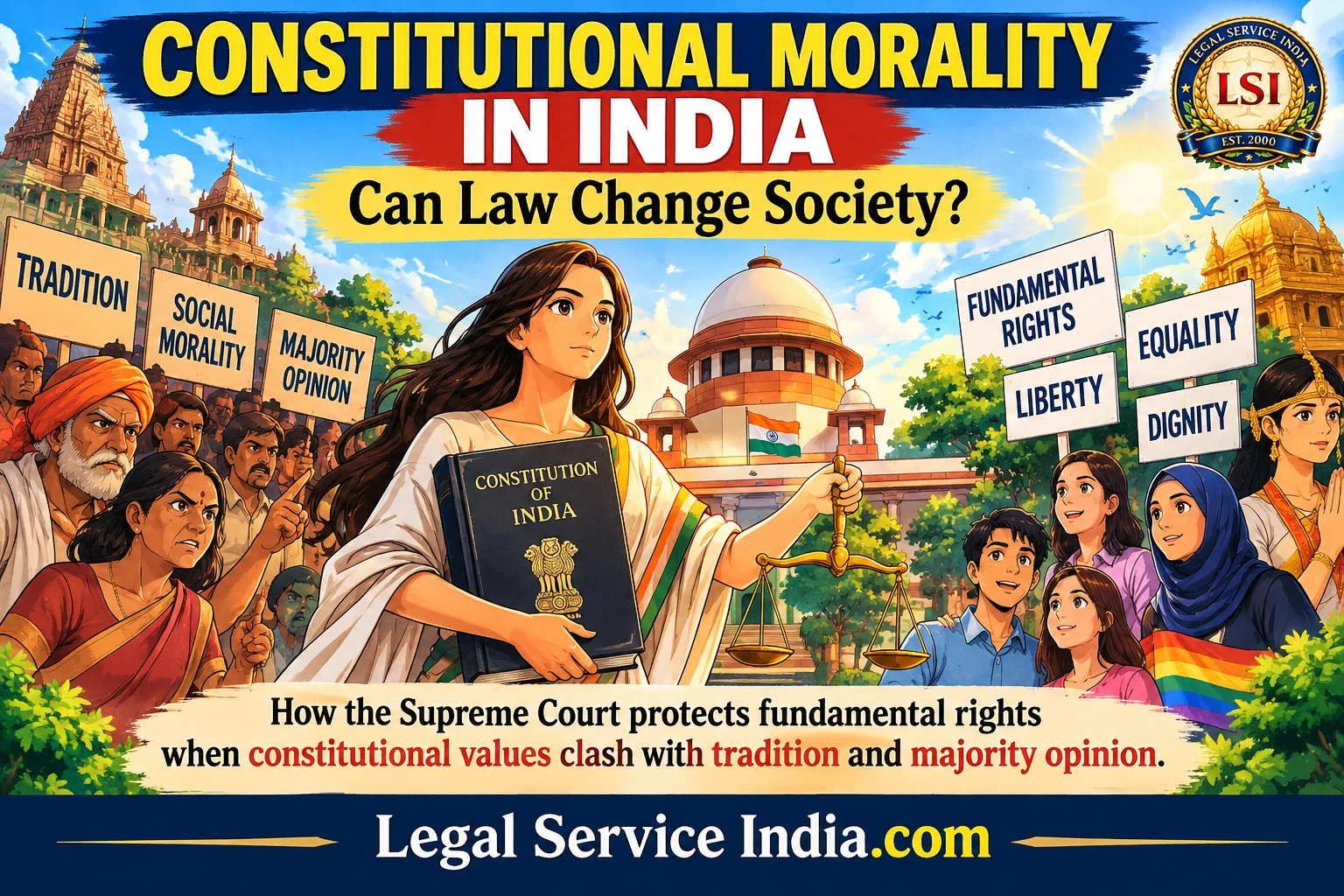
Constitutional Morality: Upholding Rights Against the Will of the Majority
“Majorities get things wrong more often than we’d like to admit. For centuries, slavery was legal because most people accepted it. Women were kept out of voting booths because most people thought that was fine too. Discrimination wasn’t some fringe belief; it was mainstream, backed by ordinary people who genuinely believed they were on the right side of things. That’s really the whole reason constitutional morality exists. Because if justice depended on what most people wanted at any given time, we’d still be living with a lot of these injustices today.”
Introduction
Long before constitutions were written, societies already had their own moral compass shaped by tradition, religion, and collective conscience. So why did we still need something called constitutional morality? Was it born out of the loopholes social morality left exposed, or a deeper realisation that shared conscience alone couldn’t protect every individual fairly? This raises a bigger question between the two: which one truly prevails in shaping our society today, and is it social morality’s closeness to lived experience or constitutional morality’s structured authority that holds more weight? But perhaps what matters most isn’t which one is superior; it’s whether the two, together, are taking our country forward or whether their growing conflict is quietly making things worse.
So many questions and answers remain full of ambiguity because of the different points of view people hold. There have been so many debates on this topic, but the conclusions have just created more confusion among people. For some, social morality stands above constitutional morality, and for others, it’s totally the opposite. What’s accepted by the law is often rejected by society, and what’s accepted by society is often considered illegal as per the law.
The best example for this vice-versa situation is the case of ‘Shakti Vahini vs. Union of India 2018 [1]. In this case, the Supreme Court rules that consenting adults have a fundamental right to marry a partner of their choice, making any interference or honour-related violence by families or community groups completely illegal. What does this case teach us? That which is considered totally wrong by society, “marriage by choice”, is the very thing being protected by the law. There are many more examples like this, which show how society and our law often clash.
Ambedkar’s Warning: Why India Needs More Than Social Morality
The term itself goes back to George Grote, a British historian, who used it to describe a kind of balance where citizens respect and follow constitutional authority but still hold on to their right to question and criticise those in power. In other words, it’s not blind obedience to the system, nor is it constant rebellion against it. It sits somewhere in between.
“Dr Ambedkar’s Thought on Constitutional Morality” invoked Grote’s idea to stress the importance of cultivating a deep respect for constitutional processes. Ambedkar observed that “constitutional morality is not a natural sentiment – it has to be cultivated.” [2]
Did Ambedkar warn people about constitutional morality? No, Ambedkar wasn’t warning people to stay away from constitutional morality; quite the opposite. His real concern was what would happen if it never took root. He didn’t believe it came naturally to people; it had to be built, deliberately, especially in a country like India. That’s why he used that harsh but honest line that Indian democracy was just a “top-dressing” on a society that was, underneath, still deeply undemocratic. He also didn’t trust methods like civil disobedience once constitutional paths were available, calling it the “Grammar of Anarchy”. And he was wary of something else too: people putting too much faith in individual leaders, because that kind of blind devotion has a way of turning into dictatorship. But the warning he kept coming back to, repeatedly, was this political democracy simply cannot survive if social and economic inequality is left unresolved. He called it a “life of contradictions”, and he wasn’t wrong to worry. Left unresolved, that contradiction was bound to explode.
Right by Law, Wrong by Society
At its core, this clash comes down to old versus new or, maybe more accurately, tradition versus principle. Social morality is what most people grew up believing is right, shaped by custom, religion, and years of shared practice. Constitutional morality, on the other hand, doesn’t really care what’s traditional or popular; it’s built on ideas like justice, liberty, equality, and the basic dignity of every individual, written directly into the Constitution. And that’s exactly why the two don’t always get along.
When these two forces collide, the majority of the time constitutional morality overrides the social morality. In the case of ‘Navtej Singh Johar vs Union of India, 2018′, the court pushed back on the earlier Suresh Kumar Koushal ruling; this legal fight actually started much earlier. It began when the NAZ Foundation, famously known as ‘Naz Foundation vs Government of NCT of Delhi, 2009′ [3], an NGO working on HIV/AIDS prevention in the LGBTQ+ community, challenged Section 377 in the Delhi High Court.
Their argument was straightforward: the law was making their work harder because it basically gave legal backing to discrimination against sexual minorities, and it violated the right to liberty under Article 21 by punishing private, consensual relationships. In 2009, the Delhi High Court agreed with them. It ruled that Section 377 stripped people of their dignity and criminalised their identity, just because of who they loved, and that this went against Article 21. But the story didn’t end there. The case went up to the Supreme Court, and in 2013, in a judgement now known as ‘Suresh Kumar Koushal vs Naz Foundation, 2013′ [4], the Court actually reversed this decision.
It said there wasn’t enough proof that the law was being misused against LGBTQ+ people, pointed out that very few people had actually been prosecuted under it, and said that deciding what counts as moral or immoral should be Parliament’s job, not the courts. So, in short, the Supreme Court brought Section 377 back, undoing years of progress, until this very judgement was later criticised and finally overturned in the Navtej Singh Johar case, pointing out that it had wrongly lumped consensual adult relationships together with offences like non-consensual acts, without drawing any real distinction between the two.
Drawing on the NALSA and Puttaswamy judgements, the Court recognised sexual orientation as a core part of a person’s identity and privacy and leaned on earlier rulings like Shakti Vahini to reaffirm that choosing a partner is a basic part of personal liberty and dignity. It made clear that public morality can’t be used to criminalise people simply for who they are; that kind of thinking, the Court said, has no place in a system built on constitutional morality. In the end, the five-judge bench unanimously struck down Section 377 as unconstitutional, decriminalising consensual sexual acts between adults in private, while making it clear that consent must always be free and without any pressure. [5]
If the Section 377 judgement showed how constitutional morality stepped in to protect sexual minorities from a society that saw them as outsiders, the Sabarimala case, called ‘Indian Young Lawyers Associates vs State of Kerela, 2018′, showed the same struggle play out along the lines of gender. For decades, women of a certain age group were barred from entering the Sabarimala temple to worship Lord Ayyappa, a practice that had simply been accepted as tradition, rarely questioned by the very society that upheld it. But when this custom was challenged in court, it forced the judiciary to ask a much bigger question, which is, can a religious tradition, however old, continue to exist if it violates the basic rights guaranteed by the Constitution?
The Sabarimala case is really where the difference between social morality and constitutional morality came into sharp focus. The Seven Judge Bench in the Supreme Court of India held that Article 25 guarantees the right to religion equally, regardless of gender, so barring women from worshipping Lord Ayyappa simply didn’t hold up. It also rejected the argument that Ayyappa devotees formed a separate religious denomination under Article 26, pointing out that just because certain devotional practices are common among Hindus doesn’t make them a distinct religion of their own, and there was no real evidence that excluding women was an “essential” religious practice to begin with. One of the most important things the Court clarified here was that “morality” means in this context not society’s version of morality, which doesn’t bend to those biases. At the end of the day, denying women entry just because of their gender was a plain violation of their fundamental rights, no matter how deep-rooted the custom was. [6]
Sometimes it isn’t just religion or gender that society tries to police; it’s who you choose to love. The ‘Shafin Jahan v. Asokan K.M. & Ors.’ case, which is famously known as the ‘Hadiya Case’, is a striking example of this, where a woman’s personal choice to convert and marry was treated not as a private decision but as something the state, the courts, and even her own family felt entitled to question.
The Hadiya case is another one that really exposed this clash. Back in May 2017, the Kerala High Court annulled her marriage, calling it a case of “love jihad”, and handed her custody back to her parents, even going so far as to label her “emotionally weak and vulnerable”, a decision that drew sharp criticism from NGOs and civil society groups who saw it as a direct violation of her right to choose her own religion and spouse. Her husband, Shafin Jahan, took the matter to the Supreme Court, arguing that the annulment had no constitutional basis and trampled on her fundamental rights. Instead of resolving things quickly, though, the Supreme Court ordered an NIA probe to check if there was some larger love jihad conspiracy at play, a move that only added to the controversy, with many arguing the real issue was Hadiya’s personal freedom, not some unproven political narrative. Through it all, Hadiya stood by her choice, and her courage earned support from women’s rights groups who pushed the judiciary to simply respect her autonomy as an adult. [7]
The Other Side: When Law Runs Ahead of Society
It’s easy to think of constitutional morality as the hero of this story the thing that steps in and fixes what society couldn’t. And in many ways, it has. But that doesn’t mean its above criticism. Some people genuinely believe that when the law moves faster than society’s mindset, it doesn’t really solve anything it just forces the problem to hide instead of disappearing. A court can strike down a custom, pass a judgment, or grant a right overnight. But people’s beliefs, the ones built over generations of tradition, religion, and habit, don’t change just because a judgment says they should. So, the law wins on paper, but the real battle the one happening in people’s minds and homes often continues exactly as before, just quietly, out of sight.
Take the Shakti Vahini judgement, for example. In 2018, the Supreme Court didn’t just suggest that honour killings and family interference in marriages were wrong it made it unmistakably clear that they were illegal, full stop. Families and community groups no longer have any legal ground to justify violence over someone’s choice of partner. On paper, that should have settled things. But years later, honour killings are still being reported, quietly, in different states, often for the exact same reason the judgment tried to address a family deciding that someone’s marriage brought them ‘shame’. The law changed overnight. The mindset behind these killings didn’t change nearly as fast. And that gap between what the Constitution promises and what actually plays out in people’s homes is exactly where the limits of constitutional morality start to show.
The same pattern showed up with Sabarimala. The Supreme Court ruled that women of all ages had the right to enter the temple a clear, constitutional win for equality. But when women actually tried to walk in and exercise that right, the were met with mobs, protests, and in some cases, outright violence. Many gave up, not because the law was against them anymore, but because society still was. Years later, most women still choose to stay away, not out of respect for tradition, but out of fear of what might happen if they don’t. The verdict changed the law. It didn’t change the temple gates, or people standing in front of them.
Something similar happened with Section 377, On September 6, 2018, a five-judge constitution bench of the Supreme Court, led by Chief Justice Dipak Misra, unanimously struck down Section 377 to the extent that it criminalized consensual same-sex relationships. The decriminalization of homosexuality in India was a historic victory for human rights, but challenges remain. While the ruling removed legal penalties, social acceptance, workplace discrimination, and marriage rights continue to be pressing issues.[8] Overnight, being gay stopped being a crime in the eyes of the law. But it didn’t stop being ‘wrong’ in the eyes of a lot of families, communities, or even workplaces. LGBTQ+ individuals in India still talk about being rejected by their own families, facing whispers and exclusion in social circles, or being quietly passed over at work. The law gave them protection. It didn’t give them acceptance. And for most people, it’s the second one that actually determines how safe or free they feel in everyday life.
Law Can Force a Decision, Not a Belief
And honestly, this is where the argument for social morality actually makes sense. Change doesn’t really stick when it’s just forced down from the top people need to accept it themselves, not just be told to. Sure, a court can hand someone a right. But if the people around that person, their family, neighbours, colleagues, don’t actually accept it, that right kind of just sits there. It’s real in the eyes of the law, in some judgment nobody outside law school ever reads, but not necessarily real in how that person is actually treated day to day. And that’s the hard part nobody likes to admit you can force a decision through law, but you can’t force what people actually believe.
Constitutional Rights and Social Acceptance
So where does all this actually leave us? Maybe the whole point was never about picking a winner between the two. Constitutional morality gives people rights they’d probably never get if it were left up to social consensus some things just wouldn’t pass a majority vote, and that’s exactly the problem it was built to fix. But social morality is what decides whether those rights actually mean something in someone’s everyday life, or whether they just sit quietly in a court judgment somewhere. Honestly, neither one really works without the other.
| Constitutional Morality | Social Morality |
|---|---|
| Gives people rights. | Determines how those rights are experienced in everyday life. |
| Can protect rights against majority opinion. | Reflects acceptance within families and communities. |
| Can change the law through constitutional interpretation. | Changes more gradually through social acceptance. |
How Far Have We Actually Come?
So let’s go back to the question this whole article started with are constitutional morality and social morality actually helping the country move forward together, or is their constant clash making things worse? Ambedkar’s warning is probably the best place to look for an answer. He never thought political democracy alone would be enough. What he actually feared was a country where rights kept moving forward while people’s attitudes just stayed the same. And honestly, looking at cases like Shakti Vahini, Sabarimala, Section 377, and Hadiya, that’s pretty much exactly what happened.
In every one of them, the Constitution moved first, and society followed slowly, or reluctantly, or sometimes, didn’t really follow at all. So has the country moved forward? Legally, yes. Rights exist today that simply didn’t exist ten years ago. But if you measure progress by how people actually treat one another, not just what the law technically allows, things look a lot messier. Ambedkar saw this contradiction coming long before any of these cases even existed. The question was never whether India would face this tension, he already knew it would. The real question is how much longer the country is willing to let that gap stay open
Law and Society: The Measure of Progress
- Legally, rights have expanded.
- Constitutional principles have moved forward.
- Social attitudes have often changed more slowly.
- The gap between legal rights and social acceptance remains an important challenge.
Closing the Gap
Pointing out the gap between law and society is the easy part. The harder question is what actually closes it. Some of it comes down to simple awareness. Most people who resist court rulings aren’t doing it out of malice, they just don’t fully know the reasoning behind them, so a verdict ends up feeling like the courts “interfering” instead of protecting someone. Some of it has to happen on the ground too, through schools, local leaders, everyday conversations, because a judgment can change the law overnight, but it takes people a community actually trusts to change how that community thinks.
And honestly, some of it just takes time. Attitudes rarely change the moment a law does. It’s usually the next generation, the ones growing up without the same rigid ideas, who end up normalizing what their parents still struggled to accept. That said, none of this means courts should just sit back and wait for society to catch up on its own. If judges only acted once something became socially acceptable, most of the rights we take for granted today probably wouldn’t even exist yet.
How the Gap Can Close
- Some of it comes down to simple awareness.
- Some of it has to happen on the ground too, through schools, local leaders, everyday conversations.
- Some of it just takes time.
- It’s usually the next generation that ends up normalizing what their parents still struggled to accept.
- Courts should not simply wait for society to catch up on its own.
No single one of these things fixes everything by itself. But together, they’re probably what slowly brings social morality a little closer to where constitutional morality already stands.
Conclusion
Ambedkar warned us about this. He said India was walking into a life of contradictions, political equality on paper, but social and economic inequality still very much alive underneath it, and that this couldn’t go on forever without something eventually giving way. Reading that today, decades later, it’s almost unsettling how true it still feels. The Constitution keeps handing out rights, one judgment at a time, while society, in a lot of places, is still trying to catch its breath from the last one.
Maybe that’s just what change costs in a country this old, this big, this tangled up in tradition. But a contradiction like this was never meant to last forever. It’s meant to be worked through, slowly, uncomfortably, one case at a time. And every time a court stands up for someone society was ready to turn its back on, that gap shrinks a little.
Whether it fully closes in our lifetime, or our kids, probably isn’t even the real point. What matters is that it keeps closing, not just in courtrooms, but in homes, in classrooms, in all the small, everyday decisions people make about who actually deserves respect, and who, in their eyes, still doesn’t.
References
- Shakti Vahini v. Union of India, (2018) 7 SCC 192.
- Drishti IAS, Constitutional Morality in India, Daily News Analysis, 3rd September 2026, https://www.drishtiias.com/daily-updates/daily-news-analysis/constitutional-morality-in-india
- Naz Foundation v. Government of NCT of Delhi, 160 DLT 277 (Del) (2009).
- https://globalfreedomofexpression.columbia.edu/cases/koushal-v-naz-foundation/
- https://privacylibrary.ccgnlud.org/case/navtej-singh-johar-and-ors-vs-union-of-india-uoi-and-ors
- https://www.ijlra.com/details/a-case-study-of-sabarimala-temple-case-indian-young-lawyers-v-state-of-kerela-%E2%80%93-by-vaasawa-sharma
- https://testbook.com/ias-preparation/hadiya-case
- https://vil.ac.in/lgbtq-rights-in-india-section-377-case-study-impact/

