





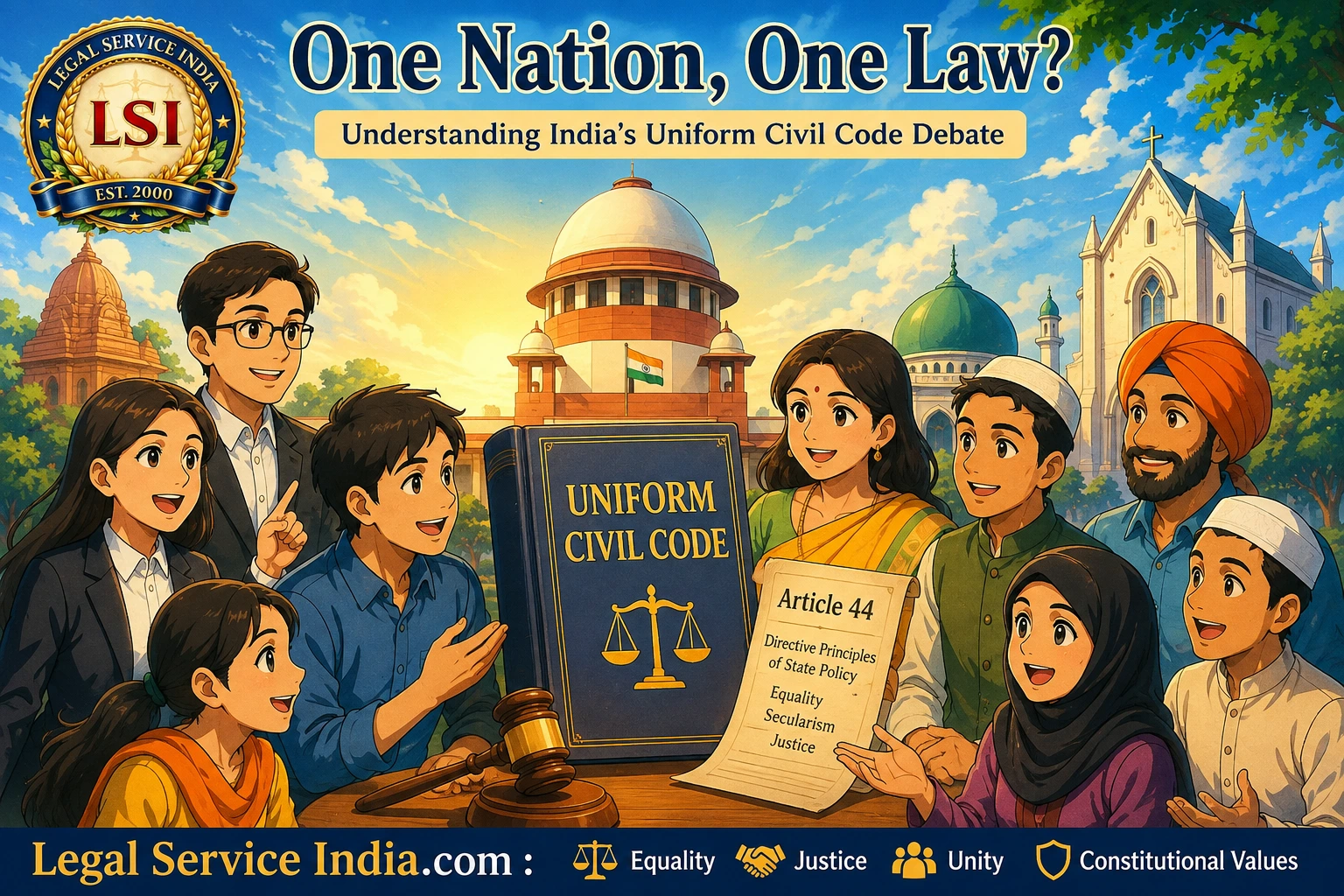
One Nation, One Law? Understanding India’s Uniform Civil Code Debate
India is home to extraordinary cultural and religious diversity. Different communities follow different personal laws governing marriage, divorce, inheritance, and adoption. This diversity is one of India’s greatest strengths, but it has also given rise to an important legal debate: Should there be one common civil law for every citizen?
The idea of a Uniform Civil Code (UCC), often described as “One Nation, One Law,” has become one of the most discussed constitutional issues in recent years. While many believe it would promote equality and simplify the legal system, others fear it could affect religious freedom and cultural identity.
What Is the Uniform Civil Code?
A Uniform Civil Code (UCC) is a proposed legal framework that seeks to replace religion-based personal laws with a common set of civil laws applicable to all citizens, irrespective of their religion. It would govern matters such as marriage, divorce, maintenance, adoption, and inheritance.
At present, different religious communities are governed by different personal laws. Supporters of the UCC argue that a common civil code would create greater legal uniformity and reduce confusion.
Why Has the UCC Become Important?
As India continues to develop socially and economically, many believe that its legal framework should also evolve. Supporters argue that a common civil code could strengthen equality before the law, promote gender justice, and reinforce the constitutional principle of secularism.
At the same time, opponents emphasise that India’s diversity requires careful consultation before introducing any uniform legal framework.
Arguments in Favour of the UCC
Supporters argue that the UCC could:
- Promote gender equality by ensuring equal civil rights.
- Strengthen secularism by applying the same civil laws to all citizens.
- Simplify the legal system by reducing multiple personal-law frameworks.
- Promote national integration through a common civil code.
- Advance the constitutional objective reflected in Article 44 of the Directive Principles of State Policy.
Arguments Against the UCC
Critics argue that the UCC may:
- Affect religious freedom protected under Article 25.
- Reduce India’s cultural and legal diversity.
- Raise concerns among minority communities regarding majoritarian influence.
- Affect customary practices followed by several tribal communities.
Constitutional Provisions and Judicial Developments
Article 44 of the Constitution encourages the State to endeavour to secure a Uniform Civil Code for all citizens. Article 14 guarantees equality before the law, while Article 25 protects the freedom of religion. The continuing debate largely revolves around balancing these constitutional values.
Article 44 and the Uniform Civil Code
One of the most significant judgments is Mohd. Ahmed Khan v. Shah Bano Begum (1985), where the Supreme Court highlighted the importance of Article 44 while deciding a maintenance dispute.
Recent Developments
Several states have explored or implemented their own approaches relating to the UCC. Since these developments continue to evolve, readers should refer to the latest official notifications for the current legal position before relying on any specific state-wise information.
My Opinion
In my opinion, the Uniform Civil Code has the potential to simplify India’s civil law framework and promote equality. However, any implementation should be gradual, carefully drafted, and based on meaningful consultation with all communities.
A successful UCC should protect constitutional values while respecting India’s cultural diversity.
Conclusion
The debate on the Uniform Civil Code is not merely about creating one law for everyone; it is about finding a balance between equality, religious freedom, and India’s pluralistic identity.
Whether or not the UCC is ultimately adopted nationwide, the discussion should remain guided by constitutional principles, mutual respect, and informed public dialogue.
A well-designed legal framework should unite citizens without compromising the diversity that defines India.
References
- Constitution of India (Articles 14, 25 and 44)
- Mohd. Ahmed Khan v. Shah Bano Begum (1985)
- Official government notifications and reliable legal sources for recent developments
Written By: Shweta Pathak, BBA LL.B. Student | Interested in Constitutional Law, Corporate Law, and Legal Research

