





Indian Jurisprudence: Personal Law vs. Child Protection Laws
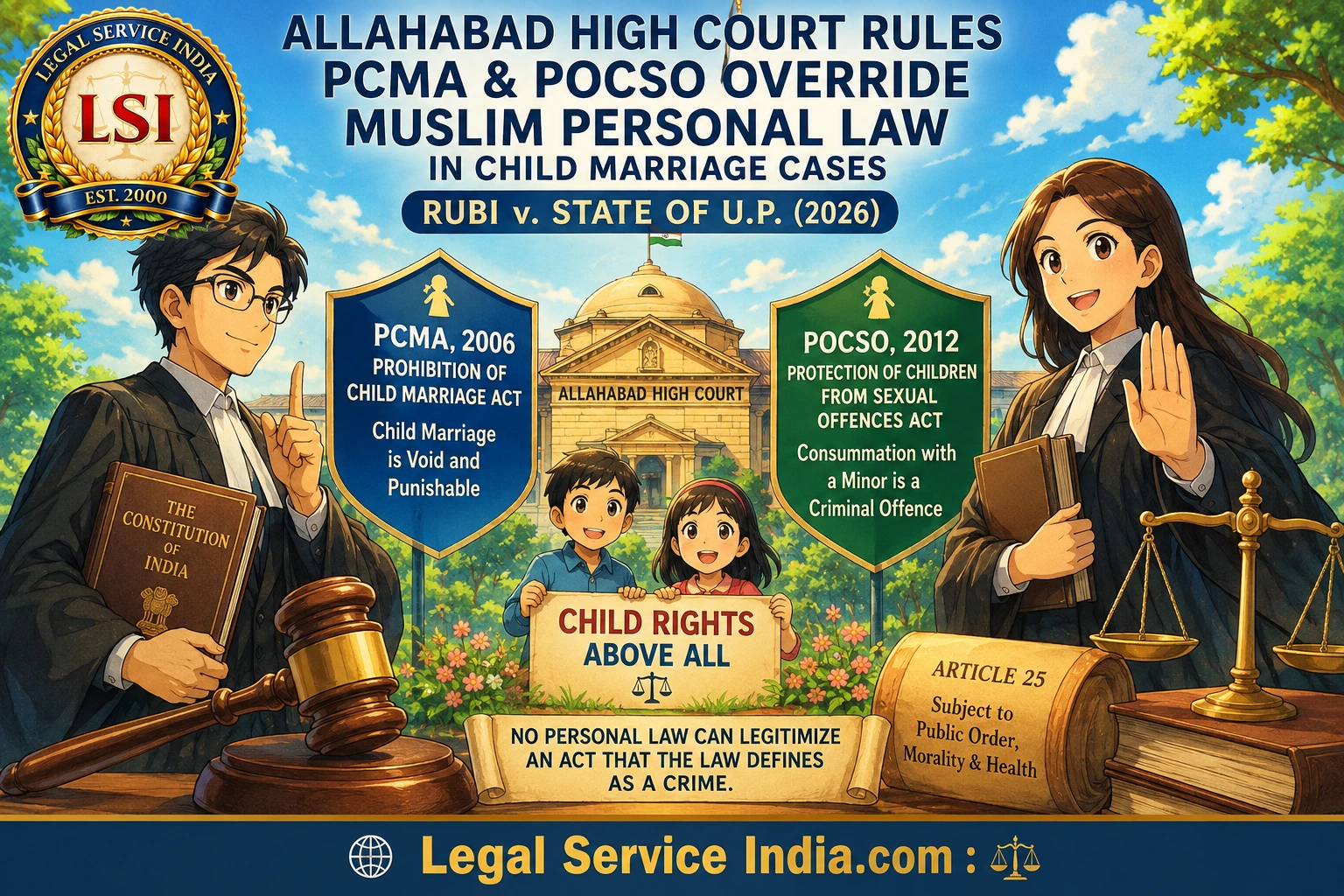
The long-standing tension in Indian jurisprudence between uncodified personal religious laws and codified, secular social welfare legislation found a decisive battleground in the Allahabad High Court’s ruling in Rubi v. State of U.P. (2026). By ruling that the Prohibition of Child Marriage Act, 2006 (PCMA) and the Protection of Children from Sexual Offences Act, 2012 (POCSO) completely override Muslim Personal Law (Shariat) regarding the marriageable age of minors, the High Court did more than resolve a localized criminal dispute. It advanced a crucial jurisprudential shift: the absolute subordination of religious customs to state-enforced, science-backed child protection frameworks.
Petitioners’ Statutory Defense
To understand the weight of this judgment, one must analyze the sophisticated statutory defense mounted by the petitioners. The defense relied on a highly calculated intersection of the Shariat Application Act, 1937, which recognizes the age of puberty as the age of marriage competency, and Section 2 of the Majority Act, 1875, which contains a historic clause stating that the standard legal age of majority does not affect the capacity of any person to act in matters of marriage.
The petitioners argued that because the Shariat Act and the Majority Act specifically preserved religious autonomy over marriage, secular age barriers could not apply.
Key Arguments Raised by the Petitioners
- The Shariat Application Act, 1937, recognizes puberty as the age of marriage competency.
- Section 2 of the Majority Act, 1875, preserves personal law in matters relating to marriage.
- Religious autonomy over marriage should prevail over secular statutory age restrictions.
High Court Rejection of the Defense
The High Court dismantled this framework by applying the rule of implied repeal and the doctrine of later general overriding statutes. The Bench noted that the PCMA and POCSO are specialized, modern statutes designed with a specific legislative intent: the eradication of child exploitation.
Because these modern laws explicitly state they apply universally to all citizens of India, within and beyond its borders, they automatically extinguish any historical exemptions carved out by colonial-era legislation like the Majority Act of 1875.
Legal Principles Applied by the Court
| Legal Principle | Application by the Court |
|---|---|
| Rule of Implied Repeal | Modern child protection statutes override inconsistent earlier laws. |
| Doctrine of Later Overriding Statutes | Later legislation with universal application prevails over older conflicting provisions. |
| Universal Applicability | PCMA and POCSO apply equally to every citizen irrespective of religion. |
Marriage and Statutory Rape: The Court’s Analytical Breakthrough
Perhaps the most potent analytical breakthrough in the judgment is how the court bridged the gap between a civil status like marriage and a criminal act like statutory rape.
Under personal law, marriage is viewed primarily as a civil contract. However, the High Court injected a dose of judicial realism into this framework, observing that physical intimacy is an inseparable component of the institution of marriage, rendering any attempt to evaluate child marriage solely through the lens of contract law a legal fiction.
The moment a marriage involving a minor under the age of eighteen is consummated, the civil contract directly triggers a criminal offense under the POCSO Act.
By highlighting this inevitability, the Court established that no personal law can legitimize an act that a secular, penal statute defines as an absolute crime, rendering the civil validity of the underlying marriage entirely irrelevant to criminal liability.
Civil Contract vs. Criminal Liability
| Aspect | Personal Law View | High Court’s Interpretation |
|---|---|---|
| Marriage | Civil contract | Civil relationship with unavoidable criminal consequences if involving a minor. |
| Consummation | Part of marital relationship | Triggers a statutory offense under the POCSO Act. |
| Criminal Liability | Dependent upon personal law validity | Independent of personal law; governed entirely by penal statutes. |
Conflicting High Court Views
For over a decade, Indian High Courts have been deeply fractured on this issue.
While the Punjab and Haryana High Court had historically upheld the validity of a fifteen-year-old minor’s marriage based on puberty and personal choice, other courts indicated the matter remained an open question pending a final apex court ruling.
The Allahabad High Court’s ruling is structurally significant because it refused to take a passive stance while waiting for the Supreme Court of India to deliver a definitive pronouncement.
Acknowledging that the apex court had previously dismissed similar challenges primarily on technicalities like locus standi, the Allahabad Bench asserted its independent judicial duty, firmly aligning itself with the progressive precedent of the Kerala High Court to tilt the judicial scale toward a uniform, secular application of child rights across the country.
Judicial Development
- The Punjab and Haryana High Court previously recognized puberty-based marriage under personal law.
- Other high courts treated the issue as unsettled.
- The Allahabad High Court independently adopted a child-rights-centric interpretation.
- The Bench aligned with the progressive approach taken by the Kerala High Court.
Child Protection as a Public Health Imperative
A foundational takeaway from this judgment is the Court’s characterization of the PCMA and the POCSO Act not merely as penal codes but as statutes based on public health and national interests.
The Bench noted that these laws are built upon a modern, scientific understanding of childhood development, psychological maturity, and reproductive health.
By categorizing child protection as a public health imperative, the judiciary firmly placed it within the domain of the state’s police powers to protect its most vulnerable citizens.
Under this analytical framework, religious freedom under Article 25 of the Constitution remains subject to public order, morality, and health, meaning traditional practices must legally yield when they threaten the biological and psychological well-being of a child.
Constitutional Framework
| Constitutional Principle | Court’s Interpretation |
|---|---|
| Article 25 | Religious freedom is subject to public order, morality, and health. |
| Public Health | Child protection is a compelling state interest. |
| Scientific Basis | Modern child development and reproductive health justify legislative intervention. |
Protection of Law Enforcement and ChildLine Workers
Finally, the judgment addresses a critical administrative reality regarding the physical vulnerability of those tasked with enforcing social justice at the grassroots level.
The fact that the law enforcement team and Child Line workers were violently assaulted highlights the intense social resistance that child protection forces face.
By aggressively rejecting the family’s bid to quash the FIR, the High Court sent a strict signal to society that cultural or religious alignment with a practice does not grant a community immunity from the penal consequences of obstructing state justice.
In upholding the criminal investigation against the community members, the Court reinforced a vital constitutional principle: the rule of law cannot be negotiated at the doorstep of tradition.
Key Takeaways
- PCMA and POCSO override conflicting personal law provisions concerning the marriageable age of minors.
- Modern child protection laws prevail over colonial-era statutory exceptions.
- Marriage involving a minor cannot shield criminal liability under the POCSO Act.
- Child protection is treated as a matter of public health and constitutional governance.
- Religious practices remain subject to public order, morality, and health under Article 25.
- Obstruction of child protection authorities attracts full penal consequences regardless of cultural or religious justification.

