





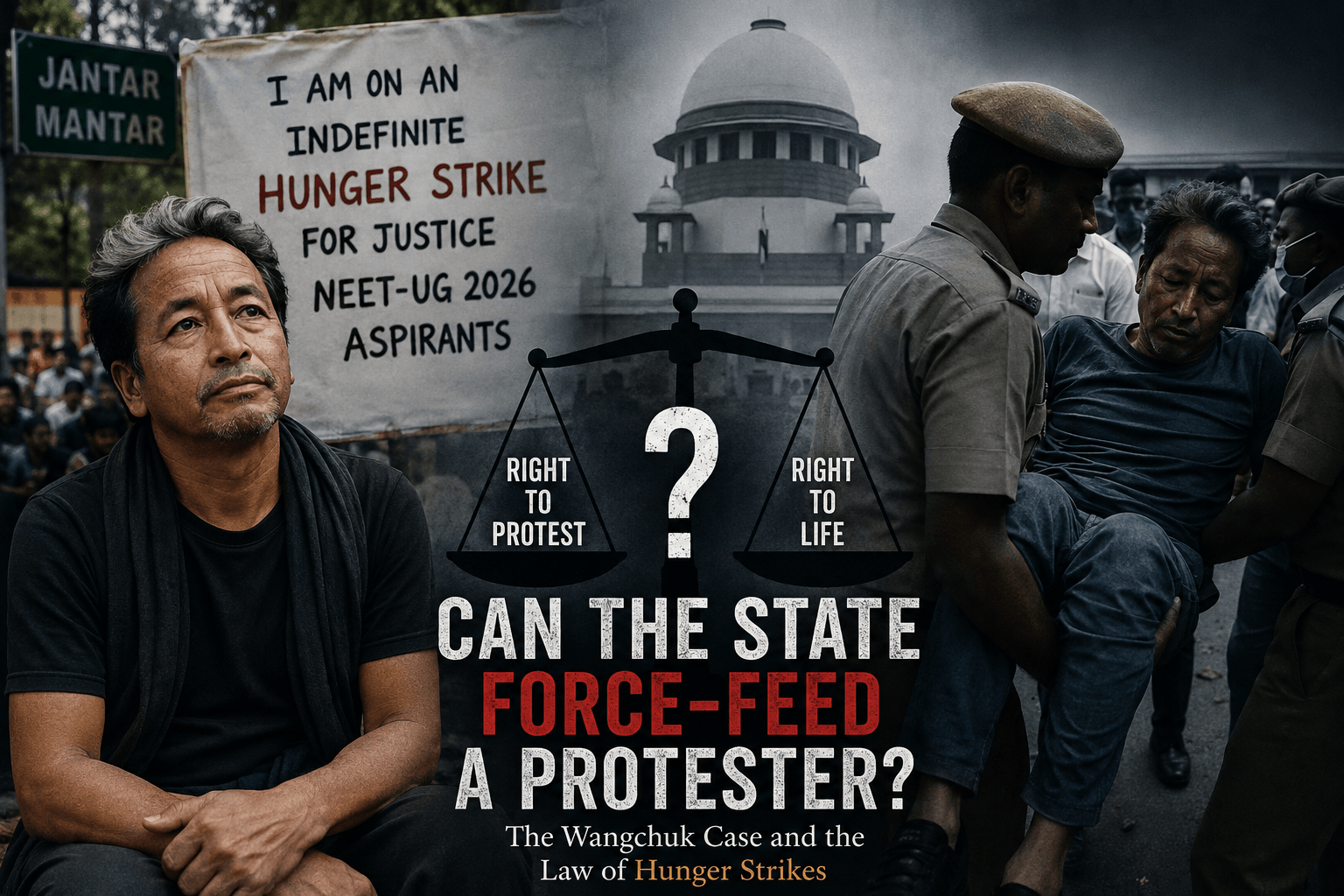
Can the State Force-Feed a Protester? The Wangchuk Case and the Law of Hunger Strikes
For twenty days, Jantar Mantar in New Delhi has been the theater of a protest that began over an examination scandal and has since turned into a constitutional question. Climate activist and educationist Sonam Wangchuk sat on an indefinite hunger strike from June 28, demanding the resignation of Union Education Minister Dharmendra Pradhan over the NEET-UG 2026 paper-leak controversy, which forced roughly 2.2 million medical aspirants to retake the national entrance exam.
On Saturday, July 18, Delhi Police physically removed Wangchuk from the protest site amid a brief scuffle with fellow protesters and shifted him to Safdarjung Hospital, citing deteriorating vitals on the twentieth day of the fast. He has reportedly refused IV fluids and other treatment even in hospital, and his partner, Gitanjali J. Angmo, has publicly insisted that no treatment be administered without family consent.
The episode raises a question Indian law has circled for decades but never definitively settled: can the State compel a citizen to eat, or accept medical treatment, against their will, to save their life?
The Right to Protest by Fasting
Hunger strikes occupy a unique place in Indian constitutional culture, inherited from Gandhian satyagraha. The Supreme Court’s judgment in the Ramlila Maidan Incident [1], delivered after the police crackdown on Baba Ramdev’s 2011 anti-corruption fast, held that resorting to a hunger strike to make a political point is neither unconstitutional nor barred by any statute and is a form of protest long accepted in India’s constitutional jurisprudence.
This finds its anchor in Article 19(1)(a), freedom of speech and expression, and Article 19(1)(b), the right to assemble peaceably. These freedoms are not absolute; they carry reasonable restrictions under Article 19(2) and (3), but the mere act of undertaking a fast does not itself trigger those restrictions [2].
The State’s Countervailing Duty Under Article 21
Set against this is Article 21, which guarantees the right to life [3] and which the courts have read as imposing a positive obligation on the State to preserve life, not merely to refrain from taking it.
It was on this basis that a public interest litigation was filed before the Delhi High Court seeking urgent medical intervention for Wangchuk, warning that he might not survive another 48 hours without treatment and even asking, explicitly, for hospitalization and force-feeding through a liquid diet.
On July 16, a Division Bench of Chief Justice Devendra Kumar Upadhyaya and Justice Tejas Karia disposed of that petition [4]. Precision on what the bench actually ordered matters, since it is where much of the current controversy lies.
What the Delhi High Court Ordered
The Court did not direct force-feeding. It directed that Wangchuk’s health be clinically monitored daily by government doctors and that whatever medical intervention those doctors’ assessment required be provided, observing that the life of every citizen is precious and all efforts ought to be made by authorities to save it.
Solicitor General Tushar Mehta assured the Bench that this monitoring mechanism was already in place.
The order, in short, was a monitoring-and-intervention direction, not an explicit force-feeding mandate, a distinction the government has leaned on to justify Saturday’s removal as compliance with judicial directions rather than a unilateral political act, even as protesters and opposition voices allege the timing was designed to defuse a movement embarrassing to the Education Ministry.
| Legal Issue | Position Described in the Case |
|---|---|
| Right to protest | Hunger strikes have been recognized as a form of political protest. |
| Article 19 | Freedom of speech and peaceful assembly provide constitutional protection, subject to reasonable restrictions. |
| Article 21 | The State has a duty to protect life. |
| Delhi High Court direction | Daily medical monitoring and necessary medical intervention were directed; force-feeding was not expressly ordered. |
| Consent and autonomy | The legality of medical intervention against a competent adult’s wishes remains a central issue. |
Does a Hunger Striker Have a “Right to Die”?
The deeper question, whether Article 21 also protects a right to refuse food and medical care, even unto death, remains genuinely contested.
In Gian Kaur v. State of Punjab [5], a Constitution Bench held that the right to life does not include a right to die and that Article 21 exists to protect the sanctity of life, not extinguish it. That case concerned the now-repealed offense of abetment of suicide, but its core holding has framed the debate since.
Two decades later, in Common Cause v. Union of India [6], a five-judge bench recognized a right to die with dignity, permitting passive euthanasia and advance medical directives for the terminally ill under strict safeguards.
That carve-out, however, was built for patients in a permanent vegetative state or facing incurable illness—a context distinct from a competent adult voluntarily fasting in protest, who retains full capacity to end the fast at will.
Legal commentators have therefore been cautious about reading Common Cause as authorizing a general right to starve to death for hunger strikers.
Precedent: From Irom Sharmila to Dallewal
India’s most vivid precedent for actual force-feeding is Irom Sharmila’s sixteen-year fast against AFSPA in Manipur, during which she was repeatedly arrested under Section 309 [7] of the erstwhile IPC (attempted suicide) and kept alive through a nasogastric tube in judicial custody.
That precedent arose because she was in state custody under a criminal charge, a materially different footing from a protester fasting openly at Jantar Mantar.
Section 309 has since been dropped; under the Bharatiya Nyaya Sanhita, 2023, attempting suicide is no longer an offense, closing the very legal route once used to justify Sharmila’s confinement and feeding.
Jagjit Singh Dallewal: A Closer Recent Parallel
A closer recent parallel is Punjab farmer leader Jagjit Singh Dallewal’s 2024 fast, where the Supreme Court affirmed the government’s duty to protect life but stopped short of ordering force-feeding, directing only medical intervention and possible hospitalization [8]—a template the Delhi High Court appears to have followed here.
The Contested Facts on the Ground
Beyond the law, there is a genuine factual dispute. Government doctors have cited dehydration and metabolic abnormalities as justifying hospitalization; several fellow protesters have countered that his condition was not so critical as to necessitate forcible removal and that adequate care could have continued at the protest site itself.
Since consent, or its absence, is central to the legality of any medical intervention, this factual disagreement goes to the heart of whether Saturday’s action was a proportionate exercise of the State’s Article 21 duty or an avoidable overreach dressed in the language of a court order.
An Unsettled Balance
What emerges is not a bright line but a balancing act courts have approached case by case: the citizen’s right to protest through self-denial against the state’s obligation to preserve life, tempered by the right to bodily autonomy and informed consent.
The Delhi High Court’s order preserved that balance on paper, requiring monitoring and permitting intervention rather than commanding force-feeding outright.
Whether it’s execution on the ground, a police team physically carrying a non-consenting adult to hospital, or overstepping it, it remains a live legal and political question.
Key Legal Questions Raised by the Wangchuk Case
- Can a competent adult legally refuse food during a political hunger strike?
- Does Article 19 protect hunger strikes as a form of political expression and peaceful protest?
- Does Article 21 impose a positive duty on the State to preserve the life of a hunger striker?
- Can the State provide medical intervention when a competent adult expressly refuses treatment?
- Does hospitalization amount to an infringement of bodily autonomy when the protester does not consent?
- Does a judicial direction for medical intervention authorize force-feeding?
- How should the courts balance the right to protest, the right to life, bodily autonomy, and informed consent?
References
- Ramlila Maidan Incident, In re (2012) 5 SCC 1.
- The Constitution of India, arts. 19(1)(a), 19(1)(b), 19(2), 19(3).
- The Constitution of India, art. 21.
- All medical efforts should be made to protect Sonam Wangchuk’s life: Delhi HC orders daily monitoring by doctors, available at https://www.barandbench.com/news/all-medical-efforts-should-be-made-to-protect-sonam-wangchuks-life-delhi-hc-orders-daily-monitoring-by-doctors (Published on July 16, 2026).
- Gian Kaur v. State of Punjab (1996) 2 SCC 648.
- Common Cause v. Union of India (2018) 5 SCC 1.
- Indian Penal Code, 1860 (Act No. 45 of 1860), s. 309.
- Labh Singh v. KAP Sinha And Anr. Contempt Petition (C) No. 930-933/2024.

