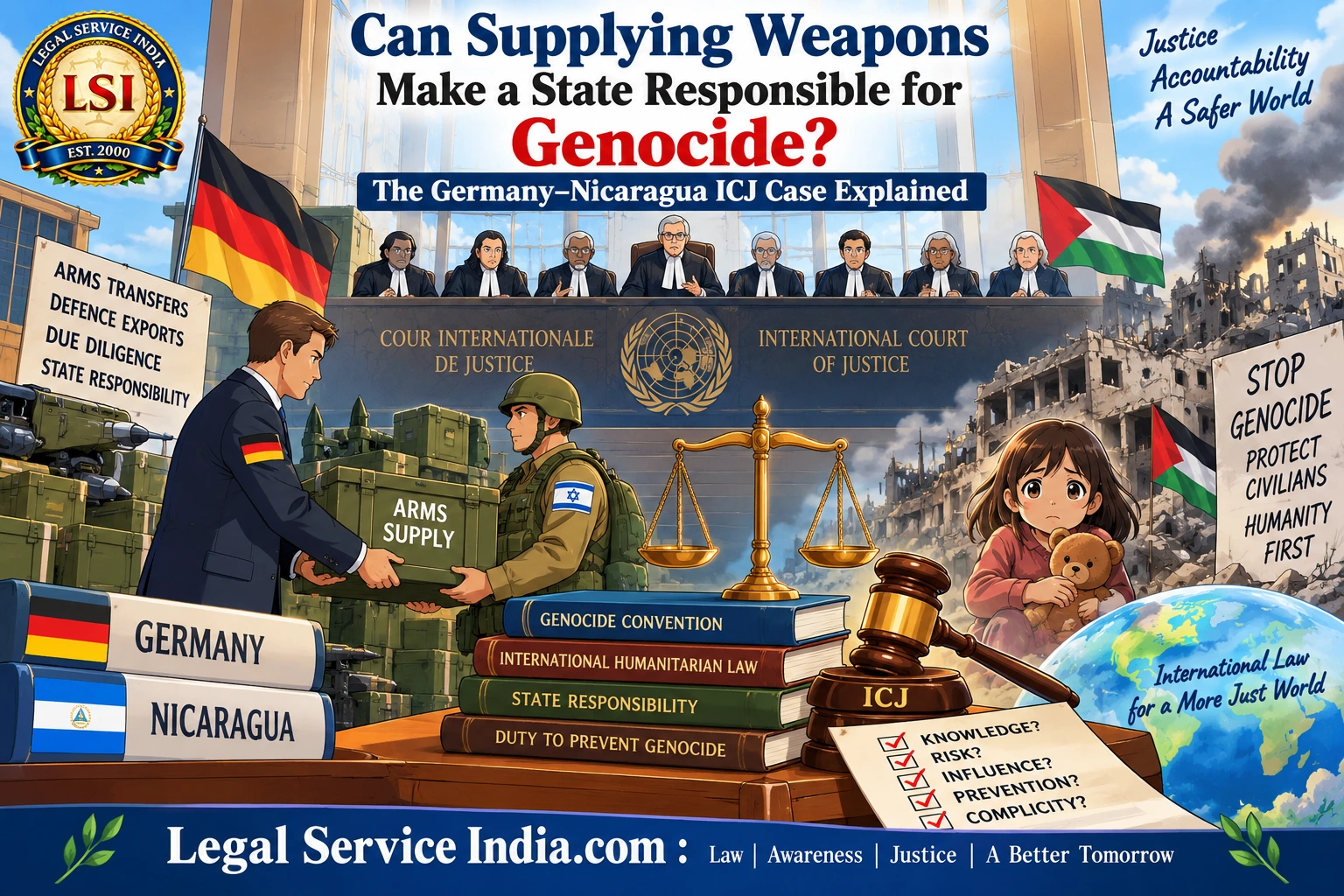
A landmark international-law battle over arms transfers, genocide prevention, state responsibility, and the limits of ICJ jurisdiction
“A weapon may leave the factory in silence, but responsibility does not always end at the factory gate. When the risk becomes impossible to ignore, the real legal question is no longer who supplied the weapon—it is who knew, who could act, and who chose not to.”
— Adv. Tarun Choudhury
There is a question now before the International Court of Justice in The Hague that reaches far beyond Germany, Nicaragua, or the present conflict in Gaza:
Can a Country Become Legally Responsible for Genocide Because It Supplies Weapons?
Can a country become legally responsible for genocide because it supplies weapons to another country?
At first glance, the answer may appear simple. If State A supplies weapons to State B, and State B allegedly uses those weapons in conduct amounting to genocide, why should State A not also bear responsibility?
International law, however, does not work on such a simple chain of reasoning.
A state does not automatically become internationally responsible merely because weapons manufactured or supplied by it are later used unlawfully. Between the supply of a weapon and the responsibility of an exporting state lie several difficult legal questions:
- What did the exporting state know?
- What should it reasonably have known?
- What was the nature of the assistance?
- What legal obligation bound it?
- What ability did it have to influence the recipient?
- What steps did it take after the risk became apparent?
Those questions are at the heart of the Germany–Nicaragua ICJ case, which is now entering a particularly important procedural stage.
And there is an important point that must be made at the very beginning.
Also Read: AI-Generated Fake Nude Images: Minnesota vs. xAI and the Future of Deepfake Law
The International Court of Justice has not found Germany responsible for genocide or complicity in genocide.
The current hearings, being held from 7 to 10 September 2026, concern preliminary objections raised by Germany. In other words, before the Court can reach the substantive allegations, it must first decide whether Nicaragua’s claims can proceed before the Court at all.
That procedural issue may itself become one of the most significant aspects of the case.
Latest Update: ICJ Hears Germany’s Preliminary Objections — September 2026
The proceedings before the International Court of Justice (ICJ) have now moved significantly beyond the provisional-measures stage considered by the Court in April 2024.
Germany filed its preliminary objections on 21 October 2025, challenging the jurisdiction of the cou10 and the admissibility and legal basis of Nicaragua’s claims. Nicaragua subsequently filed its written response on 23 February 2026.
The ICJ then held public hearings from 7 to 10 September 2026 concerning Germany’s preliminary objections. The hearings have now concluded. The Court has not yet delivered its decision on those objections.
Current Stage of the ICJ Proceedings
The present stage is therefore procedural and jurisdictional. The Court has not determined that Germany is responsible for genocide, complicity in genocide, or any other internationally wrongful act.
The distinction is important. The ICJ’s order of 30 April 2024, by which it declined to indicate the provisional measures requested by Nicaragua, was also not a final judgment on the merits. The underlying proceedings continued, leading to Germany’s preliminary objections and the September 2026 hearings.
| Development | Date / Status |
|---|---|
| ICJ order on provisional measures | 30 April 2024 |
| Germany filed preliminary objections. | 21 October 2025 |
| Nicaragua filed its written response. | 23 February 2026 |
| Public hearings on Germany’s preliminary objections | 7–10 September 2026 |
| Decision on preliminary objections | Still awaited as of 5 October 2026 |
What Happens Next in the Case?
The next major development will be the ICJ’s decision on Germany’s preliminary objections. If the court rejects the objections or accepts only some of them, the case could proceed further towards consideration of Nicaragua’s substantive allegations.
Key International-Law Issues Raised by the Case
The case therefore remains legally significant for the developing international-law principles concerning:
- the duty of states to prevent genocide;
- complicity in genocide;
- responsibility for aiding or assisting internationally wrongful conduct;
- arms transfers and international humanitarian law;
- the relevance of a state’s knowledge and ability to influence events; and
- the jurisdiction of the ICJ where the alleged wrongful conduct involves an absent third state.
Status as of 5 October 2026
As of 5 October 2026, the ICJ has completed the September 2026 hearings, but its decision on Germany’s preliminary objections is still awaited.
Important Legal Clarification
Important: The September 2026 hearings should not be described as a determination that Germany violated the Genocide Convention. They are concerned about Germany’s preliminary objections and the question of whether Nicaragua’s claims can proceed before the Court.
Legal Status of the Germany–Nicaragua ICJ Case as of 8 September 2026
The essential position is this:
| Issue | Current Position |
|---|---|
| Proceedings instituted | Nicaragua instituted proceedings against Germany on 1 March 2024. |
| Nicaragua’s allegations | Nicaragua alleges that Germany breached international obligations through its support for Israel, including allegations concerning arms transfers. |
| Legal bases invoked | Nicaragua invokes, among other legal bases, the Genocide Convention and rules of international humanitarian law. |
| Provisional measures | In April 2024, the ICJ declined to indicate the provisional measures requested by Nicaragua. |
| Effect of April 2024 decision | The court did not, however, terminate the proceedings at that stage. |
| Germany’s position | Germany subsequently raised preliminary objections. |
| Current hearings | The present hearings concern those preliminary objections. |
| Final judgement | There has been no final ICJ judgement holding Germany responsible for genocide or complicity in genocide. |
| Official case position | The official ICJ case record confirms that the Court is presently hearing Germany’s preliminary objections. |
This distinction is essential because an article that ignores it risks turning a complicated international-law dispute into a misleading headline.
The Question Behind the Headlines
The popular version of the issue is
Germany supplied weapons. Israel is accused of genocide. Therefore, is Germany responsible?
That is not the legal test.
The actual legal analysis is considerably more demanding.
There are at least three different possibilities:
1. Direct Responsibility for Genocide
Did Germany itself commit acts constituting genocide?
2. Complicity in Genocide
Did Germany knowingly assist conduct amounting to genocide in circumstances satisfying the legal requirements for complicity?
3. Failure to Prevent Genocide
Did Germany fail to take reasonably available measures after becoming aware, or when it should normally have become aware, of a serious risk of genocide?
These three concepts must never be treated as interchangeable.
That distinction was central to the International Court of Justice’s landmark 2007 judgement in Bosnia and Herzegovina v. Serbia and Montenegro.
The First Battlefield Is Not Genocide. It Is Jurisdiction.
This is perhaps the most important point emerging from the present hearings.
Germany is asking the ICJ to reject Nicaragua’s case on preliminary grounds.
Germany’s arguments include objections concerning whether a sufficiently crystallized dispute existed when Nicaragua filed the case, the temporal scope of the Court’s jurisdiction, treaty-specific jurisdictional requirements, and the significance of the legal interests of Israel, which is not a party to the proceedings. (EU Today)
That means the immediate question is not:
“Did Germany help commit genocide?”
It is:
“Does the ICJ have jurisdiction, and is Nicaragua’s application legally admissible in the form in which it has been presented?”
Only if Nicaragua survives this preliminary stage can the Court potentially proceed toward the merits.
This is why the current hearings matter so much.
The Monetary Gold Problem: Can the Court Decide Germany’s Responsibility Without Israel?
One of the most difficult issues is the principle associated with the ICJ’s Monetary Gold jurisprudence.
Germany argues, in substance, that determining its alleged responsibility for failing to prevent or assist genocide could require the court to determine the legal responsibility of Israel for the underlying conduct.
But Israel is not a party to this case.
This Creates a Difficult Question
Can the ICJ determine the responsibility of one state for failing to prevent or assist another state’s alleged wrongful conduct without making a binding determination concerning the responsibility of that absent state?
Germany’s position is that the legal interests of Israel would become central to the court’s decision.
Nicaragua’s position is fundamentally different. Its case can be framed as concerning Germany’s own international obligations and Germany’s own conduct.
This is not a trivial procedural argument.
It goes to the architecture of international adjudication.
| Possible ICJ Finding | Potential Consequence |
|---|---|
| Israel’s responsibility is indispensable to deciding Germany’s responsibility. | Nicaragua could face a serious jurisdictional obstacle. |
| Germany’s independent obligations can be adjudicated without determining Israel’s responsibility as a party. | The case could move forward. |
The present proceedings therefore have significance far beyond the immediate arms dispute.
Also Read: Can America Reform the Supreme Court? Latest 5–4 Ruling Reignites Term Limits Debate
What Does the Genocide Convention Actually Require?
The Convention on the Prevention and Punishment of the Crime of Genocide, adopted in 1948, imposes obligations concerning the prevention and punishment of genocide.
Two provisions are especially important to understanding the Germany–Nicaragua ICJ case.
Article I — The Duty to Prevent
Article I requires states to prevent and punish genocide.
The ICJ gave this provision major significance in Bosnia v. Serbia.
The Court held that the obligation to prevent genocide is distinct from responsibility for committing genocide.
A state may therefore violate its duty to prevent even though it did not itself commit the genocide.
The obligation is one of conduct.
It is not a guarantee that genocide will never occur.
The question is whether the State took measures reasonably available to it in the circumstances.
The Court’s 2007 judgement found Serbia responsible for violating its obligation to prevent the Srebrenica genocide.
Article III(e): Complicity in Genocide
Article III(e) identifies complicity in genocide as a punishable act.
But this does not mean that every form of military or financial assistance automatically becomes complicity.
The ICJ’s reasoning in Bosnia v. Serbia is extremely important.
The Court stated that conduct cannot be treated as complicity in genocide unless, at the least, the relevant actor acted knowingly and was aware of the specific intent—the dolus specialis—of the principal perpetrator.
This establishes a very high threshold.
Therefore:
- Weapons supplied ≠ automatic complicity.
- Financial assistance ≠ automatic complicity.
- Political support ≠ automatic complicity.
The legal question is much more demanding.
The relevant knowledge and the character of the assistance must be examined.
Complicity and Prevention Are Not the Same Thing
This is perhaps the most important legal distinction in the entire case.
Imagine two hypothetical situations.
Situation One
A state knows that another state intends to destroy a protected group and knowingly provides assistance that facilitates that genocidal plan.
That potentially raises the question of complicity.
Situation Two
A state does not share the perpetrator’s genocidal intent but possesses information showing a serious risk of genocide and nevertheless fails to use measures reasonably available to it to prevent the crime.
That raises the separate question of failure to prevent.
The second does not automatically require the same mental element as the first.
That distinction was central to the ICJ’s reasoning in Bosnia v. Serbia.
Therefore, an arms-exporting state could theoretically face a difficult international-law question even where establishing complicity in genocide would be extremely difficult.
That is why the prevention obligation deserves independent attention.
Also Read: Santosh Pandit Arrest: How I Would Defend Him Under BNS, BNSS & IT Act.
The Weapon Is Not the Legal Unit of Analysis
This, in my view, is the most useful way to understand the entire dispute.
International law should not be reduced to:
Weapon → victim → liability
The legal chain is more complicated:
Export decision → information available → foreseeable risk → applicable legal obligation → State’s ability to influence the recipient → preventive measures → continuing conduct → possible responsibility
The identity of the weapon matters.
But it is only one part of the legal analysis.
Consider Two Hypothetical Exports
A state exports equipment at a time when there is no apparent risk of unlawful use.
Months later, credible evidence emerges of systematic violations.
The exporting state is warned.
It possesses the legal ability to suspend further transfers.
Yet it continues without reassessment.
The legal question in that situation is no longer merely:
“Did it sell the equipment?”
It becomes:
“What did the State know when the circumstances changed, and what did it do with that knowledge?”
That is a much more sophisticated conception of state responsibility.
The Importance of Knowledge
Knowledge could become one of the most important factual questions in any future merits phase.
The inquiry should include:
- What information was available to government officials?
- What warnings had been received?
- What reports had been published?
- What information came from international organisations?
- What did diplomatic representatives report?
- What did the exporting state’s own agencies know?
- Did the recipient state provide assurances?
- Were those assurances credible?
- Did the factual situation materially change after the original export licence?
A state should not necessarily be judged with hindsight.
The relevant question is what could reasonably have been known at the relevant time.
That temporal dimension is extremely important.
The Importance of Influence
The Bosnia v. Serbia judgement also teaches another important lesson.
The duty to prevent genocide cannot be assessed in a vacuum.
A state’s capacity to influence the situation matters.
That may include:
- Diplomatic influence;
- Military relationships;
- Economic leverage;
- Political influence;
- Dependence upon particular supplies;
- Ability to suspend licences;
- Ability to impose end-use conditions;
- Ability to use diplomatic pressure.
Thus, the legal significance of an arms transfer cannot be measured simply by the monetary value of the transaction.
The question may also be:
How much influence did the exporting state possess over the recipient, and what could reasonably have been done with that influence?
Article 16 and Aid or Assistance Under State Responsibility
The broader law of state responsibility provides another important framework.
Article 16 of the International Law Commission’s Articles on Responsibility of States for Internationally Wrongful Acts deals with aid or assistance in the commission of an internationally wrongful act.
But Article 16 should not simply be equated with Article III(e) of the Genocide Convention.
They operate within related but distinct legal frameworks.
For genocide specifically, the Genocide Convention and the ICJ’s interpretation of complicity remain indispensable.
This distinction is important because legal arguments become dangerously loose when every form of assistance is labelled “complicity”.
What Did the ICJ Decide in April 2024?
The answer is frequently misunderstood.
Nicaragua requested provisional measures against Germany.
On 30 April 2024, the ICJ concluded that the circumstances then before it did not require the indication of provisional measures.
But this was not a final merits judgement exonerating Germany.
Nor was it a final determination that Nicaragua’s allegations were false.
The proceedings remained alive.
The present preliminary-objections phase exists because Germany subsequently challenged the legal foundation of Nicaragua’s case.
The ICJ’s own case record confirms that the Court’s April 2024 decision concerned provisional measures and that preliminary objections were subsequently raised by Germany.
This distinction must be preserved throughout any serious article.
Also Read: SGB Tax Crisis 2026: Can Sovereign Gold Bond Investors Demand Grandfathering and Legal Protection?
Germany’s Defence: The Other Side of the Legal Story
A balanced legal article must take Germany’s position seriously.
Germany rejects Nicaragua’s allegations.
In the current hearings, Germany has argued that Nicaragua did not properly establish the necessary dispute before filing the case and has challenged the Court’s jurisdiction over aspects of Nicaragua’s claims. Germany has also emphasised its own arms-export review procedures and changes to certain export decisions. (AP News)
This is important.
Germany’s defence is not simply:
“We supplied weapons, and therefore nothing matters.”
Its position is also that its export system takes international-law considerations into account.
That creates an important factual and legal question:
How much weight should an international court give to an exporting state’s internal risk-assessment process?
If a state can demonstrate that it systematically assessed risk, considered available evidence, imposed safeguards and reassessed its decisions as circumstances changed, that may be highly relevant to the question of due diligence.
But an internal procedure cannot automatically immunise a state from international responsibility.
Domestic legality and international responsibility are different questions.
The Difference Between Domestic Law and International Responsibility
A state might say:
“Our domestic export law permitted the transaction.”
That may answer a domestic legal question.
It does not necessarily answer an international-law question.
International responsibility is governed by the international obligation allegedly breached.
Therefore, the crucial question becomes:
Was the State’s conduct consistent with the international obligation binding upon it?
This distinction is particularly important for countries with sophisticated arms-export licensing regimes.
What This Case Could Mean for India
For India, this case deserves careful attention—not because Germany’s exact jurisdictional position automatically applies to India, but because the underlying principles could influence future debates about responsible defence exports.
India is a party to the Genocide Convention.
At the same time, India’s treaty reservations and declarations concerning ICJ jurisdiction are important and mean that one cannot simply assume that every dispute involving India would follow the same jurisdictional route as the Germany case.
This is why the correct question for India is not:
“Can Nicaragua-style proceedings automatically be brought against India?”
The correct question is:
“How should India structure its defence-export decisions so that they remain consistent with India’s international obligations while protecting legitimate national-security and foreign-policy interests?”
That is a much more useful question.
Article 51 of the Indian Constitution
Article 51 of the Constitution directs the State to foster respect for international law and treaty obligations.
But Article 51 should not be described as if every international rule automatically becomes directly enforceable domestic law.
India’s constitutional structure distinguishes between international obligations and their domestic implementation.
Therefore, the proper constitutional proposition is narrower:
Indian constitutional policy recognises the importance of respect for international law, while the domestic legal effect of treaty obligations depends upon the constitutional and statutory framework applicable to the particular obligation.
That is the legally safer formulation.
India’s Defence-Export System
India already has a substantial system regulating defence exports, including the SCOMET framework, export authorisations, end-user requirements and statutory controls.
The practical lesson from the Germany–Nicaragua ICJ case is therefore not that India necessarily needs to stop defence exports.
It is that India could strengthen the quality of its legal-risk assessment.
For particularly sensitive exports, India could consider a continuous due-diligence model.
My Proposed Model: Continuous International Humanitarian-Law Due Diligence
I would propose a simple principle:
A high-risk arms-export licence should not be treated as a one-time legal decision. It should be capable of being reassessed when the factual circumstances materially change.
The model would contain five stages.
Stage One — Pre-Export Assessment
Before authorisation:
- assess the recipient;
- identify foreseeable end use;
- assess relevant international-law risks;
- examine the recipient’s conduct;
- Document the evidence.
Stage Two — Risk Classification
Classify the transaction according to the seriousness of the identified risks.
This should not become an arbitrary mathematical formula.
The classification should remain an expert legal and policy assessment.
Stage Three — End-Use Monitoring
Where appropriate, obtain credible information concerning the actual use and destination of the equipment.
Stage Four — Triggered Reassessment
A new review should occur when there is substantial new information, such as:
- credible evidence of serious violations;
- diversion;
- material deterioration of the humanitarian situation;
- credible evidence of misuse;
- failure to comply with end-use assurances;
- significant changes in the recipient’s military conduct.
Stage Five — Documented Decision
The government should maintain a clear record:
Information → Legal assessment → Risk → Available options → Decision → Mitigation → Reassessment
This would create something extremely valuable:
An auditable due-diligence record.
Why This Could Matter
Imagine that many years later an international tribunal asks:
“What did the exporting state know?”
A responsible government should not have to reconstruct its answer from old newspaper reports.
It should be able to produce:
- What we knew.
- What we considered.
- What legal obligations we identified.
- What alternatives were available.
- Why we made the decision.
- What changed later.
- What we did after it changed.
That is the real value of a continuing due-diligence system.
But This Is Not a New Rule of International Law
I would emphasise this point.
The proposed model is a policy framework, not an existing ICJ doctrine.
It is designed to operationalise principles already visible in international law concerning:
- prevention;
- due diligence;
- knowledge;
- available means;
- risk;
- State responsibility;
- arm-transfer controls.
It should not be presented as though the ICJ has already adopted such a five-stage model.
That distinction keeps the argument intellectually honest.
A Five-Question Test for Arms-Export Responsibility
In my view, any serious analysis of an alleged internationally wrongful arms transfer should begin with five questions.
| Question | Legal Question |
|---|---|
| Question 1 | What precisely is the underlying internationally wrongful act? |
| Question 2 | What international obligation binds the exporting state independently of the recipient state? |
| Question 3 | What did the exporting state know, or what should it reasonably have known, at the relevant time? |
| Question 4 | What practical means of influence were actually available to the exporting state? |
| Question 5 | Did the State’s conduct satisfy the specific legal requirements for the alleged breach? |
Only after these five questions are answered should one speak confidently about international responsibility.
What the Germany–Nicaragua Case Could Ultimately Change
If the case survives the preliminary objections, the implications could extend beyond Germany.
The Court may eventually have to consider questions surrounding:
- the duty to prevent genocide;
- complicity;
- aid or assistance;
- arms transfers;
- humanitarian law;
- State responsibility;
- knowledge and risk;
- the legal significance of export-control procedures;
- the extent of a state’s influence over an assisted state;
- and the limits imposed by the rights of an absent third state.
But it is too early to predict the outcome.
The current proceedings are still preliminary.
And that is precisely why responsible legal journalism matters.
The Real Legal Question Is Bigger Than Germany
The most interesting question arising from the Germany–Nicaragua ICJ case is not whether Germany sold a particular weapon.
It is this:
At what point does continued assistance to another State become legally indefensible because the assisting State knows, or should reasonably know, that there is a serious risk that its assistance may contribute to conduct prohibited by international law?
That question could eventually affect not only weapons.
It could involve:
- spare parts;
- military technology;
- training;
- intelligence;
- logistics;
- financial assistance;
- technical support;
- dual-use equipment.
The legal debate could therefore move beyond the traditional question:
“Who pulled the trigger?”
toward a more difficult question:
“Who continued to make the conduct possible after the legal risk became apparent?”
That is where the future of state responsibility may become particularly interesting.
Ten Important Legal Safeguards
Any future international-law analysis of arms transfers should therefore remember:
- Arms supply does not automatically equal complicity.
- Complicity and prevention are different legal obligations.
- Knowledge matters.
- The specific intent required for genocide complicity matters.
- The duty to prevent is not a guarantee of success.
- The exporting state’s ability to influence the situation matters.
- Domestic authorisation does not automatically answer an international-law question.
- A risk assessment should be judged in light of information available at the relevant time.
- A preliminary ICJ order is not a final merits judgement.
- Jurisdiction must be established before the court can reach the substantive allegations.
The Ten Immediate Lessons for India
India can draw a practical lesson without waiting for the outcome of this litigation.
- Strengthen legal-risk assessments for sensitive defence exports.
- Distinguish ordinary exports from high-risk transfers.
- Require enhanced scrutiny when credible evidence of serious violations emerges.
- Strengthen end-user verification.
- Create clear reassessment triggers.
- Maintain an auditable record of significant decisions.
- Separate intelligence assessments from established factual findings.
- Ensure the same methodology is applied to friends and adversaries.
- Give exporters predictable rules and fast processing for low-risk transactions.
- Make international humanitarian law part of the decision-making process—not an afterthought.
Red-Team: Why This Approach Could Still Fail
No regulatory system is perfect.
A continuous due-diligence system could become bureaucratic.
It could delay legitimate defence exports.
It could be influenced by politics.
Intelligence could be incomplete or wrong.
Recipient states could provide unreliable assurances.
Exporters could attempt to circumvent restrictions.
And an overly cautious system could damage India’s strategic interests.
These objections are real.
The answer is therefore not to create a system that treats every international controversy as a reason to prohibit exports.
Instead, the system should be risk-based.
| Transaction Type | Recommended Approach |
|---|---|
| Low-risk transactions | Should remain simple. |
| High-risk transactions | Should receive deeper scrutiny. |
| Extraordinary restrictions | Should require documented reasons. |
That approach protects both national security and international-law credibility.
The Three-Lock Principle
If resources are limited, the entire proposal can be reduced to three safeguards.
Lock One — Before Export
Ask whether the proposed transfer presents a foreseeable serious international-law risk.
Lock Two — During the Relationship
Monitor end-use and material changes in circumstances.
Lock Three — After a Trigger Event
Reassess the authorisation if significant new evidence emerges.
This is inexpensive compared with creating an entirely new regulatory bureaucracy.
More importantly, it creates a defensible decision-making trail.
My Legal Assessment
The Germany–Nicaragua ICJ case should not be understood as establishing a new rule that:
“A state that supplies weapons becomes responsible for genocide.”
International law is not that simple.
The more accurate proposition is:
A state may incur international responsibility depending on the particular obligation invoked, the nature of its conduct, what it knew or should have known, the assistance it provided, its ability to influence the situation, and whether it fulfilled the applicable legal duties.
For genocide specifically, complicity has an exceptionally demanding knowledge requirement under the ICJ’s Bosnia v Serbia jurisprudence. The Court held that assistance cannot be treated as complicity in genocide unless, at least, the assisting actor acted knowingly and was aware of the principal perpetrator’s specific genocidal intent.
The duty to prevent genocide is different.
And that difference may prove central to the future of international arms-transfer law.
Conclusion: The Factory Gate Is Not Necessarily the End of Legal Responsibility
There is a tendency to think of international responsibility as beginning and ending with the person who commits the physical act.
Modern international law presents a more complicated picture.
A state that manufactures or exports weapons does not automatically become responsible for everything the recipient later does. But neither can an exporting state necessarily treat an arms licence as a permanent legal shield.
As information changes, circumstances change.
And when a state possesses substantial political, economic or military influence, the question may increasingly become whether it used the means reasonably available to it to prevent internationally prohibited conduct.
That is why the Germany–Nicaragua ICJ case is worth watching.
The Court is not currently deciding that Germany committed genocide.
It is not deciding that Germany was complicit in genocide.
It is first being asked whether Nicaragua’s claims can cross the jurisdictional and admissibility barriers raised by Germany.
If the case reaches the merits, however, the Court could be confronted with a profound question of international law:
When does assistance to another state stop being merely a foreign-policy decision and become an internationally wrongful act?
My answer, as a lawyer, is that the decisive issue will rarely be the weapon alone.
It will be the knowledge, the risk, the legal obligation, the available influence, the conduct of the assisting State and the choices it made when the facts became known.
That is the deeper lesson of the Germany–Nicaragua litigation.
And it is a lesson that every state engaged in the international arms trade—including India—would be wise to consider before the next international dispute reaches The Hague.
Need Legal Guidance on an International Law or State Responsibility Issue?
The Germany–Nicaragua ICJ case shows how complex questions of international law, state responsibility, arms transfers, genocide allegations, treaty obligations and ICJ jurisdiction can become.
If your matter involves international law, constitutional issues, public international law, treaty obligations, state responsibility, defence exports, human rights concerns or proceedings before a constitutional court, Supreme Court or international tribunal, getting the legal position right at the beginning can make a critical difference.
Do not wait until a legal dispute becomes a crisis.
A careful assessment of the facts, applicable law, jurisdiction, available remedies and legal strategy can help you understand where you stand, what risks you face and what options may be available to you.
Speak Directly With an Experienced Supreme Court Advocate
Adv. Tarun Choudhury
Supreme Court Advocate | 25+ Years of Legal Experience
📞 Call: 9891244487
💬 WhatsApp: 9891244487
For serious legal questions, informed legal advice is often the first step toward protecting your rights, interests and future.
Contact Adv. Tarun Choudhury for a legal consultation and discuss your matter directly.
Frequently Asked Questions
1. Can Supplying Weapons Make a Country Legally Responsible for Genocide?
Not automatically.
The Germany–Nicaragua ICJ case illustrates that supplying weapons to another state does not, by itself, establish international responsibility for genocide.
The legal analysis depends on the applicable international obligation, the nature of the assistance, what the exporting State knew or should reasonably have known, its ability to influence the recipient State, and whether the legal requirements for responsibility are satisfied.
2. What Is the Difference Between Complicity in Genocide and the Duty to Prevent Genocide?
Complicity in genocide and failure to prevent genocide are separate legal concepts.
Complicity under Article III(e) of the Genocide Convention involves a demanding mental element, including awareness of the principal perpetrator’s specific genocidal intent.
The duty to prevent genocide under Article I is different and concerns whether a state took reasonably available measures to prevent genocide when the relevant circumstances and risks were known or should have been known.
3. What Is the Germany–Nicaragua ICJ Case About?
The Germany–Nicaragua ICJ case concerns Nicaragua’s allegations that Germany breached its international obligations through its support for Israel, including allegations relating to arms transfers.
Germany has raised preliminary objections challenging the jurisdiction and admissibility of Nicaragua’s claims.
The present proceedings therefore concern whether the case can proceed, rather than a final determination that Germany is responsible for genocide or complicity in genocide.
4. Why Is ICJ Jurisdiction Important in the Germany–Nicaragua Case?
ICJ jurisdiction is a threshold issue.
Before the International Court of Justice can examine the substantive allegations, it must determine whether it has jurisdiction and whether Nicaragua’s claims are admissible in the form presented.
Germany’s preliminary objections therefore create a potentially decisive procedural stage before the Court can consider the underlying allegations on their merits.
5. What Does the Germany–Nicaragua ICJ Case Mean for India’s Defence Exports?
The case does not automatically impose the same legal consequences on India.
However, it raises important questions for India’s defence-export policy, particularly concerning international humanitarian law, state responsibility, end-use monitoring, legal-risk assessment and the duty to prevent internationally prohibited conduct.
A useful policy approach would involve continuous due diligence, enhanced scrutiny for high-risk transfers, reassessment when significant new evidence emerges, and maintaining an auditable record of important export decisions.
Key Takeaways: Germany–Nicaragua ICJ Case and State Responsibility
- The Germany–Nicaragua ICJ case is not a final judgement holding Germany responsible for genocide. The current proceedings concern Germany’s preliminary objections, including questions of ICJ jurisdiction and admissibility.
- Supplying weapons does not automatically make a state responsible for genocide. International responsibility depends on the applicable legal obligation, the nature of the assistance, the state’s knowledge, its ability to influence the recipient and the specific legal requirements of the alleged breach.
- Complicity in genocide and failure to prevent genocide are legally different. Article III(e) of the Genocide Convention concerns complicity, while Article I establishes the broader obligation to prevent and punish genocide.
- Complicity in genocide has a particularly demanding mental element. The article, relying on the ICJ’s Bosnia v. Serbia jurisprudence, explains that the assisting State must have the requisite knowledge, including awareness of the principal perpetrator’s specific genocidal intent.
- The duty to prevent genocide requires a different legal analysis. A state may potentially breach its prevention obligation without itself committing genocide, depending on what it knew, the seriousness of the risk and the measures reasonably available to it.
- Knowledge and timing can be crucial in determining state responsibility. The relevant inquiry includes what information was available to government officials at the relevant time, what warnings were received and whether circumstances materially changed after an export decision.
- A state’s ability to influence the recipient may also matter. Diplomatic influence, military relationships, economic leverage, export controls, end-use conditions and the ability to suspend licences can all be relevant when assessing the duty to prevent.
- Domestic authorisation does not automatically eliminate international responsibility. A defence export may be lawful under domestic procedures while still raising a separate question under the international obligation allegedly binding upon the exporting state.
- The April 2024 ICJ decision on provisional measures was not a final merits judgement. The Court did not indicate the requested provisional measures, but the proceedings continued, and Germany subsequently raised preliminary objections.
- The monetary gold principle creates a major jurisdictional question. Germany argues that Nicaragua’s claims could require the Court to address Israel’s legal responsibility even though Israel is not a party to the proceedings.
- The case has broader implications for arms-transfer law and international state responsibility. If the proceedings reach the merits, issues could include genocide prevention, complicity, aid or assistance, arms transfers, humanitarian law, knowledge, risk and the exporting State’s ability to influence the recipient.
- For India, the practical lesson is continuous international-law due diligence. Sensitive defence exports could benefit from pre-export assessment, risk classification, end-use monitoring, triggered reassessment and documented decision-making.
The Core Legal Takeaway
The Germany–Nicaragua ICJ case does not establish that supplying weapons equals complicity in genocide.
Its deeper significance lies in the difficult legal questions surrounding State responsibility, ICJ jurisdiction, knowledge, risk, influence, the duty to prevent genocide and the continuing legal obligations of States involved in international arms transfers.