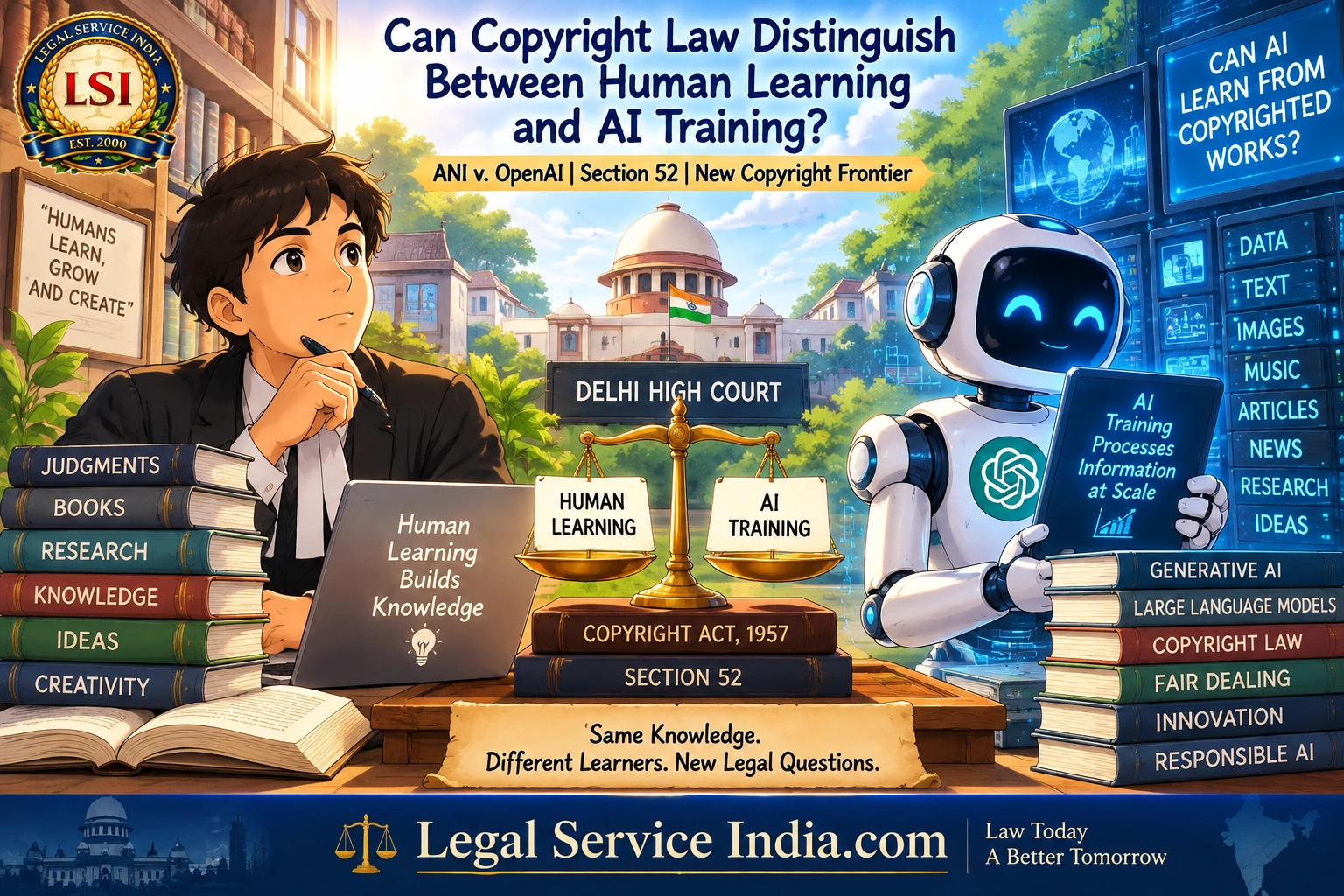
Can Copyright Law Realistically Distinguish Between Human Learning and AI Training? Prof. Arul George Scaria and the New Copyright Frontier
Introduction
The most difficult copyright question created by generative artificial intelligence is not whether AI can produce text, images or music. It is a more fundamental question:
Can copyright law realistically distinguish between human learning and AI training?
A human being may read thousands of books, newspapers and judgments, absorb ideas and patterns, and later produce an original work. Copyright law generally does not treat the acquisition of knowledge as infringement.
But an artificial intelligence system may process millions or billions of copyrighted works to develop statistical and linguistic capabilities. In doing so, copies may be created, stored and processed at enormous scale.
Does the fact that the learner is a machine transform learning into copyright infringement?
This question has moved from academic debate into serious Indian litigation following the Delhi High Court’s important decision in ANI Media Pvt. Ltd. v. OpenAI OpCo LLC, decided on 24 July 2026. The Court, at the interim stage, held prima facie that OpenAI’s storage and use of ANI’s works for training the LLMs underlying ChatGPT fell within Section 52(1)(a) of the Copyright Act, 1957. It also rejected ANI’s application for an interim injunction concerning the alleged infringing outputs.
The case is particularly important because Prof. Arul George Scaria, Professor of Law at the National Law School of India University, was appointed as an amicus curiae along with Advocate Adarsh Ramanujan because of the novelty and complexity of the technological and legal issues. Prof. Scaria made opening submissions in 2025, followed the extensive hearings, and made concluding submissions in March 2026.
The judgment therefore deserves to be studied not as a simplistic victory for AI or defeat for copyright owners, but as an important attempt to adapt a 1957 statute to a technology its framers could never have imagined.
Also Read: AI-Generated Fake Nude Images: Minnesota vs. xAI and the Future of Deepfake Law
The ANI v. OpenAI Case: What Was Actually Before the Court?
The litigation raised two distinct copyright questions.
First: The Training Claim
ANI alleged that OpenAI scraped, stored and used its copyrighted news material for training the large language models underlying ChatGPT.
The legal question was whether such copying and storage constituted infringement under Section 51 read with Section 14 of the Copyright Act, or whether it was protected by Section 52.
Second: The Output Claim
ANI also alleged that ChatGPT could reproduce or “regurgitate” ANI’s copyrighted literary works in responses to users.
The Court therefore separately examined whether ChatGPT memorised and reproduced ANI’s works and whether its responses constituted substantial reproduction.
This Distinction Is Fundamental
AI training and AI output are not the same legal act.
A court should not automatically conclude that an allegedly unlawful output proves that the entire training process was unlawful. Equally, a finding that a training activity is protected cannot provide blanket immunity for subsequent infringing outputs.
That distinction should remain at the heart of future AI copyright litigation.
| Issue | Copyright Question |
|---|---|
| AI Training | Whether copying and storage of copyrighted works for training constitute infringement or fall within Section 52. |
| AI Output | Whether ChatGPT reproduces copyrighted works and whether responses constitute substantial reproduction. |
Prof. Arul George Scaria: Why His Contribution Matters
The contribution of Prof. Arul George Scaria is particularly significant because the dispute required the Court to reconcile traditional copyright concepts with computational learning.
The central conceptual problem is simple.
Humans learn from copyrighted works all the time.
- A lawyer reads hundreds of judgments.
- A researcher reads thousands of academic papers.
- A journalist studies years of reporting.
- A novelist reads literature.
- A scientist analyses existing scientific knowledge.
The law does not ordinarily require every learner to obtain permission from every copyright owner before acquiring knowledge.
AI systems perform an analogous information-processing function, although on an enormously larger scale and through fundamentally different computational mechanisms.
The Delhi High Court recognised this technological reality and adopted an updating interpretation of the word “research” in Section 52(1)(a). It held, prima facie, that research cannot necessarily be confined to activities physically undertaken by human beings and may encompass machine learning when the activity serves a research-related purpose.
That is potentially one of the most consequential aspects of the judgment.
Also Read: AI-Generated Evidence in Indian Courts: Can Deepfakes Prove Guilt?
But Human Learning and AI Training Are Not Identical
At the same time, an experienced copyright analysis must resist an overly simple analogy.
A human being cannot ordinarily consume ten billion articles overnight.
An AI company potentially can.
A human reader does not normally make millions of electronic copies of every work encountered.
A machine-learning pipeline may.
An AI model can also become a commercial product capable of serving millions of users.
Therefore, the proposition that:
“Humans learn from copyrighted works, therefore AI should be free to train on them”
is legally incomplete.
The correct question is:
What exactly is the AI system doing with the copyrighted work, for what purpose, with what consequences, and under what statutory exception?
That is a much more defensible legal framework.
Section 14 and Section 52: Where the Real Legal Battle Lies
Section 14 grants copyright owners exclusive rights over reproduction and other specified acts.
Digital storage may therefore raise a reproduction question.
But Section 52 creates statutory exceptions where certain acts do not amount to infringement.
The Delhi High Court consequently had to examine whether OpenAI’s use came within Section 52(1)(a), which protects fair dealing with a work for purposes including private or personal use, research, criticism or review, subject to the statutory conditions.
The Court’s reasoning is important because it did not simply say:
“AI training is legal.”
Instead, it asked whether the particular use satisfied the statutory framework.
This is a far narrower and more sustainable proposition.
The Commercial-Use Objection: Probably the Most Difficult Issue
ANI argued that OpenAI’s use was fundamentally commercial.
After all, ChatGPT is a commercial service.
The obvious question is therefore:
How can commercial AI training be characterised as “research”?
This objection cannot simply be dismissed.
If every commercial technology company could describe its activity as research, Section 52 could become an extraordinarily broad exemption.
The Delhi High Court therefore examined commerciality as part of its interpretation and fairness analysis rather than treating the mere existence of a commercial business as automatically decisive. The judgment ultimately found OpenAI’s training use prima facie protected at the interim stage.
This is a particularly important point for future cases.
Commercial purpose may be relevant, but commerciality alone cannot necessarily answer the Section 52 question.
The nature and purpose of the particular use must still be examined.
Also Read: SGB Tax Crisis 2026: Can Sovereign Gold Bond Investors Demand Grandfathering and Legal Protection?
The “Non-Infringing Copy” Problem
One of the most technically important issues—often missed in popular reporting—is the statutory requirement concerning a “non-infringing copy.”
The Court specifically considered whether Section 52 protection could operate where the material used for training had itself been obtained through potentially infringing means.
This matters enormously.
There is a substantial legal difference between:
- using a lawfully obtained copy;
- scraping publicly accessible material;
- accessing material behind a paywall;
- circumventing technological protection;
- using a copy obtained through an unlawful source.
The ANI judgment examined these questions rather than reducing the case to a simplistic “internet content is free for AI” proposition.
That distinction should become increasingly important as AI companies build training datasets.
Lawful Access and Technological Protection Are Different Questions
Prof. Scaria’s subsequent explanation of the judgment highlights another important point: lawful access and technological circumvention should not be conflated.
An AI developer may have a stronger argument where content was publicly accessible.
But deliberately bypassing technological protection measures designed to restrict access presents a different legal problem.
This is likely to become a major future battleground.
Copyright law may ultimately tolerate certain forms of machine learning without requiring individual licences for every item, while still protecting publishers that employ technological measures and contractual mechanisms to control access.
Why News Content Makes ANI a Special Case
Another critical point is the nature of ANI’s material.
News reporting frequently contains facts that copyright does not monopolise. Copyright protects original expression rather than facts themselves.
Consequently, a dispute involving a news agency cannot necessarily be extrapolated without qualification to novels, photographs, music, films or highly creative artistic works.
The Court therefore had to consider the particular character of ANI’s literary works and the nature of the alleged copying.
This is one reason why future litigation involving generative AI trained on books, music, visual art or films may produce different results.
The Court’s Two-Stage Approach: Purpose and Fairness
One of the strongest aspects of the judgment is its structured treatment of Section 52.
The Court examined:
- The purpose test Was the use within a purpose recognised by Section 52? The Court concluded prima facie that OpenAI’s training activity could fall within “private or personal use, including research.”
- The fairness test The Court then examined the broader consequences, including:
- whether ANI’s works were used only for training;
- whether OpenAI’s activities created economic competition;
- whether ANI’s legitimate interests were prejudiced;
- whether actual or potential damage had been demonstrated; and
- the broader public interest served by the technology.
This is far more sophisticated than treating “research” as a magic word.
The Market-Substitution Question Could Decide Future Cases
The most important future question may be whether AI complements or substitutes the copyright owner’s product.
Suppose an AI system reads thousands of news reports and produces a genuinely new analysis.
That is different from an AI system reproducing an exclusive article substantially verbatim and thereby providing a substitute for the publisher’s product.
The Court noted that ANI had not established evidence of a decline in its market share attributable to OpenAI’s use and found, at the interim stage, insufficient basis for the injunction sought.
Future plaintiffs are therefore likely to bring much stronger economic evidence.
They may attempt to demonstrate:
- subscription displacement;
- reduced website traffic;
- loss of licensing revenue;
- substitution of AI-generated summaries for original reporting;
- systematic reproduction of protected expression; or
- exploitation of copyrighted databases.
The economics of AI copyright may consequently become as important as the technology itself.
Training and Output Must Remain Separate
The Court’s treatment of ChatGPT outputs is equally important.
It found, prima facie, that the outputs generated using the RAG technique were not substantially similar to ANI’s original literary works and that ANI had failed to establish memorisation and regurgitation sufficient to justify an interim injunction.
This does not mean AI outputs can never infringe copyright.
If an AI system reproduces substantial protected expression from a copyrighted novel, article, song or photograph, a separate infringement analysis may arise.
The key legal question will remain whether there has been reproduction of protected expression and whether the statutory requirements for infringement are satisfied.
The Extraterritorial Dimension Cannot Be Ignored
Another important issue in the judgment concerns the fact that OpenAI’s training operations were said to involve servers located outside India.
This raises difficult questions concerning:
- territorial application of Indian copyright law;
- where the act of reproduction occurs;
- where damage occurs;
- jurisdiction over global AI infrastructure; and
- whether Indian courts can regulate foreign technological processes affecting Indian copyright owners.
The judgment’s structure expressly identifies and examines the question of whether the Copyright Act applies where training takes place on servers outside India.
As AI infrastructure becomes increasingly distributed across jurisdictions, this issue could eventually require consideration by higher courts.
Why This Is Not a “Blank Cheque” for AI Companies
The biggest danger in interpreting the ANI decision is to say:
“The Delhi High Court has legalised AI training in India.”
That is incorrect.
The Court itself expressly stated that its observations were for adjudication of the interim application and would not determine the final outcome of the suit.
The decision is therefore significant, but it is not the final word on Indian AI copyright law.
It establishes a powerful prima facie judicial approach, not an unconditional immunity.
That distinction should be preserved in every serious article discussing this case.
The Larger Policy Question: Who Should Pay for AI’s Learning?
This is where the debate becomes much bigger than ANI and OpenAI.
If AI companies must obtain individual licences for every copyrighted work used for training, transaction costs could become enormous.
Large technology companies may survive such a system.
Indian startups, universities and independent researchers may not.
But the reverse proposition is equally dangerous.
If AI companies can freely appropriate the entire creative economy without compensation, authors, journalists, artists and publishers may lose the economic incentives that copyright is designed to protect.
India therefore faces a policy choice between:
- unrestricted licensing,
- unrestricted access,
- or a carefully designed middle path involving exceptions, collective licensing, remuneration or other mechanisms.
Recent policy discussions have already begun examining AI-training licensing and remuneration. The debate is likely to intensify following the ANI judgment.
The Real Legal Test Should Be Functional, Not Anthropomorphic
In my considered view, courts should not ask merely:
“Is the learner human or machine?”
They should ask:
| Legal Question | What Courts Should Examine |
|---|---|
| Access | How was the material obtained? |
| Authorisation | Was access authorised or restricted? |
| Technological Protection | Was technological protection circumvented? |
| Copying | Was a copy made? |
| Purpose | Why was the copy made? |
| Retention | Was the material retained after training? |
| Output | Is protected expression reproduced in outputs? |
| Market Impact | Does the AI product substitute for the copyright owner’s market? |
| Transformation | Is the use genuinely transformative or merely exploitative? |
| Public Interest | What legitimate public interest is served? |
This approach is technologically neutral and legally workable.
It recognises that copyright protects expression without turning knowledge itself into private property.
Conclusion
The question “Can copyright law realistically distinguish between human learning and AI training?” has no satisfactory answer if posed simply as a choice between humans and machines.
The better approach is to recognise that AI training is a technologically different method of learning, but the legal consequences must depend upon what that learning process actually entails.
The Delhi High Court’s decision in ANI Media v. OpenAI represents an important first attempt to apply India’s existing copyright framework to this new reality. At the interim stage, the Court held that OpenAI’s storage of ANI’s works for training LLMs could fall within Section 52(1)(a), while also finding that ANI had not established sufficient grounds for an injunction concerning the alleged outputs.
The importance of Prof. Arul George Scaria lies in the intellectual bridge between traditional copyright doctrine and modern machine learning. His role as amicus curiae placed before the Court the difficult proposition that concepts such as “research” cannot necessarily remain frozen in the technological world of 1957.
But there is an equally important warning.
Human learning cannot become a legal loophole for unlimited commercial appropriation.
Nor should copyright become a technological veto over every new method of acquiring knowledge.
The future law must distinguish between:
- learning and copying,
- information and expression,
- training and output,
- innovation and substitution,
- lawful access and circumvention, and
- public benefit and commercial exploitation.
That is the real copyright challenge created by artificial intelligence.
And ultimately, the question before Indian copyright law will not be whether machines should be allowed to learn.
Machines already do.
The question is whether the law can ensure that, while machines learn from humanity’s accumulated knowledge, human creators continue to have a meaningful right to create, earn and control the exploitation of their original expression.
That is the balance that the next generation of copyright jurisprudence—and eventually Parliament—will have to strike.
Facing an AI Copyright or Intellectual Property Dispute?
AI copyright law is evolving rapidly—and early legal advice can make a critical difference. If you are a content creator, author, publisher, journalist, technology company, AI developer, startup, or business dealing with AI training, copyright infringement, content scraping, generative AI, licensing, or intellectual property rights, obtaining advice from an experienced Supreme Court lawyer can help you understand your legal position and available remedies.
Get Experienced Legal Guidance Before the Dispute Escalates
Whether you are concerned about AI-generated content, unauthorised use of copyrighted material, AI training datasets, copyright licensing, online content reproduction, or emerging AI-related legal risks, discuss your matter with an experienced advocate who understands complex technology and intellectual-property disputes.
Adv. Tarun Choudhury
Supreme Court Advocate | 25+ Years of Legal Experience
📞 Call: 9891244487
💬 WhatsApp: 9891244487
Don’t leave a complex copyright or AI-law issue to uncertainty. Get professional legal guidance and understand your options.
Frequently Asked Questions (FAQs)
1. Can AI Training on Copyrighted Works Constitute Copyright Infringement in India?
AI training may involve copying and storing copyrighted works, potentially implicating copyright infringement under the Copyright Act, 1957. However, the Delhi High Court in ANI Media Pvt. Ltd. v. OpenAI OpCo LLC held prima facie at the interim stage that using copyrighted works for LLM training could fall within the fair-dealing exception under Section 52(1)(a) when undertaken for research. The ruling does not create blanket immunity for all AI training.
2. What Did Prof. Arul George Scaria Say About AI Training and Human Learning?
Prof. Arul George Scaria argued, in his role as amicus curiae, that concepts such as “research” should be interpreted in light of technological developments. The Delhi High Court accepted, prima facie, that research need not be restricted to activities performed directly by humans and that machine learning can fall within the concept of research in appropriate circumstances.
3. Is AI-Generated Content Automatically Protected From Copyright Infringement?
No. AI-generated content can potentially infringe copyright if it reproduces protected expression from an existing copyrighted work. The legality of AI training and AI-generated outputs are separate legal questions. The ANI v. OpenAI decision should therefore not be interpreted as giving AI companies unrestricted protection from copyright claims concerning their outputs.
4. Does Section 52 of the Copyright Act Permit AI Companies to Use Copyrighted Content for AI Training?
Section 52 does not expressly provide a general “AI training exception.” The Delhi High Court considered whether existing fair-dealing provisions, particularly Section 52(1)(a) and its reference to “research,” could apply to LLM training. The Court found in favour of OpenAI at the interim stage on the particular facts, but the final legal position may depend on the circumstances of each case.
5. What Legal Rights Do Authors, Publishers and Content Creators Have Against AI Companies?
Authors, publishers, journalists and other copyright owners may have remedies where an AI system unauthorisedly reproduces protected expression, unlawfully accesses content, circumvents technological protection measures, or commercially exploits copyrighted works in a manner that falls outside statutory exceptions. Anyone facing an AI copyright infringement, AI training, content scraping, copyright licensing or generative AI dispute should obtain case-specific legal advice rather than relying on the ANI judgment as a blanket rule.
AI Copyright Law: Key Takeaways
- Prof. Arul George Scaria played an important role as amicus curiae in the Delhi High Court’s landmark ANI Media v. OpenAI copyright dispute involving AI training and copyrighted content.
- The central legal question is whether AI training on copyrighted works constitutes copyright infringement under India’s Copyright Act, 1957.
- The Delhi High Court held prima facie at the interim stage that using copyrighted works for training large language models (LLMs) could fall within the fair-dealing exception under Section 52(1)(a), particularly where the purpose is connected with research.
- The judgment suggests that the statutory concept of “research” cannot necessarily be restricted to traditional human activity and may, in appropriate circumstances, encompass machine learning.
- Human learning and AI training are not legally identical. AI training can involve copying and processing enormous quantities of copyrighted material, making the scale and method of use legally significant.
- AI training and AI-generated output are separate copyright questions. A finding concerning the legality of training does not automatically protect an AI company’s subsequent outputs from copyright infringement claims.
- Commercial use does not automatically defeat a fair-dealing claim, but commercial purpose, economic competition and potential harm to copyright owners remain important considerations in assessing fairness.
- The “non-infringing copy” requirement under Section 52 is a significant issue. How an AI company obtained copyrighted material—including whether it accessed restricted material or circumvented technological protection—can affect the legal analysis.
- News content requires careful copyright analysis because copyright protects original expression, not facts themselves. The legal position may therefore differ for highly creative works such as books, music, films, photographs and artwork.
- Market substitution could become a major battleground in AI copyright litigation. Courts may increasingly examine whether AI-generated material complements creators’ works or substitutes for their original market.
- The territoriality of AI training creates another difficult issue where training infrastructure, servers and data processing are located outside India.
- The ANI decision does not mean that AI training has been permanently declared lawful in India. It is an interim-stage decision and should not be treated as a blanket exemption for AI companies.
- India’s future AI copyright law may need to balance three competing interests: copyright protection, technological innovation and public access to knowledge.
- A future regulatory framework could potentially consider AI training licences, collective licensing, remuneration mechanisms and clearer statutory exceptions, while avoiding excessive barriers to Indian AI research and innovation.
Summary
AI copyright law in India is entering a new phase. Prof. Arul George Scaria’s role in ANI Media v. OpenAI highlights the difficult question of whether AI training can qualify as research under Section 52 of the Copyright Act. The Delhi High Court’s interim ruling suggests that AI training may, in appropriate circumstances, receive fair-dealing protection, but it does not provide blanket immunity for AI-generated outputs or copyright infringement.
Legal-source note: The Delhi High Court’s official website confirms the 24 July 2026 judgment publication, while the judgment itself records the detailed issues, the Section 52 analysis, the training/output distinction and the expressly interim nature of its findings.
Delhi High Court Official Judgment Source
The Real Legal Test Should Be Functional, Not Anthropomorphic
In my considered view, courts should not ask merely:
“Is the learner human or machine?”
They should ask:
| Legal Question | What Courts Should Examine |
|---|---|
| Access | How was the material obtained? |
| Authorisation | Was access authorised or restricted? |
| Technological Protection | Was technological protection circumvented? |
| Copying | Was a copy made? |
| Purpose | Why was the copy made? |
| Retention | Was the material retained after training? |
| Output | Is protected expression reproduced in outputs? |
| Market Impact | Does the AI product substitute for the copyright owner’s market? |
| Transformation | Is the use genuinely transformative or merely exploitative? |
| Public Interest | What legitimate public interest is served? |
This approach is technologically neutral and legally workable.
It recognises that copyright protects expression without turning knowledge itself into private property.
Conclusion
The question “Can copyright law realistically distinguish between human learning and AI training?” has no satisfactory answer if posed simply as a choice between humans and machines.
The better approach is to recognise that AI training is a technologically different method of learning, but the legal consequences must depend upon what that learning process actually entails.
The Delhi High Court’s decision in ANI Media v. OpenAI represents an important first attempt to apply India’s existing copyright framework to this new reality. At the interim stage, the Court held that OpenAI’s storage of ANI’s works for training LLMs could fall within Section 52(1)(a), while also finding that ANI had not established sufficient grounds for an injunction concerning the alleged outputs.
The importance of Prof. Arul George Scaria lies in the intellectual bridge between traditional copyright doctrine and modern machine learning. His role as amicus curiae placed before the Court the difficult proposition that concepts such as “research” cannot necessarily remain frozen in the technological world of 1957.
But there is an equally important warning.
Human learning cannot become a legal loophole for unlimited commercial appropriation.
Nor should copyright become a technological veto over every new method of acquiring knowledge.
The future law must distinguish between:
- learning and copying,
- information and expression,
- training and output,
- innovation and substitution,
- lawful access and circumvention, and
- public benefit and commercial exploitation.
That is the real copyright challenge created by artificial intelligence.
And ultimately, the question before Indian copyright law will not be whether machines should be allowed to learn.
Machines already do.
The question is whether the law can ensure that, while machines learn from humanity’s accumulated knowledge, human creators continue to have a meaningful right to create, earn and control the exploitation of their original expression.
That is the balance that the next generation of copyright jurisprudence—and eventually Parliament—will have to strike.
Facing an AI Copyright or Intellectual Property Dispute?
AI copyright law is evolving rapidly—and early legal advice can make a critical difference. If you are a content creator, author, publisher, journalist, technology company, AI developer, startup, or business dealing with AI training, copyright infringement, content scraping, generative AI, licensing, or intellectual property rights, obtaining advice from an experienced Supreme Court lawyer can help you understand your legal position and available remedies.
Get Experienced Legal Guidance Before the Dispute Escalates
Whether you are concerned about AI-generated content, unauthorised use of copyrighted material, AI training datasets, copyright licensing, online content reproduction, or emerging AI-related legal risks, discuss your matter with an experienced advocate who understands complex technology and intellectual-property disputes.
Adv. Tarun Choudhury
Supreme Court Advocate | 25+ Years of Legal Experience
📞 Call: 9891244487
💬 WhatsApp: 9891244487
Don’t leave a complex copyright or AI-law issue to uncertainty. Get professional legal guidance and understand your options.
Frequently Asked Questions (FAQs)
1. Can AI Training on Copyrighted Works Constitute Copyright Infringement in India?
AI training may involve copying and storing copyrighted works, potentially implicating copyright infringement under the Copyright Act, 1957. However, the Delhi High Court in ANI Media Pvt. Ltd. v. OpenAI OpCo LLC held prima facie at the interim stage that using copyrighted works for LLM training could fall within the fair-dealing exception under Section 52(1)(a) when undertaken for research. The ruling does not create blanket immunity for all AI training.
2. What Did Prof. Arul George Scaria Say About AI Training and Human Learning?
Prof. Arul George Scaria argued, in his role as amicus curiae, that concepts such as “research” should be interpreted in light of technological developments. The Delhi High Court accepted, prima facie, that research need not be restricted to activities performed directly by humans and that machine learning can fall within the concept of research in appropriate circumstances.
3. Is AI-Generated Content Automatically Protected From Copyright Infringement?
No. AI-generated content can potentially infringe copyright if it reproduces protected expression from an existing copyrighted work. The legality of AI training and AI-generated outputs are separate legal questions. The ANI v. OpenAI decision should therefore not be interpreted as giving AI companies unrestricted protection from copyright claims concerning their outputs.
4. Does Section 52 of the Copyright Act Permit AI Companies to Use Copyrighted Content for AI Training?
Section 52 does not expressly provide a general “AI training exception.” The Delhi High Court considered whether existing fair-dealing provisions, particularly Section 52(1)(a) and its reference to “research,” could apply to LLM training. The Court found in favour of OpenAI at the interim stage on the particular facts, but the final legal position may depend on the circumstances of each case.
5. What Legal Rights Do Authors, Publishers and Content Creators Have Against AI Companies?
Authors, publishers, journalists and other copyright owners may have remedies where an AI system unauthorisedly reproduces protected expression, unlawfully accesses content, circumvents technological protection measures, or commercially exploits copyrighted works in a manner that falls outside statutory exceptions. Anyone facing an AI copyright infringement, AI training, content scraping, copyright licensing or generative AI dispute should obtain case-specific legal advice rather than relying on the ANI judgment as a blanket rule.
AI Copyright Law: Key Takeaways
- Prof. Arul George Scaria played an important role as amicus curiae in the Delhi High Court’s landmark ANI Media v. OpenAI copyright dispute involving AI training and copyrighted content.
- The central legal question is whether AI training on copyrighted works constitutes copyright infringement under India’s Copyright Act, 1957.
- The Delhi High Court held prima facie at the interim stage that using copyrighted works for training large language models (LLMs) could fall within the fair-dealing exception under Section 52(1)(a), particularly where the purpose is connected with research.
- The judgment suggests that the statutory concept of “research” cannot necessarily be restricted to traditional human activity and may, in appropriate circumstances, encompass machine learning.
- Human learning and AI training are not legally identical. AI training can involve copying and processing enormous quantities of copyrighted material, making the scale and method of use legally significant.
- AI training and AI-generated output are separate copyright questions. A finding concerning the legality of training does not automatically protect an AI company’s subsequent outputs from copyright infringement claims.
- Commercial use does not automatically defeat a fair-dealing claim, but commercial purpose, economic competition and potential harm to copyright owners remain important considerations in assessing fairness.
- The “non-infringing copy” requirement under Section 52 is a significant issue. How an AI company obtained copyrighted material—including whether it accessed restricted material or circumvented technological protection—can affect the legal analysis.
- News content requires careful copyright analysis because copyright protects original expression, not facts themselves. The legal position may therefore differ for highly creative works such as books, music, films, photographs and artwork.
- Market substitution could become a major battleground in AI copyright litigation. Courts may increasingly examine whether AI-generated material complements creators’ works or substitutes for their original market.
- The territoriality of AI training creates another difficult issue where training infrastructure, servers and data processing are located outside India.
- The ANI decision does not mean that AI training has been permanently declared lawful in India. It is an interim-stage decision and should not be treated as a blanket exemption for AI companies.
- India’s future AI copyright law may need to balance three competing interests: copyright protection, technological innovation and public access to knowledge.
- A future regulatory framework could potentially consider AI training licences, collective licensing, remuneration mechanisms and clearer statutory exceptions, while avoiding excessive barriers to Indian AI research and innovation.
Summary
AI copyright law in India is entering a new phase. Prof. Arul George Scaria’s role in ANI Media v. OpenAI highlights the difficult question of whether AI training can qualify as research under Section 52 of the Copyright Act. The Delhi High Court’s interim ruling suggests that AI training may, in appropriate circumstances, receive fair-dealing protection, but it does not provide blanket immunity for AI-generated outputs or copyright infringement.
Legal-source note: The Delhi High Court’s official website confirms the 24 July 2026 judgment publication, while the judgment itself records the detailed issues, the Section 52 analysis, the training/output distinction and the expressly interim nature of its findings.
Delhi High Court Official Judgement Source