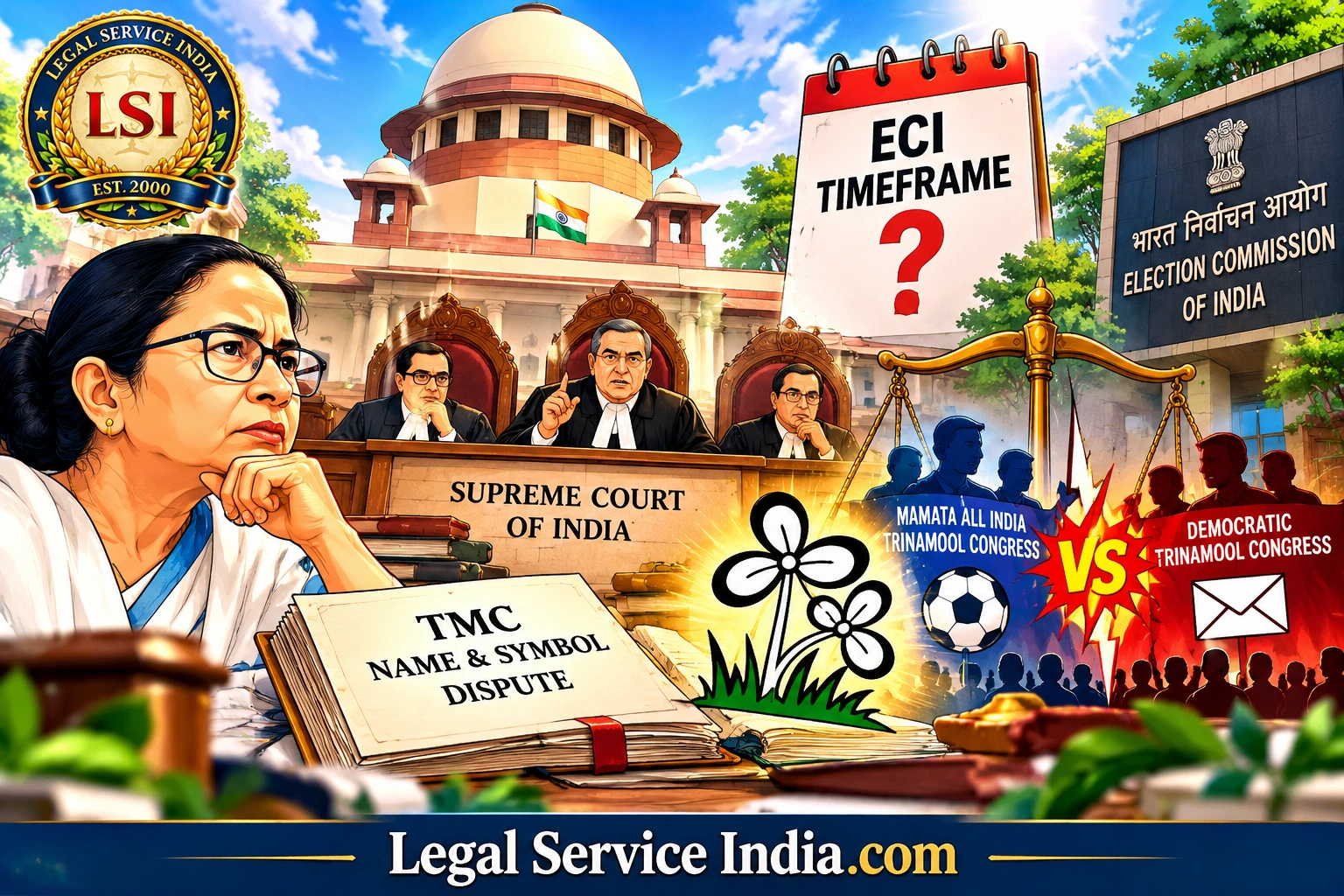
Supreme Court Seeks ECI Timeframe in TMC Name & Symbol Dispute: Why the Shiv Sena Experience Matters
Supreme Court Asks ECI How Soon TMC Name and Symbol Dispute Can Be Decided
The Supreme Court’s hearing on 24 September 2026 in the dispute over the name and election symbol of the All India Trinamool Congress (TMC) has brought one issue sharply into focus: how long should the Election Commission of India take to decide a dispute that directly affects the electoral identity of a recognised political party?
The Court has not decided which faction is entitled to the original TMC name.
It has not awarded the “Flowers and Grass” (Jora Ghash Phul) symbol to either side.
Nor has it finally determined which group represents the recognised political party.
What the Bench has done, according to reports of the oral proceedings, is ask the Election Commission to indicate a reasonable timeframe for completing the substantive adjudication under Paragraph 15 of the Election Symbols (Reservation and Allotment) Order, 1968.
The matter is to return before the court on 28 September 2026.
That Distinction Is Important
In a case involving the identity of a political party, the difference between an interim arrangement, an oral observation and a final adjudication is not merely procedural. It can determine how the electoral process unfolds.
What Happened Before the Supreme Court?
The proceedings arise from a challenge by Mamata Banerjee to the Election Commission’s interim decision concerning the TMC’s name and reserved election symbol.
The Supreme Court cause list identifies the matter as W.P.(C) No. 1213/2026, Mamata Banerjee v. Election Commission of India & Ors., listed before a Bench comprising Chief Justice of India Surya Kant, Justice Joymalya Bagchi and Justice V. Mohana.
The petition concerns the Election Commission’s handling of competing claims to the identity and organisational control of the All India Trinamool Congress.
The Election Commission had, pending its substantive adjudication, frozen the use of the original party name and reserved symbol for the rival groups in the relevant electoral context and allotted interim identities and symbols.
According to contemporaneous reports of the Supreme Court hearing, Senior Advocate Kapil Sibal, appearing for Mamata Banerjee, did not seek a stay of the notified by-elections. Instead, he pressed for an expeditious determination of the underlying dispute.
The Election Commission’s counsel, Senior Advocate Dama Seshadri Naidu, was asked to obtain instructions regarding the amount of time the Commission would require to complete the final adjudication.
The Chief Justice reportedly emphasised the need for a timeframe that would give both sides a fair opportunity to lead evidence while allowing the Commission sufficient time to consider the material and apply its independent judgement.
The matter is scheduled to come up again on 28 September.
An Important Qualification
At the time of writing, the detailed signed order of the 24 September 2026 hearing was not publicly available in the material reviewed.
Accordingly, statements concerning what individual judges said during the hearing should be understood as reported oral proceedings, rather than as the contents of a final written judicial order.
That distinction matters particularly in a pending constitutional matter.
The TMC Dispute: What Is Actually at Stake?
At first glance, this may appear to be a dispute about a name and a symbol.
It is considerably more than that.
The rival sides are effectively contesting the identity of the recognised political party itself.
The Election Commission’s proceedings concern competing claims to the All India Trinamool Congress, its organisational control and its reserved electoral symbol.
The original symbol is commonly described as “Flowers and Grass” or “Jora Ghash Phul”.
The Election Commission has, meanwhile, provided interim arrangements for the rival groups.
Interim Identities and Symbols
- The Mamata Banerjee-led faction has been allotted the name “Mamata All India Trinamool Congress” and the symbol: football player.
- The rival faction has been allotted “Democratic Trinamool Congress” and the symbol: envelope.
These arrangements are temporary and should not be confused with a final Paragraph 15 determination of which faction constitutes the recognised political party.
The immediate electoral relevance arises from the forthcoming West Bengal Assembly by-elections, including Nandigram and Rejinagar, scheduled for 6 October 2026.
The dispute also has a wider electoral footprint, with the Election Commission material concerning the interim arrangement referring to the parliamentary by-election in Nagaon, Assam.
Why Did the Supreme Court Focus on Time?
This is where the case becomes particularly interesting from the standpoint of election law.
Paragraph 15 proceeding is not an ordinary civil dispute between two private parties.
When a recognised political party splits into rival groups, both sides may claim:
- the same party identity;
- the same organisational structure;
- the same leadership;
- the same political history;
- and, ultimately, the same reserved election symbol.
The Election Commission must then determine which group, if any, is the recognised political party.
But elections do not stop while that determination is being made.
That creates an unusual legal problem.
If the Commission decides too quickly, a party may argue that it was denied a proper opportunity to produce documents and evidence.
If the proceedings continue for an excessively long period, successive elections may take place under temporary names and symbols.
The Supreme Court’s concern at the present stage appears to be directed precisely at that tension.
The Bench has therefore sought a realistic timeframe, rather than prescribing a particular number of days.
That is a subtle but important distinction.
The Supreme Court Has Not Fixed a Deadline
This point should be stated plainly.
The Supreme Court has not, on the material presently available, ordered:
“The Election Commission must decide the TMC dispute within X days.”
Instead, the Court has asked the Commission to indicate how much time it reasonably requires.
The Chief Justice’s reported formulation was directed toward finding a period that would balance:
- a fair opportunity for the parties to lead evidence;
- sufficient time for the Election Commission to consider that evidence;
- and the need to prevent the proceedings from becoming unnecessarily prolonged.
This approach is legally more nuanced than simply ordering an “early decision”.
The Election Commission is an adjudicatory constitutional authority in this field. The Court cannot sensibly require it to dispose of a potentially evidence-heavy Paragraph 15 proceeding without allowing the parties an effective opportunity of hearing.
At the same time, the process cannot become open-ended.
Paragraph 15: The Legal Heart of the Dispute
The substantive dispute falls within Paragraph 15 of the Election Symbols (Reservation and Allotment) Order, 1968.
Paragraph 15 deals with rival sections or groups of a recognised political party, each claiming to be that party.
The provision gives the Election Commission power, after considering the available facts and circumstances and hearing the persons who wish to be heard, to determine that:
- one rival group is the recognised political party; or
- none of the rival groups is the recognised political party.
The decision is binding upon the rival sections or groups.
The significance of Paragraph 15 was examined extensively by the Supreme Court Constitution Bench in Subhash Desai v. Principal Secretary, Governor of Maharashtra & Ors., decided on 11 May 2023.
That judgement is the important legal authority here.
Not because it established a deadline for the Election Commission.
It did not.
Its importance lies in explaining the legal framework within which the Commission determines rival claims to a recognised political party.
What Did the Supreme Court Actually Hold in the Shiv Sena Case?
The 2023 Constitution Bench judgement in Subhash Desai is frequently described simply as the “Shiv Sena case”.
That shorthand can obscure some important legal principles.
The Constitution Bench held, among other things, that the Election Commission and the Speaker may proceed concurrently in relation to proceedings under Paragraph 15 of the Symbols Order and the Tenth Schedule.
The Court also held that the Election Commission is not bound to mechanically apply one particular test in every Paragraph 15 dispute.
Instead, it may apply the test that is best suited to the facts and circumstances of the case before it.
That is highly relevant to the present controversy.
A party-symbol dispute is not necessarily resolved simply by counting legislators.
The organisational structure of the political party, its constitution and other relevant evidence can become important depending upon the factual circumstances and the approach adopted by the Election Commission.
The Supreme Court’s judgement also recognised the practical complications that can arise where Paragraph 15 proceedings overlap with proceedings concerning disqualification under the Tenth Schedule.
But the Shiv Sena Judgement Did Not Create a General Deadline
This is where the present TMC proceedings need to be understood carefully.
The 11 May 2023 Constitution Bench judgement did not establish a universal rule requiring the Election Commission to decide every party-symbol dispute within a fixed period.
It would therefore be incorrect to write that the Supreme Court has now applied a “timeline rule” created by the Shiv Sena judgement.
The legal position is more precise.
The 2023 judgement provides important guidance on how a Paragraph 15 dispute may be adjudicated.
The present 2026 proceedings raise an additional and more immediate concern:
How long should the particular TMC adjudication take?
Those are related questions, but they are not the same question.
Why Justice Bagchi’s Shiv Sena Reference Is Significant
According to contemporaneous reports of the 24 September hearing, Justice Joymalya Bagchi referred to the experience of the Shiv Sena dispute while discussing the question of delay.
The reported observation has been variously rendered in the media as:
“We’ve seen what delay does in the Shiv Sena case.”
The precise wording should be treated cautiously until an official transcript or signed order records it.
But the underlying point is significant.
The present court is dealing with a dispute in which an unresolved claim to a political party’s identity can have consequences across subsequent elections.
The Supreme Court’s own 2023 judgement had already recognised the practical danger of allowing a reserved symbol to remain frozen for an inordinately long period.
The Constitution Bench observed that where a reserved symbol remains frozen and interim symbols are repeatedly used for by-elections and elections, the association between the original reserved symbol and the political party may weaken in the minds of voters.
That passage provides a much stronger legal foundation for discussing the significance of delay than simply calling the Shiv Sena judgement a “delay judgement”.
It was not.
But the judgement did recognise why prolonged uncertainty over a party symbol can itself create electoral consequences.
A Political Party’s Symbol Is Not Merely a Logo
This is one of the most important aspects of Indian election law.
The Supreme Court has explained that voters frequently associate a recognised political party with its reserved symbol.
That association develops over time.
The symbol becomes particularly important at the polling stage, where it appears alongside the candidate’s name on the electronic voting machine.
The Court has also recognised that symbols can be especially significant for voters who rely heavily upon visual identification when casting their votes.
This explains why the freezing of a recognised party’s symbol is not simply an internal administrative inconvenience.
It can affect the party’s electoral identity.
At the same time, that does not mean that either faction has an automatic legal entitlement to the symbol merely because it has historically used it.
That entitlement must be determined within the statutory framework.
What Exactly Does the Election Commission Have to Decide?
The central question under Paragraph 15 is not:
Which faction is more popular?
Nor is it simply:
Which faction has more elected representatives?
The statutory question is whether one rival section or group, or none of them, constitutes the recognised political party.
The Election Commission must consider the available facts and circumstances and hear the representatives of the competing groups.
The Supreme Court’s Subhash Desai judgement makes clear that the Commission has flexibility regarding the test appropriate to the particular dispute.
Historically, legislative strength has been relevant in party-split cases.
But the Court has made clear that the Election Commission is not bound to treat legislative majority as the sole or universally controlling consideration.
That means the TMC dispute may involve substantial evidence concerning:
- the party constitution;
- organisational elections;
- office bearers;
- party meetings;
- resolutions;
- membership;
- organisational bodies;
- legislative support;
- and the competing claims concerning the validity of the party’s organisational structure.
The precise weight given to each category is ultimately a matter for the Election Commission within the legal framework governing the Paragraph 15 inquiry.
Why the October 6 Elections Make the Timing Especially Important
There is an unavoidable practical problem here.
The Election Commission’s interim arrangement was made in the context of elections that are already on the calendar.
The Nandigram and Rejinagar Assembly by-elections are scheduled for 6 October 2026.
The Court therefore faces a situation in which interfering with the notified electoral process could itself create serious complications.
According to the reports of the hearing, Kapil Sibal expressly indicated that he was not seeking a stay of the by-elections.
Instead, the argument was directed toward the timing and manner in which the underlying party dispute was being handled.
That distinction is important.
The immediate objective is not necessarily to stop an election.
It is to prevent an interim arrangement from becoming a substitute for a final determination.
Interim Arrangement Versus Final Adjudication
The Election Commission’s present allocation of alternative names and symbols should therefore be understood for what it is: an interim electoral arrangement.
It does not finally answer the question of which faction is entitled to the original:
- All India Trinamool Congress
- name and
- Flowers and Grass
- symbol.
That final determination remains to be made in the Paragraph 15 proceedings.
This is also why the Supreme Court’s present proceedings should not be described as though the Court itself is adjudicating the internal leadership contest.
At this stage, the Court is examining the legality and consequences of the Election Commission’s interim action and the pace of the underlying adjudication.
The substantive party-identity question remains before the Election Commission.
The Constitutional Dimension
The Election Commission’s role in this dispute derives from a broader constitutional framework.
Article 324 of the Constitution vests the Election Commission with the superintendence, direction and control of elections.
The Symbols Order provides the operative framework for recognition and allotment of symbols.
Paragraph 15 specifically addresses disputes between rival sections or groups claiming to constitute a recognised political party.
This gives the Commission a distinctive adjudicatory responsibility.
It must maintain electoral certainty while simultaneously ensuring that competing claims are heard fairly.
That is why the present Supreme Court proceedings should not be reduced to a simple question of whether the Commission acted “for” or “against” one political faction.
The more precise legal question is whether the Commission’s interim action and the subsequent adjudicatory process comply with the governing legal framework and principles of fairness and whether the substantive dispute is being brought to a conclusion within a reasonable procedural period.
What the Supreme Court Has Not Decided
Because this case has already attracted considerable political attention, several distinctions deserve to be put on record.
The Supreme Court has not finally decided:
- who controls the All India Trinamool Congress;
- which faction is the lawful continuation of the recognised party;
- who is entitled to the original TMC name;
- who is entitled to the “Flowers and Grass” symbol;
- whether one faction has a valid organisational majority;
- or what the ultimate Paragraph 15 determination should be.
Those matters remain unresolved.
The Court has also not, on the present record, prescribed a fixed number of days within which the Election Commission must conclude the proceedings.
What it has done is ask the Commission to return with a realistic timeframe.
That may sound procedural.
In this case, it is not.
What Happens on 28 September?
The next hearing may therefore become important for a very specific reason.
The Election Commission is expected to inform the Supreme Court what timeframe it considers realistically necessary to complete the Paragraph 15 proceedings.
The Commission has to balance competing requirements.
- On one side, the rival groups must be allowed to produce their documentary and other evidence and respond to the case made by the other side.
- On the other, the proceeding cannot sensibly remain open for an indefinite period while elections continue to take place under temporary arrangements.
The Court will then have to consider whether the proposed timeframe is reasonable.
That is different from the court itself deciding the TMC dispute.
The Larger Legal Issue: Can Electoral Uncertainty Become Indefinite?
This is, perhaps, the more enduring question raised by the case.
Indian election law recognises that party-symbol disputes can take time because they may involve complicated organisational evidence.
But the law also recognises the consequences of prolonged uncertainty.
The Subhash Desai judgement itself noted that if a reserved symbol remains frozen for an inordinately long period and interim symbols have to be used repeatedly, the connection between the original symbol and the political party can weaken in the electorate’s perception.
That observation gives today’s proceedings a broader legal context.
A temporary arrangement is useful precisely because it is temporary.
If it continues election after election, it begins to change the electoral reality that it was originally designed merely to manage.
That is why the question of time cannot be dismissed as a purely administrative matter.
My Assessment as a Practising Supreme Court Lawyer
The important feature of today’s hearing is not that the Supreme Court has chosen a side in the TMC dispute.
It has not.
The more important development is that the Court appears concerned that the Paragraph 15 adjudication should have a realistic procedural horizon.
That approach is understandable.
A fair hearing requires time.
But time cannot itself become the remedy.
The Election Commission has to hear the rival sides, examine the evidence and arrive at an independent conclusion. At the same time, a recognised party cannot realistically function through temporary electoral identities indefinitely without consequences.
The Supreme Court’s intervention therefore places the emphasis where it belongs: not on deciding the political contest itself, but on ensuring that the statutory adjudicatory process does not drift without a reasonable endpoint.
That is also why the reference to the Shiv Sena experience deserves attention.
The lesson is not that the Shiv Sena judgement created a stopwatch for the Election Commission.
It did not.
The lesson is that prolonged uncertainty over a political party’s identity and symbol can itself produce electoral consequences.
Conclusion
The Supreme Court’s 24 September 2026 hearing in the TMC name-and-symbol dispute should therefore be understood with some precision.
The Court has not awarded the TMC name or the “Flowers and Grass” symbol to either faction.
It has not imposed a fixed deadline on the Election Commission.
It has not finally determined which faction constitutes the recognised All India Trinamool Congress.
What the Court has done, according to the reported oral proceedings, is ask the Election Commission to indicate a reasonable timeframe within which the pending Paragraph 15 adjudication can be completed, while preserving a fair opportunity for both sides to present their evidence.
The next hearing on 28 September 2026 may clarify what timetable the Commission proposes and whether the Court considers that timetable adequate.
The legal significance of the case extends beyond the immediate TMC controversy.
It concerns a recurring problem in Indian election law: how to protect procedural fairness without allowing uncertainty over a political party’s identity to continue indefinitely.
The Supreme Court’s 2023 decision in Subhash Desai supplies the important legal framework concerning Paragraph 15 and the Election Commission’s choice of an appropriate adjudicatory test. The present proceedings add a different question: how quickly should that framework be brought to bear in a live electoral dispute?
That is the question now before the Court.
And for the moment, the answer is not who gets the symbol.
The answer is that the Election Commission must tell the Court how long it reasonably needs to decide who, in law, is entitled to it.
Legal Citation
Mamata Banerjee v. Election Commission of India & Ors., W.P.(C) No. 1213/2026 (Diary No. 58005/2026), Supreme Court of India, hearing dated 24 September 2026.
The detailed signed order of the 24 September hearing should be checked once uploaded before attributing any oral observation to the court as a formal direction.
The Principal Paragraph 15 Authority
Subhash Desai v. Principal Secretary, Governor of Maharashtra & Ors., (2023) INSC 441: [2023] 8 S.C.R. 857, Constitution Bench, judgement dated 11 May 2023.
Primary Legal Framework
| Legal Framework |
|---|
| Article 324, Constitution of India. |
| Paragraph 15, Election Symbols (Reservation and Allotment) Order, 1968. |
| Relevant provisions of the Representation of the People Act, 1951. |
| Supreme Court Constitution Bench judgement in Subhash Desai. |
Need Legal Representation in an Election Commission or Political Party Dispute?
A dispute over a political party’s name, election symbol, organisational control or recognition before the Election Commission of India (ECI) can have consequences that go far beyond an ordinary legal proceeding. Once an election timetable is involved, delay, procedural strategy and the quality of legal representation can become critically important.
Whether you are dealing with a TMC name and symbol dispute, a Paragraph 15 proceeding under the Election Symbols (Reservation and Allotment) Order, 1968, an ECI order, a political-party split, election-symbol recognition issue, or a challenge before the Supreme Court of India, your case requires careful assessment of the facts, the statutory framework and the available constitutional remedies.
Do not wait until the electoral process has moved beyond the point where effective relief becomes difficult.
If your political party, organisation, candidate or electoral interest is affected by an Election Commission decision, party-symbol dispute or election-law controversy, obtain professional legal advice at the earliest stage.
⚖️ Adv. Tarun Choudhury
Supreme Court Advocate | 25+ Years of Legal Experience
📞 Call: 9650499965
💬 WhatsApp: 8851978611
📧 Email: [email protected]
Legal Assistance May Be Considered For:
- Election Commission of India (ECI) proceedings
- Political party name and election-symbol disputes
- Paragraph 15: Election Symbols Order proceedings
- Political party organisational and leadership disputes
- Challenges to ECI orders before constitutional courts
- Supreme Court petitions and urgent electoral remedies
- Election-related constitutional and statutory litigation
- Judicial review of election authorities’ decisions
- Representation of political parties, candidates and affected stakeholders
Your electoral identity can have lasting consequences.
If you are facing an ECI dispute, political party recognition issue, election-symbol controversy or urgent election-law matter, taking legal advice early can help you understand your legal position, preserve your remedies and determine the appropriate course of action.
Speak directly with an experienced Supreme Court advocate.
Adv. Tarun Choudhury
Supreme Court Advocate | 25+ Years of Legal Experience
📞 9650499965 | 💬 8851978611
Frequently Asked Questions
Here are five SEO-rich FAQs designed around the article’s core search terms while keeping the legal position precise.
1. What Is the TMC Name and Symbol Dispute Before the Supreme Court?
The TMC name and symbol dispute before the Supreme Court concerns competing claims over the identity, organisational control, party name and reserved “Flowers and Grass” (Jora Ghash Phul) election symbol of the All India Trinamool Congress. In Mamata Banerjee v. Election Commission of India & Ors., W.P.(C) No. 1213/2026, the Supreme Court has not decided which faction is entitled to the original TMC name or symbol. During the reported oral proceedings on 24 September 2026, the Court asked the Election Commission of India (ECI) to indicate a reasonable timeframe for completing the underlying adjudication.
2. What Is Paragraph 15 of the Election Symbols (Reservation and Allotment)? Order, 1968?
Paragraph 15 of the Election Symbols Order, 1968 empowers the Election Commission of India to decide disputes where rival groups or sections each claim to represent a recognised political party. After considering the relevant facts and hearing the competing groups, the ECI may determine that one group—or none of the rival groups—is the recognised political party. The provision is therefore central to political party split, recognition and election-symbol disputes in India.
3. Has the Supreme Court Ordered the ECI to Decide the TMC Symbol Dispute Within a Fixed Deadline?
No. On the material presently available concerning the 24 September 2026 Supreme Court hearing, the Court did not impose a fixed deadline for deciding the TMC name and election-symbol dispute. According to reports of the oral proceedings, the Bench asked the Election Commission of India to indicate a reasonable timeframe for completing the Paragraph 15 adjudication while providing the rival parties a fair opportunity to present their evidence.
4. Why Is the Shiv Sena Judgement Relevant to the TMC Election Symbol Dispute?
The Constitution Bench decision in Subhash Desai v. Principal Secretary, Governor of Maharashtra & Ors., (2023) INSC 441 is important because it explains the legal framework governing Paragraph 15 election-symbol disputes. The Supreme Court held that the ECI is not required to mechanically apply one test in every political-party dispute and may adopt a test appropriate to the facts and circumstances. Importantly, the Shiv Sena judgement did not create a universal deadline within which the ECI must decide every party-symbol dispute.
5. Can an Election Commission Decision in a Political Party Name or Symbol Dispute Be Challenged Before the Supreme Court?
An Election Commission decision concerning political party recognition, name or election symbol is subject to judicial review in accordance with constitutional principles and the applicable procedural framework. Depending upon the nature of the ECI action and the circumstances of the case, an affected party may seek appropriate constitutional remedies. Because election disputes can become highly time-sensitive once an election schedule is underway, questions concerning ECI orders, Paragraph 15 proceedings, election symbols and Supreme Court remedies often require prompt legal assessment.
🔑 Key Takeaways: TMC Name & Symbol Dispute Before Supreme Court
- Supreme Court hearing: On 24 September 2026, the Supreme Court heard Mamata Banerjee v. Election Commission of India & Ors., concerning the TMC name and election symbol dispute.
- ECI timeframe sought: The Supreme Court asked the Election Commission of India (ECI) to indicate a reasonable timeframe for completing the pending adjudication concerning the TMC’s name, identity and election symbol.
- No fixed deadline imposed: The Court has not fixed a specific deadline for the ECI to decide the dispute. The reported proceedings indicate that the ECI was asked to propose how much time it reasonably requires.
- TMC’s original symbol remains disputed: The proceedings concern the entitlement to the “Flowers and Grass” (Jora Ghash Phul) symbol and the recognised All India Trinamool Congress identity. The Supreme Court has not finally awarded the name or symbol to either faction.
- Paragraph 15 is central: The dispute is being considered within the framework of Paragraph 15 of the Election Symbols (Reservation and Allotment) Order, 1968, which empowers the ECI to determine competing claims concerning a recognised political party.
- Interim names and symbols: Pending the final determination, the ECI has made an interim arrangement involving alternative party names and election symbols for the rival groups.
- Upcoming elections add urgency: The dispute has particular electoral significance because of the West Bengal Assembly by-elections scheduled for 6 October 2026, including Nandigram and Rejinagar.
- Shiv Sena precedent is relevant: The Supreme Court’s Constitution Bench judgement in Subhash Desai v. Principal Secretary, Governor of Maharashtra & Ors., (2023) INSC 441, provides important guidance on how Paragraph 15 disputes may be adjudicated.
- No universal “Shiv Sena deadline”: The 2023 Subhash Desai judgement did not establish a general fixed timeframe for the ECI to decide every political-party name or election-symbol dispute.
- Delay has electoral consequences: The proceedings highlight the legal tension between providing rival factions a fair opportunity to present evidence and preventing an election-symbol dispute from remaining unresolved for an unnecessarily long period.
- Supreme Court has not decided the political dispute: The Court has not determined which faction is the “real” TMC, who controls the party organisationally, or who ultimately gets the original party name and Flowers and Grass symbol.
- Next hearing: The matter is reported to be listed again on 28 September 2026, when the ECI’s proposed timeframe may be considered.
Summary
The Supreme Court’s TMC name and symbol dispute hearing concerns the Election Commission’s pending Paragraph 15 adjudication over the identity and reserved symbol of the All India Trinamool Congress. On 24 September 2026, the Court reportedly asked the ECI to indicate a reasonable timeframe for completing the dispute resolution process but did not impose a fixed deadline or decide which faction is entitled to the TMC name or “Flowers and Grass” symbol. The Supreme Court’s 2023 Subhash Desai judgement remains an important authority on Paragraph 15 political-party symbol disputes.