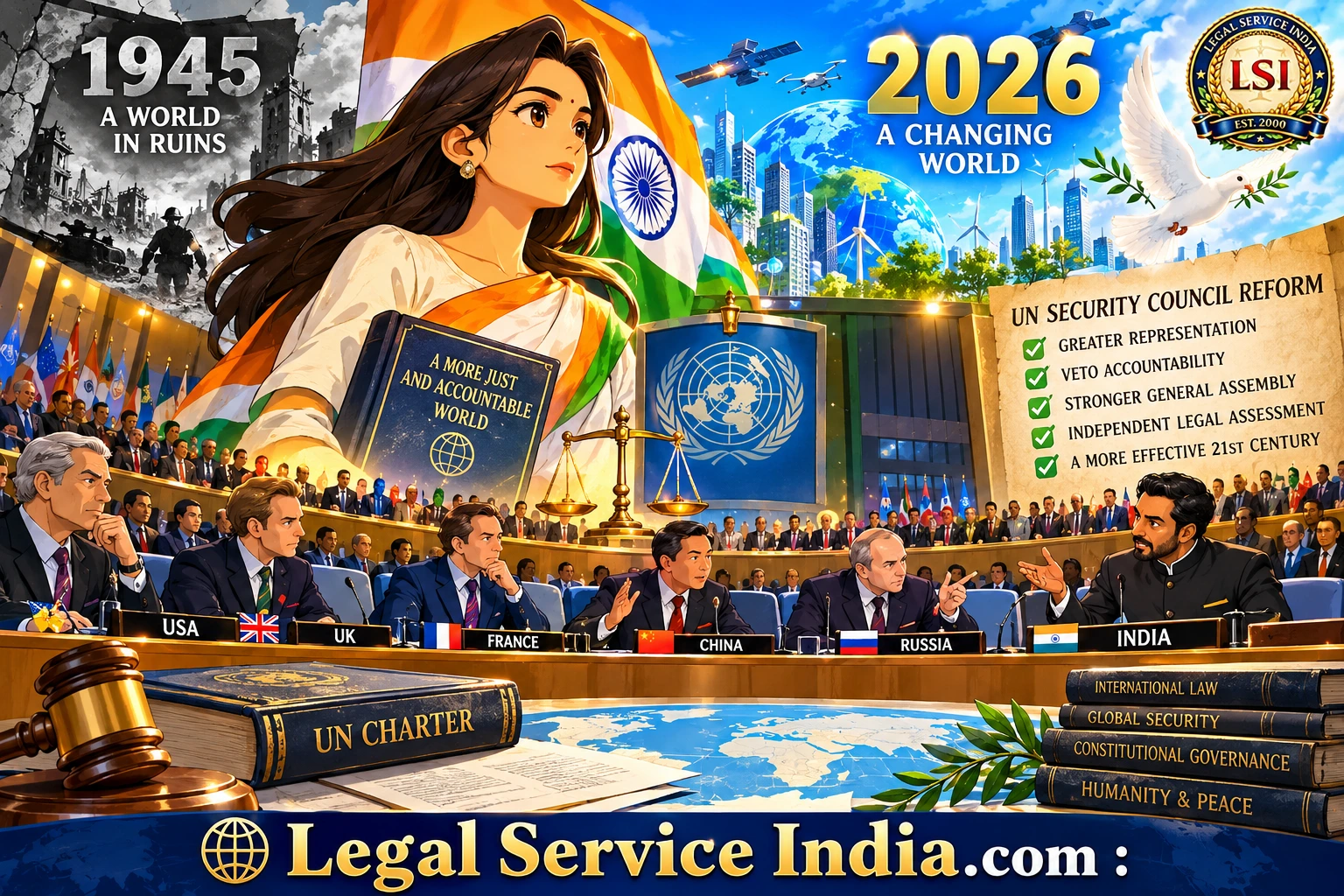
Who Guards the Guardians? Why the UN Security Council Needs to Be Rebuilt for the 21st Century
The world has changed since 1945. The question is whether the architecture of global power should remain frozen in that year.
By Adv. Tarun Choudhury
There is something deeply strange about the way the world governs peace.
We are living in 2026.
We have artificial intelligence, cyber warfare, drones, hypersonic missiles, nuclear weapons, global financial markets and military technologies capable of changing a conflict within hours. A war in one part of the world can close a shipping route, shake energy markets and affect the lives of people thousands of kilometres away.
Yet the institution created after the Second World War to deal with international peace and security still rests on a political arrangement designed in 1945.
Five countries occupy permanent seats on the UN Security Council. Five countries possess the veto.
The world has changed dramatically.
The basic distribution of institutional power has changed very little.
That does not mean the United Nations has become irrelevant. Far from it.
It means we should be willing to ask a difficult question:
Is an international security system designed for the world of 1945 adequate for the world of 2026?
The Charter begins with equality. The Security Council begins with hierarchy.
The contradiction is built into the UN Charter itself.
Article 2(1) is clear: the United Nations is based on the sovereign equality of its members.
Article 2(4) requires states to refrain from the threat or use of force against the territorial integrity or political independence of other states.
These are foundational principles.
But then we come to the Security Council.
Article 23 establishes five permanent members: China, France, Russia, the United Kingdom and the United States.
Under Article 27, substantive decisions require nine affirmative votes, including the concurring votes of the permanent members. In practical terms, a negative vote by one of those five can prevent the Council from adopting a substantive resolution.
There is an important legal distinction here. An abstention by a permanent member is not necessarily a veto, and the Council can adopt a resolution despite a permanent member abstaining.
But the larger constitutional reality remains.
The Charter speaks of sovereign equality, while the central institution responsible for international peace and security gives five states a permanent position and a unique blocking power.
That arrangement was deliberate.
It was part of the bargain that made the post-war international system politically possible.
The real question is not whether the arrangement made sense in 1945.
It probably did.
The real question is whether a bargain made in 1945 should continue to determine the constitutional structure of international security indefinitely.
A constitutional arrangement should not become sacred merely because it is old.
Why the veto was created
It is easy, from the comfort of 2026, to look at the veto and simply call it undemocratic.
History is more complicated.
The League of Nations had failed.
The Second World War had demonstrated the catastrophic consequences of international institutions being unable to prevent aggression or secure cooperation among the major powers.
The architects of the United Nations therefore faced a practical problem.
The great powers were not prepared to enter an organisation in which they could be subjected to coercive decisions made against their fundamental interests by a majority of smaller states.
The veto was part of the compromise.
The logic was straightforward: if the states possessing the greatest military and political power were not given a special role, they might simply refuse to accept the authority of the new organisation.
That concern was not imaginary.
The veto was therefore not an irrational idea.
But there is a difference between understanding why an institution was created and believing that its original design must remain appropriate forever.
Constitutions are supposed to serve societies.
They are not supposed to imprison societies in the circumstances of the year in which they were written.
The world of 1945 is gone.
The United Nations began with 51 members.
Today there are 193.
Decolonisation transformed the international system. Asia and Africa moved from being largely subjects of imperial rule to becoming sovereign participants in international affairs. New economic powers emerged. New regional organisations developed. The nature of warfare itself changed.
India was not an independent country when the UN Charter was negotiated.
The Security Council was eventually enlarged from 11 members to 15.
But the fundamental distinction between permanent and non-permanent membership remained.
That is why the current reform debate cannot be reduced to a simple question of adding a few more countries.
The problem is deeper.
The world has become more representative.
The central institution of international security has become only partially more representative.
The Charter makes fundamental reform extraordinarily difficult.
There is another problem, and it is almost constitutional in character.
Article 108 provides that Charter amendments require a two-thirds vote in the General Assembly and ratification by two-thirds of UN members, including all permanent members of the Security Council.
In other words, the states that benefit from the existing constitutional arrangement are indispensable to changing it.
That does not make reform impossible.
But it explains why Security Council reform has remained one of the great unfinished questions of international law and diplomacy.
The structure contains its own resistance to change.
When power becomes part of the accountability problem
The difficulty becomes particularly obvious when a major power is itself involved in a conflict.
The Security Council is not an international court. It is a political organ with primary responsibility for maintaining international peace and security.
Questions concerning the legality of military action may involve the UN Charter, customary international law, Article 51 on self-defence and, where jurisdiction exists, international judicial institutions.
But the Council itself operates through political decision-making.
That matters.
A smaller state does not have the same institutional ability to prevent Council action against it that a permanent member may possess.
The problem is therefore not that every veto is unlawful.
It is that the system creates different levels of political leverage.
When a powerful state is directly involved in a crisis, the institution responsible for responding to that crisis may be affected by the strategic interests of the very states whose cooperation it needs.
That is an accountability problem.
And it is a structural one.
Also Read: A$150 Million Indigenous Land Judgement: What India Can Learn About Tribal Land Rights
Iran gives us a contemporary test.
The 2026 conflict involving Iran brings this question sharply into focus.
The United States and Israel have presented their military actions through arguments concerning security and self-defence.
Iran has invoked Article 51 and presented its own actions through the language of self-defence.
The competing legal claims are contested. A government cannot establish the legality of military action merely by declaring its own legal justification.
That is precisely why international institutions exist.
The Security Council was not completely silent during the crisis.
On 11 March 2026, it adopted Resolution 2817 by a vote of 13-0-2. The resolution condemned Iranian missile and drone attacks against Bahrain, Kuwait, Oman, Qatar, Saudi Arabia, the United Arab Emirates and Jordan and addressed concerns relating to navigation and regional security.
So it would be inaccurate to say that the United Nations simply did nothing.
The more interesting question is why the Council can act in some areas while becoming deeply divided when the strategic interests of major powers collide.
That is the real institutional issue.
Not silence.
Selective capacity.
Not absence of rules.
Unequal political leverage over how those rules are applied.
What happens when the powerful and the weak face the same rules?
Imagine two countries accused of violating international law.
The legal rule does not change merely because one country is more powerful.
But the political consequences can.
A smaller state does not possess the same military capability, diplomatic influence or veto power as a permanent member.
That difference creates a dangerous perception: that international law is strongest when dealing with the weak and most negotiable when powerful interests are involved.
Whether that perception is always factually justified is another matter.
But legitimacy is not created by rules alone.
People must also believe that the rules are being applied with some degree of consistency.
The rule of law cannot ultimately depend on the size of an aircraft carrier.
The veto has been controversial from the beginning
This criticism is not new.
During the creation of the United Nations, smaller and medium-sized states questioned whether the veto was compatible with the principle of sovereign equality.
The great powers had their answer: without their participation and consent, the organisation might become politically irrelevant.
Both arguments contained something important.
The problem is that the compromise made in 1945 was never designed to settle the question for all future generations.
It was designed to get the United Nations started.
We should be careful not to confuse the political necessity of a founding compromise with the permanent legitimacy of every feature of that compromise.
Suez showed that Security Council paralysis need not mean total international paralysis.
There is an important historical lesson in the Suez crisis of 1956.
Britain and France were permanent members of the Security Council when the crisis occurred.
The Council became deadlocked.
The General Assembly then became central to the international response through the “Uniting for Peace” mechanism associated with Resolution 377A(V), adopted in 1950.
The lesson is not that the General Assembly can simply replace the Security Council.
It cannot.
The lesson is more modest—and more useful.
The wider UN membership does not have to become politically irrelevant merely because the Security Council is paralysed.
That principle is worth developing further.
The General Assembly has already taken one step towards veto accountability.
In 2022, the General Assembly adopted Resolution 76/262.
It established a standing mandate for a General Assembly debate when a veto is cast in the Security Council. It also invited the Security Council to submit a special report on the veto to the General Assembly at least 72 hours before the relevant discussion.
That does not abolish the veto.
It does something more practical.
It puts political scrutiny around the exercise of extraordinary power.
That idea could be developed much further.
The arms trade raises another uncomfortable question.
There is another part of the international system we should not ignore.
The five permanent members are also the five nuclear-weapon states formally recognised under the Nuclear Non-Proliferation Treaty.
That does not mean they are the only nuclear-armed states in the world.
They are not.
But it does demonstrate how closely permanent institutional authority and military power have been connected from the beginning.
Then there is the global arms trade.
According to SIPRI, international transfers of major conventional arms in 2021–25 were 9.2% higher than in 2016–20—the highest level since the end of the Cold War. The United States accounted for 42% of global exports, while the five largest suppliers—the United States, France, Russia, Germany and China—together accounted for 70%.
Notice something important.
The five largest arms exporters are not identical to the five permanent members. Germany is among the top five exporters but is not a permanent member, while the United Kingdom is a permanent member but was not among the top five exporters in 2021–25.
That distinction matters.
The argument is not that the P5 are simply the world’s five largest arms dealers.
The stronger point is that several of the states with the greatest institutional power over international peace and security are also major military powers and major participants in the global arms economy.
There is a structural tension here.
States need weapons for legitimate defence.
Deterrence can prevent war.
Countries cannot be expected to leave themselves defenceless in an uncertain world.
But SIPRI also identifies armed conflicts and geopolitical tensions as major drivers of arms procurement.
And that creates the familiar security dilemma.
One country buys weapons because it feels threatened.
Its neighbour sees those weapons and feels threatened.
The neighbour responds by buying more.
The cycle continues.
An AK-47 does not become a peace instrument simply because the invoice describes it as defence equipment.
And this is why we should be careful with the word security.
Security is not always experienced in the same way by both sides of a border.
Deterrence can prevent war. But deterrence is not the same thing as peace.
Military alliances and bases raise the same dilemma.
Military alliances and overseas bases are not automatically unlawful.
States may enter into defence agreements. Countries may station forces abroad with consent. Collective defence arrangements can serve legitimate security purposes.
But there is another side to the equation.
What one government describes as defensive protection may be perceived by another as an offensive threat.
That is the security dilemma again.
And when military capability, alliances, strategic bases and weapons markets intersect, the language of “security” can become extremely broad.
This is precisely why international law needs institutions capable of examining claims rather than simply accepting the narrative of the most powerful actor.
Also Read: Can a U.S. President Be Prosecuted While in Office? Presidential Immunity Explained
This is not an argument against America, Russia, China, Britain or France
This point needs to be made clearly.
The argument should not become another exercise in choosing one permanent member to blame.
The principle must apply equally.
If Russia exercises its veto, the question of accountability matters.
If the United States exercises its veto, the same question matters.
If China, France or the United Kingdom exercises it, the same standard should apply.
And if India eventually becomes a permanent member, India should accept exactly the same scrutiny.
Otherwise, reform becomes little more than redistribution of privilege.
That is not enough.
India should ask for representation—but also offer a reform blueprint.
India has a longstanding case for greater representation in the Security Council.
But India has an opportunity to make a much larger argument.
India should not say merely:
“Why not India?”
It should also ask:
“What should the Security Council become?”
That distinction is important.
If India simply joins the existing permanent-member structure, India gains influence.
That is legitimate.
But the institution itself may remain fundamentally unchanged.
India could instead put forward a reform programme built around a simple principle:
No permanent power without permanent accountability.
That principle could become the foundation of India’s reform position.
An Indian reform blueprint
1. Every veto should carry a public explanation.
A permanent member exercising a veto should be expected to publish a detailed explanation of the legal, factual and humanitarian basis for its decision.
Not a diplomatic sentence.
A reasoned explanation.
If a state possesses extraordinary institutional power, the exercise of that power should generate extraordinary transparency.
2. Every veto should automatically trigger General Assembly scrutiny
Resolution 76/262 has already created a mechanism for General Assembly debate after a veto.
India could argue for strengthening it.
A veto on a major peace-and-security matter should automatically trigger a structured General Assembly debate with:
- the permanent member required to explain its position;
- Other members allowed to respond;
- the relevant UN Secretary-General or independent experts invited to provide factual assessments;
- and a publicly recorded outcome.
The General Assembly need not acquire a veto over the veto.
But the wider membership should have the right to scrutinise its use.
3. Create an independent legal assessment mechanism
This could be one of India’s most useful proposals.
Where competing states invoke Article 51 or other legal justifications for the use of force, an independent panel of international legal experts could examine the publicly available evidence and provide a reasoned legal assessment.
It would not replace the Security Council.
It would not automatically determine political consequences.
But it would give the world something extremely valuable:
an independent legal record.
Today, competing governments can present completely different versions of the same conflict.
The public is then left to navigate competing political narratives.
International law deserves something better.
4. Develop a special procedure for mass atrocities.
India could support a special procedure for situations involving genocide, crimes against humanity or other exceptionally grave violations.
The objective would not necessarily be to abolish the veto.
It would be to create a political cost and procedural burden when the veto is used to block collective action in the most serious circumstances.
The international community has spent decades debating whether veto power should be restrained in atrocity situations.
India could help move that debate from principle to procedure.
5. Strengthen the General Assembly when the Council is paralysed
The General Assembly should not become a second Security Council.
But it should have stronger procedures for responding when the Council is unable to act.
The experience of Suez and the Uniting for Peace mechanism shows that the wider membership already has a constitutional and political role when the Council is deadlocked.
That role can be made more systematic.
The principle should be simple:
Council paralysis should not automatically mean international paralysis.
6. Expand representation without simply expanding privilege.
If the Security Council is enlarged, representation should improve.
- Africa deserves a stronger voice.
- Asia deserves greater representation.
- Latin America and the Caribbean deserve meaningful participation.
- Other regions should not have to compete indefinitely for occasional influence over decisions that can determine war and peace.
But there is a warning here.
If reform simply creates three or four additional permanent powers, we may have increased representation without changing the underlying philosophy.
That would be expansion.
Not necessarily reform.
7. Make the reform itself subject to periodic review.
This is an idea India could champion strongly.
Why should Security Council reform happen once every several decades?
The international system changes too quickly for that.
A future reform package could include a formal review mechanism every 15 or 20 years.
The Council’s composition, veto arrangements, regional representation and accountability mechanisms could then be examined against the realities of the time.
That would prevent today’s compromise from becoming tomorrow’s constitutional fossil.
8. India should accept the same rules it demands for everyone else
This may be the most important part of the Indian proposal.
If India receives permanent membership, India should voluntarily accept enhanced transparency regarding its own vetoes.
India should agree that its use of the veto can be debated in the General Assembly.
India should support independent legal scrutiny where appropriate.
India should accept that permanent membership is not a licence for permanent exemption from accountability.
That would give India’s reform proposal credibility.
It would say to the world:
We are not asking for privilege merely because we are India. We are asking for a better system—and we are prepared to live under the better system ourselves.
But what about the strongest argument against reform?
There is a serious objection.
The defenders of the veto can say that international politics cannot be wished away.
The United Nations ultimately depends upon the cooperation of powerful states.
Remove their special position and they may simply ignore the organisation.
The League of Nations is the obvious historical warning.
A Security Council that adopts resolutions which the major powers refuse to recognise or implement could become little more than a debating chamber.
That argument deserves to be taken seriously.
Military and economic capabilities are not distributed equally among states.
A system that pretends otherwise may become disconnected from political reality.
But there is a difference between recognising political reality and treating political reality as permanently beyond reform.
Reality can explain a system. It does not necessarily justify keeping that system forever.
The answer, therefore, may not be to abolish the veto tomorrow.
The answer may be to surround extraordinary power with stronger transparency, scrutiny and institutional consequences.
Also Read: File Legal Notice in India: Complete Guide to Drafting, Procedure, Cost & Legal Rights
The real question is accountability.
This is why the debate should move beyond the familiar arguments about which country deserves a permanent seat.
The deeper questions are these:
- Who scrutinises the use of veto power?
- Who examines competing claims of self-defence?
- Who provides an independent legal assessment when powerful states disagree about the legality of military action?
- What happens when the Security Council is paralysed?
- How much authority should remain concentrated permanently in five states?
- And what mechanisms should exist to ensure that international security does not simply become another expression of national strategic interest?
These are not anti-American questions.
They are not anti-Russian questions.
They are not anti-Chinese, anti-British or anti-French questions.
They are constitutional questions.
And India should be prepared to ask them.
The world does not belong to 1945.
The people who designed the United Nations were responding to a world devastated by two world wars.
They did something extraordinary.
They created an international organisation intended to prevent another catastrophe.
That achievement should not be diminished.
But respecting the founders does not require freezing their political compromise forever.
The United Nations began with 51 members.
There are now 193.
The nature of warfare has changed.
Technology has changed.
Economic power has shifted.
New regions have become major actors.
The security problems of 2026 are not the security problems of 1945.
So why should the constitutional architecture of international peace remain almost untouched?
The answer cannot simply be:
Because that is how it was designed.
That is history.
It is not an argument for eternity.
India has a bigger opportunity than simply getting a permanent seat.
India should continue to seek a greater role in the Security Council.
But India should not allow the debate to stop there.
India can make a more ambitious proposition:
Representation without accountability is incomplete reform.
A larger council is not necessarily a better council.
More permanent members are not necessarily more democratic.
A different distribution of privilege is not necessarily a different philosophy.
India can instead argue for an international security system in which:
- Power is accompanied by responsibility
- Veto is accompanied by explanation;
- Military action is accompanied by independent legal scrutiny
- Council paralysis is accompanied by a meaningful role for the wider UN membership;
- And permanent membership is never treated as permanent immunity from accountability.
That is a reform agenda worth taking to the world.
One final question
The ordinary people of the world did not design the veto.
They did not negotiate the distribution of nuclear weapons.
They did not decide where military bases would be built.
They did not create the global arms market.
Yet when the system fails, they pay the price.
They pay through displacement.
Through destroyed homes.
Through higher energy prices.
Through disrupted trade.
Through lost employment.
Through refugee flows.
And, ultimately, through human lives.
The UN was born from the ruins of war.
It should not become a monument to the political arrangements of the year in which it was born.
India should therefore pursue a greater voice—but it should also ask a much larger question about the future of international governance.
Not simply:
Who should be the next permanent member?
But:
How should permanent power itself be made accountable?
And that is where India can make its most important contribution to the debate.
India should not merely ask for a chair at the old table.
India should ask whether the table itself is still fit for the world.
If India eventually takes its place there, it should not go merely to inherit permanent privilege.
It should go with a larger proposition:
No country should be permanently above accountability.
Because the world does not need permanent bosses.
It needs permanent principles.
Need Legal Guidance on International Law, Constitutional Issues or India-Related Global Disputes?
The questions raised by international law are rarely as simple as they appear in the headlines.
Whether you are dealing with international litigation, cross-border disputes, constitutional questions, enforcement of foreign judgements or arbitral awards in India, international arbitration, sovereign or regulatory issues, or the legal implications of India’s international commitments, the right legal strategy often begins with understanding the law before taking action.
If your matter has an international, constitutional, cross-border or Supreme Court dimension, professional legal advice at an early stage can help identify the applicable law, jurisdiction, available remedies and the most appropriate legal course.
Adv. Tarun Choudhury
Supreme Court Advocate | 25+ Years of Legal Experience
If you have a specific legal issue and want to understand your rights, legal options, jurisdiction and possible remedies in India, you may contact me for a professional consultation.
📞 Call: 9650499965
💬 WhatsApp: 8851978611
✉️ Email: [email protected]
Before contacting me
To receive a more meaningful preliminary response, please provide:
- Your name
- Country and city
- A brief description of the legal issue
- The parties involved
- Any important court case, order, notice or document
- Your email address
- Your preferred method of contact
Do not wait until a legal deadline becomes a legal crisis. Early legal assessment can sometimes make the difference between reacting to a problem and preparing for it.
LegalServiceIndia.com — Legal Research, Advice & Representation for India-Related Legal Matters.
Frequently Asked Questions
1. Why does the UN Security Council need reform in 2026?
The UN Security Council needs reform because its basic structure was created in 1945, when the United Nations had only 51 members and the global balance of political, economic and military power was very different. Today, the UN has 193 member states, yet five countries continue to hold permanent seats and veto power. Security Council reform is therefore increasingly discussed in terms of greater representation, transparency, accountability and institutional effectiveness.
2. Why does India want a permanent seat on the UN Security Council?
India seeks permanent membership of the UN Security Council as part of its broader demand for greater representation in global decision-making. India is one of the world’s largest countries by population and economy and has played a significant role in UN peacekeeping and international diplomacy. However, permanent membership alone would not necessarily change the underlying structure of the Security Council. The larger question is whether India should seek not only representation but also meaningful reform of the veto and permanent-member system.
3. What is the veto power of the permanent members of the UN Security Council?
The UN Security Council veto allows any of the five permanent members—the United States, Russia, China, France and the United Kingdom—to block the adoption of a substantive Council resolution by voting against it. Article 27 of the UN Charter establishes the voting framework. A permanent member’s abstention, however, is not necessarily a veto and does not automatically prevent the Council from adopting a resolution.
4. Can the UN Security Council veto power be reformed or limited?
UN Security Council veto reform is legally and politically difficult because Article 108 of the UN Charter requires amendments to be ratified by two-thirds of UN members, including all five permanent members. Possible reforms could include greater transparency over vetoes, mandatory explanations for their use, stronger General Assembly scrutiny, independent legal assessments of competing claims of self-defence, and stronger procedures when the Security Council becomes paralysed. Any proposal to limit or abolish the veto would require substantial political agreement among UN member states.
5. What reforms could India propose for the UN Security Council?
India could combine its demand for permanent membership of the UN Security Council with a broader reform programme. Possible proposals include greater accountability for vetoes, mandatory public explanations for their use, stronger General Assembly oversight, independent legal assessments concerning the use of force, improved representation for Africa and other under-represented regions, stronger procedures when the Security Council is deadlocked, and periodic review of the Council’s structure. Such an approach would allow India to argue for both greater representation and greater accountability in international governance.
Key Takeaways
- The UN Security Council was designed in 1945, but the international system has changed dramatically. The United Nations has expanded from 51 founding members to 193 member states, while the Council’s permanent-member structure remains largely unchanged.
- Five countries—the United States, Russia, China, France and the United Kingdom—hold permanent seats and veto power in the UN Security Council, giving them a level of institutional influence that other UN members do not possess.
- UN Security Council reform is about more than adding new permanent members. The deeper issue is whether permanent membership, veto power and concentrated decision-making authority remain appropriate for the international system of the 21st century.
- India’s demand for a permanent seat on the UN Security Council should be considered alongside broader institutional reform. India can seek greater representation while also advocating greater transparency, accountability and effectiveness in the Security Council.
- The UN Charter establishes sovereign equality of member states, but the Security Council creates a different political structure by giving five permanent members special voting power on substantive decisions.
- The Security Council veto creates a significant accountability question. When a permanent member’s strategic interests are directly involved in an international crisis, the Council may face political constraints in responding collectively.
- The 2026 Iran conflict demonstrates the continuing difficulty of achieving consistent international action when major geopolitical interests collide. The issue is not simply whether the UN acts, but whether international institutions can respond consistently when powerful states are directly involved.
- The global arms trade highlights a broader security dilemma. Military capability can serve legitimate purposes of deterrence and national defence, but increased military competition can also make other states feel less secure.
- Deterrence and peace are not the same concept. A credible military capability may discourage aggression, but long-term international peace also requires diplomacy, international law, accountability and effective institutions.
- Security Council reform should strengthen representation without simply reproducing existing privilege. Adding permanent members without addressing veto accountability and institutional paralysis could change the membership without fundamentally changing the system.
- India could propose a stronger reform framework, including greater transparency over vetoes, mandatory explanations for veto decisions, stronger General Assembly scrutiny, independent legal assessments of competing claims of self-defence, greater regional representation and periodic review of the Council’s structure.
- General Assembly Resolution 76/262 provides an existing foundation for greater veto accountability by providing for a General Assembly debate when a permanent member exercises its veto in the Security Council.
- The Suez Crisis demonstrates that Security Council paralysis does not necessarily have to mean complete international paralysis. The General Assembly’s role under the Uniting for Peace framework provides an important historical example of wider UN involvement when the Council is deadlocked.
- Meaningful UN reform should apply equally to all permanent and future permanent members. If India eventually obtains permanent membership, it should also accept greater transparency and accountability for the exercise of its own institutional power.
- The central question is no longer simply who should receive a permanent seat. The more fundamental question is how permanent power can be made accountable, representative and consistent with the changing realities of international law and global governance.
In One Sentence
UN Security Council reform should not merely redistribute permanent power; it should create a more representative, accountable and effective international security system for the 21st century.