





Registered Trademark, Unregistered Intelligence
Introduction – From Asset to Liability
Artificial Intelligence has been, for the past few years, one of the fastest-growing assets a technology company can have. Valuations built on AI capability have run into the hundreds of billions of dollars; global expansion has followed just as quickly, with companies racing to establish a presence in every major market, India included. In that race, speed has usually been treated as the advantage of the company that launches first, scales first, and claims a name first, wins.
But a name is not simply a label. In trademark law, property and property have owners. A unique name, logo, or mark allows a business to build goodwill and reputation, and the law protects whoever established that identity first, not whoever became the most famous using it later. This is a principle Indian trademark law takes seriously: prior use, not prior fame, decides who owns a name.
That principle is now colliding, repeatedly, with the AI industry’s habit of moving fast and naming later. Global AI companies have entered the Indian market only to discover that their brand names the same names recognized worldwide were already registered, or already in use, by small Indian firms with no connection to AI at all. What looked like a straightforward international expansion has, in several cases, become a trademark dispute: a reminder that even the most valuable technology in the world is not exempt from the basic legal groundwork every business is expected to do before entering a new market.
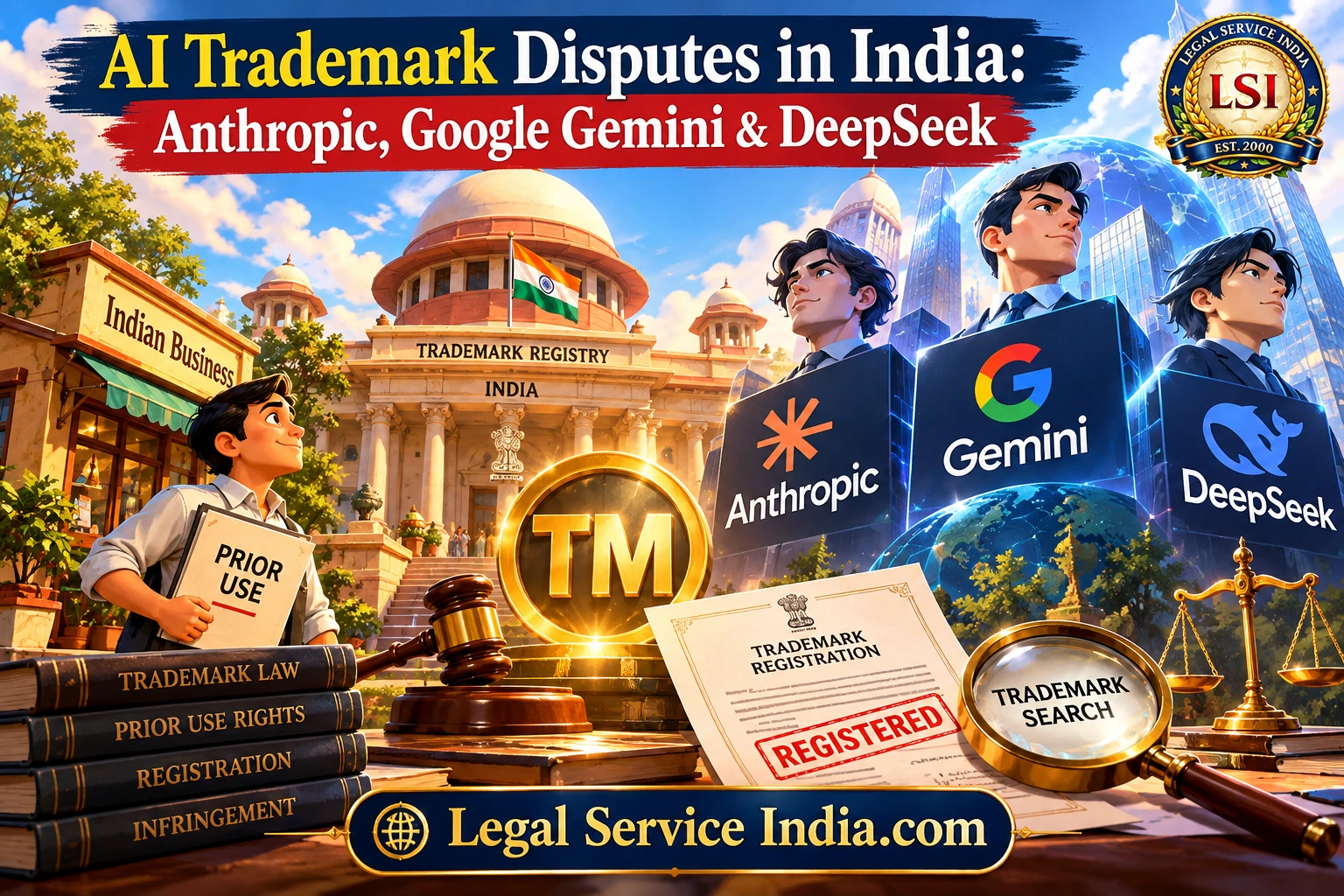
This piece looks at three such disputes currently unfolding in India involving Anthropic, Google’s Gemini, and DeepSeek each testing the same question from a different angle: what happens when a global AI giant’s biggest asset, its name, becomes its first legal liability the moment it lands in India.
First to Use, Not First to Be Famous: The Law Behind the Fight
There’s a common misconception about trademarks that registering a name makes you its legal owner. Under Indian law, that’s not quite true. Section 34 of the Trademarks Act, 1999, protects prior users. If a business has genuinely been using a mark in the market before someone else registers a similar or identical one, that later registration can’t be used to stop them. The law essentially says: whoever got there first in the marketplace keeps their right to stay there, registration or not.
Section 11 works alongside this. It’s the provision the Registrar relies on to refuse a new application when it’s too close to an existing mark identical or deceptively similar, used for similar goods or services, in a way that would leave consumers unsure who they’re actually buying from.
There is some room for two similar marks to coexist, though. Section 12 allows this when both parties can show honest concurrent use each adopted the name independently and in good faith, without knowing about the other, and built up their own market presence, usually in a different region or a different line of business, without actually confusing customers along the way.
Taken together, these three sections explain something that sounds almost counterintuitive once you see it applied: a small firm that registered a name back in 2017 can hold a stronger legal claim to it than a company now worth hundreds of billions of dollars. Fame isn’t a trademark right. Being first and being able to prove it – is.
| Provision | Core Principle |
|---|---|
| Section 34 | Protects prior users of trademarks. |
| Section 11 | Addresses refusal of marks that are identical or deceptively similar to existing marks. |
| Section 12 | Allows honest concurrent use in appropriate circumstances. |
Anthropic vs. Anthropic: A Belagavi Firm Takes on a $380 Billion Company
Mohammad Ayyaz Mulla is not a name most people following the AI industry would recognize. In 2017, he registered for a small IT company in Belagavi, Karnataka, and called it Anthropic Software Private Limited. There was no larger plan behind the name; no anticipation of what it would become entangled with years later, just a founder naming his own company.
Four years after that, in 2021, siblings Daniela and Dario Amodei both former OpenAI researchers founded an AI company in San Francisco and gave it the same name: Anthropic. By 2026, their company was valued at over $380 billion. Mulla’s, meanwhile, had spent nearly a decade quietly building its own identity under that name in India.
When Anthropic PBC began expanding into India, registering with the Ministry of Corporate Affairs and opening an office in Bengaluru, Mulla’s firm did something few small companies would dare to-it filed a lawsuit against one of the most valuable technology companies in the world, arguing prior rights over the very name both now shared.
When Fame Isn’t Enough: Google’s Gemini and Sun TV’s Prior Claim
Not every trademark fight in India needs a courtroom. Sometimes the Registrar’s office is enough to stop a billion-dollar company in its tracks.
That’s what happened when Google tried to register “Gemini” in India under Class 9 the category covering AI software and digital products for what has become one of its flagship AI platforms. The application ran straight into a mark that had nothing to do with artificial intelligence at all: Gemini TV, a Telugu-language broadcasting channel owned by the Maran family’s Sun TV Network, registered years before Google’s AI product existed.
The Indian Trademarks Registry objected on exactly the grounds Section 11 exists for that “Gemini” was already in use for Sun TV’s broadcasting business, and registering it again risked confusing the public about who was behind it. Google pushed back with an argument that sounds reasonable on its face: an AI platform and a television channel serve completely different audiences, in completely different industries, so no real customer would ever confuse the two. Citing Supreme Court precedent, Google argued that overlapping trademark classes alone don’t bar registration if actual confusion is unlikely.
Whether that argument succeeds is still an open question, and it’s the one worth sitting with, because it’s different from the Anthropic case in a specific way. Anthropic Software and Anthropic PBC are both broadly technology companies. Sun TV and Google’s Gemini aren’t in the same industry at all. So, the real question stops being who used the name first and becomes something harder: does prior use still matter when the two businesses have nothing to do with each other?
Too Many Claimants: The DeepSeek Free for All
Not every AI naming dispute in India comes down to one company against another. Sometimes it piles up.
DeepSeek’s attempt to register its name with India’s Trademarks Registry ran into a mess: at least two other entities had already filed for the identical or deceptively similar mark before it, each with no connection to the Chinese AI company. Unlike the Anthropic case, where one clear prior user is pitted against one global company, or the Gemini case, where it’s Google against a single broadcaster, DeepSeek’s dispute doesn’t have a straightforward “first” claimant at all it has several parties, each insisting they got there first.
Under Indian trademark law, this kind of pile-up doesn’t resolve itself automatically. When multiple applications for the same or a deceptively similar mark are pending, the Registry doesn’t simply pick whoever filed earliest and move on it can refuse registration outright, or push the matter into opposition and rectification proceedings, effectively forcing every applicant to prove their claim from scratch. Each one has to separately establish prior use, distinctiveness, or honest concurrent use under Section 12 the same three tests you saw at play in the Anthropic and Gemini disputes, except here they have to be argued by multiple parties at once, against each other, not just against the foreign entrant.
The result is less a single lawsuit and more a queue of a name that may take years to settle, not because any one party’s claim is especially strong, but because so many parties have made one. It’s worth noting, for contrast, how differently things went for two of DeepSeek’s AI peers: Anthropic’s own “Claude” mark sailed through Indian registration in July 2024 with zero opposition, and Perplexity AI’s trademark cleared a few months later just as cleanly. The difference wasn’t luck it was that neither name collided with something already sitting in the Indian registry.
The Different AI Trademark Situations
| AI Company / Mark | Trademark Issue |
|---|---|
| Anthropic | Prior Indian use of the name “Anthropic”. |
| Google Gemini | Existing “Gemini” mark associated with Gemini TV. |
| DeepSeek | Multiple prior applications for an identical or deceptively similar mark. |
| Claude | Indian registration in July 2024 with zero opposition. |
| Perplexity AI | Trademark cleared without the same collision described above. |
The Subsidiary Question: Can a Local Entity Shield a Global Parent?
Anthropic India’s defence, when it finally appeared in court, wasn’t about the trademark at all. It was about corporate structure.
Counsel for Anthropic India argued something narrower and more technical than “we didn’t infringe” they argued the Indian subsidiary shouldn’t be treated as directly liable in the first place. Yes, it’s wholly owned by the American parent, the argument went, but it’s a separate legal entity, incorporated on its own under Indian company law, and the claims in the suit really belong to Anthropic PBC, not to its local arm.
It’s a familiar move in Indian corporate litigation separate legal personality is one of the oldest doctrines in company law, and on paper, a subsidiary genuinely is a different legal person from its parent. But Mulla’s counsel wasn’t having it. Both the US parent and the Indian subsidiary had been named as parties from the start, they pointed out, and the subsidiary is the one actually running the business, hiring staff, and operating under the disputed name inside India, which is exactly where the alleged confusion is happening.
This is the part of the case that reaches beyond just Anthropic. If a foreign company’s local subsidiary can wall itself off from liability for a name the parent chose, then structuring an India entry through a subsidiary becomes not just a tax or operational decision but a kind of legal insulation a way to keep the real financial and reputational stakes offshore while a local entity absorbs the exposure or avoids it altogether. Courts haven’t settled this cleanly, and the outcome here could end up shaping how every future AI company or any global brand, really structures its entry into India.
Move Fast, Get Sued: What These Cases Reveal About AI’s India Strategy
Line up all three cases and a pattern starts to show, and it isn’t really about bad luck.
Anthropic didn’t check whether “Anthropic” was already taken in India before expanding here. Google didn’t catch that “Gemini” belonged to a Telugu broadcaster before filing. DeepSeek didn’t notice or didn’t care that its name was already tangled up with other claimants. Three of the best-funded, most technically sophisticated companies in the world, and in each case, something as basic as a trademark search seems to have been skipped, or at least not taken seriously enough.
That’s not really surprising if you think about how these companies actually operate. AI has rewarded speed above almost everything else the company that ships first, launches in the most markets first, and builds the most users first tends to win. Trademark clearance doesn’t fit that instinct. It’s slow, it’s unglamorous, and it rarely feels urgent until the moment it’s too late which, for all three of these companies, arrived roughly the same way: an Indian entity they’d never heard of, holding a claim to a name they thought was already theirs.
And it’s saying that it didn’t have to go this way. Anthropic’s own “Claude” cleared Indian registration in 2024 without a single objection. Perplexities did too. Nothing about being an AI company makes this collision inevitable. What makes it inevitable is treating naming as a branding decision instead of a legal one, and if global fame will simply carry over into a market with its own, older rules.
That’s the real cost of sitting underneath all three disputes. It isn’t measured only in the ₹1 crore Mulla’s firm is seeking, or in however long the DeepSeek pile-up takes to sort out. It’s the exposure of a genuine gap between how fast AI companies are used to moving and how carefully India’s trademark law built on prior use, not prior fame expects them to move instead.
Key Lessons for AI Companies Entering India
- Trademark clearance should be treated as part of market-entry planning.
- Global fame does not automatically establish Indian trademark rights.
- Prior use can be critical under Indian trademark law.
- Existing marks can create problems even when the businesses operate in different industries.
- Corporate structure may become relevant when a foreign company operates through an Indian subsidiary.
What the Law Still Doesn’t Answer
None of these cases will fully settle the questions they’ve raised. Indian trademark law is clear that prior use beats prior fame, but it has far less to say about how much weight a genuinely massive global reputation should carry when it does collide with a small, local prior user. Should a name known to hundreds of millions of people worldwide get treated the same as one known only within a few Indian states? The law says yes, in principle. Courts applying that principle to a $380 billion company for the first time may not find it quite that simple in practice.
There’s also the subsidiary question left open by the Anthropic case whether structuring an India entry through a separate local entity can genuinely limit a foreign parent’s liability for its own brand name, or whether courts will look past the corporate structure to the substance of who’s actually using the mark.
And underlying all of it: India’s trademark regime was built for a world where companies expanded into new markets slowly, with time to run searches and file oppositions before anyone got very big. It wasn’t built for companies that can go from founding to global household names in under three years. Nothing in the Act accounts for that speed, which may be the real gap.
Conclusion
None of this happened because AI is uniquely reckless, or because Indian trademark law is uniquely strict. It happened because two things that used to move at roughly the same pace how fast a company grows, and how carefully it checks its own name have come apart. Anthropic, Google, and DeepSeek didn’t lose track of something obscure. They lost track of something as basic as their own name, because checking it never felt as urgent as launching did.
Mohammad Ayyaz Mulla isn’t trying to stop the future of AI. He’s asking a much smaller, much older question: whose name was it first? In India, that question still has a real, enforceable answer and for now, at least three of the world’s biggest AI companies are waiting to hear what it is.

