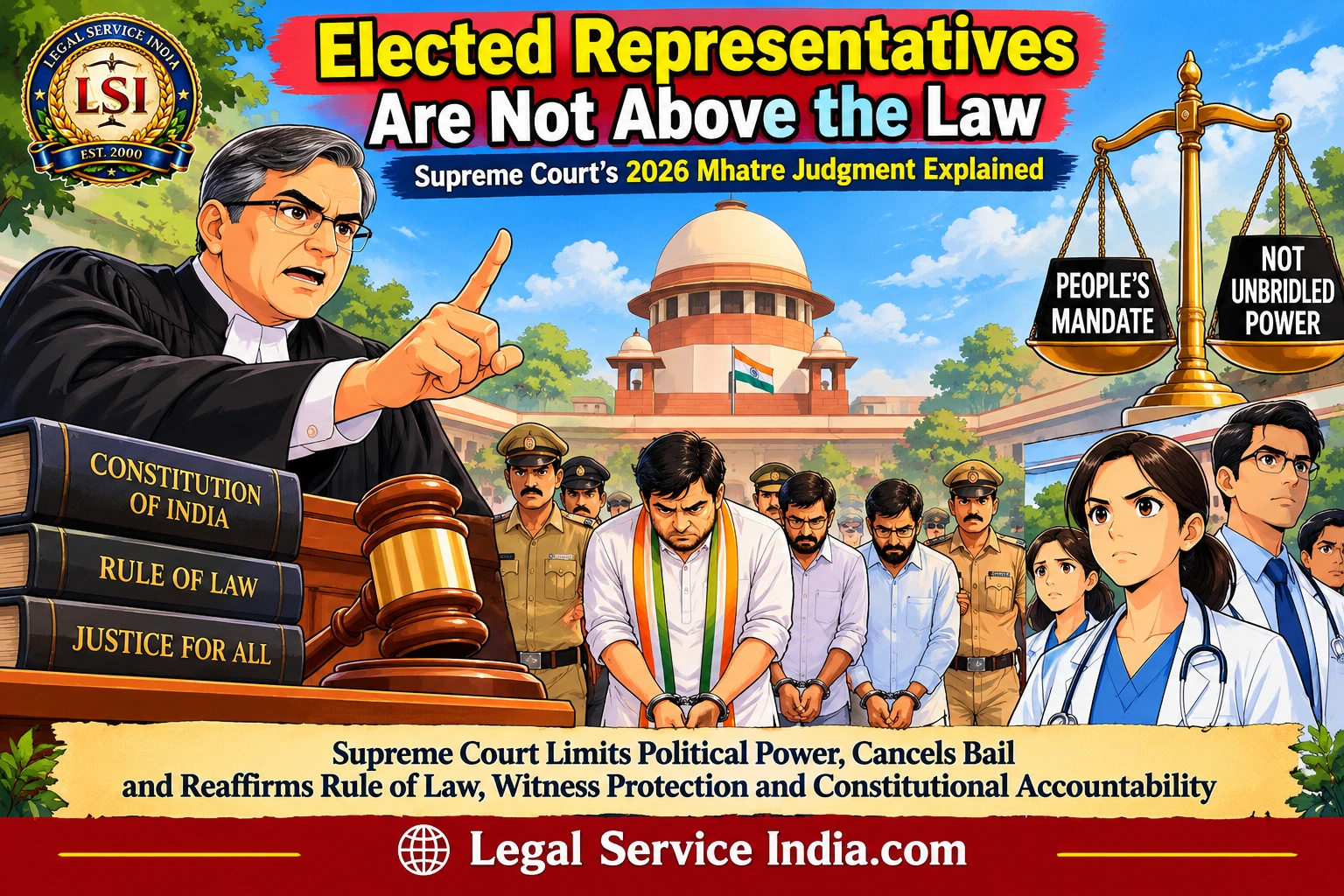
Elected Representatives Are Not Above the Law: Supreme Court Defines the Limits of Political Power and the People’s Mandate
Supreme Court of India | State of Maharashtra v. Ramesh Sukrya Mhatre & Ors. | 2026 INSC 1075 | Judgement dated 28 September 2026
Introduction
An election gives a representative authority to serve the people. It does not give him authority over the law.
That distinction lies at the heart of the Supreme Court’s recent judgement in State of Maharashtra v. Ramesh Sukrya Mhatre & Ors., 2026 INSC 1075. A bench comprising Justice Vikram Nath and Justice Sandeep Mehta set aside the Bombay High Court’s order restoring bail to an elected municipal corporator and three other accused persons in a case arising from an alleged assault on doctors at a municipal hospital.
The judgement is important for two different reasons.
- First, as a criminal-bail decision, it reiterates that the seriousness of allegations, criminal antecedents, the possibility of witness intimidation, the influence wielded by an accused and the wider societal impact of an offence cannot be ignored while exercising bail jurisdiction.
- Secondly, and more significantly for constitutional discourse, the Court made a broader observation about the meaning of democratic authority. It warned against elected representatives treating an electoral mandate as a source of personal or “unbridled” power and assuming the functions of the police, administrator or Court.
The judgement therefore raises a question larger than the fate of one bail order:
What exactly does an electoral mandate authorise an elected representative to do?
The Supreme Court’s answer is emphatic: whatever authority the law confers—but nothing beyond it.
The Case at the Centre of the Controversy
The prosecution case arose from an incident at Shastri Nagar Municipal Hospital, Dombivli, on 6 July 2026.
Ramesh Sukrya Mhatre, an elected corporator of the Kalyan-Dombivli Municipal Corporation from Ward No. 24, was alleged to have entered the labour ward along with three others during a dispute concerning the shifting of a pregnant woman in labour. The prosecution alleged that three doctors, including a woman doctor, were assaulted and verbally abused. It was further alleged that the informant doctor was threatened, resulting in apprehension and delay in registration of the FIR.
The FIR invoked provisions of the Bharatiya Nyaya Sanhita, 2023, together with Sections 3 and 4 of the Maharashtra Medicare Service Persons and Medicare Service Institutions (Prevention of Violence and Damage or Loss to Property) Act, 2010.
The Maharashtra Medicare Act is particularly relevant because it expressly prohibits violence against Medicare Service Persons and makes such offences cognisable and non-bailable. Section 4 provides for imprisonment which may extend to three years and a fine up to ₹50,000.
The accused were arrested and remanded to custody. The principal accused was stated to have 17–18 criminal cases registered against him. Nevertheless, the magistrate granted bail to him on 14 July 2026 and to the other accused on 17 July 2026, principally on parity.
The Bombay High Court subsequently took suo motu cognisance of the matter. It initially stayed the bail orders but later restored bail subject to stringent conditions, including requiring the accused to reside outside Maharashtra, report to a police station in Goa, surrender their passports and refrain from contacting witnesses.
The State of Maharashtra challenged that order before the Supreme Court.
What Did the Supreme Court Ultimately Decide?
The Supreme Court allowed the state’s appeal.
The Court held that the High Court had erred in restoring bail after having earlier found serious infirmities in the original bail orders, without adequately identifying fresh and compelling circumstances justifying the subsequent departure.
The Court considered several factors, including:
- the nature and gravity of the allegations;
- the criminal antecedents attributed to the principal accused;
- the status and vulnerability of the victims;
- the possibility of witness intimidation;
- the influence allegedly wielded by the principal accused;
- the stage of investigation;
- the wider impact of violence against doctors; and
- the fact that the prosecution case substantially depended upon doctors and hospital staff as witnesses.
The Supreme Court consequently cancelled the bail granted to all four respondents and directed them to surrender before the trial court by 5 October 2026.
The Court also directed that the Special Fast Track Court endeavour to complete the trial within six months from presentation of the Supreme Court’s order, while maintaining fairness of the proceedings.
The Constitutional Message: An Election Is Not a Licence
The most consequential part of the judgement appears towards the end.
The Supreme Court observed that the incident had to be viewed against a larger concern: elected representatives resorting to force, intimidation or extra-legal methods while dealing with citizens or public functionaries.
The Court drew a fundamental distinction between democratic legitimacy and legal authority.
An elected representative unquestionably possesses democratic legitimacy. But legitimacy does not create an independent source of coercive power.
The Court’s reasoning can be reduced to a simple constitutional proposition:
The ballot confers office; the law defines its limits.
The judgement warns that an elected representative cannot treat the electoral mandate as a substitute for legal authority.
In particular, the Court stated that an elected representative cannot assume the role of the police, administrator or Court merely because he has been elected by the people.
This is perhaps the most important conceptual contribution of the judgement.
Democratic Power and Constitutional Power Are Not the Same Thing
India is a representative democracy.
People elect MPs, MLAs, municipal councillors, sarpanches and other representatives to participate in governance. Election therefore creates a legitimate democratic relationship between the electorate and the elected representative.
But that relationship does not dissolve the constitutional division of functions.
- A legislator does not become a police officer because he has won an election.
- A municipal councillor does not become a magistrate because voters have elected him.
- A minister does not become a court because citizens have given his political party a mandate.
- An elected representative cannot impose punishment merely because he believes that an official has acted wrongly.
The constitutional system deliberately distributes public power among different institutions.
- The police investigate.
- The executive administers.
- The legislature legislates.
- The judiciary adjudicates.
An elected representative may raise grievances, demand accountability, communicate with officials, seek administrative action and represent constituents.
But representation is not coercion.
That distinction is central to the Mhatre judgement.
The Supreme Court’s Position Is Not Anti-Politics
It would be incorrect to read Mhatre as saying that elected representatives must remain passive before administrative wrongdoing.
That would actually contradict another important line of Supreme Court authority.
In Sonam Lakra v. State of Chhattisgarh, 2024 INSC 901, the Supreme Court itself emphasised the democratic legitimacy of elected grassroots representatives and criticised a bureaucratic approach that treated an elected sarpanch as subordinate to administrative officers.
The Court recognised the fundamental distinction between an elected representative and a selected public servant.
There is therefore no contradiction between Sonam Lakra and Mhatre.
The two decisions protect different sides of the same constitutional principle.
- The elected representative has democratic authority.
- The bureaucrat does not have unlimited supervisory authority over the elected representative.
- But equally, the elected representative has no personal authority to replace the police, administration or judiciary.
The constitutional balance is therefore not:
bureaucracy versus politicians.
It is:
law versus arbitrary exercise of power.
Article 14 and the Principle of Equality Before Law
The broader philosophy behind Mhatre also resonates with Article 14 of the Constitution.
Article 14 guarantees equality before the law and equal protection of the laws.
The principle is not merely that ordinary citizens must obey the law.
It also means that public office cannot create a private zone of immunity from law.
The old constitutional maxim remains relevant:
No person is above the law because of the office he occupies.
Indeed, public office arguably carries a greater responsibility because the office-holder possesses institutional influence that an ordinary citizen does not.
That is particularly relevant at the bail stage.
Where an accused occupies an influential public position and the prosecution case depends heavily upon witnesses who may reasonably fear intimidation, the Court cannot examine liberty in isolation from the integrity of the criminal process.
The Bail Principle: Liberty Is Fundamental, But Bail Is Not Automatic
One of the important features of the judgement is that the Supreme Court did not cancel bail simply because the principal accused was an elected representative.
That distinction is essential.
The Court did not create a rule that politicians should ordinarily be denied bail.
Instead, it examined the conventional bail factors in the factual setting of this case.
The Supreme Court’s reasoning was anchored in the allegation of violence, the criminal antecedents, the alleged influence of the principal accused and the potential impact upon witnesses.
This is consistent with Ash Mohammad v. Shiv Raj Singh @ Lalla Babu, (2012) 7 SCC 584, where the Supreme Court held that criminal antecedents and the nature of the crime could not be ignored merely because the accused had spent a period of time in custody. The Court treated societal concern and the totality of circumstances as relevant to the exercise of bail discretion.
The lesson from Mhatre is therefore not:
“Elected representatives should not receive bail.”
It is:
“Elected status cannot neutralise legitimate bail considerations.”
That is a far narrower—and legally sounder—proposition.
Witness Protection Becomes a Central Consideration
The Supreme Court was particularly concerned about the safety of the doctors and hospital staff who were material witnesses.
The Court recorded that the prosecution case substantially rested upon the testimony of 33 doctors and hospital staff. It therefore directed the trial court to ensure adequate protection for material witnesses throughout the trial.
The Court invoked Section 9 of the Maharashtra Witness Protection and Security Act, 2017 and relied upon Mahender Chawla v. Union of India, (2019) 14 SCC 615.
In Mahender Chawla, the Supreme Court recognised witness protection as an important component of a fair criminal justice process and made the Witness Protection Scheme, 2018 operative.
This becomes particularly important where the accused is alleged to possess political or social influence.
A witness who is technically free to testify but is psychologically or physically afraid to do so is not truly participating in a fair trial.
The criminal justice system therefore has an obligation not merely to produce witnesses before the court but to create conditions in which they can speak without fear.
The Medical Profession: A Grievance Cannot Become Violence
Another significant part of Mhatre concerns violence against doctors.
The Supreme Court began its judgment with a reference to the ancient Suśruta Saṃhitā and emphasised the importance of trust and respect in the doctor-patient relationship.
The Court recognised that doctors working in emergency situations must make rapid decisions, often without complete information.
Consequently, physical violence, intimidation or coercion can impair not merely the doctor’s personal safety but the quality of medical care available to future patients.
The Court nevertheless carefully preserved an important qualification:
Doctors are not beyond accountability.
A patient or family member remains entitled to question treatment, complain of negligence, seek investigation and pursue remedies provided by law.
What the law cannot accept is the replacement of those lawful remedies by violence.
This distinction is extremely important.
The judgment does not say:
Doctors can never be questioned.
It says, in substance:
Doctors may be held accountable through law, but not through force.
The Maharashtra Medicare Act reinforces that statutory policy by prohibiting violence against Medicare Service Persons and prescribing criminal consequences.
The BNSS Dimension
The case also demonstrates the continuing importance of the bail framework under the Bharatiya Nagarik Suraksha Sanhita, 2023.
Section 483 BNSS confers special powers upon the High Court or Court of Session concerning bail and expressly permits the High Court or Court of Session to direct that a person already released on bail be arrested and committed to custody.
The provision substantially carries forward the architecture of Section 439 of the former Code of Criminal Procedure.
Thus, the transition from the CrPC to BNSS has not eliminated the basic judicial responsibility to examine whether the liberty granted to an accused remains compatible with the interests of justice.
Mhatre illustrates how that discretion operates when allegations of violence, influence and witness intimidation intersect.
Criminal Antecedents: A Critical Distinction
The judgment’s reliance upon the alleged criminal antecedents of the principal accused must, however, be understood carefully.
Indian criminal law operates upon the foundational presumption of innocence.
The mere existence of previous FIRs does not establish guilt.
This principle was strongly emphasised in Manoj Narula v. Union of India, (2014) 9 SCC 1. The Constitution Bench recognised the serious problem of criminalisation of politics but also cautioned against treating allegations or criminal antecedents as equivalent to criminal conviction.
This is important when reading Mhatre.
The Supreme Court did not convict the accused on the basis of previous cases.
It considered the alleged antecedents as one factor relevant to the exercise of bail discretion, together with the gravity of the allegations, influence, witness vulnerability and societal impact.
That distinction preserves the presumption of innocence while permitting courts to assess risk at the interlocutory stage.
Criminalisation of Politics: The Larger Constitutional Background
The Supreme Court has repeatedly confronted the problem of criminalisation of politics.
In Lily Thomas v. Union of India, (2013) 7 SCC 653, the Court struck down the statutory protection that had permitted convicted legislators to retain membership while an appeal against conviction was pending.
In Public Interest Foundation v. Union of India, (2018) 9 SCC 501, the Court considered the growing concern regarding criminalisation of politics and the presence of persons facing serious criminal charges in electoral politics. The Court nevertheless recognised the constitutional limits of judicial power and declined to create a new disqualification which Parliament had not enacted. At the same time, it strengthened disclosure of criminal antecedents to voters.
This history is crucial.
The Supreme Court has consistently attempted to balance two competing constitutional values:
- The purity and integrity of representative democracy; and
- The constitutional limits on judicial interference with the electoral and legislative domain.
Mhatre operates within that tradition.
It does not create a new electoral disqualification.
It does not declare an elected representative incapable of exercising political authority.
It simply insists that political authority must remain within the law.
Separation of Powers: The Real Constitutional Principle
The phrase “separation of powers” is sometimes misunderstood in India as requiring an absolute wall between the organs of government.
The Indian Constitution does not establish such a rigid separation.
There is considerable interaction between the legislature, executive and judiciary.
But interaction is not substitution.
- A minister may direct an administrative department in accordance with law.
- A legislator may demand information from government authorities.
- A municipal councillor may raise a constituent’s grievance.
- A political representative may legitimately approach the police regarding a complaint.
But none of those powers automatically authorises the representative personally to investigate, threaten, punish or physically compel compliance.
That is the line Mhatre seeks to protect.
The Counter-Argument: Can the Judgment Be Read Too Broadly?
There is a legitimate opposing interpretation.
In Indian society, elected representatives frequently function as intermediaries between citizens and government institutions.
A poor citizen may approach a councillor because the police station has ignored a complaint.
A family may approach an MLA because a government hospital has allegedly denied treatment.
A villager may approach a sarpanch because a government officer is refusing to perform a statutory duty.
If courts describe every direct intervention by an elected representative as an impermissible assumption of administrative authority, legitimate democratic representation could become unnecessarily restricted.
That would be an undesirable result.
The better interpretation of Mhatre is therefore not that elected representatives must stay away from government institutions.
It is that they must use lawful institutional channels.
- A representative may complain.
- A representative may demand.
- A representative may advocate.
- A representative may expose administrative failure.
- A representative may seek judicial intervention.
But a representative cannot transform political influence into personal coercive authority.
The Most Important Distinction: Influence Versus Authority
Perhaps the most useful way to understand the judgment is through a three-part distinction.
| Situation | Constitutional Position |
|---|---|
| Elected representative raises a grievance before authorities | Legitimate democratic representation |
| Elected representative uses statutory or political powers available to the office | Legitimate exercise of public authority |
| Elected representative uses personal influence, intimidation or force to compel an outcome | Impermissible extra-legal exercise of power |
This distinction is likely to have significance well beyond municipal politics.
It can apply to:
- MPs;
- MLAs;
- ministers;
- municipal councillors;
- panchayat representatives;
- political office-bearers exercising public influence; and
- other persons whose public position gives them substantial capacity to influence officials or witnesses.
What Mhatre Does Not Decide
Legal commentary should also identify what a judgment does not hold.
The Supreme Court did not hold that:
| Issue | What the Judgment Does Not Hold |
|---|---|
| Political representatives | Every elected representative is presumptively dangerous. |
| Political intervention | Every political intervention is illegal. |
| Role in administration | Elected representatives have no role in administration. |
| Bail | An accused loses the right to seek bail merely because he holds public office. |
| Criminal allegations | Criminal allegations automatically establish guilt. |
| Doctors | Doctors are immune from negligence claims. |
| Political influence | Political influence alone constitutes a criminal offence. |
The decision is fact-sensitive.
Its operative outcome rests upon the particular combination of allegations, criminal antecedents, witness vulnerability, societal impact and the High Court’s approach to the bail orders.
The broader constitutional observations should therefore be read as a rule-of-law principle, not converted into an automatic rule for every future bail application involving a politician.
Why the Judgment Matters for India
The significance of State of Maharashtra v. Ramesh Sukrya Mhatre extends beyond the accused persons.
India’s democracy is built upon electoral legitimacy.
But constitutional democracy is not simply majority rule.
It is majority rule subject to constitutional limitations.
- An election cannot authorise a representative to disregard statutory procedure.
- A popular mandate cannot override judicial orders.
- Political influence cannot replace police investigation.
- Personal authority cannot replace administrative decision-making.
- And public anger cannot replace adjudication.
This is why the Court’s observation about the “discipline of law” is considerably broader than the immediate dispute.
The deeper constitutional message is that democracy does not abolish institutions; democracy operates through institutions.
A Supreme Court Lawyer’s Perspective
From the standpoint of constitutional practice, the judgment should be welcomed—but read carefully.
The strongest part of the decision is not that it condemns one elected representative.
The stronger proposition is institutional:
No democratic mandate creates a parallel legal system.
At the same time, courts must remain cautious not to turn strong constitutional language into a political doctrine that treats elected representatives as inherently suspect.
The Constitution requires both sides of the equation.
- Elected representatives must respect the law.
- Institutions exercising administrative power must respect elected representatives.
- Courts must protect constitutional boundaries without entering the political arena.
- And citizens must retain lawful avenues for challenging both political and bureaucratic abuse.
That is the constitutional equilibrium.
Current Legal Position After State of Maharashtra v. Ramesh Sukrya Mhatre
As of 6 October 2026, the judgment represents a significant recent Supreme Court statement on the relationship between electoral legitimacy, rule of law, bail jurisprudence and witness protection.
The operative position is that:
| Legal Principle | Position |
|---|---|
| Election and criminal law | Election does not confer immunity from criminal law. |
| Public office | Public office cannot be treated as a source of personal coercive authority. |
| Bail | Bail requires consideration of the totality of relevant circumstances. |
| Criminal antecedents | Criminal antecedents may be relevant to bail, although they cannot be treated as proof of guilt. |
| Witness intimidation | Potential witness intimidation is a legitimate concern in bail adjudication. |
| Witness protection | Victim and witness protection is integral to the integrity of the criminal process. |
| Medical negligence | Medical professionals remain accountable for negligence, but grievances must be pursued through lawful mechanisms rather than violence. |
| Elected representatives and bureaucracy | Elected representatives retain legitimate democratic authority and are not subordinate to bureaucrats merely because those bureaucrats hold administrative office. |
| Judicial restraint | The judiciary cannot create new statutory disqualifications merely because it considers them desirable, as reaffirmed in the criminalisation-of-politics cases. |
| Electoral mandate | The electoral mandate remains a source of democratic legitimacy—not a source of unbounded personal power. |
The Supreme Court itself directed the trial court to protect the material witnesses and permitted renewal of the bail prayer if there is a material change in circumstances.
Conclusion: The Ballot Gives Authority—The Constitution Gives It Boundaries
The most enduring lesson from State of Maharashtra v. Ramesh Sukrya Mhatre is not about one corporator, one hospital or even one criminal case.
It is about the meaning of public office.
- The voter gives an elected representative legitimacy.
- The Constitution gives the representative a defined institutional role.
- The statute gives him specific powers.
But none of these gives him a personal licence to become the police, the prosecutor, the administrator or the judge.
A democracy cannot survive merely because governments are elected.
It survives when those who are elected remain bound by the same constitutional order that made their election possible.
The Supreme Court has therefore drawn an important line:
Political power is legitimate only when exercised through lawful authority.
The people may confer power through the ballot.
But the ballot does not place the elected above the law.
That is not a limitation upon democracy.
That is what constitutional democracy means.
Facing a Legal Dispute Involving Political Power, Public Authority or Constitutional Rights?
Do not leave a serious constitutional, criminal or public-law dispute to chance.
When an elected representative, public authority or politically influential person is involved in a legal dispute, ordinary legal advice may not be enough. Questions involving criminal proceedings, bail, misuse of public influence, fundamental rights, constitutional remedies, witness protection, government action and Supreme Court litigation require careful legal strategy from the beginning.
If your matter has the potential to reach the High Court or Supreme Court of India, obtaining experienced legal guidance at the right stage can be critically important.
Consult an Experienced Supreme Court Advocate
Adv. Tarun Choudhury
Supreme Court Advocate | 25+ Years of Legal Experience
Whether you are:
- Facing criminal proceedings or bail-related issues;
- Challenging an order of a High Court or lower court;
- A victim or complainant facing intimidation or misuse of influence;
- Dealing with constitutional or fundamental-rights violations;
- Seeking advice concerning public authorities or elected representatives;
- Considering a Special Leave Petition (SLP) before the Supreme Court; or
- Looking for an experienced lawyer to assess the next legal step in a complex matter,
you can seek a professional assessment of your case and understand the available legal remedies, risks and strategic options.
Speak Before the Problem Becomes Bigger
- Call: 9650499965
- WhatsApp: 8851978611
- Email: [email protected]
Legal problems involving public power can become more complicated with time. Early legal assessment can help you understand your position, preserve your rights and choose the appropriate legal remedy.
👉 Contact Adv. Tarun Choudhury for a confidential preliminary discussion regarding your legal matter.
Supreme Court Litigation | Constitutional Law | Criminal Law | Bail Matters | SLPs | Public Law | Fundamental Rights
LegalServiceIndia.com — Experienced Legal Guidance for Complex Legal Matters
Frequently Asked Questions (FAQs)
1. Can an elected representative claim immunity from criminal law because of their political position?
No. An elected representative does not receive immunity from ordinary criminal law merely because they hold public office. The Supreme Court in State of Maharashtra v. Ramesh Sukrya Mhatre, 2026 INSC 1075, emphasised that an electoral mandate does not create unbridled personal authority. An elected representative remains subject to the Constitution, criminal law and judicial process.
2. Can an elected representative interfere with police investigations or assume the role of a police officer?
No. An elected representative may raise complaints, represent constituents and seek lawful administrative action, but cannot personally assume the functions of the police or other statutory authorities. The Supreme Court has stressed that political influence cannot substitute for authority conferred by law.
3. Can a politician or elected representative be denied bail because of criminal cases or political influence?
Bail is decided on the facts and circumstances of each case. Criminal antecedents, the seriousness of the allegations, the possibility of influencing or intimidating witnesses, the accused’s position and the likelihood of interference with the administration of justice can all be relevant considerations. Holding elected office does not automatically entitle a person to bail, nor does it automatically bar bail.
4. What legal remedies are available if an elected representative misuses political power or intimidates a complainant or witness?
Depending upon the facts, a person may pursue remedies under applicable criminal law, witness-protection mechanisms, constitutional remedies and proceedings before the appropriate court or authority. Where there is an immediate threat to personal safety or a risk of witness intimidation, obtaining timely legal advice from an experienced criminal and constitutional lawyer can be particularly important.
5. Can I approach a Supreme Court Advocate for a case involving political influence, constitutional rights or misuse of public authority?
Yes. Complex matters involving criminal proceedings, bail, fundamental rights, constitutional violations, public authorities, political influence, witness protection, High Court orders or Special Leave Petitions (SLPs) may require specialised legal assessment. An experienced Supreme Court Advocate can examine the facts, identify the available legal remedies and advise on the appropriate litigation strategy, including whether a matter warrants proceedings before the Supreme Court.
Citation
State of Maharashtra v. Ramesh Sukrya Mhatre & Ors., 2026 INSC 1075, Criminal Appeal arising out of SLP (Crl.) No. 16674 of 2026, decided on 28 September 2026, Bench: Vikram Nath and Sandeep Mehta, JJ.
Important Authorities
| Authority | Citation | Legal Principle |
|---|---|---|
| Ash Mohammad v. Shiv Raj Singh @ Lalla Babu | (2012) 7 SCC 584 | Criminal antecedents, gravity and societal interest in bail. |
| Lily Thomas v. Union of India | (2013) 7 SCC 653 | Disqualification of convicted legislators. |
| Manoj Narula v. Union of India | (2014) 9 SCC 1 | Criminalisation of politics and constitutional limits concerning appointment of ministers. |
| Public Interest Foundation v. Union of India | (2018) 9 SCC 501 | Disclosure of criminal antecedents and judicial restraint concerning electoral disqualifications. |
| Mahender Chawla v. Union of India | (2019) 14 SCC 615 | Witness protection and the right of witnesses to testify without fear. |
| Sonam Lakra v. State of Chhattisgarh | 2024 INSC 901 | Democratic legitimacy of elected grassroots representatives and limits on bureaucratic interference. |
Key Takeaways
- An electoral mandate is not a licence to exercise unbridled power. The Supreme Court has emphasised that elected representatives remain subject to the Constitution, statutory law and judicial authority.
- Elected representatives cannot assume the role of police, administrator or Court. Political influence cannot replace powers that the law specifically entrusts to statutory authorities and judicial institutions.
- Public office does not provide immunity from criminal law. An elected representative can face criminal investigation, prosecution, arrest and judicial proceedings in accordance with law.
- Holding political office does not automatically guarantee bail. Courts may consider the seriousness of the allegations, criminal antecedents, witness vulnerability, the possibility of intimidation and the potential impact on the administration of justice.
- Criminal antecedents can be relevant to bail, but they are not proof of guilt. Previous criminal cases must not be treated as convictions merely because they have been registered against an accused.
- Witness protection is an important component of a fair criminal trial. Where an accused allegedly possesses political or social influence, the possibility of witness intimidation may become an important consideration in bail proceedings.
- Violence against doctors cannot be justified by a genuine grievance. Patients and their families can challenge medical negligence through lawful remedies, but cannot use physical force or intimidation against medical professionals.
- Doctors are not above the law either. Allegations of medical negligence or misconduct can and should be investigated through legally recognised mechanisms rather than extra-legal punishment.
- Democratic representation and bureaucratic authority must both operate within the law. Elected representatives have a legitimate role in raising public grievances and holding administration accountable, but cannot use personal influence to substitute institutional processes.
- The Supreme Court’s decision reinforces the rule of law. Democratic legitimacy comes from the people, but the exercise of public power remains controlled by constitutional and statutory limits.
- The judgment is particularly relevant to criminal law and constitutional litigation. Its principles may be significant in matters involving bail, political influence, witness protection, fundamental rights, public authorities and misuse of public office.
- The central constitutional message is simple: the ballot gives an elected representative democratic legitimacy; it does not place the representative above the law.
Summary
The Supreme Court’s decision in State of Maharashtra v. Ramesh Sukrya Mhatre reinforces that elected representatives remain bound by the rule of law and cannot use an electoral mandate, political influence or public office to assume the powers of police, administrators or courts or to interfere with the fair administration of criminal justice.