




Introduction
There has always been a debate about what is the best remedy in a particular factual matrix. More often than not, a lawyer faces this dilemma: which remedy is best suited for his/her client, as multiple legal routes can be explored on the same set of facts.
If the choice is only one, things become quite straightforward for a lawyer. That is to follow the path and put your best foot forward. But, if two or multiple options are available and all are mutually exclusive, then the lawyer has to make the wisest and most practical choice for his client.
The topic of discussion emanates from such situations involving the recovery of amounts from government agencies.
Legal Position
It is a well-known established legal position that for recovery of dues, a party has to prefer a suit for recovery against the other party, even if the party from whom the amount is to be recovered is the government or a government agency.
A writ petition is not maintainable when an alternative remedy is available. There is no question of any quarrel with the above-said well-established legal proposition.
When Can a Writ Petition Be Considered for Admitted Government Dues?
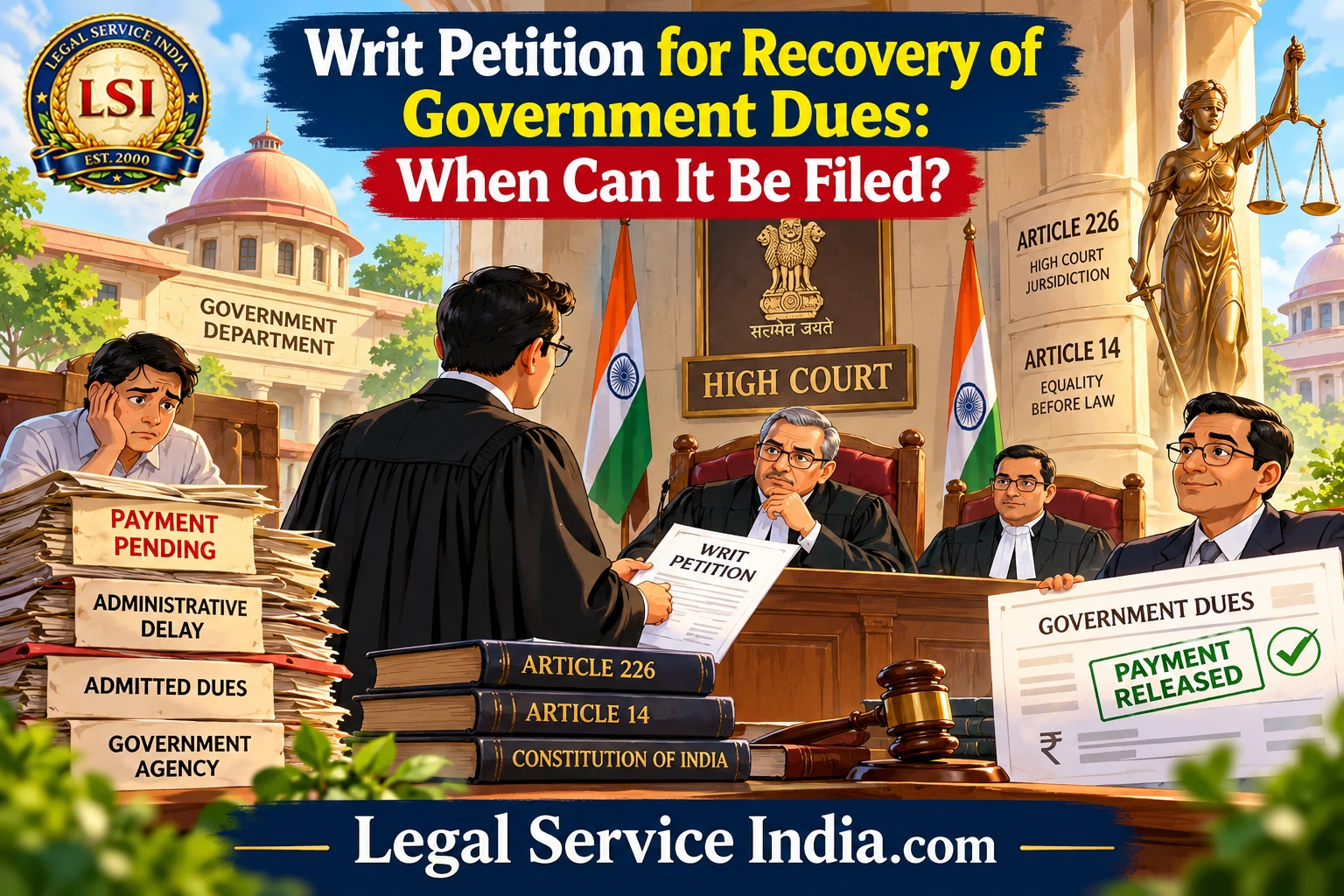
However, when an amount is undisputably to be paid by a government agency to the other party, which may be contractual dues or otherwise, the position may be different.
The government agency does not dispute its liability to pay in any manner whatsoever. In fact, the government agency admits its liability. Non-payment is purely on account of administrative oversight or any other such reason.
In such a case, the action of the government agency may come under the definition of ‘unreasonable’ or ‘arbitrary’ action.
In such a scenario, the party claiming the money may approach the Hon’ble High Court of the concerned jurisdiction alleging violation of Article 14 of the Constitution of India.
The Hon’ble Court, of course based on the facts of each case, may consider invoking its jurisdiction under Article 226 of the Constitution of India and give some directions against the government agency.
Such an exercise may save a party from years of rigors of a civil proceeding.
Key Conditions for Invoking Writ Jurisdiction
The above legal position is particularly relevant where the following circumstances exist:
- The amount payable by the government agency is admitted or undisputed.
- The government agency has acknowledged its liability to pay.
- The work or obligation giving rise to the payment has been completed.
- There is no genuine dispute regarding the amount payable.
- The non-payment is attributable to administrative oversight or an unreasonable delay.
- The withholding of the admitted amount results in infringement of a legal or constitutional right.
However, the availability of a writ remedy will always depend on the facts and circumstances of each individual case.
Calcutta High Court Judgment on Recovery of Admitted Dues
There are several judgments of the Hon’ble Supreme Court of India and various Hon’ble High Courts of India that have upheld the above-said legal position.
In a recent judgment of the Hon’ble Calcutta High Court titled ‘Amjad Hossain Vs State of West Bengal and Others’, the Court held as under:
“4. After considering the rival contentions of the parties and upon perusal of the materials on record, the series of events stated above, would show the admission of jural relationship between the concerned municipality and the petitioner to the effect that, the concerned municipality has issued the tender and the Work Order in favour of the petitioner and the petitioner has completed the work without any objection raised by the concerned municipality. Thus, the entire work has been admitted to have been executed to the satisfaction of the concerned municipality without any objection.
When the tender was floated and the Work Order was issued and the work has been done successfully, it is the legal obligation on the part of the concerned municipality to pay the entire billed amount to the petitioner. More so, when the part payment has been made in 2018, it shows the admission and acknowledgement of liability towards the petitioner. At this juncture, neither the State nor the concerned municipality can deny release of the balance payment which is otherwise an admitted sum. The requests made by the municipality to
the respondent no. 3 to release payment further show an admission of liability towards the petitioner against the work done by it.
In the facts of this case, since admitted sum is due and payable to the petitioner, such sum is the property of the petitioner and withholding it without due process of law is a clear violation of the right of the petitioner guaranteed under Constitution.
When an Article 12 authority fails to discharge its obligations and duties, in the manner stated above and thereby the right of a party is infringed, this Constitutional Court in exercise of its jurisdiction under Article 226 of the Constitution of India has plenary power to direct such Article 12 authority to discharge its obligations and duties to prevent the infringement of right of the party.”
Significance of the Amjad Hossain Judgment
The judgment is significant because it deals with a situation where the government authority has admitted its liability and the amount payable is not genuinely disputed.
| Factor | Legal Significance |
|---|---|
| Work completed | The work was completed without objection from the concerned municipality. |
| Admission of liability | The government authority had acknowledged its liability towards the petitioner. |
| Part payment | Part payment was made, supporting the admission and acknowledgement of liability. |
| Admitted balance amount | The remaining amount was treated as an admitted sum due and payable. |
| Article 226 jurisdiction | The High Court considered its constitutional jurisdiction to direct the authority to discharge its obligations. |
Writ Petition for Recovery of Admitted Government Dues
It is a well-known position that a writ petition is not a remedy for a contractual dispute. However, in a scenario when the subject matter for recovery is an admitted amount, the party may explore the remedy of a writ petition in terms of the above judgment.
Contractual Dispute Versus Admitted Liability
| Situation | Possible Legal Approach |
|---|---|
| Genuine contractual dispute regarding liability | A civil suit or other appropriate alternative remedy may ordinarily be required. |
| Amount is disputed by the government agency | Writ jurisdiction may ordinarily not be the appropriate remedy for adjudicating the disputed claim. |
| Amount is admitted and undisputed | The claimant may explore the possibility of invoking Article 226 jurisdiction. |
| Government authority has acknowledged liability but withheld payment | The claimant may consider seeking appropriate directions from the High Court, depending on the facts. |
Conclusion
It is a well-known position that a writ petition is not a remedy for a contractual dispute.
However, in a scenario when the subject matter for recovery is an admitted amount, the party may explore the remedy of a writ petition in terms of the above judgment.
The crucial distinction is between a genuine disputed contractual claim and an admitted and undisputed amount payable by a government authority. Where liability is admitted and non-payment appears to be unreasonable or arbitrary, the constitutional jurisdiction of the High Court under Article 226 may become relevant, subject to the facts of the particular case.
