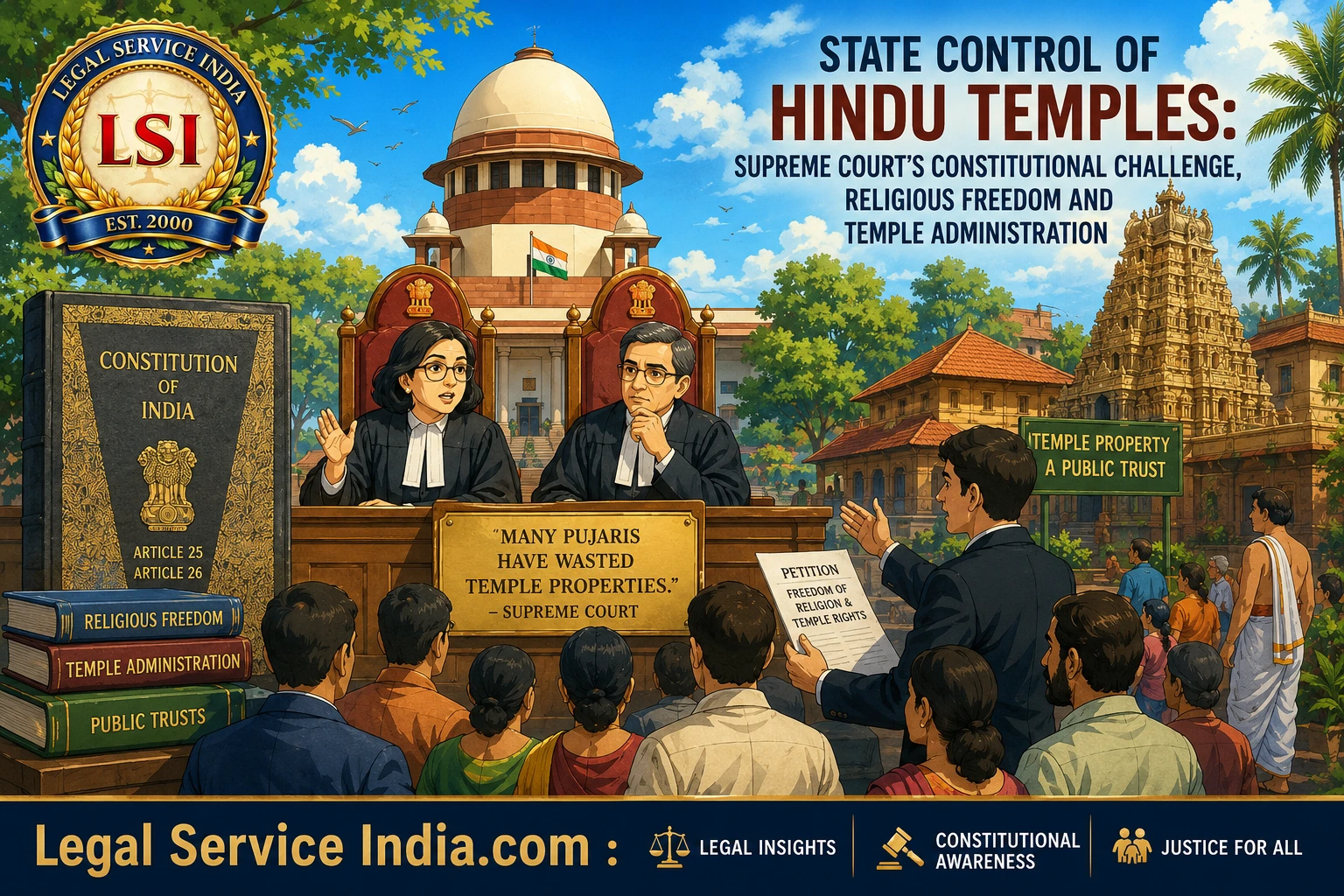
State Control of Hindu Temples: Supreme Court’s Constitutional Challenge, Religious Freedom and Temple Administration
Few constitutional questions in independent India have generated as much legal, political, and social debate as the issue of state control over Hindu temples. The recent proceedings before the Supreme Court of India have once again brought this long-standing controversy into national focus. Hearing a batch of petitions challenging the constitutional validity of various state laws governing Hindu temples, the court made an important oral observation that “many pujaris have wasted temple properties. ” At the same time, the Bench also questioned the broader issue of prolonged governmental control over temple administration.
These observations have reignited a debate that extends far beyond the management of religious institutions. At stake is the delicate constitutional balance between the autonomy guaranteed to religious denominations under Articles 25 and 26 of the Constitution of India and the authority of the state to regulate the secular administration of religious endowments in the larger public interest.
The controversy touches upon fundamental constitutional values. It raises questions about the meaning of religious freedom, the limits of executive power, the protection of charitable endowments, the legal status of Hindu deities as juristic persons, and the fiduciary responsibilities of those entrusted with managing temple properties. It also raises broader concerns about equality, secularism, and whether prolonged state administration of religious institutions is compatible with the constitutional vision adopted by the framers.
It is important to appreciate at the outset that the Supreme Court has not yet delivered its final judgment. The oral observations made during the hearing do not constitute binding law under Article 141 of the Constitution. Nevertheless, they provide valuable insight into the issues engaging the Court and indicate the constitutional principles that may ultimately shape one of the most significant decisions on religious freedom since the landmark judgment in The Commissioner, Hindu Religious Endowments, Madras v. Sri Lakshmindra Thirtha Swamiar of Shirur Mutt, AIR 1954 SC 282.
This article undertakes a comprehensive examination of the constitutional issues involved, the historical development of state control over Hindu temples, the relevant statutory framework, landmark judicial precedents, and the possible implications of the Supreme Court’s eventual verdict.
Citation
| Particular | Details |
|---|---|
| Matter | Batch of petitions challenging the constitutional validity of various Hindu Religious and Charitable Endowments (HR&CE) laws governing temple administration in Tamil Nadu, Andhra Pradesh, Telangana, and Puducherry. |
| Court | Supreme Court of India |
| Present Status | Pending adjudication before the Supreme Court. |
| Bench | Justice B.V. Nagarathna and Justice S.C. Sharma. |
| Important Note | As the matter is presently under consideration, the Supreme Court’s oral observations during hearings should not be treated as binding precedent until a final judgment is pronounced. |
Why This Case Is Constitutionally Significant
Constitutional litigation occasionally transcends the immediate dispute between the parties and assumes broader national importance. The present case undoubtedly falls into that category.
The outcome of these proceedings is likely to determine the future relationship between the state and thousands of Hindu religious institutions across India. Depending upon the principles ultimately laid down by the Supreme Court, the judgment could reshape the constitutional understanding of religious autonomy, executive regulation, and the administration of public religious trusts.
Several factors contribute to the exceptional significance of this litigation.
Key Reasons for National Significance
- It concerns the interpretation of Articles 25 and 26, provisions that form the cornerstone of India’s constitutional guarantee of religious freedom.
- It involves the management of temple properties worth thousands of crores of rupees, including vast tracts of agricultural land, commercial properties, historical monuments, and charitable institutions.
- The case raises the larger constitutional issue of how far the State may regulate religious institutions without assuming permanent control over them.
- The litigation has implications extending beyond Hindu temples. The principles evolved by the Supreme Court may influence future disputes concerning the administration of religious institutions belonging to other faiths, thereby shaping Indian secular jurisprudence for decades.
Constitutional Issues at a Glance
| Issue | Why It Matters |
|---|---|
| Religious Freedom | Tests the scope of Articles 25 and 26 of the Constitution. |
| Temple Administration | Determines whether long-term state control is constitutionally permissible. |
| Executive Power | Examines the limits of governmental regulation over religious institutions. |
| Temple Properties | Concerns management of assets worth thousands of crores. |
| Future Precedent | The judgment may influence governance of religious institutions across India. |
Key Takeaways
- The Supreme Court has not yet delivered its final verdict.
- The oral observations made during hearings are not binding law under Article 141.
- The litigation examines whether prolonged state control over Hindu temples violates Articles 25 and 26 of the Constitution.
- The case is likely to become one of the most significant constitutional decisions on religious freedom in recent decades.
- The final judgment may redefine the constitutional balance between religious autonomy and governmental regulation.
Background of the Present Litigation
The petitions presently before the Supreme Court challenge the constitutional validity of various state enactments that regulate Hindu religious institutions.
Among these are the Hindu Religious and Charitable Endowments laws enacted by states such as Tamil Nadu, Andhra Pradesh, Telangana, and Puducherry. These statutes empower government authorities to supervise, regulate, audit, appoint executive officers, and in many cases exercise extensive administrative control over temple affairs.
The petitioners contend that while reasonable regulation of secular matters may be constitutionally permissible, the continuing and pervasive governmental management of Hindu temples violates the guarantees contained in Articles 25 and 26 of the Constitution.
Their challenge is not directed merely against isolated provisions but against what they describe as a statutory framework that has gradually transformed regulatory oversight into permanent executive administration.
During the recent hearing, the Supreme Court observed that there had been instances where priests themselves had mismanaged temple properties. This observation is significant because it acknowledges one of the historical justifications advanced by state governments for enacting temple administration laws.
However, the Court also appeared to examine whether historical instances of mismanagement can constitutionally justify indefinite governmental control over religious institutions.
It is this constitutional tension that lies at the heart of the present litigation.
Issues Raised Before the Supreme Court
| Issue | Question Before the Court |
|---|---|
| Validity of HR&CE Laws | Whether various state enactments governing Hindu temples are constitutionally valid. |
| Scope of Regulation | Whether regulation of secular affairs has crossed into permanent governmental control. |
| Articles 25 & 26 | Whether continuing state management infringes religious freedom and denominational autonomy. |
| Temple Property | Whether protection of temple assets justifies long-term executive administration. |
| Constitutional Balance | Where should the line be drawn between regulation and control? |
The Historical Evolution of State Control Over Hindu Temples
To appreciate the present controversy, one must understand its historical origins.
Contrary to popular belief, governmental involvement in temple administration did not originate after Independence. Its roots extend back to the colonial administration under the East India Company.
Early East India Company Administration
During the eighteenth and early nineteenth centuries, the East India Company directly administered several prominent temples in South India. Revenue officials supervised temple finances, appointed managers, and exercised considerable control over religious endowments.
This involvement soon attracted criticism in England, where it was argued that a Christian colonial government should not administer institutions belonging to another religion.
Consequently, the British gradually withdrew from direct management while retaining statutory mechanisms to supervise public religious endowments.
This marked the beginning of the distinction between religious functions, which were left to the religious community, and secular administration, which remained subject to governmental regulation.
Ironically, this distinction continues to form the foundation of modern constitutional jurisprudence.
Key Features of Company-Era Administration
- Direct governmental supervision of major temples.
- Revenue officials managed temple finances.
- Appointment of temple managers by the administration.
- Growing criticism over state involvement in religious institutions.
- Development of the distinction between religious functions and secular administration.
The Religious Endowments Act, 1863
One of the earliest legislative attempts to regulate religious institutions was the Religious Endowments Act, 1863.
The Act substantially reduced direct governmental management and transferred many administrative responsibilities to committees composed of local trustees and community representatives.
Although the legislation aimed to promote religious autonomy, it nevertheless recognized that charitable endowments dedicated to public purposes required legal oversight.
The philosophy underlying the Act continues to influence constitutional adjudication even today.
| Aspect | Significance |
|---|---|
| Legislation | Religious Endowments Act, 1863 |
| Primary Objective | Reduce direct governmental management. |
| Administrative Model | Local trustees and community representatives. |
| Long-Term Impact | Influenced later constitutional thinking on regulation of religious institutions. |
Provincial Legislation Before Independence
During the early twentieth century, several provinces enacted laws governing Hindu religious institutions.
These enactments increasingly recognized that temples receiving large public donations performed important charitable functions extending beyond purely religious worship.
Accordingly, legislatures introduced provisions relating to the following:
- Financial audits.
- Maintenance of accounts.
- Appointment of trustees.
- Preservation of temple properties.
- Prevention of alienation of endowed lands.
- Protection of devotees’ interests.
These legislative experiments eventually laid the groundwork for the post-Constitution Hindu Religious and Charitable Endowments Acts enacted by various states.
Evolution of Temple Governance Laws
| Period | Development |
|---|---|
| Colonial Era | Direct government management of several temples. |
| 1863 | The Religious Endowments Act shifted administration to local committees. |
| Early 20th Century | Provincial laws introduced statutory regulation of temple administration. |
| Post-Independence | States enacted HR&CE laws governing Hindu religious institutions. |
The Constitutional Vision After Independence
The adoption of the Constitution in 1950 fundamentally transformed the legal landscape.
Religious freedom was elevated from a statutory privilege to a fundamental right enforceable against the state.
The framers consciously adopted a model of secularism that neither established a state religion nor imposed a rigid separation between religion and the state. Instead, the Constitution sought to ensure equal respect for all religions while permitting reasonable regulation of secular activities associated with religious practice.
It is within this constitutional framework that Articles 25 and 26 assume extraordinary importance.
The Supreme Court has repeatedly observed that these provisions seek to preserve religious autonomy while allowing the state to regulate secular aspects of religious institutions in the interests of public order, morality, health, and social welfare.
The central constitutional question, however, has always been where regulation ends and control begins.
Historical Timeline
| Timeline | Major Development |
|---|---|
| East India Company Era | Direct administration of temples by colonial authorities. |
| 1863 | The Religious Endowments Act decentralized temple administration. |
| Early 1900s | Provincial legislation regulating Hindu religious institutions. |
| 1950 | The constitution guarantees religious freedom through Articles 25 and 26. |
| Post-Constitution | States enact Hindu Religious and Charitable Endowments (HR&CE) laws. |
| Present Litigation | The Supreme Court examines constitutional limits of continued state control over temples. |
Articles 25 and 26: The Constitutional Foundation of Religious Freedom
The present litigation revolves primarily around the interpretation of Articles 25 and 26 of the Constitution.
Although these provisions are often read together, they operate in distinct fields.
Article 25: Individual Freedom of Religion
Article 25 guarantees every individual the freedom of conscience and the right to freely profess, practice, and propagate religion.
However, this freedom is not absolute.
The Constitution expressly makes it subject to the following:
- Public order.
- Morality.
- Health.
- The other provisions contained in Part III of the Constitution.
The State is therefore competent to enact legislation regulating secular activities associated with religious practice, provided such regulation satisfies constitutional requirements.
Scope of Article 25
| Provision | Constitutional Protection |
|---|---|
| Freedom of Conscience | Protects every individual’s religious belief. |
| Profession of Religion | Freedom to openly profess one’s religion. |
| Practice of Religion | Protects religious practices, subject to constitutional limitations. |
| Propagation | Permits propagation of religion within constitutional boundaries. |
| Restrictions | Subject to public order, morality, health, and other fundamental rights. |
Article 26: Autonomy of Religious Denominations
While Article 25 protects individual religious liberty, Article 26 safeguards the collective rights of religious denominations.
Every religious denomination has the constitutional right to:
- Establish institutions for religious and charitable purposes.
- Manage its own affairs in matters of religion.
- Own and acquire movable and immovable property.
- Administer such property in accordance with law.
The expression “administer such property in accordance with law” has generated decades of constitutional litigation.
Does this phrase permit the State merely to regulate administration?
Or does it authorize long-term governmental management?
The answer to this question lies at the center of the present challenge before the Supreme Court.
Rights Guaranteed Under Article 26
| Constitutional Right | Meaning |
|---|---|
| Establish Institutions | Create religious and charitable institutions. |
| Manage Religious Affairs | Exercise autonomy in matters of religion. |
| Own Property | Acquire and possess movable and immovable property. |
| Administer Property | Manage religious property in accordance with law. |
The Constitutional Balance
Neither Article 25 nor Article 26 contemplates absolute immunity from regulation.
Equally, neither provision authorizes unrestricted governmental control over religious institutions.
The constitutional objective is to strike a balance between two competing principles.
Two Competing Constitutional Principles
| Principle | Constitutional Objective |
|---|---|
| Religious Autonomy | Protect the independence of religious denominations and preserve freedom of religion. |
| Public Accountability | Ensure transparency and proper administration of charitable and religious institutions. |
On one hand lies religious autonomy.
On the other lies public accountability in the management of charitable institutions.
Finding that balance has occupied constitutional courts for more than seven decades and remains the central issue before the Supreme Court today.
Constitutional Questions Before the Supreme Court
- Can the State regulate temple administration without assuming permanent control?
- Does prolonged governmental management violate Articles 25 and 26 of the Constitution?
- What is the constitutional distinction between regulation and control?
- Can historical instances of mismanagement justify indefinite state administration?
- How should religious autonomy be balanced with public accountability?
- What constitutional safeguards should govern the management of temple properties?
Quick Summary
| Topic | Key Takeaway |
|---|---|
| Article 25 | Protects the individual’s freedom of conscience and religion, subject to constitutional restrictions. |
| Article 26 | Protects the collective autonomy of religious denominations. |
| Core Dispute | Whether prolonged state control over Hindu temples exceeds permissible constitutional regulation. |
| Central Constitutional Issue | Determining where regulation ends and governmental control begins. |
| Importance | The Supreme Court’s decision may redefine the constitutional relationship between the state and religious institutions across India. |
Key Takeaways
- Article 25 safeguards individual religious freedom but permits reasonable regulation of secular activities.
- Article 26 protects the autonomy of religious denominations in managing their religious affairs and properties.
- The phrase “administer such property in accordance with law” remains the central point of constitutional interpretation.
- The Supreme Court must determine whether existing HR&CE laws amount to regulation or unconstitutional governmental control.
- The eventual judgment is expected to become one of the most significant constitutional precedents on religious freedom and temple administration in modern India.
Landmark Constitutional Precedents, the Shirur Mutt Doctrine, Essential Religious Practices, and the Limits of State Regulation
The Constitutional Journey Begins: The Landmark Shirur Mutt Judgment
No discussion on the constitutional validity of state control over Hindu temples can begin without referring to one of the most celebrated decisions in Indian constitutional history—The Commissioner, Hindu Religious Endowments, Madras v. Sri Lakshmindra Thirtha Swamiar of Shirur Mutt, AIR 1954 SC 282, popularly known as the Shirur Mutt Case.
Even after more than seventy years, the judgment remains the bedrock of Indian jurisprudence on religious freedom. Virtually every subsequent decision involving temple administration, church property, mosques, gurdwaras, or other religious institutions traces its legal foundations to the principles laid down in Shirur Mutt.
The Constitution Bench was called upon to examine the constitutional validity of the Madras Hindu Religious and Charitable Endowments Act, 1951, a piece of legislation that vested extensive powers in the state to supervise Hindu religious institutions.
The petitioners contended that the Act enabled excessive governmental interference in matters constitutionally protected under Articles 25 and 26.
The Supreme Court accepted many of these contentions and, in doing so, laid down constitutional principles that continue to govern religious institutions throughout India.
The Four Fundamental Principles Laid Down in Shirur Mutt
The decision established several enduring propositions of constitutional law.
| Principle | Core Constitutional Position |
|---|---|
| Religion Includes More Than Faith Alone | Religion encompasses rituals, ceremonies, observances, modes of worship, and religious customs. |
| Matters of Religion Are Constitutionally Protected | Religious affairs receive protection under Article 26. |
| Secular Administration May Be Regulated | Financial and administrative matters can be regulated through valid legislation. |
| Regulation Cannot Destroy Autonomy | State regulation cannot become permanent executive control over religious institutions. |
1. Religion Includes More Than Faith Alone
The Supreme Court held that religion is not confined merely to matters of personal belief or spiritual philosophy.
It also encompasses:
- rituals,
- ceremonies,
- observances,
- modes of worship,
- religious customs,
- practices regarded as integral by the religion itself.
Consequently, governmental authorities cannot decide what constitutes genuine religious practice merely on administrative convenience.
This principle later evolved into what is now known as the Essential Religious Practices Doctrine.
2. Matters of Religion Are Constitutionally Protected
The Court drew a clear distinction between religious affairs and secular administration.
Matters such as:
- performance of rituals,
- temple worship,
- appointment of priests according to religious customs,
- observance of festivals,
- religious ceremonies,
constitute religious affairs protected by Article 26.
The State ordinarily cannot interfere in such matters unless compelling constitutional considerations arise.
3. Secular Administration May Be Regulated
While recognizing religious autonomy, the Court also clarified that administration of property, maintenance of accounts, audits, and financial management are essentially secular functions.
Therefore, legislatures may regulate these activities through valid law.
This principle explains why governments may prescribe the following:
- audit procedures,
- accounting standards,
- prevention of misappropriation,
- qualifications for trustees,
- measures against encroachments.
However, the Court never suggested that regulation authorizes permanent executive control over religious institutions.
That distinction remains central even today.
4. Regulation Cannot Destroy Autonomy
Perhaps the most important constitutional principle emerging from Shirur Mutt is that regulation must remain regulation.
If governmental supervision becomes so extensive that the religious denomination effectively loses control over its own institution, the constitutional guarantee under Article 26 may stand violated.
This principle continues to dominate the present litigation before the Supreme Court.
Why Shirur Mutt Is Central to the Present Case
The petitions presently pending before the Supreme Court repeatedly rely upon the constitutional philosophy articulated in Shirur Mutt.
The petitioners argue that although States may regulate secular administration, many HR&CE enactments effectively convert temporary supervision into permanent executive management.
They contend that this goes far beyond what the Constitution permits.
The States, on the other hand, argue that the statutes merely regulate secular administration and are therefore fully consistent with Shirur Mutt.
Ultimately, the Supreme Court will have to determine whether present-day statutory mechanisms remain within the constitutional limits drawn by the Constitution Bench in 1954.
The Doctrine of Essential Religious Practices
One of the most influential doctrines in Indian constitutional law emerged directly from Shirur Mutt.
The Court held that constitutional protection extends primarily to practices regarded as essential to a religion.
This doctrine has subsequently shaped decisions involving:
- temple rituals,
- entry into places of worship,
- appointment of priests,
- religious processions,
- denominational rights,
- religious customs.
What Is an Essential Religious Practice?
An essential religious practice is one that is regarded as fundamental to the religion itself.
It is not every custom or tradition that enjoys constitutional protection.
Rather, the court examines the following:
- religious scriptures,
- long-standing traditions,
- theological principles,
- historical practices,
- evidence produced by the parties.
The purpose is to determine whether the disputed practice forms an indispensable part of the religion.
| Factors Considered by the Court | Purpose |
|---|---|
| Religious Scriptures | To understand doctrinal foundations. |
| Long-standing Traditions | To examine historical continuity. |
| Theological Principles | To determine religious significance. |
| Historical Practices | To assess whether the practice has consistently existed. |
| Evidence Produced by the Parties | To determine whether the practice is indispensable to the religion. |
Judicial Criticism of the Doctrine
Although widely applied, the Essential Religious Practices doctrine has also attracted criticism.
Several jurists have questioned whether constitutional courts should determine theological questions that religious communities themselves may be better equipped to answer.
Some judges have expressed concern that courts should protect religious liberty rather than decide what constitutes genuine religion.
The Supreme Court itself has acknowledged these concerns in several later judgments.
Nevertheless, until reconsidered by a larger bench, the doctrine continues to remain an integral part of Indian constitutional jurisprudence.
Regulation Is Not the Same as Takeover
One of the most misunderstood aspects of temple administration law is the distinction between regulation and takeover.
Constitutionally, the difference is profound.
| Concept | Constitutional Position |
|---|---|
| Regulation | Permissible when confined to secular administration through valid legislation. |
| Takeover | Raises constitutional concerns if it results in permanent executive control over religious institutions. |
Regulation Is Not the Same as Takeover
One of the most misunderstood aspects of temple administration law is the distinction between regulation and takeover.
Constitutionally, the difference is profound.
What Constitutes Regulation?
Regulation ordinarily includes measures such as the following:
- financial audits;
- maintenance of accounts;
- transparency in donations;
- prevention of corruption;
- protection against encroachments;
- preservation of heritage structures;
- ensuring public access;
- compliance with safety norms.
These measures seek to improve administration without replacing the institution’s own governing body.
What Constitutes Takeover?
A governmental takeover usually involves:
- appointment of Executive Officers,
- displacement of hereditary trustees,
- assumption of administrative control,
- management of finances,
- supervision of temple staff,
- control over properties,
- decisions relating to administration.
While temporary takeover during exceptional circumstances may sometimes be justified, constitutional questions arise where such control becomes indefinite.
The petitioners argue that in many states temporary intervention has effectively become permanent administration.
Whether this contention is legally sustainable will ultimately be decided by the Supreme Court.
| Regulation | Takeover |
|---|---|
| Financial audits | Appointment of Executive Officers |
| Maintenance of accounts | Displacement of hereditary trustees |
| Transparency in donations | Administrative control |
| Protection against encroachments | Management of finances |
| Compliance with statutory norms | Control over temple properties and administration |
| Regulates administration | Replaces institutional management |
Can Temporary State Intervention Become Permanent?
This question may become one of the decisive issues in the present litigation.
Earlier Supreme Court decisions have recognized that temporary intervention may sometimes be justified where
- serious financial irregularities exist;
- trustees have committed misconduct;
- public interest demands immediate action;
- Temple properties require urgent protection.
However, constitutional jurisprudence generally suggests that once the reasons for intervention disappear, normal management should ordinarily be restored.
Otherwise, temporary regulation risks becoming permanent governmental control, raising concerns under Article 26.
Temple Property Is Not Government Property
One of the most fundamental legal misconceptions concerns ownership of temple assets.
The existence of governmental regulation does not convert temple property into state property.
Indian law has consistently maintained this distinction.
Temple lands, donations, ornaments, and endowments continue to belong to the religious institution or, more accurately, to the deity itself.
The government acts, at best, as a regulator—not as the owner.
This distinction assumes enormous constitutional importance.
| Temple Assets | Legal Position |
|---|---|
| Temple lands | Do not become state property because of regulation. |
| Donations | Continue to belong to the religious institution. |
| Ornaments | Remain temple assets. |
| Endowment properties | Remain vested in the religious institution/deity. |
| Government | Acts only as a regulator, not as the owner. |
Hindu Deities as Juristic Persons
Indian law recognizes an extraordinary legal concept that has evolved over centuries.
A Hindu deity is treated as a juristic person capable of owning property.
This principle has been consistently recognized by the Supreme Court and earlier Privy Council decisions.
Accordingly,
- temple lands belong to the deity;
- donations belong to the deity;
- endowment properties belong to the deity;
- trustees merely administer these assets.
The deity remains the legal owner.
| Temple Asset | Legal Owner |
|---|---|
| Temple lands | The deity |
| Donations | The deity |
| Endowment properties | The deity |
| Administration | Trustees act only as administrators |
Why Is This Doctrine Important?
The doctrine explains why neither priests, nor trustees, nor governments can claim ownership over temple properties.
Each performs a different legal role.
- The deity is the owner.
- The trustee is a fiduciary.
- The pujari performs religious functions.
- The state, where authorized by law, acts only as a regulator of secular administration.
Confusing these distinct legal roles often leads to misunderstanding of temple administration laws.
Fiduciary Nature of Temple Administration
Temple administration is not an exercise of proprietary rights.
It is the discharge of fiduciary obligations.
A trustee manages property not for personal benefit but for the following:
- the deity,
- the devotees,
- the charitable objects of the endowment.
Accordingly, trustees owe duties of the following:
- honesty,
- transparency,
- prudence,
- accountability,
- preservation of temple assets.
Where these duties are violated, legislative intervention may become necessary.
However, constitutional jurisprudence requires that corrective measures remain proportionate.
| Stakeholder | Legal Role |
|---|---|
| Deity | Legal owner of the endowed property |
| Trustee | Fiduciary administrator |
| Pujari | Performs religious functions |
| State | Regulator of secular administration where authorised by law |
The Supreme Court’s Recent Observation Regarding Pujaris
Against this legal backdrop, the Supreme Court’s recent observation assumes greater significance.
The Court reportedly remarked that many pujaris have wasted temple properties.
The observation appears to recognize that historical misuse of temple assets has occurred in certain instances and that legislative intervention was often justified to prevent dissipation of religious endowments.
At the same time, it would be incorrect to interpret this oral observation as a judicial finding that all hereditary management systems are defective.
Nor does it amount to approval of perpetual governmental control.
Rather, the observation highlights the competing constitutional considerations confronting the Court.
- On one side lies the need to protect valuable public religious endowments from mismanagement.
- On the other lies the constitutional guarantee of religious autonomy under Articles 25 and 26.
Reconciling these competing principles is likely to form the central theme of the Court’s eventual judgment.
The Constitutional Question Before the Court
The real issue before the Supreme Court is therefore not whether temples should be accountable.
Virtually every stakeholder accepts the necessity of transparency, proper accounting, and protection of temple properties.
The real constitutional issue is far narrower, yet immensely significant:
Can the State continue exercising pervasive and long-term administrative control over Hindu temples once the immediate reasons for intervention have ceased, or does such continuing control violate the autonomy guaranteed to religious denominations under Article 26 of the Constitution?
The answer to this question will determine the future constitutional relationship between the Indian state and thousands of Hindu religious institutions across the country.
| Core Constitutional Issue | Question Before the Supreme Court |
|---|---|
| Temple Accountability | Accepted by virtually every stakeholder. |
| Transparency and Proper Accounting | Generally undisputed. |
| Protection of Temple Properties | Recognized as necessary. |
| Long-term State Control | Whether continuing executive control after the reasons for intervention have ceased violates Article 26. |
Constitutional Arguments, Landmark Judgments, Comparative Analysis, and the Possible Impact of the Supreme Court’s Verdict
The present batch of petitions before the Supreme Court raises some of the most significant constitutional questions concerning the relationship between the state and Hindu religious institutions. At the heart of the dispute lies the interpretation of Articles 25 and 26 of the Constitution of India and the extent to which state governments may regulate or administer Hindu temples under various Hindu Religious and Charitable Endowments (HR&CE) laws.
This section examines the competing constitutional arguments, landmark judicial precedents, comparative constitutional perspectives, and the possible implications of the Supreme Court’s eventual verdict.
The Petitioners’ Constitutional Challenge
The petitioners have mounted a far-reaching challenge to the constitutional validity of various Hindu Religious and Charitable Endowments (HR&CE) laws. Their case is not founded merely on administrative inconvenience but on what they describe as a continuing infringement of fundamental rights guaranteed by the Constitution.
According to the petitioners, the issue is not whether temple administration should be transparent or accountable. Rather, the real issue is whether the State can, in the name of regulation, assume continuing control over religious institutions for decades.
Their principal constitutional arguments may be summarized as follows.
Summary of the Petitioners’ Constitutional Arguments
| Issue | Petitioners’ Stand |
|---|---|
| Article 26 | Religious denominations have the constitutional right to manage their own institutions. |
| State Regulation | Regulation cannot become permanent governmental management. |
| Temple Property | Temple property belongs to the deity, not to the government. |
| Article 14 | Differential treatment of Hindu temples raises equality concerns. |
| Secularism | Indian secularism requires equal respect for all religions, not selective control. |
1. Article 26 Guarantees Institutional Autonomy
The petitioners rely heavily upon Article 26, which guarantees every religious denomination the right to
- to establish institutions for religious and charitable purposes;
- to manage its own affairs in matters of religion;
- to own and acquire property; and
- to administer such property in accordance with law.
They argue that the expression “administer such property” necessarily implies that the religious denomination itself remains the administrator.
While the State may prescribe reasonable legal standards governing administration, it cannot replace the denomination altogether and become the permanent administrator of religious institutions.
According to the petitioners, any contrary interpretation would render Article 26 largely meaningless.
Key Constitutional Takeaway
| Constitutional Provision | Petitioners’ Interpretation |
|---|---|
| Article 26 | Permits regulation through law but does not authorize permanent governmental takeover of religious institutions. |
2. Regulation Cannot Become Permanent Management
The petitioners concede that temporary governmental intervention may be justified where there is
- fraud,
- corruption,
- financial irregularity,
- breach of trust,
- danger to temple property.
However, they argue that once the circumstances justifying intervention cease, control should ordinarily revert to the religious institution.
They contend that in many states, temporary supervision has gradually evolved into permanent governmental administration extending over several decades.
According to them, this was never contemplated either by the Constitution or by the judgments of the Supreme Court.
Core Contention
- Temporary intervention may be constitutionally permissible.
- Permanent governmental administration is constitutionally impermissible.
- Control should revert once mismanagement ceases.
- Long-term executive management defeats the purpose of Article 26.
3. Temple Property Is Dedicated to the Deity
A recurring theme in the petitions is the unique legal character of Hindu temple property.
Unlike ordinary property, temple assets are dedicated to the deity.
The deity, recognized as a juristic person, is regarded in law as the owner of:
- lands,
- buildings,
- jewellery,
- donations,
- investments,
- endowment funds.
Neither priests nor trustees own these properties.
Equally, according to the petitioners, the government cannot claim any proprietary interest merely because legislation authorizes regulatory supervision.
The State, they argue, is at best a statutory regulator—not the owner or permanent manager of religious endowments.
Legal Position on Temple Property
| Aspect | Position Taken by the Petitioners |
|---|---|
| Owner of Temple Property | The deity |
| Role of Priests | Managers, not owners |
| Role of Trustees | Fiduciaries, not owners |
| Role of Government | Regulator, not proprietor |
4. Equality Before Law
One of the more sensitive constitutional arguments concerns Article 14.
Some petitioners contend that Hindu temples are subjected to a level of governmental control that is not generally applicable to religious institutions belonging to certain other faiths.
They argue that such differential treatment raises issues of equality before law.
This contention has attracted considerable public debate.
However, it is important to note that constitutional adjudication depends upon the specific statutory framework applicable to each institution. The Supreme Court is therefore likely to examine this issue with considerable caution rather than adopting broad generalizations.
Constitutional Issue Under Article 14
- Whether unequal regulatory treatment exists.
- Whether any differential treatment is constitutionally justified.
- Whether the statutory framework satisfies the equality doctrine.
5. Secularism Requires Equal Respect, Not Selective Control
The petitioners further submit that Indian secularism differs fundamentally from the Western model of strict separation between church and state.
Indian secularism, they argue, is based upon equal respect for all religions.
Accordingly, the state should not assume prolonged administrative control over religious institutions except where constitutionally justified by compelling public interest.
The States’ Defence of the HR&CE Laws
The State Governments defending the legislation are expected to advance a substantially different constitutional perspective.
Their arguments are rooted in the public character of temples receiving large donations and possessing extensive charitable endowments.
Summary of the States’ Constitutional Defence
| Issue | States’ Position |
|---|---|
| Article 26 | Administration of property may be regulated in accordance with law. |
| Historical Experience | Past instances of mismanagement justified legislative intervention. |
| Public Interest | Temples receiving public donations require accountability. |
| Devotees | Regulation protects the interests of millions of worshippers. |
1. Regulation Is Expressly Permitted by Article 26
The States emphasize that Article 26 itself provides that property may be administered “in accordance with law.”
According to them, this constitutional phrase expressly authorizes legislatures to regulate administration through statutory enactments.
The impugned laws, they argue, merely establish a legal framework governing secular administration.
States’ Core Argument on Article 26
- Article 26 expressly permits administration “in accordance with law.”
- Legislatures are constitutionally empowered to enact regulatory statutes.
- The challenged laws govern secular administration rather than religious practices.
2. Historical Mismanagement Necessitated Legislative Intervention
Governments are also likely to rely upon historical experience.
Numerous committees and commissions over several decades documented instances involving:
- alienation of temple lands;
- disappearance of valuable jewellery;
- unauthorised transfers;
- financial irregularities;
- failure to maintain accounts;
- encroachments upon temple property.
The states argue that these concerns justified legislative intervention in the public interest.
Indeed, the Supreme Court’s recent observation regarding wastage of temple properties by certain pujaris lends some support to the historical basis of governmental regulation, although it does not determine the constitutional validity of the present statutory framework.
Historical Basis for State Intervention
| Documented Concerns | Purpose of Legislative Intervention |
|---|---|
| Alienation of temple lands | Protection of temple assets |
| Loss of jewellery | Preservation of religious property |
| Unauthorised transfers | Prevent misuse of endowments |
| Financial irregularities | Ensure accountability |
| Failure to maintain accounts | Promote transparency |
| Encroachments | Safeguard temple property |
3. Devotees Are Also Beneficiaries
Another significant argument concerns the position of devotees.
Temples attracting millions of worshippers each year perform functions extending beyond private religious worship.
They administer:
- educational institutions,
- hospitals,
- charitable trusts,
- feeding programmes,
- cultural preservation,
- social welfare activities.
Governments therefore contend that effective regulation protects not only the institution but also the rights of millions of devotees whose offerings sustain these public religious trusts.
Why Devotees Matter
- Temples serve broader public and charitable functions.
- Millions of devotees contribute offerings.
- Regulation is intended to safeguard public religious trusts.
- Transparency benefits both institutions and worshippers.
Landmark Judgment: Ratilal Panachand Gandhi v. State of Bombay
Citation: AIR 1954 SC 388
Delivered in the same constitutional era as Shirur Mutt, this Constitution Bench decision further clarified the scope of religious liberty.
The Supreme Court held that freedom of religion extends beyond mere belief and protects acts done in pursuance of religion.
However, the Court also recognized that administration of property may legitimately be regulated by law.
Perhaps the most enduring observation from the judgment is that the State cannot appropriate religious property under the guise of regulation.
This principle continues to influence constitutional adjudication today.
Key Principles from Ratilal Panachand Gandhi
| Issue | Supreme Court Principle |
|---|---|
| Freedom of Religion | Extends beyond belief to religious acts. |
| Administration of Property | May be regulated by law. |
| Religious Property | Cannot be appropriated under the guise of regulation. |
Landmark Judgment: Sri Adi Visheshwara of Kashi Vishwanath Temple v. State of U.P.
Citation: (1997) 4 SCC 606
This important decision examined legislation restructuring the administration of the Kashi Vishwanath Temple.
The Supreme Court upheld significant aspects of the legislation while reiterating an important constitutional distinction.
The court recognized that:
- secular administration may be regulated;
- Religious practices remain constitutionally protected.
The judgment illustrates that not every statutory reform of temple administration violates Article 26.
The constitutionality of each enactment depends upon its scope, object, and degree of interference.
Constitutional Distinction Recognised
| Protected Area | Position of the Supreme Court |
|---|---|
| Religious Practices | Constitutionally protected. |
| Secular Administration | May be regulated by legislation. |
Landmark Judgment: Dr. Subramanian Swamy v. State of Tamil Nadu
Citation: (2014) 5 SCC 75
This decision has assumed renewed importance in the present litigation.
The dispute concerned the administration of the historic Chidambaram Nataraja Temple.
The Supreme Court recognized that although temporary governmental intervention may sometimes be necessary, continuing state control cannot become permanent merely because the government once assumed management.
The Court observed that where the reasons justifying intervention disappear, the administration should ordinarily revert to the lawful religious body.
This judgment is likely to feature prominently during the hearing of the present petitions because it directly addresses one of the central constitutional controversies before the Court.
Key Principles from Dr. Subramanian Swamy
| Issue | Supreme Court Principle |
|---|---|
| Temporary Governmental Intervention | May be constitutionally permissible in appropriate circumstances. |
| Permanent State Control | Cannot continue indefinitely once the reasons for intervention cease. |
| Temple Administration | Should ordinarily revert to the lawful religious body. |
Juristic Personality of Hindu Deities: Why It Matters
Indian law attributes legal personality to Hindu deities.
This doctrine is not a theological fiction but a well-established principle of property law.
The deity:
- owns temple property;
- receives gifts and endowments;
- can sue and be sued through a next friend or shebait;
- remains the beneficiary of the religious trust.
Consequently, temple administration is fundamentally a fiduciary function.
Neither the government, nor trustees, nor priests acquire ownership merely because they administer the institution.
This distinction is crucial in evaluating constitutional challenges to state control.
Why the Doctrine of Juristic Personality Is Important
| Legal Principle | Significance |
|---|---|
| Deity as Juristic Person | The deity is recognized in law as the owner of temple property. |
| Role of Trustees | They administer property in a fiduciary capacity. |
| Role of Government | Administration does not confer ownership. |
| Constitutional Relevance | Supports arguments concerning limits on state control. |
Comparative Constitutional Perspective
Several constitutional democracies regulate charitable and religious institutions.
However, the nature of such regulation varies considerably.
For example:
- In the United Kingdom, the Charity Commission regulates charitable trusts while generally avoiding interference in matters of religious doctrine.
- In the United States, the First Amendment significantly limits governmental involvement in ecclesiastical matters, although financial and taxation laws remain applicable.
- In several European jurisdictions, governments supervise public charitable assets but ordinarily refrain from assuming long-term management of religious worship.
India occupies a distinctive constitutional position.
Its model of secularism permits greater regulatory engagement with religious institutions, yet simultaneously guarantees extensive religious autonomy through Articles 25 and 26.
The present case therefore requires the Supreme Court to define the uniquely Indian constitutional balance.
Comparative Analysis of Constitutional Models
| Jurisdiction | Approach to Religious Institutions |
|---|---|
| United Kingdom | Regulates charitable trusts while avoiding interference in religious doctrine. |
| United States | Limits governmental involvement in ecclesiastical matters under the First Amendment. |
| Europe | Supervises charitable assets but generally avoids long-term management of places of worship. |
| India | Permits regulatory engagement while protecting religious autonomy under Articles 25 and 26. |
Oral Observations Versus Binding Judgments
Public discourse often treats oral remarks made during hearings as judicial pronouncements.
Constitutionally, this approach is incorrect.
The Supreme Court’s observation that many pujaris have wasted temple properties was made during the course of arguments.
While such observations may provide insight into the Court’s thinking, they do not constitute binding law.
Under Article 141 of the Constitution, only the law declared in a final judgment becomes binding on all courts.
This distinction is especially important in matters of significant constitutional sensitivity.
Difference Between Oral Observations and Binding Law
| Judicial Observation | Legal Effect |
|---|---|
| Oral Remarks During Hearing | May indicate the Court’s thinking but are not binding. |
| Final Judgment under Article 141 | Constitutes binding law applicable throughout India. |
Constitutional Tests the Supreme Court May Apply
Although predicting judicial outcomes is neither appropriate nor possible, constitutional jurisprudence suggests that the Supreme Court may examine several important questions while deciding the present batch of petitions.
Among them are:
- Does the impugned legislation regulate only secular administration, or does it substantially interfere with protected religious autonomy?
- Is the degree of governmental control proportionate to the objective sought to be achieved?
- Can executive control continue indefinitely after the circumstances justifying intervention have ceased?
- Does the statutory framework preserve meaningful autonomy for religious denominations as contemplated by Article 26?
- Are adequate safeguards available against arbitrary or excessive governmental intervention?
The answers to these questions are likely to determine the constitutional validity of the challenged enactments.
Why the Final Judgment Could Become a Constitutional Milestone
Regardless of the eventual outcome, the Supreme Court’s decision is likely to become one of the most significant constitutional judgments concerning religious freedom in recent decades.
The judgment may:
- redefine the limits of State regulation;
- clarify the scope of Articles 25 and 26;
- establish principles governing temporary governmental takeovers;
- influence future legislation concerning religious institutions;
- affect the administration of thousands of temples across India.
Like Shirur Mutt, the decision may ultimately become a leading precedent in Indian constitutional law.
The Supreme Court’s Recent Observations: Understanding Their Legal Context
The recent hearing attracted nationwide attention because of the Supreme Court’s oral observation that “many pujaris have wasted temple properties.” This remark immediately generated intense public discussion, with some interpreting it as an endorsement of continued state control over Hindu temples and others viewing it as criticism directed at hereditary temple management.
A careful legal analysis, however, suggests that neither interpretation is entirely accurate.
Experienced constitutional lawyers distinguish between observations made during oral hearings and the ratio decidendi contained in a final judgment.
The Court’s observation appears to acknowledge an undeniable historical reality—that in some instances temple properties have suffered from mismanagement, encroachments, unauthorized alienation, or inadequate financial oversight. Such historical experience has often been cited by legislatures as justification for enacting Hindu Religious and Charitable Endowments (HR&CE) laws.
However, acknowledging instances of mismanagement does not automatically resolve the constitutional question presently before the Court.
The real issue is not whether mismanagement has occurred. Rather, it is whether permanent governmental administration is a constitutionally permissible response once the immediate reasons for intervention have ceased.
This distinction is likely to remain central to the Court’s final determination.
Balancing Competing Constitutional Values
Every constitutional case involves competing values rather than absolute principles.
The present litigation requires the Supreme Court to reconcile two legitimate constitutional objectives.
Religious Autonomy
The Constitution guarantees religious denominations substantial autonomy in managing their own affairs.
This autonomy serves several purposes:
- Preserving religious identity
- Protecting institutional independence
- Preventing excessive governmental interference
- Safeguarding pluralism
- Promoting freedom of conscience
These values lie at the heart of Articles 25 and 26.
Public Accountability
At the same time, temples receiving large public donations perform functions extending far beyond private worship.
Many administer
- Hospitals
- Educational institutions
- Charitable trusts
- Feeding programmes
- Cultural preservation projects
- Heritage monuments
- Social welfare schemes
Consequently, transparency and accountability are equally important constitutional concerns.
The Supreme Court is therefore not required to choose between autonomy and accountability.
Its constitutional task is to determine how both may coexist.
A Possible Constitutional Framework
Although predicting judicial outcomes is inappropriate, previous precedents indicate that the Court may evolve a balanced constitutional framework incorporating the following principles:
| Constitutional Principle | Explanation |
|---|---|
| Religious matters remain outside governmental control. | Questions involving rituals, ceremonies, festivals, religious doctrine, customs, and worship should ordinarily remain under the control of the religious denomination, subject only to constitutional limitations. |
| Secular administration may be regulated. | Financial management, auditing, preservation of records, prevention of corruption, and protection of endowment properties may continue to remain subject to statutory regulation. |
| Governmental intervention should ordinarily be proportionate. | The degree of governmental involvement should correspond to the nature and seriousness of the administrative deficiencies sought to be corrected. |
| Temporary intervention should not become permanent. | If the original reasons justifying governmental administration disappear, restoration of management to the lawful religious body may become constitutionally necessary. |
Such an approach would be broadly consistent with earlier decisions, including Shirur Mutt and Dr. Subramanian Swamy v. State of Tamil Nadu.
Practical Consequences of the Supreme Court’s Final Judgment
The implications of this litigation extend far beyond the parties presently before the Court.
Depending upon the final decision, several practical consequences may follow.
1. Review of Existing HR&CE Laws
If the court finds certain provisions constitutionally excessive, state legislatures may be required to amend existing statutes governing temple administration.
2. Greater Institutional Autonomy
Religious denominations may receive greater administrative independence, particularly where no continuing irregularities exist.
3. Enhanced Financial Accountability
Regardless of the outcome, it is unlikely that transparency requirements such as audits, accounting standards, and anti-corruption measures will disappear.
Indeed, the Court may strengthen such safeguards.
4. Protection of Temple Properties
The judgment may introduce more effective mechanisms for
- Preventing encroachments
- Recovering temple lands
- Preserving historical monuments
- Protecting donations
- Ensuring proper utilisation of charitable funds
5. Guidance for Future Constitutional Litigation
The principles evolved by the Supreme Court may influence future disputes concerning:
- Churches
- Mosques
- Gurdwaras
- Monasteries
- Charitable religious trusts
Thus, although the present petitions concern Hindu temples, the constitutional reasoning may have wider implications for religious institutions across India.
Frequently Asked Questions (FAQs)
Does the Supreme Court’s recent observation amount to a final judgment?
No. The observations were made during the hearing. Under Article 141 of the Constitution, only the law declared in the Court’s final judgment is binding.
Are all Hindu temples controlled by the government?
No. Temple administration varies significantly across different states. Some temples are governed by statutory authorities, while others continue to be managed by private trusts, hereditary trustees, religious denominations, or autonomous boards.
Can the government regulate temple finances?
Yes. The Supreme Court has consistently recognized that secular aspects such as accounting, audits, financial transparency, and prevention of corruption may be regulated through valid legislation.
Can the government perform religious rituals?
No. Matters relating to religious practices, rituals, ceremonies, and doctrine ordinarily remain protected under Articles 25 and 26 and are generally beyond executive control.
What is the difference between regulation and management?
| Regulation | Management |
|---|---|
| Prescribing legal standards to ensure transparency and accountability. | Actually administering the institution, appointing officials, controlling finances, and making day-to-day administrative decisions. |
The constitutional dispute centers upon whether prolonged governmental management exceeds permissible regulation.
Why are Hindu deities recognized as legal persons?
Indian law treats a Hindu deity as a juristic person capable of owning property. Trustees and managers administer those properties for the benefit of the deity and the religious institution rather than in their personal capacity.
Could the Supreme Court abolish all HR&CE laws?
That is unlikely. Constitutional adjudication generally favors reading statutes harmoniously with fundamental rights wherever possible.
The Court may instead uphold certain provisions, strike down others, or read them down to ensure compliance with Articles 25 and 26.
Key Takeaways
- The present litigation concerns the constitutional validity of various state laws governing Hindu temple administration.
- The principal constitutional provisions involved are Articles 25 and 26.
- The distinction between religious affairs and secular administration lies at the heart of the dispute.
- The landmark Shirur Mutt judgment continues to provide the foundational constitutional framework.
- Earlier decisions recognize that while secular administration may be regulated, religious autonomy remains constitutionally protected.
- The doctrine recognizing Hindu deities as juristic persons remains central to temple property law.
- The Supreme Court’s recent observations during the hearing do not constitute binding precedent.
- The final judgment is likely to become one of the most significant constitutional decisions concerning religious freedom and administration of religious institutions in recent decades.
Author’s Analysis
From the standpoint of constitutional jurisprudence, this case is not merely about temples or governmental control. It concerns the larger philosophy of Indian secularism and the proper relationship between the state and religion.
The framers of the Constitution consciously rejected both a theocratic state and an anti-religious state. Instead, they envisioned a constitutional order in which religious freedom would coexist with social accountability.
The challenge before the Supreme Court is therefore exceptionally delicate.
If governmental regulation is rendered ineffective, valuable public religious endowments may remain vulnerable to mismanagement and encroachments.
Conversely, if executive control becomes perpetual, the autonomy guaranteed by Article 26 risks becoming illusory.
The Constitution requires neither extreme.
Rather, it demands a careful balance that protects religious liberty while ensuring transparency and accountability in the administration of public religious institutions.
The Supreme Court’s eventual judgment will likely determine where that constitutional equilibrium lies.
Conclusion
The pending challenge to state control over Hindu temples presents one of the most important constitutional questions to arise before the Supreme Court in recent years. Although public attention has focused on the Court’s observation that “many pujaris have wasted temple properties,” the legal issues run far deeper than isolated instances of mismanagement. At stake is the constitutional architecture governing the relationship between the state and religious institutions.
The jurisprudence developed since The Commissioner, Hindu Religious Endowments, Madras v. Sri Lakshmindra Thirtha Swamiar of Shirur Mutt, AIR 1954 SC 282, has consistently recognized that while the state may regulate the secular administration of religious endowments, it cannot ordinarily intrude into matters that are essentially religious. Equally, decisions such as Ratilal Panachand Gandhi v. State of Bombay, AIR 1954 SC 388, Sri Adi Visheshwara of Kashi Vishwanath Temple v. State of U.P., (1997) 4 SCC 606, and Dr. Subramanian Swamy v. State of Tamil Nadu, (2014) 5 SCC 75, demonstrate that constitutional adjudication in this field has always sought to reconcile institutional autonomy with public accountability rather than elevate one principle at the expense of the other.
The Supreme Court’s eventual judgment will therefore have consequences extending far beyond the administration of Hindu temples. It will clarify the meaning of religious freedom under Articles 25 and 26, define the constitutional limits of state regulation, reaffirm the fiduciary character of religious endowments, and provide enduring guidance on the balance between autonomy and accountability in a secular constitutional democracy.
Whatever the outcome, the decision is poised to become a landmark precedent in Indian constitutional law. It will not only shape the future governance of thousands of temples across the country but will also enrich the evolving jurisprudence on religious liberty, institutional independence, and the rule of law. For lawyers, judges, policymakers, trustees, devotees, and constitutional scholars alike, this case represents a defining moment in the continuing effort to harmonize faith, governance, and constitutional values in the Republic of India.