





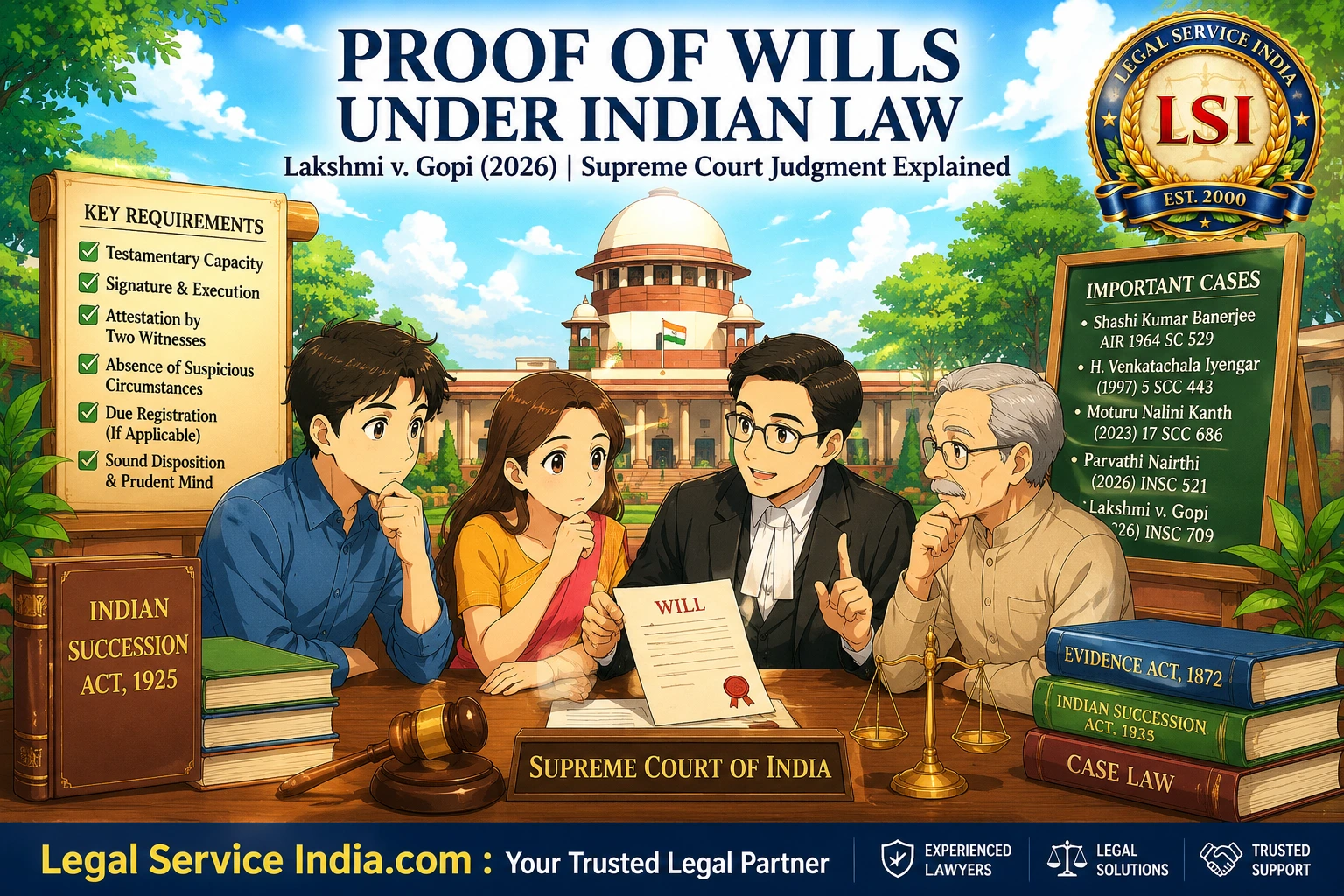
From H. Venkatachala Iyengar to Lakshmi V. Gopi—Statutory Foundations, the Prudent-Mind Test, and the Exclusion-of-Heirs Divide
Introduction
The Supreme Court’s recent restatement in Lakshmi v. Gopi & Ors., 2026 INSC 709 (Date of Judgment: 15-07-2026), once again ties together the Indian Succession Act, 1925, and the Indian Evidence Act, 1872, in the matter of proving a will. Read in isolation, that judgment—together with Meena Pradhan v. Kamla Pradhan, (2023) 9 SCC 734, and Parvathi Nairthi (Dead) v. Laxmi Nairthy (Dead) Through LRs., 2026 INSC 521—already supplies a workable template for practitioners. But none of these three decisions arose in a vacuum. Each draws, expressly or implicitly, on more than six decades of Supreme Court authority stretching back to the Constitution Bench in Shashi Kumar Banerjee v. Subodh Kumar Banerjee, AIR 1964 SC 529, and forward through Jaswant Kaur v. Amrit Kaur, Uma Devi Nambiar v. T.C. Sidhan, Kavita Kanwar v. Pamela Mehta, and the 2023 pair of Moturu Nalini Kanth and Derek A.C. Lobo.
I. Statutory Foundation: Evidence Act and Indian Succession Act
The doctrine rests on four statutory pillars. Section 63, Indian Succession Act, 1925, prescribes the formal requirements for execution and attestation of an unprivileged will—the signature or mark of the testator (or signature by another at his direction and in his presence) and attestation by at least two witnesses. Section 59 ISA requires that the testator be of sound mind and capable of understanding the nature and effect of the dispositions made. Section 68 of the Indian Evidence Act, 1872, mandates that an attested document required by law to be attested cannot be used as evidence unless at least one attesting witness is examined to prove execution. Section 67 governs proof of signature and handwriting, supplemented by Sections 45 and 47 (expert opinion and the opinion of persons acquainted with the testator’s handwriting).
Four Statutory Pillars at a Glance
| Provision | Purpose |
|---|---|
| Section 59, Indian Succession Act, 1925 | Requires the testator to be of sound mind and capable of understanding the nature and effect of the dispositions. |
| Section 63, Indian Succession Act, 1925 | Prescribes execution and attestation requirements for an unprivileged will. |
| Section 67, Indian Evidence Act, 1872 | Deals with proof of signature and handwriting. |
| Section 68, Indian Evidence Act, 1872 | Requires examination of at least one attesting witness for proving execution. |
The Constitution Bench in Shashi Kumar Banerjee v. Subodh Kumar Banerjee, AIR 1964 SC 529, remains the earliest authoritative fusion of these provisions and is worth mentioning here precisely because later decisions, including Lakshmi v. Gopi, build on it without always naming it.
Shashi Kumar Banerjee v. Subodh Kumar Banerjee — AIR 1964 SC 529
Constitution Bench (Gajendragadkar, Subba Rao, Wanchoo, Ayyangar, and Mudholkar JJ.); decided 13 September 1963.
The appeal concerned probate of a 97-year-old testator’s holograph will. Wanchoo J., writing for the Bench, held that the mode of proving a will does not differ from that of proving any other document, save for the special requirement of attestation under Section 63 ISA. The court further cautioned that handwriting-expert evidence is inherently weak and can rarely displace the direct and consistent testimony of attesting witnesses—a proposition still cited in trial courts today.
“Where, however, there are suspicious circumstances, the onus is on the propounder to explain them to the satisfaction of the court before the document is accepted as the last will of the testator.” — Wanchoo J., Shashi Kumar Banerjee
II. Why Wills Are Treated Differently
A will, though proved like any other document, occupies a distinct evidentiary position because it speaks only from the death of the testator, who is no longer available to depose to its genuineness. This posthumous operation attaches a degree of sanctity to the instrument, but the courts have been consistent—from Shashi Kumar Banerjee through to Lakshmi v. Gopi—that sanctity does not dilute the rigor of proof; it justifies stricter scrutiny, not a relaxed one.
III. Lakshmi v. Gopi: The Six Requirements, and the Reprimand of the First Appellate Court
2026 INSC 709; Karol and Pancholi JJ. decided 15 July 2026.
The dispute arose from a suit filed by the appellant against her siblings following their mother’s death in 2011 over a will that excluded her from a share in the family property. The trial court at Thrissur held that the will was not proved in accordance with Section 63 ISA and granted the appellant a 2/10 share; the Kerala High Court, sitting in appeal, reversed this finding and additionally directed that the trial judge be sent for training for having “failed to understand the controversy.”
The Supreme Court restored the trial court’s decree. In doing so, it crystallized six requirements for proof of a will, drawing on H. Venkatachala Iyengar v. B.N. Thimmajamma:
Six Requirements for Proof of a Will
- The sanctity attaching to a testamentary instrument.
- Proof of the testator’s signature under Section 67 of the Evidence Act.
- Due attestation by two witnesses under Section 63 of the ISA.
- Testamentary capacity and soundness of mind under Section 59 ISA.
- Examination of at least one attesting witness under Section 68 Evidence Act.
- A fourfold prudent-mind inquiry—whether the testator signed the will, understood its nature, understood the effect of its dispositions, and signed knowing what the document contained.
Independently of the will-proof holding, the bench held that the High Court’s remarks against the trial judge were unwarranted, invoking State of U.P. v. Mohd. Naim and Justice Karol’s own earlier ruling in State of Punjab v. Shikha Trading Co. for the proposition that appellate courts must act as a “friend, philosopher, and a guide” rather than wield authority over subordinate courts. This procedural holding is discussed further in Part VII below.
IV. Meena Pradhan v. Kamla Pradhan: Structuring the Proof
(2023) 9 SCC 734; 2023 INSC 847; Civil Appeal No. 3351 of 2014; Oka and Karol JJ.; decided 21 September 2023.
A first wife challenged a will executed by the common husband in favor of his second wife and daughter. Relying on H. Venkatachala Iyengar, Bhagwan Kaur v. Kartar Kaur, (1994) 5 SCC 135, Janki Narayan Bhoir v. Narayan Namdeo Kadam, (2003) 2 SCC 91, Yumnam Ongbi Tampha Ibema Devi v. Yumnam Joykumar Singh, (2009) 4 SCC 780, and Shivakumar v. Sharanabasappa, (2021) 11 SCC 277, the Court deduced that proof of a will requires the following:
- Satisfaction of the prudent mind rather than mathematical accuracy.
- Strict compliance with Section 63 ISA formalities.
- In the absence of real suspicious circumstances, acceptance of the concurrent findings of fact by the courts below.
The Court declined to examine unrelated allegations of bigamy, holding them irrelevant to testamentary validity.
V. The Suspicious-Circumstances Doctrine: Origins and Refinement
Rani Purnima Debi v. Kumar Khagendra Narayan Deb — AIR 1962 SC 567
One of the earliest post-independence statements of the rule is that the propounder bears an enhanced burden once suspicion attaches to a will’s execution, frequently cited in tandem with Shashi Kumar Banerjee as the doctrine’s twin foundations.
Pushpavathi v. Chandraraja Kadamba — AIR 1972 SC 2492
Establishes the corollary: once the propounder succeeds in removing suspicion, the court must give effect to the will even if it is unnatural in the sense of cutting off, wholly or partly, near relations. This is the seed from which the later exclusion-of-heirs line (Part VI below) grows.
Jaswant Kaur v. Amrit Kaur — 1977 AIR (SC) 74; (1977) 1 SCC 369
Chandrachud, Goswami, and Gupta JJ. decided 25 October 1976.
A widow’s suit for maintenance and a share in her deceased husband’s estate led to a will surfacing years after the relevant proceedings had concluded. The Supreme Court reversed a High Court that had too readily accepted the will as free of suspicion, holding that proof of testamentary documents does not demand mathematical certainty but must satisfy the ordinary test of a prudent mind—and that unexplained suspicious circumstances, once shown, are fatal to probate regardless of whether they were specifically pleaded at trial.
“There is a long line of decisions bearing on the nature and standard of evidence required to prove a will.” — Chandrachud J., Jaswant Kaur v. Amrit Kaur, para 10
P.P.K. Gopalan Nambiar v. P.P.K. Balakrishnan Nambiar — 1995 Supp (2) SCC 664; AIR 1995 SC 1852
Supplies an important limiting principle that disciplines the doctrine on the other side: suspicious features must be real, germane, and valid—not, in the Court’s words, “fantasy of the doubting mind.” This case is regularly paired with Uma Devi Nambiar (Part VI) to prevent the suspicious-circumstances test from becoming a vehicle for defeating genuine wills on speculative grounds.
VI. The Active-Participation Test
Surinder Pal v. Saraswati Arora — (1974) 2 SCC 600
Holds that where the propounder takes a prominent part in the execution of a will that confers a substantial benefit on him, that fact is itself a suspicious circumstance requiring removal by clear evidence.
Niranjan Umesh Chandra Joshi v. Mridula Jyoti Rao — (2006) 13 SCC 433
Reaffirms the Surinder Pal principle in the context of a beneficiary who had taken a dominant role in procuring execution of the instrument.
Kavita Kanwar v. Pamela Mehta — 2020 INSC 397
Civil Appeal No. 3688 of 2017; Khanwilkar and Maheshwari, JJ.; decided 19 May 2020.
An executor-daughter, also the principal beneficiary, sought probate of her mother’s will, which excluded a widowed sister and materially favored the appellant. Both the trial court and the Delhi High Court refused probate, finding the appellant’s dominant role in procuring the will—combined with the unexplained exclusion of other children—to be a cumulative suspicious circumstance the appellant had failed to dispel. The Supreme Court affirmed, applying Surinder Pal and Niranjan Umesh Chandra Joshi, and holding that no single suspicious factor needs to be conclusive if the totality of circumstances leaves the court’s conscience unsatisfied.
“The propounder was required to remove the doubts by clear and cogent evidence, which she failed to do.” — summarising the Court’s finding in Kavita Kanwar v. Pamela Mehta
VII. Exclusion of Natural Heirs: Two Lines Compared
Parvathi Nairthi is best understood not in isolation but as the continuation of a specific sub-doctrine that begins with Pushpavathi and is stated most clearly in Uma Devi Nambiar v. T.C. Sidhan, (2004) 2 SCC 321 (decided 11 December 2003). There, the Court held that a will exists precisely to alter the ordinary mode of intestate succession, so that exclusion of natural heirs—without more—cannot be treated as suspicious. Kavita Kanwar shows the outer limit of this principle: exclusion becomes relevant once it combines with the excluded beneficiary’s own dominant role in procuring the instrument.
Comparison of Leading Decisions
| Case | Facts | Ratio on Exclusion of Heirs |
|---|---|---|
| Uma Devi Nambiar v. T.C. Sidhan (2004) 2 SCC 321 | A bequest in favor of an offspring, with other heirs given a lesser or no share. | Exclusion of natural heirs, by itself, is not a suspicious circumstance — a will exists precisely to alter the ordinary line of succession. |
| Parvathi Nairthi v. Laxmi Nairthy 2026 INSC 521 | Testator bequeathed properties to his sister, excluding his wife and children, on the stated ground that they were already provided for. | Reaffirms Uma Devi Nambiar; non-registration and revenue mutation entries do not defeat a duly proved will. |
| Kavita Kanwar v. Pamela Mehta 2020 INSC 397 | The executor-beneficiary daughter took a dominant role in procuring the will and excluded her siblings without explanation. | Where exclusion is compounded by the beneficiary’s own dominant role in execution, the combination—not the exclusion alone—becomes suspicious, and probate was refused. |
Rabindra Nath Mukherjee v. Panchanan Banerjee, (1995) 4 SCC 459, sits at the root of this comparative table and is common to both Uma Devi Nambiar and Parvathi Nairthi, holding that deprivation of natural heirs should not, by itself, raise suspicion because that is the very idea behind executing a will.
VIII. Contemporary Refinements (2023)
Moturu Nalini Kanth v. Gainedi Kaliprasad (Dead) Thr. LRs — 2023 INSC 1004; 2023 SCC OnLine SC 1488
Confirms that an unregistered will is not, for that reason alone, invalid—registration under the Registration Act, 1908, is not compulsory for wills—but non-registration heightens the propounder’s burden to establish free and conscious execution under Section 63 ISA.
Derek A.C. Lobo v. Ulric M.A. Lobo (Dead) by LRs—2023 INSC 1093; 2023 SCC OnLine SC 1893
Ravikumar and Sanjay Kumar JJ. decided 7 December 2023.
Adds a pleading-stage discipline to the doctrine: a party challenging execution of a will as suspicious must specifically plead the suspicious circumstances relied upon; only then does the propounder’s burden to remove them arise. The court relied on Meenakshiammal v. Chandrasekharan and P.P.K. Gopalan Nambiar and on its own recent decision in Moturu Nalini Kanth.
IX. Parvathi Nairthi v. Laxmi Nairthy: Forgery, Mutation Entries, and Unproved Affidavits
2026 INSC 521; Bhuyan and Bishnoi, JJ., decided 21 May 2026.
The testator, a chartered accountant, bequeathed his properties to his sister to the exclusion of his wife and children, recording in the will that he had already provided for them. The Supreme Court upheld the will, holding that mere exclusion of natural heirs — even of a spouse and children — does not by itself constitute a suspicious circumstance. It further held that non-registration of a will is not fatal, that mutation entries in revenue records carry limited evidentiary value and do not confer title, and that unsworn or unproved affidavits cannot displace a formally proved testamentary instrument. Allegations of forgery or fabrication must be proved by the party asserting them, ordinarily through the witness box or expert evidence; this aligns with Ishwardeo Narain Singh v. Kamta Devi and Rabindra Nath Mukherjee v. Panchanan Banerjee, both relied upon in the judgment.
X. Role of the First Appellate Court
Lakshmi v. Gopi has a strong processual dimension that the will-proof discussion in Part III does not fully capture. The Supreme Court held that a first appellate court cannot reverse a trial court’s findings on the genuineness of a will through a cryptic or unreasoned order; it must independently reassess the evidence relating to execution, attestation, testamentary capacity, and suspicious circumstances. The bench went further, disapproving the High Court’s direction that the trial judge be sent for training and holding—applying State of U.P. v. Mohd. Naim—that adverse remarks against judicial officers must be guided by justice, fair play, and restraint, since appellate courts should act as a “friend, philosopher, and a guide” rather than exercise supervisory authority in a heavy-handed manner. For practitioners, the lesson is two-fold: first-appeal memoranda in testamentary matters should compel the appellate court to engage with each of the six requirements individually and should not invite generalized criticism of the trial court in the process.
XI. Doctrinal Synthesis
The decisions discussed above collectively establish a coherent framework governing proof of wills under Indian law. The following principles emerge consistently from the authorities.
- Formal compliance with Sections 59 and 63 of the ISA and Sections 67 and 68 of the Evidence Act is non-negotiable across every decision surveyed, from Shashi Kumar Banerjee (1963) to Lakshmi v. Gopi (2026).
- The prudent-mind test, not mathematical certainty, remains the control standard (Jaswant Kaur; Meena Pradhan; Lakshmi v. Gopi).
- Suspicion must be real and germane, not speculative (P.P.K. Gopalan Nambiar); once shown, the burden to dispel it lies squarely on the propounder (Shashi Kumar Banerjee; Rani Purnima Debi).
- Exclusion of natural heirs, standing alone, is not suspicious (Pushpavathi, Uma Devi Nambiar, Parvathi Nairthi) but becomes relevant when compounded by the excluded beneficiary’s own dominant role in procuring the will (Surinder Pal, Kavita Kanwar).
- Non-registration does not invalidate a will but heightens the burden of proof (Moturu Nalini Kanth; Parvathi Nairthi).
- Suspicious circumstances must be specifically pleaded before the propounder’s burden to remove them is triggered (Derek A.C. Lobo).
- Mutation entries and unproved affidavits carry limited evidentiary weight against a duly proved will (Parvathi Nairthi).
- Appellate scrutiny of testamentary findings must be substantive and reasoned, not cryptic (Lakshmi v. Gopi).
XII. Citation Verification Table
| Case | Citation | Decided | Core Holding |
|---|---|---|---|
| H. Venkatachala Iyengar v. B.N. Thimmajamma | 1959 Supp (1) SCR 426 / AIR 1959 SC 443 | 1958 | Foundational prudent-mind test; origin of suspicious-circumstances doctrine. |
| Shashi Kumar Banerjee v. Subodh Kumar Banerjee | AIR 1964 SC 529 | 13.09.1963 | A constitution bench will prove like any document, subject to S.63 attestation; expert opinion is weak evidence. |
| Rani Purnima Debi v. Kumar Khagendra Narayan Deb | AIR 1962 SC 567 | 1962 | Early statement of suspicious-circumstances burden on the propounder. |
| Pushpavathi v. Chandraraja Kadamba | AIR 1972 SC 2492 | 1972 | Once suspicion is dispelled, the court must give effect to the will despite disinheritance. |
| Jaswant Kaur v. Amrit Kaur | 1977 AIR (SC) 74 / (1977) 1 SCC 369 | 25.10.1976 | The prudent-mind test was restated; unexplained suspicious circumstances are fatal to probate. |
| Surinder Pal v. Saraswati Arora | (1974) 2 SCC 600 | 1974 | Propounder’s prominent role + substantial benefit is a suspicious circumstance. |
| P.P.K. Gopalan Nambiar v. P.P.K. Balakrishnan Nambiar | 1995 Supp (2) SCC 664 / AIR 1995 SC 1852 | 1995 | Suspicion must be real and germane, not “fantasy of the doubting mind.” |
| Rabindra Nath Mukherjee v. Panchanan Banerjee | (1995) 4 SCC 459 | 1995 | Deprivation of natural heirs alone is not suspicious. |
| Uma Devi Nambiar v. T.C. Sidhan | (2004) 2 SCC 321 | 11.12.2003 | Exclusion of natural heirs, by itself, is not a suspicious circumstance. |
| Niranjan Umesh Chandra Joshi v. Mridula Jyoti Rao | (2006) 13 SCC 433 | 2006 | Reaffirms active-participation-of-beneficiary suspicion test. |
| Kavita Kanwar v. Pamela Mehta | Civil Appeal No. 3688/2017; 2020 INSC 397 | 19.05.2020 | Probate refused — executor-beneficiary’s dominance + unexplained exclusion of siblings. |
| Meena Pradhan v. Kamla Pradhan | (2023) 9 SCC 734 / 2023 INSC 847 | 21.09.2023 | Structures the proof: signature, attestation, sound mind, free will — no real suspicion found. |
| Moturu Nalini Kanth v. Gainedi Kaliprasad | 2023 INSC 1004 / 2023 SCC OnLine SC 1488 | 2023 | Non-registration heightens, but does not defeat, the propounder’s burden. |
| Derek A.C. Lobo v. Ulric M.A. Lobo | 2023 INSC 1093 / 2023 SCC OnLine SC 1893 | 07.12.2023 | Suspicious circumstances must first be specifically pleaded by the challenger. |
| Parvathi Nairthi v. Laxmi Nairthy | 2026 INSC 521 | 21.05.2026 | Exclusion of wife/children upheld; non-registration and mutation entries not fatal. |
| Lakshmi v. Gopi & Ors. | 2026 INSC 709 | 15.07.2026 | Sixfold requirements restated; the first appellate court reprimanded for a cryptic reversal. |
XIII. Practitioner Checklist
The following checklist provides a quick reference for lawyers handling testamentary disputes:
- Plead suspicious circumstances specifically and at the earliest opportunity if challenging a will—Derek A.C. Lobo makes this a threshold requirement.
- Secure the availability of at least one attesting witness, credible and prepared to depose to the signature, attestation, and the testator’s sound and disposing state of mind.
- Do not treat the exclusion of natural heirs as, by itself, either a ground of challenge or a vulnerability to be defended—lead evidence on any accompanying suspicious factor instead (dominant role, unexplained departure from prior dispositions, or doubtful signature).
- Where the propounder is also the principal beneficiary and played an active role in procuring execution, anticipate the Surinder Pal / Kavita Kanwar line and prepare corroborative, independent evidence of the testator’s free volition.
- Non-registration is not fatal but should be affirmatively explained with contemporaneous circumstances (Moturu Nalini Kanth).
- Do not rely on revenue mutation entries or unsworn affidavits to displace a formally proved will; if alleging forgery, be prepared to enter the witness box or lead expert evidence (Parvathi Nairthi).
- At the first-appeal stage in testamentary matters, insist that the appellate court engage individually with each of the six Lakshmi v. Gopi requirements rather than issue a general or cryptic reversal.
Concluding Note
Read together, the fourteen decisions surveyed here show a doctrine that has not shifted in substance since 1963 but has been steadily disciplined at its edges—first by confining what counts as a genuine suspicious circumstance (P.P.K. Gopalan Nambiar; Uma Devi Nambiar), then by requiring that challenges be specifically pleaded (Derek A.C. Lobo), and most recently by insisting on substantive, reasoned appellate engagement rather than summary reversal (Lakshmi v. Gopi). For practitioners, the practical value lies less in any single holding than in the pattern: courts will protect testamentary freedom against speculative challenge but will not relax the statutory formalities or the propounder’s burden once real suspicion is shown.
Key Takeaways
The following key takeaways summarize the important legal principles governing the proof of wills under Indian law, as reaffirmed by the Supreme Court in Lakshmi v. Gopi (2026) and earlier landmark decisions.
- Lakshmi v. Gopi (2026) reaffirms that a will must satisfy both the Indian Succession Act, 1925, and the Indian Evidence Act, 1872, before it can be accepted as legally proved.
- The Supreme Court identified six essential requirements for proving a valid will, including execution, attestation, testamentary capacity, proof of signature, examination of an attesting witness, and satisfaction of the prudent-mind test.
- Section 63 of the Indian Succession Act governs the execution and attestation of wills, while Sections 67 and 68 of the Indian Evidence Act regulate proof of signatures and examination of attesting witnesses.
- The prudent-mind test, first articulated in H. Venkatachala Iyengar and consistently reaffirmed thereafter, remains the governing standard for evaluating the validity of a will. Courts require reasonable judicial satisfaction rather than mathematical certainty.
- A will is subject to stricter judicial scrutiny because it becomes operative only after the death of the testator, making direct testimony impossible.
- Suspicious circumstances surrounding a will do not automatically invalidate it. However, once genuine suspicion is established, the burden shifts to the propounder to remove those doubts through clear and convincing evidence.
- The Supreme Court repeatedly emphasizes that suspicious circumstances must be real, relevant, and supported by evidence, not based on conjecture or mere suspicion.
- Excluding natural heirs from a will is not, by itself, a suspicious circumstance. Since a will exists to alter normal succession, disinheritance alone cannot invalidate testamentary intent.
- However, exclusion of legal heirs may become suspicious when combined with additional factors, such as the beneficiary’s active participation in drafting or procuring the will.
- A beneficiary who plays a dominant role in preparing or executing the will bears a heavier evidentiary burden to demonstrate that the testator acted voluntarily and with full understanding.
- Registration of a will is optional under Indian law. An unregistered will remains legally valid if execution and attestation are proved according to law.
- Although registration is not mandatory, non-registration may increase judicial scrutiny, requiring stronger evidence of free and conscious execution.
- Revenue mutation entries do not establish ownership and cannot override a duly proved will.
- Unproved affidavits carry little evidentiary value in testamentary disputes and cannot displace a properly proved testamentary document.
- Allegations of forgery or fabrication must be established through admissible evidence, including witness testimony or expert evidence where appropriate.
- The Supreme Court clarified that a party challenging a will must specifically plead suspicious circumstances. General allegations are insufficient to shift the burden onto the propounder.
- First appellate courts cannot overturn a trial court’s findings on the validity of a will through cryptic or unreasoned judgments. They must independently evaluate every aspect of execution, attestation, testamentary capacity, and suspicious circumstances.
- The judgment also reiterates that appellate courts should act as a “friend, philosopher, and guide” to subordinate courts and avoid unnecessary adverse remarks against judicial officers.
- More than six decades of Supreme Court jurisprudence—from Shashi Kumar Banerjee (1963) to Lakshmi v. Gopi (2026)—demonstrate remarkable doctrinal consistency in the law governing proof of wills.
- For advocates and litigants, success in probate and testamentary litigation depends on strict statutory compliance, credible attesting witnesses, proper pleadings, and persuasive evidence that removes genuine suspicion surrounding the will.
Quick Reference Table
| Legal Principle | Key Takeaway |
|---|---|
| Applicable Laws | The Indian Succession Act, 1925, and the Indian Evidence Act, 1872, must both be satisfied. |
| Proof of Will | Requires execution, attestation, testamentary capacity, signature, attesting witness, and prudent-mind satisfaction. |
| Prudent-Mind Test | Reasonable judicial satisfaction—not mathematical certainty—is the governing standard. |
| Suspicious Circumstances | Must be genuine, evidence-based, and removed by the propounder once established. |
| Natural Heirs | Exclusion alone is not a suspicious circumstance. |
| Beneficiary’s Active Role | May increase judicial scrutiny and evidentiary burden. |
| Registration | Optional, but non-registration may require stronger proof. |
| Mutation Entries | Do not confer title and cannot override a duly proved will. |
| Forgery Allegations | Must be established through admissible evidence. |
| First Appeal | Appellate courts must independently evaluate all evidence before reversing trial court findings. |

