





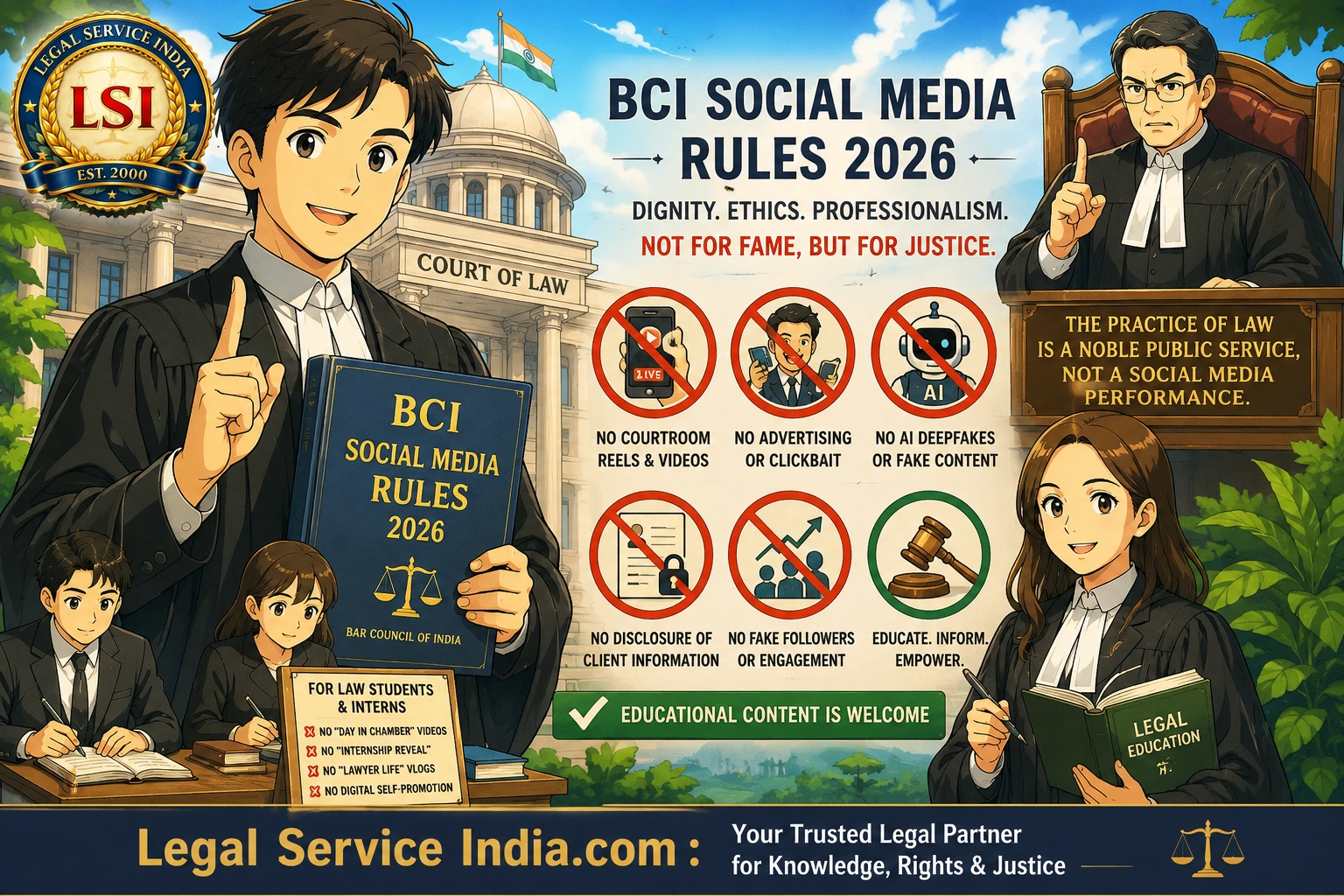
BCI Social Media Crackdown on the Legal Profession
In an unprecedented move to protect the structural integrity of the legal system, the Bar Council of India (BCI) has officially drawn a battle line between professional dignity and digital clout. Issued on July 17, 2026, the BCI’s comprehensive 37-page circular unleashes a massive institutional crackdown on advocates, law students, interns, and legal educators who leverage social media for sensationalism, commercial self-promotion, and algorithmic validation.
The message from the apex regulatory body is uncompromisingly loud and clear: The practice of law is a noble public service, not a commodified TikTok or Instagram aesthetic. Driven by the rampant rise of dramatic courtroom edits, deepfakes, and indirect client solicitation, this circular seeks to abruptly halt the trend of turning solemn judicial proceedings into digital entertainment.
It is highly pertinent to note that just days prior to the formal release of this circular, on July 14, 2026, the Supreme Court of India in Anil Pandey and Another v. The Bar Council of India (Writ Petition (Civil) No. 817 of 2026) issued a notice to the BCI on a public interest litigation (PIL) seeking strict regulations on the digital footprint, influencer collaborations, and aggressive advertising practices of lawyers. While the BCI explicitly clarified in the circular that its internal subcommittee had already been independently deliberating and drafting these measures since June 8, 2026, this parallel judicial intervention heavily underscores the critical, multi-institutional urgency to purge commercial exhibitionism from the legal fraternity.
What Is Strictly Prohibited?
The BCI has detailed an exhaustive list of “Don’ts” designed to purge commercial exploitation and sensationalism from the legal ecosystem.
For Advocates
| Prohibited Activity | BCI Direction |
|---|---|
| Courtroom as Props | Advocates are strictly prohibited from making reels or vlogs or taking promotional photographs inside court premises, courtrooms, corridors, and bar rooms. Using court signage, bands, robes, or active case files as props for social media branding is entirely banned. |
| Sensationalizing Live Streams | The circular cracks down on the selective editing, clipping, or circulating of live-streamed court proceedings. Adding dramatic music, clickbait captions, voiceovers, or thumbnails that ridicule or mock judges, counsel, or litigants is now a punishable violation. |
| Indirect Advertising & Clickbait | Because the legal profession is strictly non-commercial, posts designed to attract clients through outcome guarantees, such as “guaranteed bail” or “divorce in a few days,” are forbidden. Furthermore, buying fake followers, bot-driven engagement, or publishing unverified client testimonials to manipulate professional credibility is banned. |
| The AI Threat | The BCI has heavily red-flagged the misuse of AI tools. Uploading or circulating AI-generated images, deepfake videos, voice-cloned audio, or synthetic avatars depicting judges or court officers is completely outlawed. The creation or circulation of fake judgments and fabricated legal citations will invite severe consequences. |
| Breaching the Vault of Confidentiality | Disclosing client strategies, settlement discussions, opinions, drafts, or privileged communications on public platforms is strictly forbidden. |
Summary of Restrictions for Advocates
- Making reels, vlogs, or promotional photographs inside court premises is prohibited.
- Using court signage, robes, bands, or case files for branding is banned.
- Editing or sensationalizing live-streamed court proceedings is punishable.
- Indirect advertising and clickbait legal promotions are forbidden.
- Fake followers, bot engagement, and fabricated testimonials are prohibited.
- AI-generated deepfakes, fake judgments, and fabricated legal citations are banned.
- Disclosure of confidential client information is strictly prohibited.
For Law Students and Interns
| Category | Restriction |
|---|---|
| The Death of the “Lawyer Life” Aesthetic | The BCI has specifically banned popular short-form video genres typically created by interns. Content formatted as “day in a chamber,” “internship reveal,” “courtroom drama,” or generalized “lawyer life” vlogs that trivialize serious court craft or breach professional confidentiality are officially prohibited. |
| No Social Media Leverage | Students are banned from using their internship placement under a judge, senior advocate, or law firm as a tool for digital self-promotion or personal branding. |
Key Takeaways for Law Students and Interns
- “Day in a chamber” videos are prohibited.
- “Internship reveal” and “courtroom drama” content is banned.
- “Lawyer life” vlogs that trivialize legal practice are prohibited.
- Internships cannot be used for digital self-promotion or personal branding.
What Is Explicitly Allowed?
The BCI clarified that the circular is not a total digital media blackout; rather, it aims to filter out commercial exploitation while protecting genuine legal literacy. The baseline rule is that digital content must remain strictly educational, accurate, and non-promotional.
Permitted Digital Activities
| Permitted Activity | BCI Clarification |
|---|---|
| Responsible Legal Awareness | Disseminating factual, neutral information regarding legal rights, consumer awareness, cyber safety, and constitutional literacy is fully permitted. |
| Academic Discourse | The neutral, accurate reporting and respectful academic discussion of judgments, legal principles, and statutory rules remain protected. |
| Regulated Short-Form Education | Educational reels, shorts, and carousels are allowed, provided they are contextual, entirely non-solicitous, free of outcome assurances, and carry clear disclaimers advising viewers to seek independent professional advice. |
| Accountability Disclosures | Enrolled advocates who create educational content must transparently display their full name, their respective state bar council, and their enrollment number to help the public differentiate authorized practitioners from self-styled legal influencers. |
Key Permitted Practices
- Share factual and neutral legal awareness content.
- Publish educational material on constitutional rights and consumer awareness.
- Discuss judgments, statutes, and legal principles in an academic manner.
- Create educational reels and short videos without solicitation or guarantees.
- Include appropriate legal disclaimers wherever required.
- Advocates creating educational content should disclose their name, State Bar Council, and enrollment number.
The Enforcement Matrix: Graded Violations and Sworn Oaths
To ensure this directive is not treated as mere paperwork, the BCI is introducing a strict compliance architecture:
| Component | Implementation Mechanism |
|---|---|
| New Enrollees | Must execute a mandatory, standalone sworn affidavit at the stage of enrollment affirming compliance with these digital ethics. |
| Law Students | Every student entering an LL.B. or LL.M. program must sign a standalone undertaking at admission and execute a fresh one before commencing every institutional internship. |
| Institutional Setup | State bar councils are mandated to set up digital ethics committees and online portals to receive complaints, log metadata URLs, and review violations. |
Classification of Breaches
Breaches are classified into minor, serious, and aggravated categories. While minor first-time lapses may get away with warnings or forced deletion, serious or repeated offenses—such as deepfakes, fake citations, or structural solicitation—will trigger immediate disciplinary action under the Advocates Act, 1961; contempt proceedings; or the immediate withdrawal of student internship opportunities.
Possible Consequences of Violations
| Violation Level | Possible Consequences |
|---|---|
| Minor Violations | Warning or mandatory deletion of the offending content. |
| Serious Violations | Disciplinary proceedings under the Advocates Act, 1961. |
| Aggravated Violations | Contempt proceedings, disciplinary action, or immediate withdrawal of internship opportunities. |
Highlights of the Compliance Framework
- Mandatory affidavits for new enrollees.
- Undertakings required from every law student.
- Fresh undertaking before each institutional internship.
- Digital ethics committees to be established by state bar councils.
- Dedicated online complaint portals for reporting violations.
- Monitoring of URLs and digital evidence relating to misconduct.
- Graduated penalties depending upon the seriousness of the violation.
Necessary Shield or Algorithmic Overreach?
There is no denying that the BCI’s heavy-handed response is a necessary corrective to a rapidly deteriorating digital landscape. The viral trend of reducing complex, high-stakes human struggles in courtrooms into 15-second sensationalized clips, often weaponized to defame judges or mock opposing counsel, was actively eroding public trust in the judiciary. Similarly, the threat of AI-generated fake citations and predatory “guaranteed outcome” clickbait targeted at legally vulnerable citizens demanded swift institutional intervention.
However, the sweeping brush with which this circular paints the digital landscape risks borderline over-policing. By targeting harmless creative formats like “day in the life of a law intern” vlogs, the BCI might inadvertently stifle the relatable, authentic glimpses of the legal world that inspire first-generation law students.
The thin line between preserving institutional decorum and suppressing youthful, harmless personal expression must be navigated carefully. As State Bar Councils deploy nodal officers to monitor the web, the legal fraternity must ensure that these digital ethics mechanisms do not devolve into tools for personal rivalries, puritanical moral policing, or the silencing of legitimate, constructive critiques of the judicial system.
The ambivalence surrounding this directive is entirely justified, as it straddles the line between a necessary defense mechanism and an absolute chokehold on the next generation of lawyers.
Arguments Supporting the BCI Circular
- Protects the dignity and sanctity of judicial institutions.
- Discourages sensationalized courtroom content.
- Prevents misleading legal advertisements and outcome guarantees.
- Addresses the growing misuse of AI-generated legal misinformation.
- Strengthens public confidence in the justice delivery system.
Concerns Raised by the Circular
- May unintentionally discourage genuine legal education.
- Could restrict harmless educational and experiential content.
- Risks over-policing of young lawyers and interns.
- Requires careful implementation to prevent misuse.
Balancing Professional Ethics and Digital Freedom
On one hand, the Anil Pandey PIL exposed a legitimate institutional crisis: sacred court robes being degraded into commercial props and predatory marketing targeting vulnerable litigants under the fake banner of “legal awareness.” Stopping digital touting, outcome guarantees, and the circulation of manipulated AI citations is crucial to protecting public trust in the administration of justice.
On the other hand, the BCI’s response feels like a heavy-handed overcorrection. Enforcing mandatory standalone affidavits for enrollees and threatening to derail an intern’s career over a harmless “day in a chamber” vlog risks creating a culture of institutional paranoia. Public legal literacy in India is already low; building an overly rigid digital ceiling could inadvertently kill the genuine, well-meaning democratization of legal knowledge online.
Even the BCI explicitly warned in the text that these rules must not devolve into “moral policing or personal rivalry,” yet that is exactly the weaponized monster a sweeping ban risks creating. It leaves the profession asking a difficult question: Is the Bar truly protecting its solemn history, or is it simply terrified of the transparency demanded by the digital age?
The Final Verdict
The BCI’s circular marks the absolute end of the Wild West era for legal social media in India. The glamour, the dramatic background music, and the transactional search for digital followers are officially out; text-heavy accountability, professional restraint, and academic humility are back in.
Ultimately, the legal profession has survived for generations not because of the theatricality of the spectacle, but because of the depth of its learning, the strictness of its restraint, and the sanctity of the public trust. Advocates and future bar members are now left with a definitive baseline: if your legal identity exists to serve the justice delivery system, it is welcome online; if it exists merely to serve an algorithm, pull the plug.
Key Takeaways
| Topic | Summary |
|---|---|
| Objective | Protect the dignity of the legal profession while regulating digital conduct. |
| Who Is Covered? | Advocates, law students, interns, legal educators, and Bar Councils. |
| Major Restrictions | Ban on promotional courtroom content, indirect advertising, deepfakes, fake legal citations, and confidentiality breaches. |
| Permitted Activities | Educational, factual, and non-promotional legal awareness content. |
| Compliance | Mandatory affidavits, undertakings, digital ethics committees, and disciplinary mechanisms. |
| Overall Impact | Represents one of the most comprehensive attempts to regulate lawyers’ use of social media in India. |
References
- Bar Council of India Circular – https://www.barcouncilofindia.org/info/forwarding-d4cwwl
- Bar & Bench Report – https://www.barandbench.com/news/supreme-court-seeks-response-from-state-bar-councils-on-plea-against-advertising-by-lawyers-through-reels-videos
Author
Written By: Rayees, an independent legal researcher and writer. He can be reached at [email protected].
Important Links
Important Links:
- Lawyers in India
- Copyright Registration in India
- Caveat Filing in Supreme Court of India
- Mutual Consent Divorce in Delhi/NCR : WhatsApp 9650499965
Quick Reference Table
| Legal Service | Link |
|---|---|
| Lawyers in India | View Directory |
| Copyright Registration in India | Learn More |
| Caveat Filing in Supreme Court of India | Read More |
| Mutual Consent Divorce in Delhi/NCR | Get Details — WhatsApp: 9650499965 |

