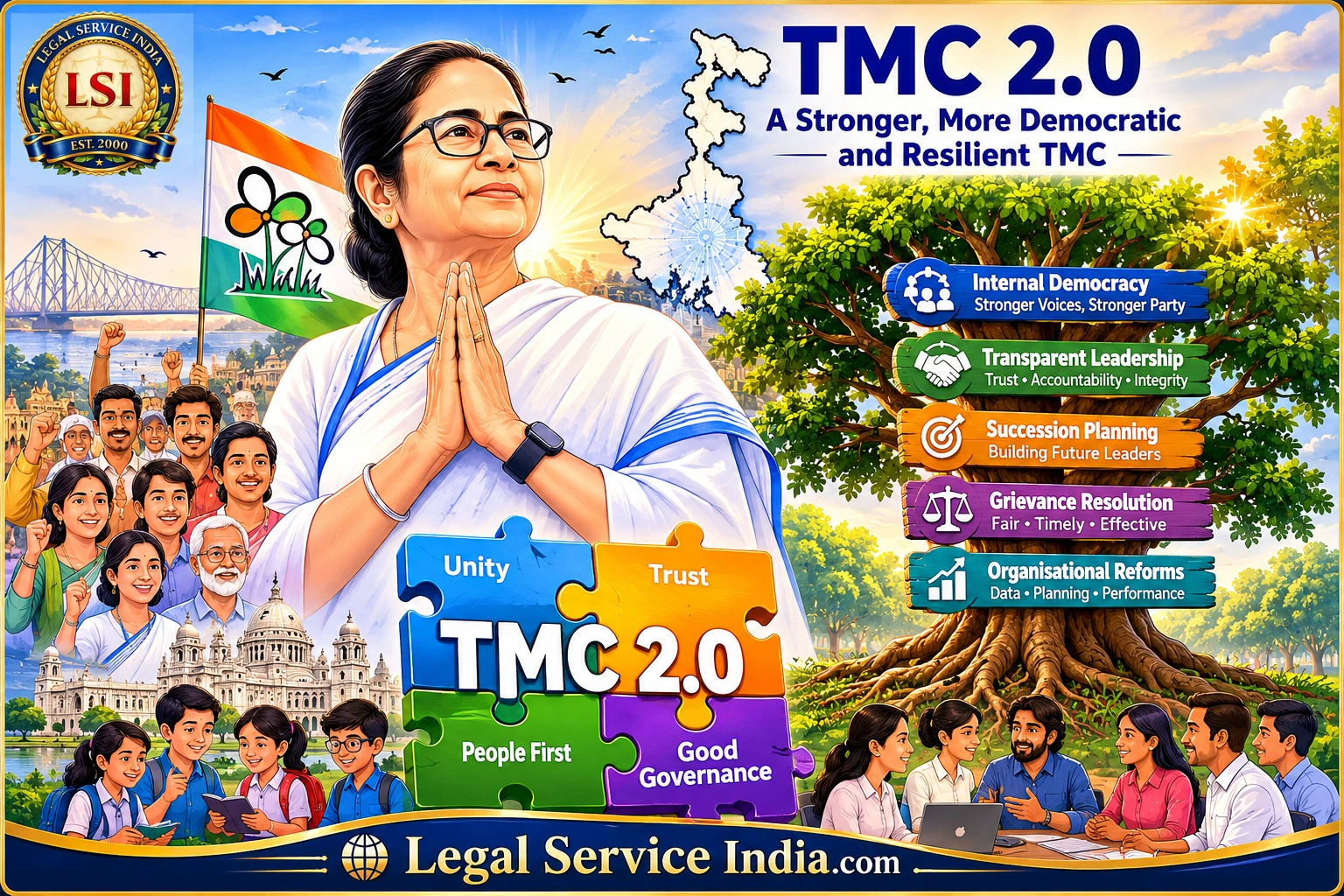
Where Did TMC and Mamata Banerjee’s Leadership Go Wrong After the West Bengal Election?
Introduction: The Bigger Question Behind TMC’s Crisis
The political crisis that unfolded within the Trinamool Congress after the West Bengal Assembly election raises a question far more important than who joined which faction.
Why did so many elected representatives become willing to challenge the leadership of Mamata Banerjee so soon after the election?
An electoral defeat is normal in a democracy. Political parties lose elections and return to power later. What is unusual is when an electoral defeat is followed by a serious internal challenge to the party leadership itself.
The West Bengal situation, therefore, deserves to be examined not merely as a story of defections, factionalism, or political opportunism. It should be examined as a case study in political leadership, organizational design, succession planning, and institutional resilience.
My assessment is that Mamata Banerjee’s principal weakness was not a lack of authority. It was, paradoxically, too much concentration of authority around the leadership and too little institutional independence within the party.
A political organization can be extremely effective when its leader is powerful. But the real test of an organization comes when that leader loses governmental power.
That is where the TMC crisis becomes particularly instructive.
The Election Defeat and the Internal Crisis Are Two Different Problems
The first mistake would be to treat everything that happened as one single problem.
The 2026 West Bengal Assembly election produced a major electoral setback for the Trinamool Congress. According to the Election Commission results, the BJP won 207 of the 294 Assembly seats, while TMC won 80. The BJP secured approximately 45.84% of the vote, and TMC approximately 40.80%.
These numbers are important.
TMC did not become an insignificant political force. It continued to command the support of more than four out of every ten voters.
Therefore, the election result cannot simply be described as the people completely rejecting TMC.
The more interesting question is this:
How did a party with a 40.80% vote share end up with only 80 seats?
That requires a constituency-level analysis of vote distribution, candidate performance, anti-incumbency, alliances, local organization, and the BJP’s ability to convert votes into seats.
But the post-election crisis presents a different question:
Why did the party’s own elected representatives become so dissatisfied with its leadership structure?
That is an organizational question.
And the answer to that question is potentially more important for TMC’s long-term survival than the election result itself.
A Party Can Lose an Election Without Losing Its Organization
Political parties routinely lose elections.
The Congress lost power repeatedly and survived.
The Left Front lost West Bengal and survived as a political organization for years.
The BJP has lost important elections and subsequently returned to power.
The important distinction is between electoral defeat and organizational collapse.
| Situation | What It Means | Why It Matters |
|---|---|---|
| Electoral Defeat | The voters did not give the party enough seats. | The party can rebuild and seek a fresh mandate. |
| Organizational Collapse | The party’s own members no longer agree about who should lead it. | The party’s internal stability and future survival may be threatened. |
An electoral defeat means:
“The voters did not give us enough seats.”
An organizational collapse means:
“Our own people no longer agree about who should lead us.”
The second problem is much more dangerous.
Reports following the West Bengal election indicated that a very large number of TMC legislators backed Ritabrata Banerjee’s challenge to the existing leadership structure. Different reports and competing political claims have put the number at different levels, so the precise figure should be treated cautiously.
But the broader fact is difficult to ignore:
A substantial section of the elected TMC legislative party was prepared to challenge the existing leadership.
That tells us something about the organization that an election result alone cannot tell us.
Where Did Mamata Banerjee’s Leadership Go Wrong?
There is no single answer.
The problem appears to have developed through several interconnected weaknesses.
1. TMC Became Too Closely Identified With Mamata Banerjee
Mamata Banerjee is unquestionably the central political personality of the Trinamool Congress.
That has been one of TMC’s greatest strengths.
Her personal credibility, political communication, mass appeal, and ability to mobilize voters helped transform TMC from a relatively new political organization into the dominant political force in West Bengal.
But the same strength can become a weakness.
When a party becomes too closely identified with one leader, a subtle transformation takes place.
The organization begins to depend on the leader for:
- Political legitimacy;
- Candidate selection;
- Conflict resolution;
- Strategic direction;
- Appointments;
- Succession;
- Communication with senior leaders.
Eventually, members may become loyal to the person rather than to the institution.
That distinction becomes visible only when the leader loses power.
While Mamata Banerjee was Chief Minister and TMC controlled the government, there was little reason for anyone to challenge the structure.
After the election defeat, the incentives changed.
Suddenly the question became:
What does remaining inside the organization provide to a politician who no longer has the protection of governmental power?
That is where institutional weakness becomes dangerous.
2. Strong Leadership Is Not the Same as Strong Institution
There is an important difference between a strong leader and a strong political organization.
A strong leader can make quick decisions.
A strong institution can survive bad decisions.
A strong leader can win elections.
A strong institution can survive losing elections.
A strong leader can settle disputes.
A strong institution can prevent disputes from becoming destructive.
TMC appears to have been extremely strong in the first category.
The 2026 crisis raises questions about the second.
The lesson is not that Mamata Banerjee should become weaker.
The lesson is that the organization around her should become stronger.
The objective should be
Mamata should lead the party without becoming the entire institutional structure of the party.
3. The Succession Question Was Never Properly Institutionalized
Every political party eventually faces the succession question.
The question is not necessarily
“Who will replace Mamata Banerjee tomorrow?”
The more important question is
“What is the process by which TMC will choose its future leadership?”
The rise of Abhishek Banerjee naturally created a potential answer to that question.
But a succession plan based primarily on personalities is fragile.
A durable succession system should tell party members:
- Who can contest for leadership;
- Who votes;
- What qualifications are required
- How candidates are evaluated;
- How disputes are resolved;
- How the leadership can be changed;
- What role the founder or senior leader retains.
If those rules are unclear, succession becomes a political contest between individuals.
And once that happens, factions become inevitable.
4. Candidate Selection May Have Created Hidden Resentment
One of the most interesting aspects of the 2026 election was the scale of candidate changes.
TMC reportedly dropped dozens of sitting MLAs and changed candidates across many constituencies.
From an electoral perspective, this can be entirely rational.
A party facing anti-incumbency may decide:
“We need new faces.”
But politics is not mathematics.
A politician who has spent years building a constituency network may feel personally rejected when denied a ticket.
If the party does not provide a transparent explanation or an alternative political role, that politician does not necessarily disappear.
The network remains.
The supporters remain.
The local workers remain.
And resentment remains.
This produces what I would call a political shadow organization.
Officially, the politician may no longer be part of the leadership structure.
Unofficially, the politician may still possess:
- Loyal workers;
- Local influence;
- Community relationships;
- Elected representatives;
- Financial networks;
- Personal supporters.
That network can become extremely important after an electoral defeat.
5. The Missing Institution Was a Grievance Mechanism
A healthy organization needs a place where people can disagree.
This sounds simple, but it is one of the hardest things to create in politics.
If an MLA cannot tell the leadership:
“I disagree with this decision.”
Without being considered disloyal, the disagreement does not disappear.
It moves somewhere else.
Eventually it may become:
Private conversations → Faction → Collective bargaining → Rebellion.
That is precisely why political parties need institutional channels for dissent.
The objective should not be to eliminate disagreement.
It should be to institutionalize disagreement.
A mature political organization should be able to say:
“You are free to disagree with the leadership. You are not free to destroy the organization.”
That distinction is essential.
6. TMC May Have Confused Loyalty With Agreement
This is a subtle but important leadership problem.
A party leader needs loyalty.
But loyalty should not mean permanent agreement.
In fact, a leader surrounded only by people who agree with everything is vulnerable to bad information.
The most valuable MLA is sometimes the person who says:
“This policy will fail in my constituency.”
The most valuable district president may be the person who says:
“The workers are unhappy.”
The most valuable strategist may be the person who tells the leadership:
“The public mood has changed.”
If such people are ignored, the leader eventually receives only filtered information.
And filtered information is one of the greatest dangers for a political leader.
The Real Failure: TMC Had an Election Machine but Needed an Institution
This, in my view, is the central lesson.
TMC developed a highly effective system for:
Leader → Organization → Candidate → Campaign → Voter
But political organizations also require another system:
Member → Grievance → Discussion → Mediation → Decision → Acceptance
The first system helps win elections.
The second system helps prevent internal collapse.
A modern political party needs both.
A New Way Forward: TMC 2.0
If I were advising the TMC leadership, I would not recommend simply replacing rebel leaders with more loyal politicians.
That would solve today’s problem while preserving tomorrow’s problem.
Instead, I would recommend rebuilding the organization around what I would call:
The Dual-Key Institutional Party Model
The idea is straightforward.
Major party decisions should require two types of legitimacy:
| Key | Primary Role | Core Responsibilities |
|---|---|---|
| Key One: Leadership Legitimacy | Political leadership | Vision, electoral strategy, ideology, alliances, public communication, and overall direction |
| Key Two: Institutional Legitimacy | Organizational oversight | Candidate selection, disciplinary review, succession, dispute resolution, and constitutional oversight |
Key One: Leadership Legitimacy
The party leadership provides:
- Political vision;
- Electoral strategy;
- Ideology;
- Alliances;
- Public communication;
- Overall direction.
Key Two: Institutional Legitimacy
An elected party council provides:
- Organizational legitimacy;
- Candidate-selection oversight;
- Disciplinary review;
- Succession arrangements;
- Internal dispute resolution;
- Constitutional oversight.
This does not eliminate strong leadership.
It prevents strong leadership from becoming the only source of legitimacy.
The Political Ombudsman
TMC should create an internal political ombudsman.
The Ombudsman would not replace courts or the Election Commission.
It would function as an internal dispute-resolution institution.
An MLA, MP, district leader, or senior party worker could approach the Ombudsman regarding:
- Candidate-selection disputes;
- Arbitrary disciplinary action;
- Denial of access to leadership;
- Organizational discrimination;
- Internal financial concerns;
- Local factional disputes;
- Removal from organizational positions.
The objective would be simple:
Resolve political disputes before they become political rebellions.
The 30-Day Cooling-Off Rule
One of the most practical reforms would be a mandatory cooling-off period.
Before removing or expelling a senior elected representative, the party should ordinarily provide a defined period—for example, 30 days—for:
- Written complaint;
- Written response;
- Mediation;
- Independent internal review;
- Final decision.
Serious cases involving criminal conduct or urgent disciplinary circumstances could be exempted.
Why is this important?
Because political relationships are often destroyed during moments of anger.
A cooling-off mechanism acts like a shock absorber.
It gives both sides time to reconsider.
Candidate Selection Needs a New System
Instead of simply deciding:
“You have the ticket.”
or
“You do not have the ticket.”
The party should create a transparent evaluation process.
Candidates could be assessed on:
- Constituency performance;
- Public accessibility;
- Legislative work;
- Organizational contribution;
- Local reputation;
- Ethical record;
- Membership building;
- Ability to work with other factions.
An unsuccessful incumbent should receive a reasoned explanation wherever practical.
The person may still disagree.
But there is a huge psychological difference between:
“Mamata does not want me.”
and:
“I lost the internal evaluation on five defined criteria.”
The second system creates institutional legitimacy.
The Party Stability Index
The most innovative part of this proposal is the creation of an internal Party Stability Index.
Political parties generally discover internal problems too late.
By the time dozens of MLAs publicly revolt, the crisis is already mature.
TMC should borrow a concept from banking, cybersecurity, and aviation safety:
Early-warning indicators.
Every district could receive a monthly organizational health rating.
| Level | Meaning |
|---|---|
| Green | Stable |
| Amber | Growing dissatisfaction |
| Red | Serious risk of organizational fracture |
Indicators could include:
- Resignations of local office-bearers;
- Rising complaints;
- Declining membership;
- Reduced organizational meetings;
- Candidate disputes;
- Poor leadership accessibility;
- Falling constituency performance;
- Repeated factional conflicts;
- Unusual movement of senior workers.
The objective is revolutionary in its simplicity:
Detect the rebellion when five people are unhappy, not when sixty people have signed a letter.
What Technology Can Do
Technology cannot solve political problems.
But it can help leadership see them.
TMC could create a secure internal organizational dashboard containing:
Member Database
A verified record of organizational membership.
Grievance Tracker
Every complaint receives:
Complaint → Responsible Person → Deadline → Resolution
Constituency Dashboard
Each constituency could be monitored for:
- Membership;
- Meetings;
- Grievances;
- Organizational activity;
- Elected representative performance.
Early-Warning System
The system could automatically flag constituencies where several negative indicators appear simultaneously.
The purpose is not surveillance.
It should be an organizational diagnosis.
Mamata Banerjee’s Role Should Evolve—Not Disappear
There is no reason to argue that Mamata Banerjee should simply step aside.
That would ignore political reality.
Her experience and political authority remain valuable.
Instead, her role could evolve into something like
Founder and Strategic Chairperson
She would retain responsibility for:
- ideology;
- major political strategy;
- alliances;
- national direction;
- mass mobilization;
- strategic arbitration.
But ordinary organizational decisions would increasingly be made through elected party institutions.
This would create a healthier formula:
Mamata + institution
rather than:
Mamata = institution
What About Abhishek Banerjee?
The same principle should apply.
Abhishek Banerjee’s organizational and political role can be important.
But the party should avoid creating a system in which the future of TMC is perceived as a question of:
Mamata versus Abhishek.
The future should instead be:
What institutional process decides TMC’s future leadership?
If Abhishek ultimately wins that process, his authority will be stronger because it is institutional rather than merely familial or personal.
The Legal Dimension
The anti-defection law is important, but it cannot solve the underlying organizational problem.
The Tenth Schedule of the Constitution provides mechanisms for disqualification in cases involving voluntary giving up of party membership or voting contrary to party directions, subject to the constitutional provisions.
There is also a merger exception under the Tenth Schedule where the prescribed conditions are satisfied.
The Supreme Court has repeatedly examined the distinction between political parties and legislative parties in anti-defection disputes.
But there is a fundamental lesson:
Anti-defection law can regulate political behavior. It cannot manufacture political loyalty.
If sixty legislators are deeply dissatisfied with their party leadership, legal rules may prevent some forms of defection.
They cannot make those legislators enthusiastic party workers.
The answer, therefore, lies partly in law but primarily in organizational design.
The Pilot Program
The reforms should not begin across the entire party.
That would create another political confrontation.
Start small.
Three District Pilot
Select:
- one strong TMC district;
- one competitive district;
- one organizationally weak district.
Run the program for approximately 90 days.
Create a small team responsible for:
- grievance management;
- organizational data;
- leadership meetings;
- conflict resolution;
- constituency analysis.
The pilot should test whether politicians actually use the institutional mechanisms.
That is the key experiment.
How Will We Know It Works?
Do not initially measure success by opinion polls.
Measure organizational behavior.
Important indicators would include:
- percentage of grievances resolved within 30 days;
- MLA participation;
- district meeting frequency;
- member satisfaction;
- number of unresolved leadership disputes;
- senior worker resignations;
- candidate disputes;
- constituency organizational activity;
- leadership accessibility.
Time From Disagreement to Resolution
The most important measurement could be
Time From Disagreement to Resolution
Today the political pathway can become:
Disagreement → faction → rebellion → media controversy → split
The desired pathway is
Disagreement → complaint → mediation → decision → acceptance
That is institutional maturity.
The Biggest Objection
Someone may say:
“But politicians will manipulate the new system.”
Of course they will try.
Politics will never become free from factionalism.
The objective is not to eliminate factions.
It is to ensure that factional competition occurs inside institutions rather than outside them.
That is the difference between a political party and a political battlefield.
Another Objection: Will This Make TMC Too Slow?
Possibly.
But not every decision needs institutional approval.
Routine campaign decisions can remain centralized.
Major decisions involving:
- expulsion;
- succession;
- constitutional changes;
- candidate removal;
- senior leadership;
should require stronger safeguards.
The principle should be
Speed for ordinary decisions; deliberation for existential decisions.
Another Objection: What If BJP Exploits Internal Democracy?
It almost certainly will try.
But that is not a reason to avoid institutional democracy.
Political competitors will always exploit weaknesses.
The better defense is to build an organization whose members have reasons to remain inside it.
The Deeper Lesson for Indian Political Parties
The West Bengal experience contains a lesson far beyond TMC.
Indian political parties often become extremely effective around charismatic leaders.
That can be an advantage during elections.
But a political organization needs a different architecture for the period after defeat.
The party should therefore be designed for two environments:
Winning Environment
- Fast decisions.
- Central strategy.
- Strong leadership.
- Electoral mobilization.
Losing Environment
- Internal consultation.
- Grievance resolution.
- Leadership review.
- Succession planning.
- Institutional legitimacy.
TMC appears to have been highly optimized for the first environment.
The 2026 crisis exposed the weakness of the second.
What Should Mamata Banerjee Do Now?
If I had to reduce the entire strategy to five recommendations, I would say:
First
Do not treat the rebellion merely as a disciplinary problem.
Find out why the rebellion became attractive.
Second
Meet every important legislator personally.
Not in a large meeting.
One-to-one.
Third
Create a formal internal grievance system.
A politician must have somewhere to go before going to another faction.
Fourth
Institutionalize succession.
Do it while Mamata remains powerful rather than waiting until she is no longer powerful.
Fifth
Build TMC as an organization that can survive defeat.
That is the ultimate test.
The Real Meaning of Leadership
There is a temptation in politics to measure leadership by control.
How many MLAs follow you?
How many workers obey you?
How quickly can you remove dissenters?
But there is another definition of leadership.
A truly successful political leader creates an organization that remains strong even when the leader is not standing at the center of it.
That is a much harder achievement.
Mamata Banerjee’s political career demonstrates extraordinary ability to build and sustain electoral power.
The current crisis presents her with a different challenge:
Can she institutionalize the organization she built?
If she succeeds, the 2026 defeat may ultimately become the moment when TMC becomes a more mature political institution.
If she fails, the election defeat may be remembered not as the end of TMC, but as the moment when its internal weaknesses became impossible to conceal.
Conclusion
The simplest explanation for the TMC crisis would be
Some leaders became ambitious and switched sides.
That explanation is too easy.
A better explanation is that the election changed the political incentives surrounding the party.
When TMC controlled government, centralized leadership looked like strength.
After TMC lost power, the same centralization became a vulnerability.
The lesson is therefore not that Mamata Banerjee needs to become more authoritarian or that TMC needs more discipline.
The lesson is almost the opposite.
TMC needs more institutions.
It needs a stronger internal constitution, a credible grievance mechanism, transparent candidate selection, an institutional succession process, independent internal review, and an early-warning system capable of identifying organizational problems before they become rebellions.
The ultimate reform should be simple:
Mamata Banerjee should continue to lead TMC—but TMC should no longer depend entirely on Mamata Banerjee to remain TMC.
That is the difference between a political movement built around one leader and a political institution capable of surviving generations.
And perhaps that is the real test of Mamata Banerjee’s legacy.
Not whether she can win another election, but whether the organization she created can remain united when she is no longer the most powerful person in the room.
Need Legal Guidance on Political, Constitutional, or Electoral Matters?
Political parties, elected representatives, leadership disputes, and anti-defection issues can involve complex questions of constitutional law, election law, political-party governance, and legislative procedure.
For professional legal guidance and consultation, contact:
Adv. Tarun Choudhury
Supreme Court Advocate | 25+ Years of Legal Experience
📞 Call: 9891244487
💬 WhatsApp: 9891244487
Get experienced legal guidance on constitutional, electoral, and legislative matters.
For legal consultation, contact Adv. Tarun Choudhury directly.
Key Takeaways
- TMC’s post-election crisis is more than an electoral defeat: It reveals deeper weaknesses in party organization, internal democracy, leadership succession, and institutional resilience.
- Mamata Banerjee’s biggest challenge was excessive centralization: TMC’s strong dependence on its central leadership may have created organizational vulnerabilities when the party lost governmental power.
- TMC retained a significant voter base despite losing the election: The party’s substantial vote share shows that its electoral support did not disappear, making the internal organizational crisis particularly important.
- Electoral defeat and organizational collapse are different problems: Losing seats can be temporary, but losing the confidence of elected representatives can threaten a party’s long-term survival.
- Leadership succession needs institutionalization: TMC needs a transparent process for future leadership rather than allowing succession to become primarily a contest between individuals or factions.
- Candidate selection can create internal resentment: Replacing sitting MLAs may improve electoral prospects, but without transparent evaluation and an appeal mechanism, rejected candidates can become sources of factional opposition.
- Political parties need a formal grievance mechanism: A credible internal system could allow MLAs, MPs, and party workers to raise disagreements before dissatisfaction turns into rebellion.
- The anti-defection law cannot create political loyalty: Constitutional protections may regulate defections, but genuine organizational unity must come from political incentives, institutional trust, and effective leadership.
- TMC needs stronger internal institutions, not simply stronger discipline: A durable party requires transparent candidate selection, internal elections, dispute resolution, leadership accountability, and succession planning.
- The proposed TMC 2.0 model uses “dual-key” governance: political leadership would retain strategic authority while elected party institutions would provide organizational legitimacy and oversight.
- A political ombudsman could prevent internal conflicts from escalating: An independent internal grievance-resolution mechanism could address disputes involving candidate selection, disciplinary action, leadership access, and organizational conflicts.
- A 30-day political cooling-off period could reduce factional escalation: Major disciplinary decisions involving senior elected representatives could ordinarily receive structured mediation and review before final action.
- A Party Stability Index could provide an early-warning system: Monitoring resignations, grievances, membership trends, factional disputes, and constituency performance could help identify organizational problems before they become major rebellions.
- Technology should support political management, not replace it: A secure internal dashboard could track grievances, constituency activity, organizational health, and unresolved disputes.
- The most important reform is institutional resilience: TMC should become capable of surviving electoral defeat without allowing disagreements to become organizational fragmentation.
Core Insight
The TMC crisis after the West Bengal election highlights the risks of excessive leadership centralization. The long-term solution is to strengthen internal democracy, institutionalize succession, improve grievance resolution, reform candidate selection, and create an early-warning system for organizational instability.
Summary
The post-election TMC crisis reflects not only electoral setbacks but also weaknesses in organizational structure, leadership succession, internal grievance mechanisms, and political incentives. A stronger institutional model could help TMC remain united and resilient after electoral defeat.
Important Links
- lawyers in India
- Copyright Registration in India
- Caveat Filing in Supreme Court of India
- Mutual Consent Divorce in Delhi NCR: WhatsApp 9650499965