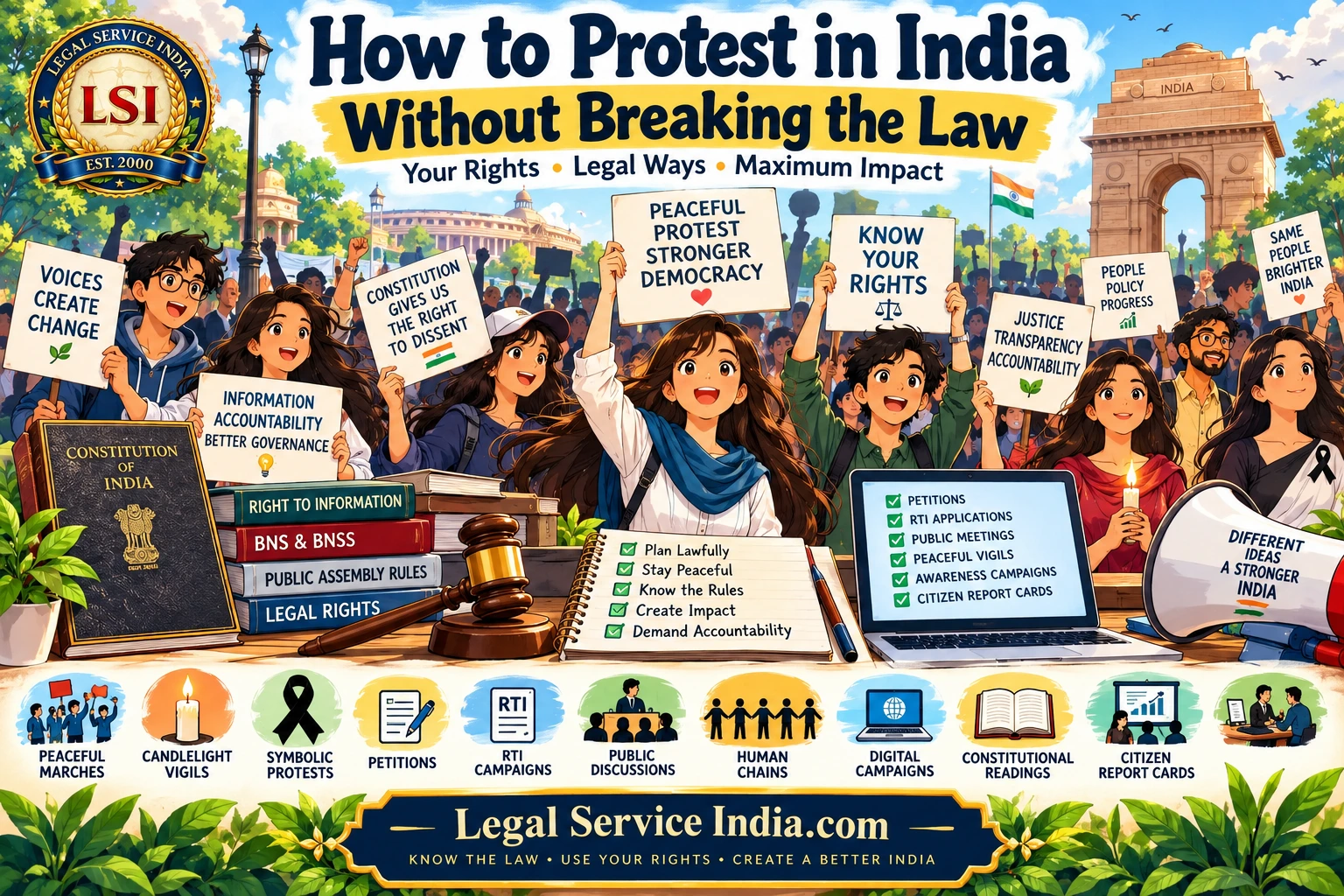
How to Protest in India Without Breaking the Law: A Constitutional Guide to Peaceful, High-Impact Protest
Introduction: Can You Protest Without Breaking the Law?
A democracy needs dissent.
Citizens must be able to say “I disagree”, question government decisions, oppose legislation, demand accountability and bring public attention to injustice. The Constitution does not require citizens to remain silent merely because the government disagrees with them.
But there is an equally important principle:
The right to protest is not a licence to obstruct, threaten, damage property or ignore a lawful order.
The real legal question therefore is not simply:
“Do I have a right to protest?”
The better question is:
“How can I protest so that my message is powerful, my conduct remains peaceful, and my constitutional protection remains as strong as possible?”
That distinction is extremely important.
The Supreme Court has repeatedly recognised peaceful protest and dissent as important democratic rights. In a recent Supreme Court judgment, the Court reiterated that the right to dissent lawfully is part of Article 19(1)(a), while also emphasising that protest remains subject to constitutionally permissible restrictions.
This article develops a practical framework for doing exactly that.
1. The Constitutional Foundation: Protest Is a Right—But Not an Absolute Right
Three constitutional freedoms are particularly important.
Article 19(1)(a): Freedom of Speech and Expression
This protects the citizen’s ability to communicate an opinion, criticism, grievance or demand.
A placard, speech, slogan, article, poster, symbolic display or peaceful public message may therefore fall within constitutionally protected expression.
Article 19(1)(b): Right to Assemble Peacefully and Without Arms
This is the constitutional foundation for peaceful demonstrations, marches, meetings and similar collective activities.
The words “peaceably and without arms” matter enormously.
The Constitution protects peaceful assembly—not violence or intimidation.
Article 19(1)(c): Freedom of Association
Citizens may form associations, organisations and groups through which collective civic activity can be organised.
However, Articles 19(2) and 19(3) permit reasonable restrictions in specified interests, including public order.
Therefore:
- The constitutional right is real, but its exercise is regulated.
The Supreme Court has recognised peaceful demonstrations as an aspect of Articles 19(1)(a), 19(1)(b) and 19(1)(c).
2. The Most Important Legal Principle: There Is No “Arrest-Proof” Protest
This point should be made absolutely clear.
There is no form of protest that gives a person immunity from arrest in every circumstance.
A person can be peacefully protesting and nevertheless face police action if, for example:
- a valid prohibitory order applies;
- the person knowingly disobeys a lawful direction;
- the assembly becomes unlawful;
- the protest causes legally relevant obstruction or danger;
- violence occurs;
- property is damaged;
- threats are made;
- prohibited objects are carried;
- the protest exceeds the conditions of an applicable permission/NOC.
Consequently, this article does not promise “protection from arrest.”
Instead, it explains how to minimise legal exposure and maximise constitutional protection.
That is the legally responsible way to approach protest.
3. The Four Things Protesters Must Never Confuse
One of the biggest mistakes in discussions about protest law is treating four different concepts as though they mean the same thing.
| Concept | Meaning |
|---|---|
| Constitutional protection | The activity may fall within a fundamental right |
| Permission/NOC | Administrative authorisation may be required for the particular place, route or event |
| Legal defence | A person may have arguments against a particular prosecution or police action |
| Practical arrest risk | Police may nevertheless detain/arrest a person where statutory conditions are satisfied |
A protest can therefore be constitutionally protected and still be subject to reasonable regulation.
Conversely, the absence of permission does not automatically answer every constitutional question—but it can substantially increase practical legal risk depending upon the applicable local law/order.
4. Supreme Court’s Basic Approach to Peaceful Protest
Several Supreme Court decisions form the backbone of the law.
Himat Lal K. Shah v. Commissioner of Police
The Supreme Court recognised that public streets and places may be legitimate venues for public meetings, while also recognising the State’s regulatory power.
The important principle is:
Regulation is permissible; arbitrary or unguided suppression is not.
Mazdoor Kisan Shakti Sangathan v. Union of India
The Supreme Court examined the competing interests of protesters and residents/commuters.
The Court recognised the importance of peaceful protest but emphasised that competing rights must also be balanced.
The Court stressed that public ways and public spaces cannot simply be occupied indefinitely in a manner that seriously interferes with others’ rights.
This produces a useful practical rule:
Choose a form of protest that creates maximum public awareness with minimum interference with other citizens.
Amit Sahni v. Commissioner of Police
The Shaheen Bagh litigation reinforced the principle that the right to protest does not include an unlimited right to occupy public roads indefinitely.
The Supreme Court specifically distinguished legitimate dissent from indefinite occupation of public ways that causes grave inconvenience to commuters.
In Re: Ramlila Maidan Incident
This is equally important from the other side.
Even where the State possesses powers to maintain public order, police action must remain constitutionally controlled.
The Supreme Court scrutinised excessive force and emphasised the need for restraint and least-invasive measures.
Therefore:
A protester must obey lawful directions, but the State does not acquire unlimited power merely because a protest is taking place.
5. The New Legal Reality: BNSS Has Replaced the CrPC
Since 1 July 2024, the Bharatiya Nagarik Suraksha Sanhita, 2023 (BNSS) has replaced the CrPC framework for current criminal procedure.
For protesters, two provisions deserve particular attention.
BNSS Section 163
Section 163 concerns urgent cases of nuisance or apprehended danger.
It permits an empowered Executive Magistrate, where the statutory conditions are satisfied, to issue a written order directing persons to abstain from a particular act or take specified measures where necessary to prevent obstruction, danger to human life, disturbance of public tranquillity, riot or affray.
This is the modern statutory provision corresponding broadly to the old Section 144 CrPC framework.
Practical Lesson
Before organising a physical protest, particularly in Delhi or another major city:
- Check whether a current Section 163 order applies to the proposed location, date, route and activity.
This is not a theoretical precaution.
‘s official notification database currently records multiple Section 163 orders issued during 2026, including orders issued by the Commissioner of Police and district-level officers.
| Provision | What Protesters Should Consider |
|---|---|
| BNSS Section 163 | Check whether a current order applies to the proposed location, date, route and activity. |
| Old Section 144 CrPC | BNSS Section 163 broadly corresponds to the earlier Section 144 framework. |
6. BNSS Section 148: When an Assembly Can Be Ordered to Disperse
Section 148 BNSS provides for dispersal of an unlawful assembly and also applies to an assembly of five or more persons likely to cause a disturbance of public peace.
The provision allows the competent authority to command such an assembly to disperse. If the assembly refuses or demonstrates a determination not to disperse, the law provides further powers, including use of force and, where necessary, arrest.
This produces one of the most important practical rules in this entire article:
Five people do not automatically constitute an unlawful assembly. But five or more people can fall within Section 148 where the statutory conditions concerning disturbance of public peace are met.
The number of protesters alone does not determine legality.
The circumstances and common object matter.
| Factor | Why It Matters |
|---|---|
| Number of protesters | Five people do not automatically constitute an unlawful assembly. |
| Disturbance of public peace | The statutory conditions concerning disturbance of public peace are relevant. |
| Common object | The circumstances and common object matter when determining legality. |
7. BNS Section 223: Why Ignoring an Applicable Order Can Become Dangerous
Section 223 of the Bharatiya Nyaya Sanhita concerns disobedience of an order duly promulgated by a public servant.
Where the statutory requirements are satisfied, knowingly disobeying such an order can attract criminal liability. The provision also distinguishes consequences depending upon whether the disobedience causes or tends to cause obstruction, danger to human life, health or safety, riot or affray.
Therefore
- Do not assume that “I am exercising my fundamental right” automatically answers a charge alleging deliberate disobedience of a valid order.
The validity, scope, communication and constitutional reasonableness of the order can become matters of legal examination—but deliberately ignoring it is a serious risk.
8. Fifteen Powerful Ways to Protest Without Breaking the Law
The following methods are deliberately designed around one principle:
Maximum visibility + minimum unnecessary legal exposure
1. Placard March
This is probably the most recognisable form of peaceful protest.
Participants walk in an organised procession carrying placards containing lawful messages.
Constitutional Foundation
Primarily:
- Article 19(1)(a)
- Article 19(1) (b)
- Article 19(1)(c)
How to Make It Lawful
Before organising:
- identify the proposed route;
- check local restrictions/orders;
- obtain whatever permission/NOC is legally required;
- communicate the expected number of participants;
- specify start and end time;
- appoint organisers/marshals;
- maintain pedestrian and emergency access;
- prohibit weapons;
- prohibit property damage;
- establish a clear dispersal time.
expressly states that NOCs are required for public rallies, meetings, morchas and protest gatherings in public spaces.
Maximum-Impact Version
Instead of thousands of identical placards, use a single coordinated message architecture:
One problem → one fact → one demand.
For example:
“WE ARE NOT HERE TO BLOCK THE CITY.
WE ARE HERE TO ASK ONE QUESTION.”
That can be considerably more memorable than hundreds of unrelated slogans.
Legal Protection
Potentially strong, provided the assembly, route and content comply with applicable law and orders.
9. Silent Protest
A silent protest can be extraordinarily powerful.
Participants stand together without slogans, speeches or amplification.
Each person carries one sentence.
Example:
- “I HAVE A QUESTION.”
- Or:
- “WHO IS ACCOUNTABLE?”
Why It Is Legally Attractive
It substantially reduces:
- noise disputes;
- inflammatory speech;
- amplification issues;
- confrontational interaction.
It does not, however, eliminate assembly or location-related restrictions.
Legal Protection
Generally stronger from a speech/noise perspective, but still subject to reasonable restrictions governing assembly and location.
10. Black Ribbon or Black Badge Protest
Participants wear:
- black ribbons;
- black badges;
- black armbands;
- symbolic clothing.
No gathering is necessarily required.
This is particularly useful where organisers want thousands of people to participate without creating a large physical assembly.
Constitutional Foundation
It is primarily a form of symbolic expression protected by Article 19(1)(a), subject to lawful restrictions.
The Supreme Court’s jurisprudence has recognised that even peaceful symbolic forms of demonstration can fall within constitutional protection.
Maximum-Impact Strategy
Create a designated day:
“Black Badge Day — One Question, One Demand.”
Participants upload photographs using one common hashtag.
This creates a national visual event without requiring a huge physical gathering.
11. Human Chain
Participants stand in a line holding placards or joining hands.
Legal Advantage
A human chain can be more controlled than a moving procession.
Major Risk
Do not allow the chain to:
- block highways;
- block emergency routes;
- prevent pedestrians from passing;
- surround buildings unlawfully;
- obstruct traffic.
Best Design
Conduct it:
- inside a designated protest area or other lawfully permitted location.
The principle is simple:
Make the protest visible—not physically obstructive.
12. Candlelight Vigil
A candlelight vigil combines symbolism with peaceful assembly.
It works particularly well for:
- memorials;
- demands for justice;
- institutional accountability;
- public awareness campaigns.
Legal Safeguards
Avoid:
- blocking roads;
- dangerous placement of candles;
- aggressive confrontation;
- unauthorised occupation;
- excessive amplification.
Maximum-Impact Version
Give every participant the same card:
NAME → DATE → QUESTION → DEMAND
The result becomes a visual statement rather than merely a crowd.
13. The “1000 Letters in One Hour” Protest
This is one of the most interesting alternatives to a conventional rally.
Instead of 1,000 people gathering at one location, 1,000 people independently send representations to the relevant authority.
The protest becomes a paper-and-digital demonstration of public concern.
Why It Works
It creates:
- documentary evidence;
- administrative workload;
- measurable participation;
- an institutional record.
But every representation must be genuine and independently made.
Do not generate fake identities or fabricated complaints.
Legal Protection
Generally high, provided the representations are truthful, lawful and non-threatening.
14. RTI-Based Civic Protest
A protest can also be transformed into an information campaign.
Citizens may independently use the Right to Information Act where the information sought falls within the Act.
For example:
- “How much money was sanctioned?”
- “How many applications were pending?”
- “What inspection reports exist?”
- “What action was taken?”
The resulting information can then be compiled into a public accountability report.
Why This Is Powerful
A slogan says:
“We believe something is wrong.”
An evidence-based RTI campaign can say:
“Here are the documents. Now answer the question.”
That is a very different kind of pressure.
15. Public Lecture or “Teach-In” Protest
Instead of shouting slogans, organise a public discussion.
Invite:
- Lawyers;
- Academics;
- Affected persons;
- Researchers;
- Journalists;
- Subject experts.
The programme can explain the issue and conclude with a formal demand.
Legal Advantage
A structured event can reduce spontaneous confrontation.
Important Caution
Venue-specific permissions and local rules still matter.
A “seminar” is not automatically exempt from regulation simply because it is educational.
16. Empty Chair Protest
Place an empty chair labelled:
“THE AUTHORITY WE ARE WAITING TO HEAR FROM.”
The participants remain peaceful.
The symbolism does the work.
This is an example of low-risk visual communication.
17. Constitutional Reading Protest
Participants assemble lawfully and read selected constitutional provisions aloud.
For example:
- Article 14
- Article 19
- Article 21
- Article 32
The protest then ends with a written demand.
Why It Is Interesting
Instead of saying:
“Listen to us.”
The demonstration communicates:
“We are exercising the constitutional freedoms that we believe belong to every citizen.”
18. Human Billboard
Participants stand in an organised formation, each carrying one word.
For example:
- JUSTICE
- ACCOUNTABILITY
- TRANSPARENCY
- ANSWER
The participants form a large visual message.
This can generate substantial photographic and social media visibility without the disruption associated with a moving procession.
19. One-Minute National Silence
This is an example of a distributed protest.
Participants do not need to travel to Delhi.
At a specified time:
- People stand silently;
- Display a common symbol;
- Photograph the moment;
- Publish it with a common campaign identifier.
The physical gathering is decentralised.
Legal Advantage
Individual participation may involve considerably less assembly-related exposure than bringing thousands of people into one location.
But participants should still comply with applicable laws governing any local gathering.
20. The “Report Card” Protest
Prepare a factual report card.
| Promise/Issue | Official Position | Available Evidence | Current Status |
|---|---|---|---|
| Issue A | X | Document Y | Pending |
| Issue B | X | Document Z | Completed |
| Issue C | X | RTI response | Unanswered |
Then publicly release the report.
Why It Is Powerful
It moves the protest from:
emotion → evidence
and from:
crowd → record
21. The Most Innovative Model: Distributed Lawful Protest
Here is where the concept becomes much more interesting.
The conventional model is:
10,000 people → one location → one day → one demonstration.
The alternative model is:
10,000 citizens → hundreds of lawful actions → one coordinated message.
For example:
- 1,000 genuine representations;
- 500 RTI applications were independently appropriate;
- 2,000 symbolic badge participants;
- 100 experts;
- 20 public discussions;
- 5 peaceful vigils;
- One evidence report;
- One website/page containing verified documents;
- One formal petition;
- One press briefing.
The objective is not to create disorder.
The objective is to create institutional visibility.
22. The Golden Rule: Do Not Block the Public to Make Your Point
One of the most important lessons from Supreme Court jurisprudence is that protesters have rights, but commuters, residents, businesses and other citizens have rights too.
The Supreme Court has expressly rejected indefinite occupation of public ways that causes serious inconvenience to commuters.
Therefore:
| Prefer | Over |
|---|---|
| Designated space + fixed duration + controlled numbers + clear exit | Road occupation + indefinite duration + uncontrolled crowd |
This is not merely good public relations.
It can materially improve the legal position of the protest.
23. What Should Protesters Avoid?
If the objective is lawful protest, certain tactics should simply be excluded.
Avoid:
- ❌ Violence
- ❌ Weapons
- ❌ Damage to public or private property
- ❌ Threats against officials or private persons
- ❌ Intimidation
- ❌ Blocking ambulances or emergency routes
- ❌ Deliberately preventing people from entering or leaving premises
- ❌ Deliberate destruction of barricades
- ❌ Forced occupation of premises
- ❌ Incitement to violence
- ❌ Hate speech
- ❌ Deliberate disobedience of a known lawful order
- ❌ Continuing an assembly after a lawful dispersal direction where the statutory conditions for dispersal are satisfied
- ❌ Unauthorised loudspeaker use
The objective should be:
Maximum democratic pressure—not maximum confrontation.
24. What If Police Order You to Disperse?
This is where protesters sometimes make a serious strategic mistake.
Do not immediately turn a peaceful protest into a confrontation with the police.
Ask calmly:
“Officer, may I know the legal basis and the order under which we are being asked to disperse?”
If an order exists, obtain or record its particulars where lawfully possible.
Do not obstruct the officer.
Do not physically resist.
Do not abuse the police.
If the order is disputed, the constitutional/legal challenge can be made through appropriate legal proceedings.
The protest site is generally not the courtroom.
25. If You Are Arrested: Know Your Legal Rights
A person who is actually arrested does not lose constitutional protection.
Article 22 provides important safeguards.
The BNSS also contains statutory protections.
Grounds of Arrest
Section 47 BNSS requires the person arrested without warrant to be informed of the grounds of arrest and contains provisions regarding the right to bail in applicable cases.
Informing a Relative or Friend
Section 48 BNSS requires information regarding the arrest and place of custody to be given to a relative, friend or nominated person as prescribed.
Arrest Memorandum
Section 36 BNSS contains procedural duties concerning the arresting officer and the memorandum of arrest.
Twenty-Four-Hour Rule
Section 58 BNSS provides that a person arrested without warrant ordinarily cannot be detained beyond the prescribed period without the necessary judicial order, subject to the statutory exceptions and the time required for production before a magistrate.
A Practical Protester’s Checklist
If arrested:
- Remain calm.
- Do not physically resist.
- Ask what offence or grounds are being alleged.
- Ask that your nominated relative/friend be informed.
- Contact your lawyer.
- Do not sign documents you do not understand.
- Preserve information concerning witnesses and recordings.
- Note the place and approximate time of arrest.
- Seek medical attention where required.
- Ensure production before the magistrate within the legally prescribed framework.
26. The Protester’s “Legal Safety Card”
Every organised protest should give participants a small card containing:
Before the Protest
- ✔ Check local orders
- ✔ Check whether permission/NOC is required
- ✔ Know the route and location
- ✔ Save organiser’s contact number
- ✔ Save lawyer/emergency contact
- ✔ Carry identification where appropriate
- ✔ Understand the protest rules
During the Protest
- ✔ Remain peaceful
- ✔ Carry no weapons
- ✔ Do not damage property
- ✔ Do not threaten anyone
- ✔ Do not obstruct emergency services
- ✔ Follow lawful directions
- ✔ Keep the protest within its approved/legally permissible boundaries
If Police Action Starts
- ✔ Remain calm
- ✔ Do not physically resist
- ✔ Ask for the legal basis of the direction
- ✔ Record events lawfully where possible
- ✔ Contact your lawyer/family
27. The “Legal Protection Ladder”
Not every protest has the same level of legal exposure.
A useful practical model is:
Level 1 — Individual Expression
Badge, ribbon, clothing, poster, article.
Generally lowest physical assembly risk.
↓
Level 2 — Distributed Expression
Letters, RTI applications, online campaign, coordinated symbolic participation.
Low physical assembly risk.
↓
Level 3 — Structured Public Event
Seminar, lecture, public discussion.
Moderate regulatory requirements.
↓
Level 4 — Peaceful Gathering
Vigil, human chain, designated demonstration.
Higher assembly/location requirements.
↓
Level 5 — Procession
March or morcha.
Greater route, traffic and public-order considerations.
↓
Level 6 — Large Public Assembly
Large rally.
Highest organisational and regulatory complexity.
The lesson is not that large rallies are unlawful.
It is:
Use the least disruptive method capable of achieving your legitimate objective.
28. The Most Powerful Question for Every Protest Organiser
Before organising a protest, ask five questions:
1. What Exactly Is Our Demand?
Not:
“We are angry.”
But:
“We want X authority to do Y by Z date.”
2. What Evidence Supports Our Demand?
Documents are stronger than rumours.
3. What Is the Least Disruptive Method?
Can the objective be achieved without blocking a road?
4. What Restrictions Apply at the Chosen Location?
Check current orders—not old social-media posts.
5. What Happens When the Protest Ends?
A protest without an institutional follow-up mechanism often produces publicity without accountability.
29. The “Protest → Evidence → Petition → Litigation” Model
A particularly sophisticated civic campaign can operate as a four-stage process.
Stage 1 — Protest
Generate public attention.
↓
Stage 2 — Evidence
Collect documents, RTI responses, official records and verified facts.
↓
Stage 3 — Petition
Submit a structured representation to the appropriate authority.
↓
Stage 4 — Legal Remedy
If a genuine legal grievance remains, consider the appropriate judicial or statutory remedy.
This transforms protest from a one-day event into a constitutional accountability process.
30. Why Lawful Protest Can Sometimes Be More Powerful Than Confrontational Protest
There is a misconception that a protest must be disruptive to be effective.
That is not necessarily true.
Imagine two campaigns.
Campaign A
10,000 people block a road.
News headline:
“Traffic disrupted during protest.”
Campaign B
10,000 citizens submit verified representations.
1,000 RTI applications produce documents.
100 experts analyse the documents.
A 50-page evidence report is released.
A peaceful public meeting explains the findings.
A formal representation is submitted.
The campaign then approaches the appropriate legal forum.
The headline becomes:
“10,000 Citizens Demand Answers After Evidence-Based Accountability Campaign.”
The second model creates something extremely important:
A record.
And records matter.
31. The Real Objective: Visibility Per Unit of Legal Risk
This is perhaps the central principle emerging from the entire research.
Traditional protest thinking often asks:
“How many people can we bring?”
A more sophisticated question is:
“How much public and institutional attention can we generate without unnecessarily increasing legal exposure?”
That produces a different strategy.
Crowd size is not the only measure of protest power.
Other measures include:
- media visibility;
- number of genuine participants;
- documentary evidence;
- official responses;
- RTI disclosures;
- parliamentary attention;
- administrative action;
- public discussion;
- expert participation;
- judicial scrutiny;
- policy change.
A protest should therefore be designed like a civic accountability system, not merely a crowd.
32. A Practical “Lawful Protest Formula”
The model can be expressed simply:
PEACEFUL EXPRESSION
LAWFUL ASSEMBLY
DOCUMENTED DEMAND
EVIDENCE
PUBLIC VISIBILITY
INSTITUTIONAL FOLLOW-UP
= HIGH-IMPACT LAWFUL PROTEST
And the opposite formula should be avoided:
ANGER + OBSTRUCTION + VIOLENCE + PROPERTY DAMAGE + DISOBEDIENCE = HIGH LEGAL EXPOSURE
33. A Special Warning for Delhi
Delhi deserves particular caution because protest regulation is highly location-specific.
[Original source attribution to be retained here where applicable.] maintains an official system for permissions relating to processions, rallies and other events, and [original authority] specifically states that NOCs are required for public rallies, meetings, morchas and protest gatherings in public spaces.
Moreover, the [original notification database] shows that Section 163 orders are issued from time to time for different areas and circumstances.
Therefore:
Never rely on a three-year-old WhatsApp message saying that “protests are allowed at X place.”
Check the current order applicable to the actual date, location, route and nature of the proposed protest.
34. The 10-Point Lawful Protest Checklist
Before proceeding, organisers should ask:
| Question | Yes/No |
|---|---|
| Is the objective clearly defined? | ☐ |
| Is the proposed location legally available? | ☐ |
| Have current prohibitory orders been checked? | ☐ |
| Is permission/NOC required? | ☐ |
| Has the route been cleared where necessary? | ☐ |
| Are emergency routes protected? | ☐ |
| Are marshals appointed? | ☐ |
| Are participants instructed to remain peaceful? | ☐ |
| Is there a defined end time? | ☐ |
| Is there a legal response plan if police action occurs? | ☐ |
If several answers are “No”, the protest should not proceed until those issues are addressed.
Final Conclusion: Protest Smart, Not Reckless
The Constitution does not demand political silence.
It protects speech.
It protects peaceful assembly.
It protects association.
It recognises dissent as an important component of democracy.
But constitutional freedom operates within a legal framework.
The Supreme Court’s jurisprudence demonstrates both sides of the equation: peaceful dissent deserves constitutional protection, while public order, the rights of commuters and residents, and lawful regulation cannot simply be ignored.
The most intelligent protest is therefore not necessarily the loudest.
It is the protest that makes it difficult for the institution being questioned to ignore the issue without giving the State an unnecessary legal reason to focus on the protesters instead of the cause.
The modern protester should therefore think in four dimensions:
- Know the Constitution.
- Know the current local order.
- Know your legal boundaries.
- Know your evidence.
And perhaps the most important principle is this:
Do not make your protest about the police. Make it about the issue.
A peaceful, disciplined, evidence-driven citizen campaign can create enormous democratic pressure without violence, intimidation or unlawful obstruction.
That is not a weaker form of protest.
It is a more sophisticated form of protest.
Need Legal Advice About a Protest in India?
Knowing that you have a constitutional right to protest is only the first step. The real difficulty is understanding where you can protest, whether permission or a NOC is required, whether a current BNSS Section 163 order applies, what conduct may expose you to criminal action, and what to do if the police intervene or an arrest takes place.
If you are planning a peaceful protest, march, dharna, public meeting, candlelight vigil, human chain, symbolic protest or other form of public demonstration, do not leave these questions to guesswork.
Get Professional Legal Guidance Before You Act
Adv. Tarun Choudhury
Supreme Court Advocate | 25+ Years of Legal Experience
📞 Call: 9891244487
💬 WhatsApp: 9891244487
✉️ Email: [email protected]
You can seek professional guidance regarding:
- How to organise a lawful protest in India
- Constitutional rights under Articles 19(1)(a) and 19(1)(b)
- BNSS Sections 148, 163 and 223
- Police permissions and NOC requirements
- Protest routes, venues and public-order restrictions
- Peaceful marches, dharnas, vigils and public meetings
- Legal precautions for protest organisers
- What to do if police issue a dispersal direction
- Arrest and detention safeguards
- Legal remedies where a protester’s rights are allegedly violated
Don’t Wait Until a Peaceful Protest Becomes a Legal Problem
A few minutes of legal planning before a protest can prevent hours, days or even years of unnecessary legal complications later.
If you are planning a protest or have already received a police notice, restriction or criminal complaint, contact Adv. Tarun Choudhury for professional legal consultation.
Call or WhatsApp: 9891244487
Email: [email protected]
Legal Service India.com — Know the Law. Use Your Rights. Protect Your Interests.
Frequently Asked Questions: How to Protest in India Without Breaking the Law
1. Is Protesting a Fundamental Right in India?
Yes. Peaceful protest in India is protected primarily under Article 19(1)(a), which guarantees freedom of speech and expression, and Article 19(1)(b), which protects the right to assemble peacefully and without arms. However, the right to protest is subject to reasonable restrictions relating to public order and other constitutionally permitted grounds.
2. Do I Need Police Permission or an NOC to Organise a Protest in India?
It depends on the nature, location and circumstances of the protest and the applicable local rules or orders. A protest march, public meeting, dharna or rally in a public place may require prior permission or an NOC from the police or other competent authority. Protesters should also check whether any BNSS Section 163 order or other restriction is currently in force at the proposed location.
3. Can I Be Arrested for Participating in a Peaceful Protest in India?
Peaceful participation in a lawful protest does not by itself make a person a criminal. However, peaceful protest does not provide absolute immunity from arrest. Legal consequences may arise if the assembly becomes unlawful, a valid order is knowingly disobeyed, violence or threats occur, public property is damaged, or other offences are committed. If arrested, a person has important constitutional and statutory safeguards relating to the grounds of arrest, communication with relatives, legal assistance and production before a Magistrate.
4. What Are the Safest Legal Ways to Protest in India?
Lawful forms of protest can include a placard march, silent protest, candlelight vigil, human chain, black-ribbon protest, public meeting, constitutional reading, petition campaign, RTI-based awareness campaign, peaceful dharna and symbolic protest, provided applicable laws, permissions and restrictions are followed. The safest approach is generally to choose a peaceful, organised and non-obstructive form of protest, avoid violence and property damage, protect emergency access and comply with valid legal directions.
5. What Should I Do if the Police Stop or Order Me to Disperse During a Protest?
Remain calm and do not physically resist or obstruct the police. You may politely ask for the legal basis of the direction and, where appropriate, note the details of the order. If you believe the police action or restriction is unlawful, the issue can be challenged through the appropriate legal remedy or court proceeding rather than through confrontation at the protest site. If you are arrested, contact your lawyer and exercise your applicable arrest and detention rights.
Important Legal Disclaimer
This article is a general constitutional and legal guide, not advice for a particular protest. Protest restrictions, permissions, NOCs, Section 163 orders, local police directions and venue-specific regulations can change rapidly. Before organising an actual protest, the current order applicable to the precise location, date, route and activity should be checked.
For a real protest, “lawful in principle” and “lawful at this location at this particular time” are not necessarily the same question.
Key Takeaways: How to Protest in India Without Breaking the Law
- Peaceful protest is a constitutional right in India, primarily protected under Articles 19(1)(a) and 19(1)(b), subject to reasonable restrictions imposed by law.
- The right to protest is not an unrestricted right to protest anywhere. The location, timing, route, size and nature of a demonstration may be regulated in the interests of public order and the rights of others.
- Police permission or an NOC may be required for rallies, marches, public meetings, morchas and other organised protests in public places, depending on the applicable local rules and circumstances.
- Protest organisers should always check whether a current BNSS Section 163 order or other prohibitory/restrictive order applies to the proposed location and date.
- BNSS Section 148 is important where an assembly is considered unlawful or is likely to cause a disturbance of public peace. Participants should understand the consequences of refusing a lawful dispersal direction.
- BNSS Section 223 can become relevant where a person knowingly disobeys an order duly promulgated by a public servant. Claiming a constitutional right to protest does not automatically excuse deliberate disobedience of a valid order.
- There is no completely “arrest-proof” form of protest. Even a peaceful protest can lead to legal consequences if other laws or valid orders are violated.
- Lawful protest methods can include placard marches, silent protests, candlelight vigils, human chains, black-ribbon protests, peaceful public meetings, petitions, RTI campaigns, constitutional readings and symbolic demonstrations.
- The strongest protest strategy is often “maximum visibility with minimum legal exposure”—a protest should communicate its message effectively without unnecessary obstruction, confrontation or disruption.
- Blocking public roads indefinitely is legally risky. Protesters must also respect the rights of commuters, residents, businesses and emergency services.
- Protesters should avoid violence, weapons, threats, intimidation, property damage, hate speech, obstruction of emergency services and deliberate disobedience of lawful orders.
- If police intervene, protesters should remain calm, avoid physical resistance and ask politely for the legal basis of the direction. If the action is disputed, the appropriate remedy is through legal proceedings rather than confrontation.
- If arrested, a protester retains important constitutional and statutory safeguards, including safeguards concerning the grounds of arrest, informing relatives or friends, legal assistance and production before a Magistrate.
- A modern protest does not have to depend on one large crowd. A distributed lawful protest can combine peaceful demonstrations, petitions, RTI applications, public discussions, symbolic participation and evidence-based advocacy.
- The most effective civic campaign can follow a “Protest → Evidence → Petition → Legal Remedy” model, converting public attention into a documented demand for accountability.
The Central Lesson
The objective of a lawful protest should not be maximum confrontation. It should be maximum democratic impact with minimum unnecessary legal risk.
Know your constitutional rights. Check the current restrictions. Plan carefully. Remain peaceful. Document your demand. And use the appropriate legal remedy when necessary.