





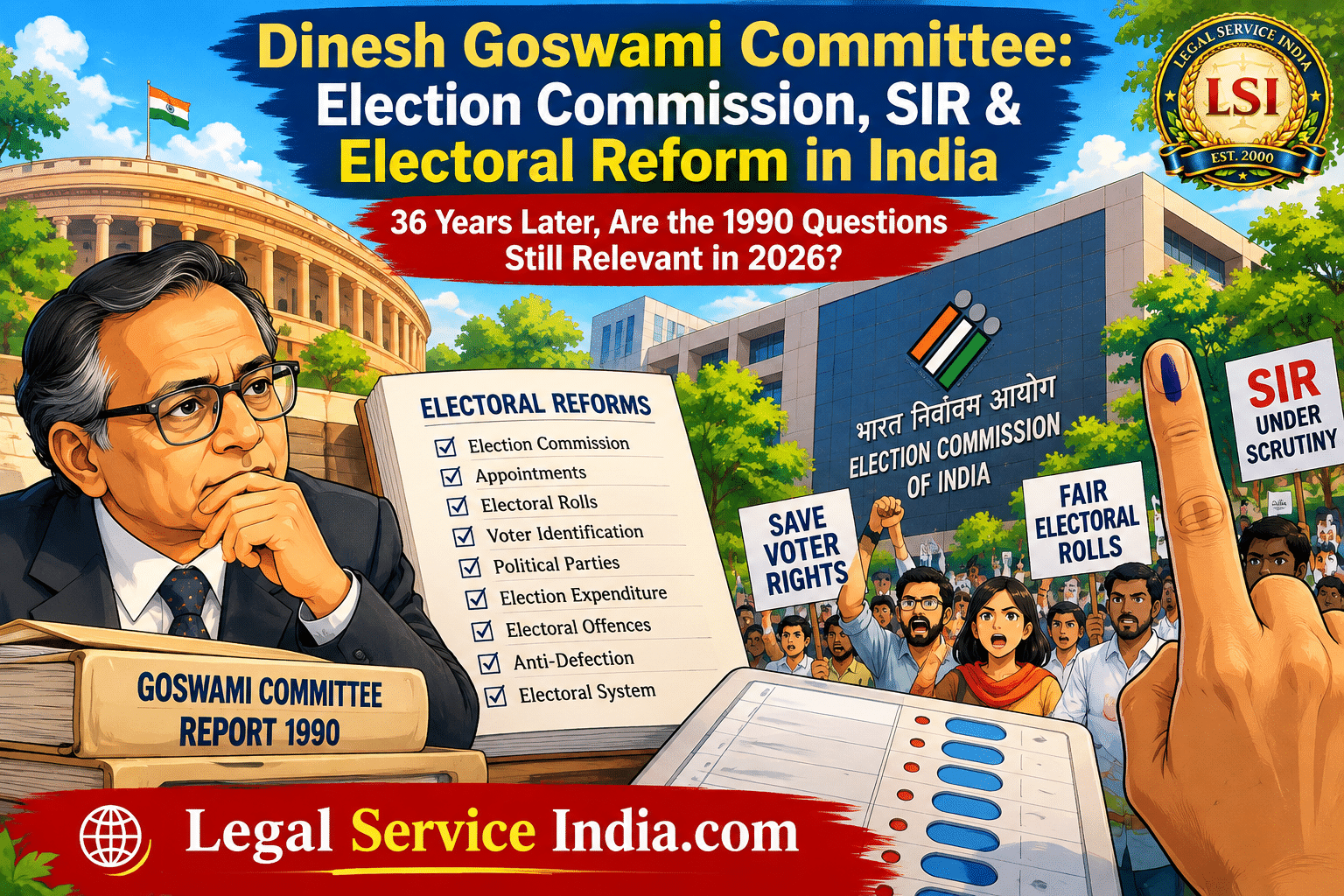
Election Commission Under Protest: The Goswami Questions India Is Still Asking
36 Years Later, Are the Electoral Reform Questions of 1990 Still Relevant to India’s Democracy?
By Adv. Tarun Choudhury, Supreme Court Advocate
India is once again debating the Election Commission.
The immediate controversy is around the Special Intensive Revision (SIR) of electoral rolls. Political parties opposing the exercise have raised serious objections and alleged that the revision process could result in wrongful exclusion of voters. The Election Commission has defended the exercise and maintained that its purpose is to ensure that eligible citizens remain on the electoral rolls while ineligible entries are removed.
On 6 October 2026, opposition MPs and leaders marched from Parliament towards the Election Commission’s office in New Delhi. Police stopped the march and detained a large number of participants. The protesters demanded, among other things, the resignation of Chief Election Commissioner Gyanesh Kumar and changes to the SIR exercise.
These are politically contested allegations and demands. They should not be presented as established findings unless a competent court or authority has so determined.
But there is a larger question behind the current confrontation.
- How independent should the Election Commission be?
- How should Election Commissioners be appointed?
- How should electoral rolls be prepared and revised?
- What protection should an ordinary voter have against wrongful exclusion?
And perhaps the most interesting question of all:
Why were many of these questions being debated in India as far back as 1990?
Thirty-six years ago, the Government of India constituted the Committee on Electoral Reforms under Dinesh Goswami, then Union Law Minister.
The Committee’s report remains one of the most important documents in the history of electoral reform in India.
Some of its recommendations became law.
Some influenced later reforms.
Some were rejected.
And some of the most important questions it raised are still before us.
The Present Controversy Is Not the Whole Story
It is tempting, whenever there is a political controversy involving the Election Commission, to look at the issue entirely through the lens of the political parties involved.
That would be a mistake.
The Election Commission is not an institution belonging to the government of the day. Nor does it belong to the opposition.
It is a constitutional institution.
The party in power today may be in opposition tomorrow. The opposition today may form the government tomorrow.
That is why the real issue is not whether one political party likes or dislikes the Election Commission.
The real issue is whether the institutional structure of the Election Commission inspires confidence irrespective of who is in power.
This is precisely why the Goswami Committee deserves another look.
What Was the Dinesh Goswami Committee?
Following an all-party meeting on 9 January 1990 on electoral reforms, the Government constituted a Committee on Electoral Reforms under the chairmanship of Dinesh Goswami, the then Union Law Minister.
The Committee met seven times between 3 February and 11 April 1990, and its report was approved on 4 May 1990.
It examined much more than the Election Commission.
The Committee considered:
- electoral machinery;
- delimitation;
- electoral rolls;
- voter identification;
- political parties;
- candidates;
- election expenditure;
- limited State assistance;
- booth capturing;
- electoral offences;
- election disputes;
- anti-defection;
- office of profit; and
- the electoral system itself.
In other words, Goswami was looking at the entire electoral ecosystem.
And that is the first lesson worth remembering.
An election does not begin when a voter presses a button. It begins much earlier — with the electoral roll, the candidates, political parties, campaign finance, election officials and the rules governing the contest.
The First Big Goswami Question: Who Should Control the Election Commission?
The Committee recommended that the Election Commission should be a three-member body.
That recommendation eventually became part of India’s electoral system.
The Election Commission’s historical account records the subsequent development of the multi-member Commission, and the Supreme Court later upheld the constitutional validity of the multi-member arrangement in T.N. Seshan v. Union of India, (1995) 4 SCC 611.
But the more interesting recommendation concerned something else.
It concerned who should appoint the Election Commissioners.
The Goswami Committee proposed a consultation mechanism involving the Chief Justice of India and the Leader of the Opposition for the appointment of the Chief Election Commissioner, with the Chief Election Commissioner also being involved in the consultation process concerning the other Election Commissioners.
There is an important distinction here.
Goswami recommended consultation.
It did not create a binding judicial-government collegium.
That distinction matters.
Thirty-Three Years Later, the Supreme Court Returned to the Same Question
The issue eventually reached the Supreme Court in Anoop Baranwal v. Union of India, (2023) 6 SCC 161.
The case concerned the constitutional framework for appointment of Election Commissioners.
The Supreme Court, pending parliamentary legislation, directed that appointments should be made on the recommendation of a committee consisting of:
- the Prime Minister;
- the Leader of the Opposition; and
- the Chief Justice of India.
But Parliament subsequently enacted the Chief Election Commissioner and Other Election Commissioners (Appointment, Conditions of Service and Term of Office) Act, 2023.
The statutory arrangement is different.
The selection committee consists of:
- the Prime Minister;
- the Leader of the Opposition in the Lok Sabha; and
- a Union Cabinet Minister nominated by the Prime Minister.
Thus, the Chief Justice of India is not a member of the statutory selection committee under the 2023 law.
And the matter is not merely academic.
The constitutionality of the 2023 appointment mechanism is itself under challenge.
On 23 September 2026, a Division Bench delivered differing views concerning the challenge and the matter was directed to be placed before the Chief Justice for consideration of a Constitution Bench.
So a question first raised by the Goswami Committee in 1990 remains part of India’s constitutional debate in 2026.
That is remarkable.
Why Does the Appointment of Election Commissioners Matter?
A simple question explains the importance.
Imagine that an institution has to supervise an election in which the political party controlling the government is seeking re-election.
Would it be desirable for that institution to have complete institutional independence?
Most people would instinctively say yes.
But constitutional law is more complicated than that.
Independence does not mean that an institution becomes unaccountable.
The Election Commission must be:
- independent enough to resist political pressure,
- but also
- accountable enough to remain within the Constitution and the law.
That balance is the real constitutional challenge.
The Goswami Committee understood this problem more than three decades ago.
The Election Commission’s Constitutional Position
Article 324 of the Constitution gives the Election Commission the superintendence, direction and control of elections.
That is an extremely wide constitutional responsibility.
But Article 324 does not mean that the Election Commission exists above the law.
The Supreme Court has repeatedly explained the relationship between the Commission’s constitutional powers and legislation.
In Mohinder Singh Gill v. Chief Election Commissioner, (1978) 1 SCC 405, the Supreme Court recognised the breadth of the Election Commission’s powers under Article 324.
But in A.C. Jose v. Sivan Pillai, (1984) 2 SCC 656, the Court also made it clear that the Commission cannot simply override a specific statutory provision enacted by Parliament.
That balance is important.
The Election Commission is powerful.
But it is not sovereign.
The Second Goswami Question: Who Is on the Electoral Roll?
If the Election Commission conducts the election, the electoral roll determines who is entitled to participate in it.
This makes electoral rolls one of the most sensitive parts of the entire democratic process.
The Goswami Committee recognised this.
It recommended improvements in the preparation and revision of electoral rolls and supported the introduction of photo identity cards.
Over the following years, the Election Commission developed the Electors Photo Identity Card system, commonly known as EPIC.
Today, almost every voter understands the importance of the voter ID card.
But the larger principle is more important than the card itself.
An Electoral Roll Must Protect Both Inclusion and Integrity
An electoral roll has to achieve two objectives simultaneously:
| Objective | Why It Matters |
|---|---|
| Keep ineligible entries out | It protects the integrity and accuracy of the electoral roll. |
| Keep eligible citizens in | It protects genuine voters from wrongful exclusion. |
Keep ineligible entries out.
And:
Keep eligible citizens in.
A system that achieves only the first objective can disenfranchise genuine voters.
A system that ignores the first objective can undermine the integrity of the election.
A credible electoral system must do both.
The SIR Debate: The Question Every Voter Should Ask
This brings us directly to the present controversy surrounding Special Intensive Revision, or SIR.
The Election Commission has stated that the objective of the exercise is to ensure that eligible citizens are not left out while ineligible persons are not included.
The legal framework includes Article 324 of the Constitution, Section 21 of the Representation of the People Act, 1950, and the Registration of Electors Rules, 1960.
The controversy is not about whether electoral rolls can ever be revised.
They obviously must be revised.
People:
- die;
- change residence;
- become eligible to vote;
- become ineligible;
- have duplicate registrations;
- correct errors in their details.
The real question is:
What safeguards operate when someone’s name is proposed to be removed or when an eligible citizen says that he or she has been wrongly excluded?
That is a legal question, not merely a political one.
What If Your Name Is Missing?
This is perhaps the most useful part of the entire debate for an ordinary citizen.
If you are concerned about the electoral roll, do not depend entirely upon political statements or social-media messages.
Check your own name.
The Election Commission provides facilities for voters to:
- search the electoral roll;
- register as voters;
- correct details;
- submit claims and objections;
- track applications; and
- access SIR-related services.
The legal framework also provides procedures for inclusion, correction and objections.
A voter whose electoral rights are affected should act promptly and preserve:
- notices received;
- applications submitted;
- acknowledgements;
- documentary evidence;
- correspondence with election officials; and
- orders or decisions rejecting an application.
In election law, documents and dates matter.
The October 2026 Controversy: What We Know and What We Do Not
The current controversy has developed rapidly.
The SIR process has been challenged politically and legally.
There have also been reports concerning disagreements within the Election Commission regarding changes associated with Form 6 and the SIR process.
These reports should be treated carefully.
On 5 October 2026, while hearing petitions concerning the Chief Election Commissioner and Form 6, the Supreme Court observed that it had not approved the modified Form 6 and indicated that the relevant records would have to be examined to determine what had been modified and by whom.
The Court did not, at that stage, order an ex parte suspension of the Chief Election Commissioner.
That distinction is important.
A judicial observation during the hearing is not the same thing as a final judgment declaring the entire SIR process unconstitutional.
Likewise, a newspaper report about disagreement between Election Commissioners is not automatically a judicial finding.
This is precisely why legal reporting must distinguish between:
- allegation;
- report;
- observation;
- order; and
- final judgment.
The October 6 Protest
On 6 October 2026, opposition MPs and leaders marched from Parliament towards Nirvachan Sadan, the Election Commission’s headquarters.
The police stopped the march on Parliament Street.
A large number of participants were detained and later released.
The protesters raised demands including:
- resignation of the Chief Election Commissioner;
- suspension or scrapping of SIR;
- restoration of names alleged to have been deleted;
- greater notice before deletion; and
- other changes to the electoral process.
Some political leaders have also called for a return to paper ballots.
These are political demands.
Whether particular allegations are legally established is a separate question.
And that distinction should be maintained throughout any serious discussion of electoral reform.
The Right to Protest Against the Election Commission
There is nothing constitutionally unusual about citizens criticising a constitutional institution.
Article 19(1)(a) protects freedom of speech and expression.
Article 19(1)(b) protects the right to assemble peaceably and without arms.
But both rights are subject to constitutionally permitted restrictions.
Therefore, the right to protest does not automatically mean a right to:
- enter restricted premises;
- obstruct roads indefinitely;
- damage public property;
- disobey lawful police orders; or
- use violence.
At the same time, restrictions on assembly do not make criticism of the Election Commission unlawful.
The precise legality of a particular protest depends upon its facts, location, applicable orders and the conduct of participants.
This is the constitutional middle ground.
Goswami Was Also Worried About Money
The Goswami Committee did not stop at institutional independence.
It examined election expenditure and political finance.
The problem it confronted was familiar:
The amount officially shown as election expenditure may not necessarily reflect the real resources deployed during a campaign.
The Committee therefore examined:
- election expenditure ceilings;
- accounts;
- political-party expenditure;
- financial assistance; and
- ways of bringing electoral expenditure under effective scrutiny.
The problem has only become more complicated.
In 1990, campaigning was conducted through:
- public meetings;
- posters;
- vehicles;
- newspapers;
- radio;
- television.
Today we have:
- social media;
- digital advertising;
- targeted messaging;
- influencers;
- online campaign infrastructure;
- data analytics;
- artificial intelligence.
The technology has changed.
The question has not.
Who pays for political influence, and how transparent is that expenditure?
What About Political Parties?
Another important part of the Goswami Report concerned political parties themselves.
This is an area that deserves much greater public attention.
We often discuss whether the Election Commission is independent.
But political parties are equally central to the democratic process.
The Goswami Committee examined issues such as:
- registration;
- accounts;
- auditing;
- financial reporting;
- internal functioning; and
- party regulation.
The broader philosophy was clear.
A political party is not merely a temporary group of candidates that appears during an election.
Political parties are the principal institutions through which citizens seek political power.
That naturally raises another question:
Should political parties themselves be required to maintain higher standards of transparency and internal accountability?
The Goswami Report recognised this problem.
India has never implemented the entire regulatory structure contemplated by the Committee.
The Anti-Defection Problem
Perhaps the most intellectually interesting part of the Goswami Report concerns the anti-defection law.
The Tenth Schedule had been introduced only a few years earlier.
The Committee recognised a fundamental tension.
Political parties need discipline.
But elected representatives are also representatives of the people.
If a party whip effectively controls every vote on every subject, how much independent legislative judgment remains with the elected representative?
The Goswami Committee therefore proposed a narrower approach to disqualification.
It contemplated disqualification principally for:
- voluntarily giving up party membership; and
- voting against the party direction on certain critical matters such as confidence and no-confidence motions, Money Bills and the Motion of Thanks.
It also proposed a different mechanism for determining defection cases — involving the President or Governor acting on the advice of the Election Commission.
Those proposals were not adopted in that form.
The Tenth Schedule continues to place the initial decision with the Speaker or Chairman, subject to judicial review.
The 91st Constitutional Amendment, 2003 subsequently removed the earlier “split” exception.
But the larger Goswami question remains:
How do we maintain party discipline without turning every legislator into a bound vote?
That is a question about representative democracy itself.
A Correction That Is Important: The One-Fourth Rule
There is one detail about the Goswami Report that is often repeated incorrectly.
The Committee recommended that a candidate who failed to obtain one-fourth of the votes polled should forfeit the security deposit.
But that recommendation did not become the present statutory rule.
Under Section 158 of the Representation of the People Act, 1951, the deposit is forfeited where the candidate’s valid votes do not exceed one-sixth of the votes counted.
| Point | Goswami Committee Recommendation | Present Statutory Rule |
|---|---|---|
| Security deposit | A candidate failing to obtain one-fourth of the votes polled should forfeit the deposit. | Under Section 158 of the Representation of the People Act, 1951, the deposit is forfeited where the candidate’s valid votes do not exceed one-sixth of the votes counted. |
This is a good illustration of why original committee reports should be read rather than relying on summaries.
A recommendation is not the same thing as law.
And Another Important Correction: Goswami Did Not Create EVMs
EVMs are frequently described as one of the major Goswami reforms.
The Committee did recommend their use and supported their wider introduction.
But the legal history is more precise.
The statutory provision authorising the use of voting machines — Section 61A of the Representation of the People Act, 1951 — had already been introduced by legislation enacted before the Goswami Report.
The Supreme Court’s decision in A.C. Jose and the subsequent legislative framework are important parts of that history.
Therefore, it is more accurate to say:
Goswami supported and recommended the wider use of EVMs; the Committee did not create the original statutory foundation for EVM voting.
That distinction may seem technical.
It is not.
When discussing electoral law, dates matter.
What Did Goswami Actually Change?
It would be unfair to say that the Committee was ignored.
A number of reforms associated with its recommendations eventually became part of India’s electoral system.
Among the significant developments were:
| Electoral Reform | Status |
|---|---|
| A multi-member Election Commission | Implemented. |
| Restriction on contesting more than two constituencies | Implemented through Section 33(7) of the Representation of the People Act, 1951. |
| Voter identity cards | Implemented progressively. |
| Strengthening of electoral-roll safeguards | Implemented through subsequent legislative and administrative measures. |
| Increased security deposits | Implemented through later amendments. |
| Stronger provisions concerning booth capturing | Implemented through subsequent amendments to electoral law. |
But some of Goswami’s more ambitious proposals did not become law in the form proposed.
These included:
- the proposed appointment mechanism for Election Commissioners;
- an independent Election Commission secretariat;
- statutory treatment of important portions of the Model Code;
- comprehensive political-party regulation;
- the proposed anti-defection mechanism;
- the proposed limited in-kind State assistance; and
- the proposed one-fourth forfeiture threshold.
1990 to 2026: A 36-Year Journey
The history becomes clearer when viewed as a timeline.
| Year | Development |
|---|---|
| 1990 | Dinesh Goswami Committee examines electoral reforms. |
| 1991 | The multi-member Election Commission framework is legislated. |
| 1990s | EPIC and EVM use develop progressively. |
| 1995 | The Supreme Court upholds the multi-member Election Commission in T.N. Seshan. |
| 2003 | The 91st Constitutional Amendment removes the Tenth Schedule’s split exception. |
| 2015 | The Law Commission undertakes a comprehensive review of electoral reforms. |
| 2023 | The Supreme Court decides Anoop Baranwal concerning the appointment of Election Commissioners. |
| 2023 | Parliament enacts the Chief Election Commissioner and Other Election Commissioners Act. |
| 2026 | The constitutional validity of that appointment framework remains under challenge. |
| September–October 2026 | The Election Commission’s SIR exercise becomes the subject of intense political and legal controversy. |
| October 2026 | Opposition parties protest against the Election Commission and the SIR process. |
The striking point is not that nothing has changed.
A great deal has changed.
The striking point is that some fundamental institutional questions have survived all those changes.
What the Goswami Committee Got Right About Democracy
I would not suggest that every recommendation made in 1990 should automatically be revived.
Some were products of their time.
Some have been overtaken by constitutional amendments and technological developments.
But several underlying principles remain sound.
- First: Elections require an independent administrator.
- Second: Electoral rolls must be accurate without sacrificing genuine voters.
- Third: Money and political influence require transparency.
- Fourth: Political parties themselves need accountability.
- Fifth: Election disputes need timely remedies.
- Sixth: Party discipline must be balanced against legislative independence.
- Seventh: Electoral reform cannot be treated as a one-time exercise.
These are not left-wing or right-wing principles.
They are institutional principles.
The Question Is Not Whether the Election Commission Should Be Powerful
The better question is:
How should the power of the Election Commission be structured so that it is both independent and accountable?
A weak Election Commission cannot protect the electoral process.
An unaccountable Election Commission would create a different constitutional problem.
The answer lies in institutional checks and balances.
That means:
- independence + transparency + statutory safeguards + judicial review + procedural fairness.
The same principle applies to electoral-roll revision.
A government cannot simply be allowed to determine who is entitled to vote.
But neither can the electoral roll be treated as permanently frozen.
There must be a lawful process for correcting it.
What Should an Ordinary Voter Do Today?
The current controversy should encourage citizens to become more involved in the electoral process, not merely more partisan.
A voter should:
Check the Electoral Roll
Do not assume your name is present simply because it was present in the previous election.
Keep Your Documents
If you receive a notice or submit an application, retain copies and acknowledgements.
Respond Within the Prescribed Time
Electoral disputes are often highly time-sensitive.
Use the Statutory Remedies
The Election Commission provides mechanisms for inclusion, correction, claims and objections.
Do Not Rely Solely on Social Media
A viral message is not a legal order.
If Your Voting Rights Are Actually Affected, Obtain Legal Advice
Particularly where a deletion, rejection or other administrative decision may have serious consequences, the documents and procedural history should be examined carefully.
The Deeper Lesson of the Current Protests
There is a temptation in every political controversy to divide the country into two camps:
- Those who trust the Election Commission.
- and
- Those who do not.
That is too simplistic.
A healthy democracy should permit citizens to question constitutional institutions.
At the same time, allegations should not automatically become facts merely because they are repeated loudly.
The proper response to an electoral controversy is:
- evidence,
- transparency,
- legal procedure and
- judicial scrutiny where necessary.
That is ultimately stronger than either blind trust or blanket distrust.
India Has Asked These Questions Before
The most remarkable thing about the present controversy is that many of its underlying questions are not new.
In 1990, the Goswami Committee was already asking:
- How independent should the Election Commission be?
- Who should appoint Election Commissioners?
- How should electoral rolls be protected?
- How should money in elections be controlled?
- How should political parties be regulated?
- How should electoral offences be dealt with?
- How quickly should election disputes be decided?
- How much power should political parties have over elected representatives?
Thirty-six years later, some of those questions have answers.
Some have partial answers.
And some remain contested.
The Goswami Committee and the Election Commission in 2026
The present protests will eventually end.
The SIR exercise will eventually be completed.
The current Election Commissioners will eventually leave office.
Governments will change.
Political parties will change.
But the Election Commission will remain.
That is why the debate should go beyond the personality of one Chief Election Commissioner or the politics of one election.
The Institutional Question: Can India Build a Fair Electoral System?
The real question is institutional:
Can India design an electoral system in which the government, opposition parties, candidates and ordinary voters have confidence that the rules will be administered fairly, transparently and according to law?
The Dinesh Goswami Committee tried to answer that question in 1990.
It did not solve everything.
No committee could.
But it gave India a remarkably detailed starting point.
And perhaps that is why its report deserves to be read again today.
Conclusion
The current protests against the Election Commission should not be viewed only as another political confrontation.
They provide an opportunity to revisit a much older constitutional conversation.
The Dinesh Goswami Committee Report of 1990 reminds us that electoral democracy is not merely about who wins an election.
It is about the integrity of the entire process by which the people choose their representatives.
It begins with the electoral roll.
It continues through candidates, political parties, campaign finance, election officials, polling and counting.
It ends, where necessary, in courts and election petitions.
If any part of that chain loses credibility, public confidence in the democratic process can suffer.
The answer, however, is not to treat every allegation as fact or every institutional criticism as an attack on democracy.
Nor is the answer to assume that a constitutional institution is beyond criticism.
The answer is law, transparency, institutional independence, accountability and effective remedies.
That was the deeper challenge identified by Goswami more than three decades ago.
And as India watches the present debate unfold in 2026, the question remains remarkably familiar:
How do we build an Election Commission that is strong enough to conduct free and fair elections, independent enough to resist political pressure, and accountable enough to command the confidence of every voter — whether that voter supports the government or the opposition?
That is not merely a question for politicians.
It is a question for every citizen of India.
Need Legal Advice on an Election Commission, SIR or Electoral Roll Matter?
Electoral disputes can become time-sensitive. If your name has been excluded from an electoral roll, you are affected by Special Intensive Revision (SIR), or you are facing a dispute involving the Election Commission, electoral rights, election law or constitutional remedies, it is important to understand your legal position before the matter becomes more difficult to resolve.
When fundamental voting rights, eligibility, electoral registration or an election-related dispute is involved, experienced legal guidance can make a critical difference.
Speak Directly With a Supreme Court Advocate
Adv. Tarun Choudhury
Supreme Court Advocate | 25+ Years of Legal Experience
With more than 25 years of experience in legal practice, Adv. Tarun Choudhury provides legal consultation concerning Supreme Court matters, constitutional issues, election law, Election Commission disputes, electoral roll matters, SIR-related issues and other complex legal proceedings.
If you believe that an electoral decision has adversely affected your rights, do not rely only on general information available online. Your individual facts, documents and legal remedy need to be examined carefully.
Your Matter May Require Immediate Legal Assessment If You Are:
- Facing an issue relating to Special Intensive Revision (SIR) of electoral rolls
- Concerned that your name has been deleted or omitted from the voter list
- Facing difficulty regarding inclusion, correction or verification of electoral records
- Seeking to challenge an Election Commission decision or action
- Dealing with an election-related constitutional or statutory dispute
- Considering proceedings before a High Court or the Supreme Court of India
- A political party, candidate or organisation seeking advice on an election-law issue
- Looking for an experienced Supreme Court Advocate for an electoral or constitutional matter
Don’t Wait Until the Legal Position Becomes Complicated
Election-related matters can involve strict procedures, statutory deadlines, documentary requirements and questions of jurisdiction. A preliminary legal consultation can help you understand what remedy may be available, what documents are required and what legal forum may be appropriate.
If your electoral rights or election-related dispute is important to you, take informed legal advice at the earliest stage.
Contact Adv. Tarun Choudhury
- 📞 Call: 9650499965
- 💬 WhatsApp: 8851978611
- 📧 Email: [email protected]
Adv. Tarun Choudhury
Supreme Court Advocate | 25+ Years of Legal Experience
For legal consultation regarding Election Commission matters, SIR, electoral rolls, election disputes, constitutional remedies and Supreme Court proceedings, contact Legal Service India.
Frequently Asked Questions
1. What did the Dinesh Goswami Committee recommend about the Election Commission of India?
The Dinesh Goswami Committee on Electoral Reforms, constituted in 1990, made several recommendations concerning the independence and functioning of the Election Commission of India, including consultation in the appointment of the Chief Election Commissioner and Election Commissioners, a stronger institutional structure, an independent Election Commission secretariat and reforms concerning electoral rolls, election expenditure and electoral offences. Several recommendations were not implemented in their original form.
2. What is the legal basis of Special Intensive Revision (SIR) of electoral rolls in India?
Special Intensive Revision (SIR) of electoral rolls is conducted under the constitutional powers of the Election Commission under Article 324 of the Constitution of India, read with the statutory framework governing electoral rolls, particularly Section 21 of the Representation of the People Act, 1950 and the Registration of Electors Rules, 1960. Questions concerning deletion, inclusion or correction of names may depend on the applicable procedure and individual facts.
3. Can I challenge the deletion of my name from the electoral roll in India?
Yes. A person affected by deletion of a name from the electoral roll may have statutory and administrative remedies depending on the circumstances. The relevant provisions include the Representation of the People Act, 1950 and the Registration of Electors Rules, 1960. Where appropriate, further legal remedies may also arise before the High Court or, in suitable cases, the Supreme Court. The exact remedy depends upon the reason for deletion and the procedural stage of the matter.
4. Can the Election Commission of India be challenged in the Supreme Court?
Yes, subject to the nature of the dispute and the availability of an appropriate legal remedy. Although Article 324 of the Constitution gives the Election Commission wide powers over elections, those powers are not unlimited and remain subject to the Constitution, statutory provisions and judicial review. The Supreme Court has considered the scope and limits of Election Commission powers in important cases including Mohinder Singh Gill v. Chief Election Commissioner and A.C. Jose v. Sivan Pillai.
5. Is the appointment process of the Chief Election Commissioner and Election Commissioners under the 2023 law still under challenge?
Yes. The constitutional validity of the Chief Election Commissioner and Other Election Commissioners (Appointment, Conditions of Service and Term of Office) Act, 2023 has been challenged. The controversy concerns, among other things, the composition of the appointment mechanism and the independence of the Election Commission. As of October 2026, the matter has not been finally decided on the merits, and the proceedings concerning the constitutional challenge remain significant to the wider debate over Election Commission independence.
Key Takeaways: Dinesh Goswami Committee, Election Commission & SIR
- The Dinesh Goswami Committee on Electoral Reforms was constituted in 1990 to examine weaknesses in India’s electoral system and recommend reforms to strengthen free and fair elections.
- Election Commission independence was a major concern of the Goswami Committee. It recommended a consultative process for appointing the Chief Election Commissioner and Election Commissioners, although the recommendation was not implemented in its original form.
- Article 324 of the Constitution gives the Election Commission wide powers of superintendence, direction and control over elections, but those powers remain subject to the Constitution, parliamentary law and judicial review.
- The Election Commission is not beyond judicial scrutiny. Supreme Court decisions such as Mohinder Singh Gill v. Chief Election Commissioner and A.C. Jose v. Sivan Pillai explain both the breadth and limits of the Commission’s constitutional powers.
- Special Intensive Revision (SIR) of electoral rolls is legally significant. Electoral roll revision operates within the framework of Article 324, Section 21 of the Representation of the People Act, 1950 and the Registration of Electors Rules, 1960.
- Deletion of a voter’s name is not merely an administrative formality. Electoral roll correction, inclusion and deletion must follow the applicable statutory and procedural safeguards.
- A voter affected by electoral-roll deletion may have legal remedies. Depending on the facts and procedural stage, remedies may include statutory applications, objections, appeals or appropriate proceedings before a High Court or the Supreme Court.
- The Goswami Committee recommended several reforms that remain relevant today, including reforms concerning electoral rolls, election expenditure, political parties, electoral offences, Election Commission independence and the conduct of elections.
- Not every Goswami Committee recommendation became law. For example, its recommendation for forfeiture of an election deposit below one-fourth of valid votes was not adopted; the statutory threshold under Section 158 of the Representation of the People Act, 1951 remains one-sixth.
- The Election Commission became a three-member body in 1993, a reform broadly consistent with the Goswami Committee’s institutional approach. The Supreme Court subsequently upheld the multi-member structure in T.N. Seshan v. Union of India.
- The 2023 law governing appointment of Election Commissioners remains constitutionally important. Its appointment mechanism has been challenged, making the question of Election Commission independence central to India’s continuing electoral-reform debate.
- The 2026 SIR controversy brings many of the Goswami Committee’s 1990 concerns back into focus, particularly questions of institutional independence, transparency, electoral-roll accuracy, procedural fairness and public confidence in elections.
- Political criticism of the Election Commission and legal findings are not the same thing. Allegations made during political protests must be distinguished from findings actually recorded by a court or established through evidence.
- Electoral disputes can become time-sensitive. Anyone facing a problem concerning SIR, voter-list deletion, electoral-roll correction, Election Commission action or an election-related constitutional issue should examine the applicable legal remedy promptly.
In One Sentence
The Dinesh Goswami Committee’s 1990 electoral-reform agenda remains highly relevant in 2026 because many of its questions about Election Commission independence, electoral-roll integrity, transparency and voter protection continue to shape India’s debate over free and fair elections.
Legal Disclaimer
This article is intended for general legal and informational purposes. It does not constitute legal advice on any individual electoral-roll dispute, election petition or constitutional proceeding. The legal position in a particular case will depend upon the facts, documents, applicable electoral notifications and the latest judicial orders.
