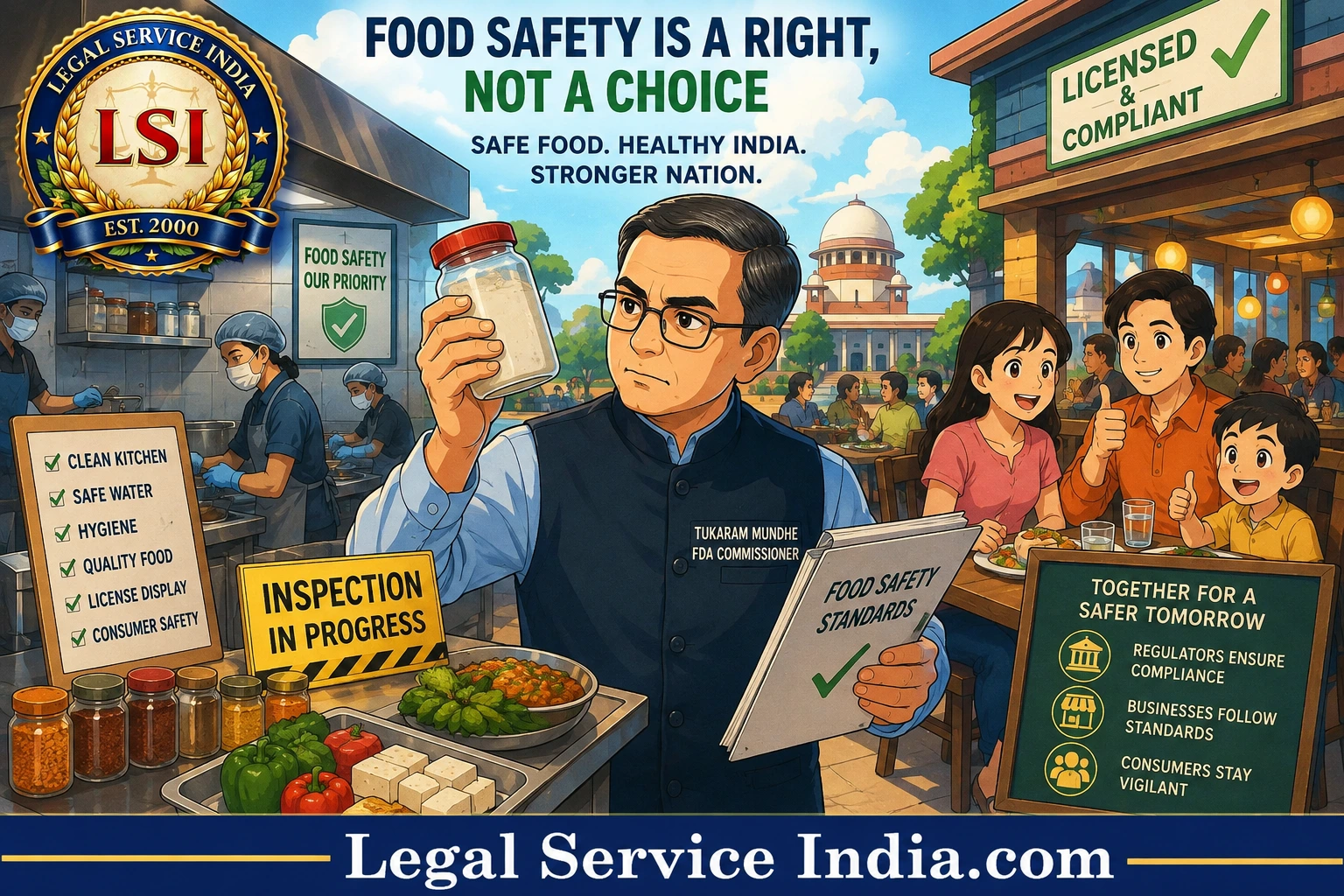
Introduction
The recent food-safety enforcement drive in Maharashtra under Food and Drug Administration Commissioner Tukaram Mundhe has generated an unusually strong public response.
Restaurants, food businesses, food-delivery operators, warehouses and other food-business establishments have increasingly found themselves under regulatory scrutiny. The controversy has generated two competing narratives.
| Perspective | Position |
|---|---|
| Public Health and Rule of Law | One side sees the enforcement drive as a much-needed assertion of the rule of law and public-health protection. |
| Proportionality and Fairness | The other raises questions concerning proportionality, procedural fairness, economic consequences and the manner in which regulatory powers are exercised. |
As a matter of constitutional and administrative law, both questions deserve serious consideration.
The issue cannot properly be reduced to whether an officer is “strict” or “lenient”. The more important legal question is this:
When the State regulates a food business in the interest of public health, how far may it go, and what procedural and constitutional safeguards govern the exercise of that power?
The answer lies not merely in administrative practice but in the statutory framework of the Food Safety and Standards Act, 2006, the regulations framed under it, principles of natural justice, Article 14 of the Constitution and the doctrine of proportionality developed by the Supreme Court of India.
The recent discussion surrounding Tukaram Mundhe is therefore significant beyond one officer or one state.
It raises a fundamental question about modern governance:
Can effective enforcement of the law be both uncompromising on public health and fair to regulated businesses?
In my view, the answer must be yes.
The Tukaram Mundhe Food Safety Crackdown: Why It Has Attracted National Attention
Tukaram Mundhe’s recent regulatory approach has attracted considerable public attention because it has brought food-safety enforcement into the everyday consciousness of consumers.
The uploaded interview records his position that he does not regard his work as extraordinary. According to him, a public servant is assigned a particular responsibility and must perform that responsibility honestly, transparently and according to law.
That philosophy is important from the standpoint of administrative law.
An officer exercising statutory power is not exercising a personal power.
He or she is exercising public power created by legislation.
That distinction is fundamental.
The Commissioner, Food Safety Officer or Designated Officer cannot act merely because the officer personally believes a particular practice to be undesirable. The authority must be traceable to the statute, regulations, delegated powers and applicable procedures.
Conversely, a regulated business cannot claim an unrestricted right to operate regardless of statutory requirements.
Food is not an ordinary commodity.
Unsafe food can directly affect human health, and the State therefore has a legitimate and compelling interest in regulating its production, storage, distribution and sale.
Food Safety Is a Statutory Obligation, Not Merely an Administrative Preference
The Food Safety and Standards Act, 2006, created a comprehensive statutory framework for food safety in India.
The Act places substantial responsibility upon food business operators.
Section 26 requires food business operators to ensure that food satisfies the requirements of the Act and applicable rules and regulations at all relevant stages of production, processing, distribution and sale.
It further prohibits food businesses from manufacturing, storing, selling or distributing unsafe food, misbranded or substandard food, food requiring a licence without complying with licence conditions, or food otherwise sold in contravention of the statutory framework.
This has an important legal consequence.
A restaurant cannot reasonably argue that food-safety compliance is merely an internal business matter.
Once food is offered to the public, the activity enters a regulated field.
The operator assumes statutory responsibilities.
Licensing Is the Foundation of Food-Business Regulation
Section 31 of the Food Safety and Standards Act establishes the licensing and registration framework for food businesses.
As a general statutory rule, a person cannot commence or carry on a food business except under the requisite licence, subject to the statutory exception concerning petty food businesses that are required to register.
The licence is therefore not simply an administrative certificate.
It represents the state’s recognition that the business is operating within a regulatory framework.
The licence also carries conditions.
Failure to comply with those conditions can have regulatory consequences.
This is particularly relevant when discussing restaurants, cloud kitchens, home-based commercial food operations, warehouses and businesses supplying food through digital platforms.
The legal question is not simply:
“Where was the food prepared?”
The more relevant question is:
“Is a commercial food business being carried on, and if so, is it complying with the applicable statutory requirements?”
Section 32: The Legal Basis for Improvement Notices and Suspension
Much of the current debate surrounding Maharashtra’s enforcement drive concerns Section 32 of the Food Safety and Standards Act, 2006.
The statutory structure is important.
Where the Designated Officer has reasonable grounds to believe that a food business operator has failed to comply with applicable regulations, an improvement notice may be issued.
The notice must identify the grounds of non-compliance, specify the matters constituting the failure and identify the measures required to achieve compliance.
The legislation ordinarily contemplates a period for compliance.
If the food business operator fails to comply with the improvement notice, the licence may be suspended.
If non-compliance continues, cancellation may follow after the prescribed procedure, including an opportunity to show cause.
However, Section 32 also contains an important public-health proviso permitting immediate suspension where such action is necessary in the interest of public health, with reasons recorded in writing.
The provision also provides an appellate mechanism against suspension, cancellation and related decisions.
| Regulatory Situation | Legal Approach Described |
|---|---|
| Ordinary Regulatory Non-Compliance | Ordinary regulatory non-compliance, where corrective mechanisms may be appropriate. |
| Serious or Immediate Public-Health Risk | Serious or immediate public-health risk, where the State may need to act more rapidly. |
This statutory architecture answers an important criticism.
It demonstrates that the law itself recognises two different situations:
- ordinary regulatory non-compliance, where corrective mechanisms may be appropriate; and
- serious or immediate public-health risk, where the State may need to act more rapidly.
Therefore, the question is not whether the authority possesses power.
The real question is whether the particular exercise of power falls within the statutory conditions.
The Principle of Proportionality: The Most Important Constitutional Safeguard
This is where the debate becomes particularly interesting from the perspective of constitutional law.
An administrative authority may possess statutory power and yet exercise that power unlawfully.
Why?
Because statutory power is not an unrestricted licence for arbitrary action.
Article 14 of the Constitution requires state action to meet standards of fairness and non-arbitrariness.
The Supreme Court has developed the doctrine of proportionality as an important principle in reviewing certain forms of state action.
In Om Kumar v. Union of India, the Supreme Court explained proportionality in terms of maintaining an appropriate balance between the adverse effects of administrative action and the legitimate objective sought to be achieved.
The principle is especially important where governmental action affects rights, liberties or legitimate interests.
In simple language:
The State may pursue a legitimate public objective, but the regulatory measure should not be more drastic than necessary to achieve that objective.
This does not mean that every enforcement action must be mild.
It means that the seriousness of the regulatory response should have a rational relationship with the seriousness of the violation and the public-health risk.
Does Proportionality Mean That Regulators Must Be Lenient?
Absolutely not.
This is one of the most important distinctions that is sometimes lost in public debate.
Proportionality is not synonymous with leniency.
A serious public-health danger may justify serious regulatory action.
For example, the statutory framework recognises circumstances in which immediate suspension may be justified in the interest of public health, subject to the statutory requirements and recording of reasons.
Therefore, the legal question is not:
“Was the regulator strict?”
The proper question is:
“Was the regulatory response legally authorised, factually supported, procedurally fair and proportionate to the risk?”
A regulator who takes strong action against a serious and continuing health hazard may be acting entirely within constitutional principles.
Conversely, an officer who imposes an extreme consequence for a trivial technical violation without considering relevant circumstances may expose the decision to judicial scrutiny.
One Mosquito Is Not the Legal Test
One of the most discussed criticisms in the public debate concerns whether a restaurant should face severe action merely because an insect or mosquito was discovered.
From a lawyer’s perspective, that is an oversimplification.
The presence of an insect may be evidence of a hygiene problem, but the legal assessment cannot necessarily stop there.
The relevant questions include:
- What did the inspection actually establish?
- Was there evidence of infestation?
- Were food-preparation areas affected?
- Was food exposed to contamination?
- Were there multiple sanitation violations?
- Was the condition temporary or systemic?
- Was there an open drain or other source of contamination?
- Were previous notices ignored?
- Was the business given an opportunity to rectify the problem where legally required?
- Was there an immediate public-health risk?
- What does the applicable regulation prescribe?
The uploaded interview itself records Mundhe’s position that licence suspension should not be understood as punishment for merely one mosquito or one isolated incident, but as an action based upon the overall inspection report and the seriousness of the violations.
That is legally the more meaningful way to examine the issue.
A court would ordinarily be far more interested in the inspection record and reasons for the decision than in the headline surrounding the incident.
The Inspection Report May Be More Important Than the Social-Media Narrative
This is a point that deserves emphasis.
In an age of viral videos, photographs and social-media outrage, there is a danger that regulatory adjudication may become driven by publicity rather than evidence.
Administrative law does not operate on social media popularity.
It operates on records.
A proper regulatory decision should ordinarily be capable of being traced through:
inspection → evidence → statutory violation → risk assessment → applicable provision → reasons → regulatory response → opportunity of hearing where required → appeal/review.
The uploaded material describes a process in which the Food Safety Officer conducts the inspection and submits facts and evidence, while the designated authority makes the consequential decision concerning warning, improvement notice or suspension.
If that procedure is followed faithfully, it provides an important institutional safeguard.
Natural Justice and the Right to Be Heard
The principle of audi alteram partem—hear the other side—is one of the fundamental principles of administrative law.
It does not mean that every emergency public-health action must necessarily wait for a prolonged hearing.
The legislature itself may authorise urgent preventive action where immediate protection of public health is required.
But where the statutory framework requires notice, an opportunity to respond or a show-cause process, the authority must respect those requirements.
Section 32 itself reflects this graduated structure.
An improvement notice can be issued to identify deficiencies and require corrective measures; continued non-compliance can result in suspension and eventually cancellation, while immediate suspension is separately contemplated for public-health situations, subject to recording reasons.
Thus, the legality of a particular action depends heavily on the circumstances and the statutory route followed.
The Right to Carry on Business Under Article 19(1)(g)
Restaurants and food businesses are not merely economic entities.
They also represent individuals’ constitutional interest in carrying on an occupation, trade or business under Article 19(1)(g).
That right, however, is expressly subject to reasonable restrictions in the interests recognised by Article 19(6).
Food safety is plainly an area in which the State possesses a strong regulatory interest.
The constitutional balance is therefore not between business freedom and no regulation.
It is between:
the legitimate freedom to conduct business
and
the State’s duty to protect public health.
The law must accommodate both.
This is precisely why proportionality becomes so important.
Public Health Versus Business Interests: The Correct Constitutional Balance
A restaurant licence suspension can have serious consequences.
- Employees may lose wages.
- Suppliers may suffer.
- Investors may incur losses.
- Customers may be affected.
- The reputation of a business may suffer even after a regulatory dispute is resolved.
These consequences cannot be ignored.
The uploaded interview itself acknowledges that businesses contribute to employment and the economy and that the State has an interest in economic growth.
But economic consequences cannot automatically override public-health requirements.
The constitutional approach should be one of balancing.
Where a serious health hazard exists, the protection of consumers must carry substantial weight.
Where the violation is minor and readily curable, corrective mechanisms may be more appropriate where the statute permits them.
That is what a mature regulatory system should achieve.
The Supreme Court’s Approach to Administrative Proportionality
The Supreme Court’s administrative-law jurisprudence provides useful guidance.
In Om Kumar v. Union of India, the Court recognised proportionality as relevant to judicial review in appropriate circumstances and explained the distinction between proportionality review and Wednesbury review.
The Supreme Court has continued to discuss proportionality in later cases concerning executive action and Article 14.
The broader principle is that governmental action cannot be justified merely by pointing to the existence of power.
The authority must act within the statutory purpose.
The decision must be based on relevant considerations.
Irrelevant considerations cannot become the foundation of the decision.
And where proportionality applies, the measure must maintain a rational relationship with the legitimate objective.
Questions That May Arise in a Restaurant Licence Suspension Challenge
Therefore, if a restaurant challenges a licence suspension before a constitutional court, the litigation may involve questions such as:
- Was there statutory authority?
- Was the correct authority exercising the power?
- Were the statutory conditions satisfied?
- Was there adequate evidence?
- Were relevant factors considered?
- Were irrelevant factors ignored?
- Were reasons recorded?
- Was the required hearing provided?
- Was the action arbitrary?
- Was the measure proportionate to the public-health objective?
These are classic administrative-law questions.
Food Safety Is a Chain of Responsibility
One of the most valuable aspects of the current debate is that food safety cannot be reduced to restaurants alone.
The Food Safety and Standards Act places responsibilities upon food business operators across stages of production, processing, distribution and sale.
That means the regulatory chain can encompass:
Manufacturer → Processor → Warehouse → Distributor → Retailer → Restaurant → Delivery Platform → Consumer.
A failure at any point can potentially compromise food safety.
This is particularly important in the era of quick commerce and online food delivery.
The official FSSAI’s current FoSCoS platform expressly identifies compliance obligations for e-commerce food businesses and provides systems for licensing, registration and consumer grievance processes.
Therefore, digital transformation does not eliminate food regulation.
It makes regulatory responsibility more complex.
Home Kitchens and Cloud Kitchens: Is a Home-Based Food Business Exempt?
Another important legal question concerns people who prepare food from their homes and sell it commercially.
The answer cannot simply be that “it is a home kitchen; therefore, food law does not apply.”
Once an activity becomes a commercial food business, applicable licensing or registration obligations may arise depending upon the nature and scale of the operation.
The legal principle is straightforward:
The location of the kitchen does not, by itself, determine whether the activity is regulated.
The nature of the commercial activity and the applicable statutory provisions are relevant.
Emerging Food Business Models
This is increasingly important as India’s food economy moves toward:
- cloud kitchens;
- home bakers;
- online food sellers;
- subscription meal services;
- social-media food businesses;
- quick-commerce warehouses; and
- platform-based food distribution.
Regulation must evolve with the business model.
Food Safety and Children’s Rights
The discussion also raises a larger constitutional question concerning children.
The uploaded interview refers to regulations concerning balanced diets and school canteens and argues that restrictions on unhealthy food should not automatically be characterised as an attack on liberty.
This is an important policy distinction.
Children are a particularly vulnerable category.
Food choices made in schools may influence lifelong dietary habits.
FSSAI materials have addressed wholesome and nutritious food for school children, including balanced diets, HFSS foods and hygiene and sanitation in school canteens.
From a constitutional perspective, protecting children from avoidable health risks can provide a particularly strong justification for reasonable food-safety regulation.
The State is not necessarily saying:
“You have no freedom to choose.”
It may instead be saying:
“Where children are especially vulnerable, the regulatory environment must provide reasonable protection against preventable health risks.”
That distinction matters.
India’s Food-Safety Framework Is Continuously Evolving
The current regulatory landscape is not static.
FSSAI maintains a comprehensive framework of regulations made under the Food Safety and Standards Act, including licensing, food-product standards, additives, contaminants, laboratory analysis and other regulatory areas.
The regulatory system has also continued to change during 2026, with new amendments and notifications concerning licensing and registration and other food-safety matters.
This has an important practical implication for food businesses:
Compliance cannot be treated as a one-time event.
Obtaining a licence is only the beginning.
A responsible food business must maintain continuing compliance.
Enforcement Must Be Evidence-Based, Not Personality-Based
One of the dangers of personality-driven administration is that public admiration can sometimes become confused with legality.
A strong administrator can be popular.
A strong administrator can also be unpopular.
Neither fact determines legality.
The legal system requires something more fundamental:
institutional accountability.
The best legacy of a strict regulator is therefore not that businesses “fear the officer”.
The better outcome is that businesses understand the law so well that they comply even when the officer is not present.
That is the difference between personality-based enforcement and institutionalised rule of law.
The uploaded interview records Mundhe making essentially this point when he says that the objective is compliance and that the ideal situation would be one where regulatory intervention is no longer necessary because businesses themselves follow the standards.
That is a sound regulatory philosophy.
The Real Test: What Happens After the Officer Leaves?
This, in my view, is the most important question.
Suppose a strict commissioner conducts hundreds of inspections.
Licences are suspended.
Notices are issued.
Businesses receive publicity.
Consumers applaud.
What happens six months later?
- Have businesses changed their systems?
- Are kitchens cleaner?
- Are food-storage practices better?
- Are records maintained?
- Are suppliers being audited?
- Are employees trained?
- Are consumers receiving safer food?
- Are complaints being resolved efficiently?
- Has digital monitoring improved?
If the answer is yes, enforcement has produced institutional change.
If the answer is no, the system may merely have produced temporary fear.
The ultimate objective of food regulation must be sustainable compliance.
The Consumer Is Also an Important Participant
Food safety cannot be left entirely to government regulators.
Consumers have a role.
The public should learn to distinguish between:
- safe food;
- sub-standard food;
- adulterated food;
- misbranded food;
- improperly stored food;
- contaminated food; and
- food that merely fails to meet personal taste or dietary preferences.
Consumers should also be willing to report genuine violations through appropriate channels.
The official FSSAI ecosystem provides licensing and consumer-grievance functionality through FoSCoS.
A vigilant consumer population reduces the burden on the regulator and strengthens the enforcement ecosystem.
What Restaurants Should Do to Protect Themselves Legally
From a legal-compliance perspective, food businesses should not wait for an inspection.
They should undertake periodic internal compliance audits.
At minimum, businesses should examine:
1. Licence and Registration
Ensure that the correct licence or registration exists and remains valid.
2. Licence Conditions
Compliance should extend beyond merely possessing the licence.
The conditions attached to the licence must also be followed.
3. Hygiene and Sanitation
Kitchen surfaces, equipment, storage areas, water supply and waste-disposal systems should be regularly monitored.
4. Pest Control
Documented pest-control arrangements should be maintained.
5. Food Storage
Temperature, segregation, expiry dates and storage conditions should be monitored.
6. Raw Materials
Suppliers should be properly documented, and food inputs should satisfy applicable standards.
7. Staff Hygiene
Employees involved in food handling should follow appropriate hygiene requirements.
8. Records
Inspection-related documents, corrective actions and compliance records should be preserved.
9. Complaint Handling
Consumer complaints should be investigated rather than ignored.
10. Legal Response
If an improvement notice or suspension order is received, the business should obtain prompt legal advice and examine the statutory remedy rather than relying solely on informal representations.
What Should a Food Business Do After Receiving an Improvement Notice?
A common mistake is to treat an improvement notice as an attack by the regulator.
That is not necessarily the correct legal approach.
An improvement notice can be understood as a statutory mechanism designed to identify deficiencies and secure compliance.
The business should therefore:
- First, carefully examine every alleged violation.
- Second, compare the allegations with the inspection report and applicable regulation.
- Third, immediately correct curable deficiencies.
- Fourth, document the corrective measures.
- Fifth, preserve photographs, invoices, laboratory reports, training records and other relevant evidence.
- Sixth, submit an appropriate response within the statutory framework.
- Seventh, where a suspension or cancellation order is passed, examine the available appellate or judicial remedy without delay.
The Act itself provides an appeal mechanism against certain regulatory decisions.
What Regulators Should Also Do
Strict enforcement does not eliminate the regulator’s responsibility.
Indeed, greater enforcement power requires greater administrative discipline.
A regulator should ideally ensure:
- clear statutory authority;
- properly documented inspections;
- credible evidence;
- consistent standards;
- reasoned orders;
- proper delegation;
- compliance with procedural safeguards;
- avoidance of personal bias;
- proportionality;
- timely appellate mechanisms; and
- transparency.
The more serious the consequence, the greater the importance of a clear administrative record.
This is not merely a courtesy to the business.
It protects the regulator as well.
A well-reasoned order is easier to defend before an appellate authority or constitutional court.
The Larger Constitutional Principle: Rule of Law Must Apply to Everyone
There is a deeper constitutional lesson in the Tukaram Mundhe food-safety debate.
The rule of law does not mean that the state must be weak.
Nor does it mean that businesses are immune from regulation.
The rule of law means that everyone is governed by known legal rules.
A restaurant cannot escape food-safety obligations because it is famous.
A small food operator cannot ignore the law because the business is home-based.
A multinational company cannot claim immunity because of its brand.
And a regulator cannot exceed statutory authority merely because the objective is desirable.
The same principle applies to everyone.
Businesses must obey the law. Regulators must obey the law.
That is the essence of constitutional governance.
Tukaram Mundhe’s Personal Philosophy and the Idea of Public Service
Perhaps the most interesting element of the interview is not the enforcement statistics.
It is Mundhe’s explanation of why he acts as he does.
He repeatedly frames his approach as simply performing the responsibility attached to public office.
He rejects the idea that his work should be treated as extraordinary and says that his ultimate accountability is to his conscience and society.
That sentiment reflects an important principle of public administration.
A civil servant does not require political office to exercise public leadership.
Effective administration can itself be a form of public service.
But such leadership becomes truly durable only when individual commitment becomes institutional practice.
My Legal Assessment
After more than two decades of experience dealing with constitutional, administrative and regulatory matters, I would approach the present debate with both appreciation and caution.
The Appreciation Is Straightforward
Food safety is a legitimate and important public-health objective.
The State unquestionably possesses regulatory authority over food businesses.
The Food Safety and Standards Act provides a detailed statutory framework for licensing, compliance, improvement notices, suspension and other enforcement mechanisms.
The Caution Is Equally Important
Strict enforcement must never become arbitrary enforcement.
The credibility of any regulatory regime ultimately depends upon whether its decisions can withstand legal scrutiny.
The proper model is therefore not:
“Fear the regulator.”
Nor is it:
“Protect the business at all costs.”
The correct constitutional model is:
“Protect public health through lawful, evidence-based, proportionate and accountable regulation.”
That is a considerably higher standard.
Conclusion: The Real Hero Should Be the Rule of Law
The public fascination with Tukaram Mundhe is understandable.
At a time when citizens frequently complain that regulations exist on paper but are weakly enforced, an officer who visibly implements statutory standards can attract extraordinary attention.
But there is a danger in making the individual the story.
The real story should be larger.
It should be about food safety.
It should be about consumer rights.
It should be about administrative accountability.
It should be about the rule of law.
And it should be about building institutions that continue functioning effectively regardless of which officer occupies the chair.
The Wider Significance of the Tukaram Mundhe Food Safety Crackdown
The Tukaram Mundhe food safety crackdown therefore offers an opportunity for a much wider national conversation.
India does not merely need more laws.
- It needs better compliance.
- It needs better inspection systems.
- It needs transparent enforcement.
- It needs technologically enabled regulation.
- It needs informed consumers.
- It needs responsible food businesses.
And it needs regulators who understand that strong administration and constitutional restraint are not opposites.
They are complementary.
The True Measure of Successful Food-Safety Regulation
The ultimate measure of successful food-safety regulation will not be the number of licences suspended or the number of raids conducted.
It will be whether an ordinary Indian can walk into a restaurant, order a meal and reasonably trust that the food placed before him or her is safe.
That is the real purpose of the law.
And that is where the Tukaram Mundhe food safety crackdown acquires significance far beyond one officer, one department or one state.
The strongest regulator is not the one who is feared.
The strongest regulatory system is one in which compliance becomes so deeply institutionalised that fear is no longer necessary.
Key Legal Citations
| No. | Legal Authority / Source | Relevance |
|---|---|---|
| 1 | Food Safety and Standards Act, 2006 — Sections 26, 31 and 32 | Statutory responsibilities of food business operators, licensing and improvement notices/suspension. |
| 2 | Om Kumar v. Union of India, (2001) 2 SCC 386 | Supreme Court’s discussion of proportionality and judicial review of administrative action. |
| 3 | Food Safety and Standards Authority of India — Regulations | Official repository of regulations and amendments under the FSS Act. |
| 4 | FSSAI FoSCoS | Official licensing, registration and consumer-grievance platform. |
| 5 | Recent Maharashtra Enforcement Reporting | Reuters has reported the current Maharashtra crackdown involving food businesses and quick-commerce warehouses, while The Indian Express has reported the broader enforcement campaign and the debate over due process. |
Need Legal Advice on Food-Safety Enforcement or Regulatory Action?
Adv. Tarun Choudhury
Supreme Court Advocate | 25+ Years of Legal Experience
If your restaurant, cloud kitchen, food business or other establishment has received an improvement notice, suspension order, cancellation order or other regulatory action, obtain prompt legal advice on your statutory and judicial remedies.
- 📞 Call: 9650499965
- 💬 WhatsApp: 8851978611
LegalServiceIndia.com — Experienced Legal Guidance for Complex Regulatory Matters